If you’re reading this, you’ve probably experienced that familiar knot in your stomach when you see a roller coaster. Maybe you’ve watched friends and family members scream with delight while you stood on the sidelines, wishing you could join them. Or perhaps you’ve tried to ride and found yourself gripping the safety bar so hard your knuckles turned white, your heart pounding so intensely you thought it might burst out of your chest.
You’re not alone. Fear of roller coasters is one of the most common phobias related to amusement parks. Estimates suggest that between 10-15% of the population experiences significant anxiety around roller coasters, and many more experience mild to moderate fear. The good news? This fear is highly treatable. With the right approach, most people can overcome their coaster anxiety and learn to enjoy the thrill.
This guide is based on proven psychological techniques used by therapists to treat phobias and anxiety disorders. You’ll learn why you’re afraid, what makes the fear worse, and most importantly, how to systematically overcome it. By the end, you’ll have a concrete plan to conquer your coaster anxiety and experience the thrill that millions of people enjoy every year.
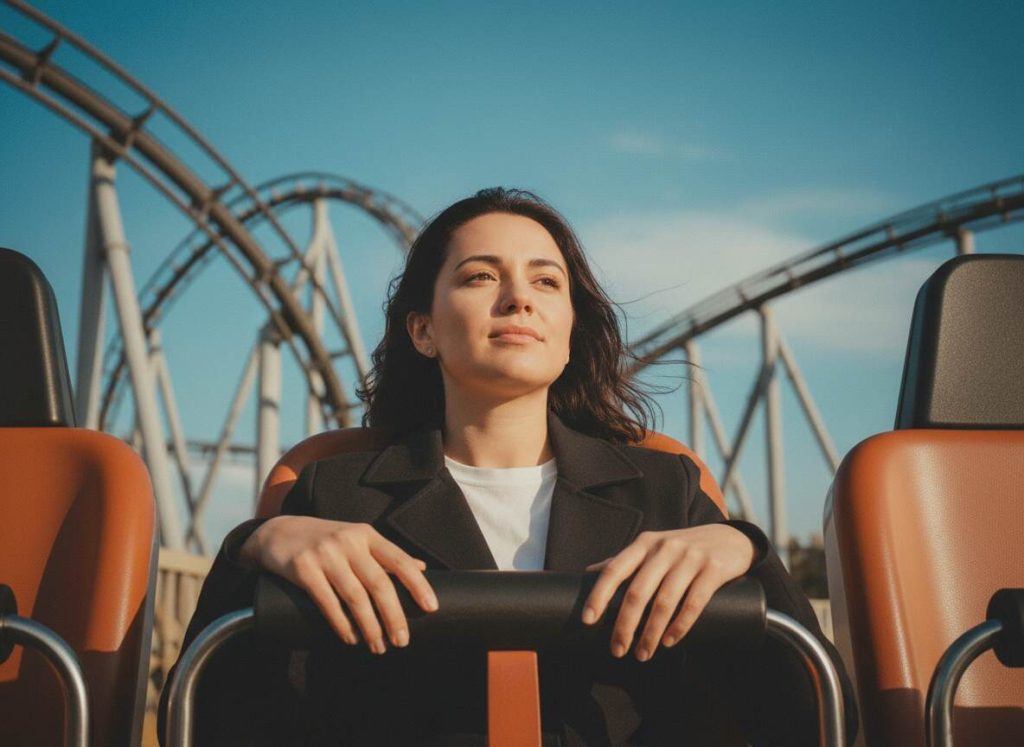
Understanding Your Fear: Why Are You Afraid of Roller Coasters?
The Root Causes of Coaster Anxiety
Fear of roller coasters isn’t irrational—it’s actually a very logical response to perceived danger. Your brain is trying to protect you from what it perceives as a threat. Understanding the root of your fear is the first step to overcoming it.
Common sources of coaster fear include:
- Fear of heights: Many coasters involve significant elevation, which can trigger acrophobia (fear of heights). The higher the coaster, the more intense this fear can be.
- Fear of loss of control: On a roller coaster, you have no control over what happens. You’re strapped in and at the mercy of the ride. For people who value control, this can be extremely anxiety-provoking.
- Fear of falling: The sensation of dropping or plummeting can trigger a primal fear response. Even though you logically know you won’t fall, your body reacts as if you might.
- Fear of speed: The acceleration and high speeds can feel dangerous, even though modern coasters are designed to be safe.
- Fear of the unknown: Not knowing what’s coming next on the ride can amplify anxiety. The anticipation of the unknown can be as frightening as the actual experience.
- Fear of crowds: The crowded environment of an amusement park can amplify anxiety for some people, making the coaster experience feel more overwhelming.
- Previous negative experience: If you’ve had a bad experience on a coaster—feeling sick, experiencing panic, or witnessing someone else’s distress—you may have developed a conditioned fear response.
- Catastrophic thinking: Your mind may jump to worst-case scenarios, imagining that something terrible will happen, even though the statistical risk is extremely low.
The Anxiety Cycle: How Fear Perpetuates Itself
Understanding the anxiety cycle is crucial because it explains why avoidance makes your fear worse, not better. Here’s how it works:
When you encounter a coaster (or even think about riding one), your anxiety increases. To reduce that anxiety, you avoid the coaster. The avoidance brings immediate relief, which reinforces the belief that the coaster is dangerous and that avoidance is the right strategy.
However, this relief is temporary and comes at a cost. Each time you avoid, you miss an opportunity for your brain to learn that the coaster is actually safe. Your brain never gets the chance to discover that your anxiety naturally decreases over time if you stay in the situation. Instead, avoidance strengthens the fear and makes it more difficult to overcome.
This is why people who avoid coasters often find that their fear gets worse over time, not better. The longer you avoid, the more powerful the fear becomes.
The Science Behind Fear and Anxiety
How Your Brain Processes Fear
Your brain has an ancient alarm system designed to protect you from danger. When you perceive a threat, your amygdala (the brain’s fear center) triggers a “fight or flight” response. Your heart rate increases, your breathing becomes shallow, your muscles tense, and adrenaline floods your system.
This response is incredibly useful when facing a real threat, like a predator. However, when facing a roller coaster—which is statistically safer than driving—this response is disproportionate to the actual danger.
The key insight is this: your fear is not based on rational assessment of danger. It’s based on what your brain believes is dangerous. And what your brain believes can be changed through exposure and learning.
Habituation and Extinction Learning
When you’re exposed to a feared stimulus repeatedly without the feared outcome occurring, your brain gradually learns that the stimulus is not actually dangerous. This process is called habituation or extinction learning.
Here’s what happens: the first time you’re exposed to the feared stimulus, your anxiety is high. But if you stay in the situation (without avoiding), your anxiety naturally decreases over time. This is called habituation. If you repeat this exposure multiple times, your brain learns that the stimulus is safe, and your baseline anxiety decreases.
This is the principle behind exposure therapy, which has a 60-90% success rate for specific phobias like coaster fear. Exposure therapy works because it allows your brain to learn that the feared situation is safe.
Why Avoidance Makes Your Fear Worse
The Avoidance Trap
As mentioned earlier, avoidance provides immediate relief from anxiety. However, this relief comes at a significant cost. Each time you avoid, you reinforce the belief that the coaster is dangerous and that avoidance is the correct strategy.
Over time, avoidance can lead to:
- Increased fear: Your fear doesn’t decrease; it often increases because you never get the opportunity to learn that the coaster is safe.
- Expanded avoidance: Your fear may generalize to other situations. You might start avoiding not just coasters, but other rides, or even amusement parks altogether.
- Reduced quality of life: You miss out on experiences with family and friends, and you limit your own potential for growth and enjoyment.
- Increased anxiety overall: Avoidance as a coping mechanism can generalize to other areas of your life, making you more anxious overall.
- Shame and embarrassment: You may feel ashamed of your fear, which can lead to isolation and further anxiety.
The bottom line: avoidance feels good in the short term but makes your fear worse in the long term. To overcome your fear, you need to do the opposite of what your anxiety tells you to do—you need to approach the feared situation, not avoid it.
Cognitive Behavioral Therapy (CBT) Techniques for Coaster Fear
What Is CBT?
Cognitive Behavioral Therapy (CBT) is a form of psychotherapy that focuses on the relationship between thoughts, feelings, and behaviors. CBT is the gold-standard treatment for anxiety disorders and phobias, with extensive research demonstrating its effectiveness.
The basic principle of CBT is that our thoughts influence our feelings, and our feelings influence our behaviors. By changing our thoughts and behaviors, we can change our feelings.
Cognitive Restructuring: Challenging Anxious Thoughts
One of the most powerful CBT techniques is cognitive restructuring, which involves identifying and challenging unhelpful or inaccurate thoughts.
When you’re anxious about roller coasters, your mind likely generates catastrophic thoughts such as:
- “The coaster is going to crash.”
- “I’m going to have a heart attack.”
- “I’m going to lose control and do something embarrassing.”
- “Something terrible is going to happen.”
- “I can’t handle this.”
These thoughts feel true when you’re anxious, but they’re not based on evidence. Cognitive restructuring involves examining these thoughts and replacing them with more realistic, balanced thoughts.
Here’s how to do it:
Step 1: Identify the anxious thought. Write down the catastrophic thought that comes up when you think about riding a coaster.
Step 2: Examine the evidence. Ask yourself: “What evidence do I have that this thought is true? What evidence do I have that this thought is false?”
For example, if your thought is “The coaster is going to crash,” you might note:
- Evidence for: None. You’ve never seen a coaster crash.
- Evidence against: Coasters are inspected regularly, they have multiple safety systems, millions of people ride them safely every year, the statistical risk of death is 1 in 750 million.
Step 3: Develop a more balanced thought. Replace the catastrophic thought with a more realistic one. For example: “This coaster has been inspected and is safe. Millions of people ride coasters every year without incident. I can handle this.”
Step 4: Practice the new thought. Repeat the balanced thought to yourself regularly, especially when you notice the anxious thought coming up.
Behavioral Activation: Taking Action Despite Anxiety
Another key CBT principle is behavioral activation—taking action despite anxiety. This is the opposite of avoidance. Instead of avoiding the coaster, you approach it, even though you’re anxious.
The key insight is this: you don’t have to feel calm to take action. You can feel anxious and still ride the coaster. In fact, riding the coaster while anxious is exactly what will help your brain learn that it’s safe.
Behavioral activation involves:
- Identifying activities you’ve been avoiding due to coaster fear
- Committing to doing those activities, even though you’re anxious
- Noticing that your anxiety decreases over time as you stay in the situation
- Repeating the activity multiple times to strengthen the learning
Systematic Desensitization: Building a Fear Ladder
What Is Systematic Desensitization?
Systematic desensitization is a therapeutic technique that involves gradually exposing yourself to feared situations in a hierarchical manner. Instead of jumping straight to riding a coaster, you start with less anxiety-provoking situations and gradually work your way up.
This approach is based on the principle that you can’t be relaxed and anxious at the same time. By pairing relaxation with exposure to the feared stimulus, you can gradually reduce your anxiety response.
Building Your Fear Ladder
The first step in systematic desensitization is to create a “fear ladder”—a list of coaster-related situations ranked from least to most anxiety-provoking.
Here’s an example fear ladder for coaster anxiety:
- Level 1 (Minimal anxiety): Looking at pictures of roller coasters online
- Level 2: Watching videos of people riding roller coasters
- Level 3: Watching POV (point-of-view) videos of roller coasters
- Level 4: Reading about roller coaster safety statistics
- Level 5: Visiting an amusement park and walking around (not riding anything)
- Level 6: Walking past a roller coaster at the park
- Level 7: Getting in line for a coaster but not riding
- Level 8: Getting in the station and looking at the train
- Level 9: Sitting in a coaster train without it moving
- Level 10: Riding a small, slow coaster
- Level 11: Riding a medium-sized coaster
- Level 12: Riding a large, fast coaster
Your fear ladder will be unique to you. Some people might find watching videos more anxiety-provoking than visiting the park. Customize your ladder based on your own experience.
Working Through Your Fear Ladder
Once you’ve created your fear ladder, you work through it systematically:
Step 1: Start with relaxation. Before exposing yourself to the feared situation, practice a relaxation technique (see below) to get yourself into a calm state.
Step 2: Expose yourself to the feared situation. Move to the next level on your fear ladder. Stay in the situation for at least 15-20 minutes, or until your anxiety has decreased by at least 50%.
Step 3: Notice your anxiety decreasing. As you stay in the situation, your anxiety will naturally decrease. This is habituation. Notice this decrease—it’s evidence that the situation is safe and that your brain is learning.
Step 4: Repeat. Repeat the same level multiple times until your anxiety is minimal. Then move to the next level.
Step 5: Progress at your own pace. Don’t rush. It’s better to spend extra time on a level than to move too quickly and overwhelm yourself.
Relaxation and Breathing Techniques
Why Relaxation Matters
Relaxation techniques are crucial for managing anxiety. When you’re relaxed, your nervous system is in “rest and digest” mode, which is incompatible with the “fight or flight” response triggered by anxiety. By practicing relaxation techniques, you can reduce your overall anxiety level and make it easier to face your fears.
Deep Breathing: The 4-7-8 Technique
Deep breathing is one of the most effective and accessible relaxation techniques. The 4-7-8 breathing technique is particularly powerful for anxiety:
Step 1: Inhale through your nose for a count of 4.
Step 2: Hold your breath for a count of 7.
Step 3: Exhale through your mouth for a count of 8.
Step 4: Repeat 4-8 times.
The key is to make your exhale longer than your inhale. This activates your parasympathetic nervous system, which is responsible for relaxation and calm.
Practice this technique daily, not just when you’re anxious. The more you practice, the more effective it becomes. You can use it before riding a coaster, during the queue, or anytime you feel anxiety rising.
Box Breathing: A Simple Alternative
If the 4-7-8 technique feels too complicated, box breathing is a simpler alternative:
Step 1: Inhale for a count of 4.
Step 2: Hold for a count of 4.
Step 3: Exhale for a count of 4.
Step 4: Hold for a count of 4.
Step 5: Repeat 5-10 times.
Box breathing is used by military personnel and athletes to manage stress and anxiety. It’s simple, effective, and can be done anywhere.
Progressive Muscle Relaxation
Progressive muscle relaxation involves tensing and relaxing different muscle groups to reduce physical tension associated with anxiety.
Here’s how to do it:
Step 1: Start with your feet. Tense the muscles in your feet for 5 seconds, then relax them completely. Notice the sensation of relaxation.
Step 2: Move up to your calves. Tense them for 5 seconds, then relax.
Step 3: Continue this process, moving up through your body: thighs, glutes, abdomen, chest, hands, arms, shoulders, neck, jaw, and face.
Step 4: Once you’ve gone through your entire body, take a few deep breaths and notice the overall sense of relaxation.
Progressive muscle relaxation can be done in 10-15 minutes and is particularly effective for reducing physical tension. Practice it regularly, especially before facing your fears.
Mindfulness and Body Scan Meditation
Mindfulness involves paying attention to the present moment without judgment. A body scan meditation is a mindfulness technique that can help reduce anxiety:
Step 1: Lie down or sit comfortably. Close your eyes.
Step 2: Bring your attention to the top of your head. Notice any sensations without trying to change them.
Step 3: Slowly move your attention down through your body, pausing at each area for a few seconds.
Step 4: Notice sensations of warmth, coolness, tingling, or tension without judgment.
Step 5: Continue until you’ve scanned your entire body.
Mindfulness helps reduce anxiety by anchoring you in the present moment. When you’re anxious about a coaster, your mind is often in the future, imagining worst-case scenarios. Mindfulness brings you back to the present, where you’re actually safe.
Grounding Techniques: Staying Present During Anxiety
What Are Grounding Techniques?
Grounding techniques are tools that help you stay present and connected to your surroundings when anxiety is high. They’re particularly useful when you’re in the queue or on the coaster itself, and your anxiety is spiking.
The 5-4-3-2-1 Technique
The 5-4-3-2-1 technique is a sensory-based grounding exercise that’s simple and effective:
Step 1: Notice 5 things you can see. Look around and identify 5 specific objects.
Step 2: Notice 4 things you can feel. This might be the ground beneath your feet, the air on your skin, or the texture of your clothing.
Step 3: Notice 3 things you can hear. Listen for sounds around you—music, voices, wind, etc.
Step 4: Notice 2 things you can smell. If you can’t identify smells, that’s okay—just notice the absence of smell.
Step 5: Notice 1 thing you can taste. This might be gum, mints, or just the taste of your mouth.
This technique works because it anchors you in the present moment using your senses. When you’re focused on what you can see, feel, hear, smell, and taste, you’re less likely to be caught up in anxious thoughts about the future.
The Grounding Stone Technique
Another grounding technique involves holding a stone or object and focusing on its physical properties:
Step 1: Hold a smooth stone or object in your hand.
Step 2: Notice its temperature. Is it warm or cool?
Step 3: Notice its texture. Is it smooth or rough?
Step 4: Notice its weight. How heavy is it?
Step 5: Notice its color and shape.
You can carry a small stone or object with you to the amusement park and use it as a grounding tool when anxiety spikes.
The Name Game Technique
This grounding technique involves naming objects in your environment:
Step 1: Look around and identify objects by category. For example, name all the colors you can see, or all the metal objects, or all the people wearing specific colors.
Step 2: Challenge yourself to find as many items as possible in each category.
Step 3: This keeps your mind engaged in the present moment and away from anxious thoughts.
Visualization and Mental Rehearsal
How Visualization Works
Visualization involves creating a detailed mental image of yourself successfully riding a coaster. Research shows that mental rehearsal activates similar neural pathways as actually performing the activity. By visualizing yourself riding successfully, you’re training your brain to expect success.
Guided Visualization Exercise
Here’s a visualization exercise you can practice daily:
Step 1: Find a quiet, comfortable place. Close your eyes and take a few deep breaths.
Step 2: Imagine yourself arriving at the amusement park. Visualize the sights, sounds, and smells. Feel the ground beneath your feet.
Step 3: Imagine yourself walking toward your chosen coaster. Notice the structure, the colors, the people around you.
Step 4: Imagine yourself getting in line. Feel calm and confident. Notice your breathing is steady.
Step 5: Imagine yourself moving through the queue. You’re feeling a bit nervous, but you know you can handle it.
Step 6: Imagine yourself entering the station and sitting in the coaster train. The restraints are secure and comfortable.
Step 7: Imagine the coaster starting to move. You feel the lift hill pulling you upward. Your heart is beating faster, but you’re managing your breathing.
Step 8: Imagine the first drop. You feel the rush of adrenaline, but you’re safe. Your restraints are secure.
Step 9: Imagine the rest of the ride. You’re experiencing the turns, inversions, and speed. You’re scared, but you’re doing it.
Step 10: Imagine the ride coming to an end. You’re pulling into the brake run. Your heart is pounding, but you’re smiling. You did it.
Step 11: Imagine yourself exiting the coaster. You’re excited, proud, and energized. You feel a sense of accomplishment.
Step 12: Open your eyes and notice how you feel.
Practice this visualization daily for at least 2 weeks before attempting to ride a coaster. The more you practice, the more real it becomes in your mind.
Practical Strategies for Visiting an Amusement Park
Planning Your Visit
Preparation is key to managing coaster anxiety. Here are some practical strategies for planning your visit:
- Choose the right time: Visit the park during a less crowded time. Crowds can amplify anxiety. Weekday visits or off-season visits are typically less crowded than weekends.
- Choose the right coaster: Don’t start with the tallest, fastest coaster. Choose a smaller, slower coaster that matches your current anxiety level.
- Bring a support person: Having a friend or family member who’s supportive can help. Choose someone who won’t pressure you but will encourage you.
- Arrive early: Arriving early means shorter lines and less time to build anxiety in the queue.
- Eat and hydrate: Low blood sugar and dehydration can amplify anxiety. Eat a healthy meal and drink water before riding.
- Avoid caffeine: Caffeine can increase anxiety and heart rate. Avoid it on the day you plan to ride.
- Get enough sleep: Sleep deprivation increases anxiety. Make sure you’re well-rested before your visit.
- Wear comfortable clothing: Tight clothing can increase physical tension and anxiety. Wear comfortable, loose-fitting clothes.
Managing Anxiety in the Queue
The queue is often the most anxiety-provoking part of the experience because you have time to build anxiety while waiting. Here are strategies for managing anxiety while waiting:
- Use grounding techniques: Use the 5-4-3-2-1 technique or other grounding exercises to stay present.
- Practice breathing: Use box breathing or 4-7-8 breathing to keep your nervous system calm.
- Distract yourself: Talk to your support person, play a game on your phone, or observe other riders.
- Watch POV videos: If the park has screens showing POV videos of the coaster, watch them. Familiarity reduces anxiety.
- Positive self-talk: Remind yourself that you can do this. Use your balanced thoughts from cognitive restructuring.
- Focus on the present: Don’t think about the future. Focus on where you are right now.
- Accept the anxiety: Don’t try to eliminate the anxiety. Accept that you’re nervous and that’s okay. You can be nervous and still ride.
During the Ride
Once you’re on the coaster, here are strategies for managing anxiety:
- Focus on your breathing: Keep your breathing steady and controlled. This helps prevent panic.
- Relax your grip: If you’re gripping the safety bar tightly, consciously relax your hands. Tension amplifies anxiety.
- Lean into the experience: Instead of bracing yourself, try to relax and go with the ride. Fighting the sensations amplifies anxiety.
- Focus on the sensations: Instead of being afraid, try to notice the sensations. The speed, the wind, the G-forces. Curiosity is incompatible with fear.
- Remember that it’s temporary: The ride will end. Remind yourself that the intense sensations are temporary.
- Celebrate small wins: If you make it through a particular element (like the first drop), mentally celebrate. You’re doing it.
After the Ride
What you do after the ride is crucial for reinforcing your learning:
- Notice your relief: After the ride ends, notice that nothing bad happened. You’re safe. This is the key learning moment.
- Celebrate your accomplishment: You did something that scared you. That’s a big deal. Celebrate it.
- Ride again: If possible, ride the same coaster again. Repetition strengthens the learning that the coaster is safe.
- Reflect on the experience: Think about what you learned. Your anxiety was high, but you managed it. You’re braver than you thought.
- Share your success: Tell your support person and others about your accomplishment. External validation reinforces the learning.
Addressing Specific Types of Coaster Fear
Fear of Heights (Acrophobia)
If your primary fear is heights, here are specific strategies:
- Start with lower coasters: Begin with coasters that don’t go very high. Gradually work your way up to taller coasters.
- Focus on the track: Instead of looking down, focus on the track in front of you. This keeps your attention away from the height.
- Use cognitive restructuring: Challenge thoughts like “I’m going to fall.” Replace them with “The track is secure. I’m safe.”
- Practice looking down: In your visualization, practice looking down from the coaster. This desensitizes you to the height.
Fear of Loss of Control
If your primary fear is loss of control, here are specific strategies:
- Focus on what you can control: You can control your breathing, your thoughts, and your response to the ride. Focus on these.
- Understand the coaster’s control systems: Learn about the computer systems, sensors, and safety mechanisms that control the coaster. Knowledge reduces fear.
- Practice letting go: In your daily life, practice letting go of control in small ways. This builds your tolerance for uncertainty.
- Reframe loss of control: Instead of “I have no control,” think “I’m allowing myself to experience something new.”
Fear of Falling
If your primary fear is falling, here are specific strategies:
- Understand the physics: Learn how coasters are designed to keep you in your seat. Multiple wheel systems, restraints, and G-forces all work together to keep you secure.
- Practice the sensation: Jumping on a trampoline or doing other activities that create the sensation of falling can help desensitize you.
- Focus on the restraints: During the ride, focus on how secure the restraints are. They’re holding you safely.
- Cognitive restructuring: Challenge thoughts like “I’m going to fall.” Replace them with “The restraints are secure. I’m safe.”
Fear of Speed
If your primary fear is speed, here are specific strategies:
- Start with slower coasters: Begin with coasters that don’t go very fast. Gradually work your way up to faster coasters.
- Understand acceleration: Learn about how coasters accelerate and decelerate. Understanding the physics can reduce fear.
- Practice the sensation: Driving on the highway or riding in a fast car can help you get used to the sensation of speed.
- Focus on the experience: Instead of focusing on the speed, focus on the sensations and the thrill.
Common Mistakes to Avoid
Mistake #1: Forcing Yourself Too Quickly
One of the biggest mistakes people make is trying to overcome their fear too quickly. They jump straight to riding the biggest coaster, which overwhelms them and reinforces their fear.
Instead, use systematic desensitization. Work through your fear ladder gradually. It’s better to spend extra time on each level than to rush and have a negative experience.
Mistake #2: Avoiding the Anxiety
Another common mistake is trying to avoid feeling anxious. People use distraction, reassurance-seeking, or other avoidance strategies to prevent anxiety.
However, this actually reinforces the fear. The key is to allow yourself to feel anxious and stay in the situation anyway. Your anxiety will naturally decrease over time.
Mistake #3: Relying on Reassurance
While it’s helpful to have a support person, relying too heavily on reassurance can actually maintain your fear. If you need constant reassurance that the coaster is safe, you’re not learning that it’s safe through your own experience.
Instead, use your support person for encouragement and companionship, not for constant reassurance. Trust your own experience to teach you that coasters are safe.
Mistake #4: Not Celebrating Progress
Many people overlook the importance of celebrating their progress. If you ride a coaster and survive, that’s a win. Acknowledge it. Your brain learns through positive reinforcement. Each time you ride and nothing bad happens, your brain updates its threat assessment of coasters.
Celebrate small wins: getting in line, sitting in the seat, making it through the first drop, completing the whole ride. Each of these is progress worth celebrating.
Building a Fear Ladder: Your Personalized Exposure Plan
What Is a Fear Ladder?
A fear ladder is a personalized list of coaster-related situations, ranked from least anxiety-provoking to most anxiety-provoking. You work through the ladder gradually, spending time at each level until your anxiety decreases before moving to the next level.
The key to systematic desensitization is that you don’t jump to the top of the ladder. You start at the bottom and work your way up gradually.
Creating Your Fear Ladder
Here’s how to create your personalized fear ladder:
Step 1: List all coaster-related situations that trigger anxiety. Think about everything from looking at pictures of coasters to actually riding them.
Step 2: Rate each situation on a scale of 0-10, where 0 is no anxiety and 10 is extreme anxiety.
Step 3: Organize your list from lowest anxiety (0-3) to highest anxiety (8-10).
Step 4: This is your fear ladder.
Example Fear Ladder
Here’s an example of what a fear ladder might look like:
- Level 1 (Anxiety: 1-2): Looking at pictures of coasters online
- Level 2 (Anxiety: 2-3): Watching coaster POV videos
- Level 3 (Anxiety: 3-4): Watching someone else ride a coaster in person
- Level 4 (Anxiety: 4-5): Visiting an amusement park and walking around without riding
- Level 5 (Anxiety: 5-6): Walking through the queue of a small coaster without committing to ride
- Level 6 (Anxiety: 6-7): Sitting in a stationary coaster train
- Level 7 (Anxiety: 7-8): Riding a small, slow coaster
- Level 8 (Anxiety: 8-9): Riding a medium-sized coaster
- Level 9 (Anxiety: 9-10): Riding a tall, fast coaster with inversions
Your ladder will be unique to you. Some people might find watching POV videos more anxiety-provoking than others. Customize your ladder based on your own experience.
Working Through Your Fear Ladder
Once you’ve created your fear ladder, here’s how to work through it:
Step 1: Start at the bottom of your ladder. Choose a level that causes mild anxiety (2-3 out of 10).
Step 2: Expose yourself to that situation. If it’s Level 1, spend time looking at coaster pictures or videos.
Step 3: Stay in the situation until your anxiety decreases. This typically takes 20-30 minutes. Your anxiety will naturally decrease as your brain realizes there’s no real danger.
Step 4: Repeat the exposure several times over a few days or weeks. The more you expose yourself, the faster your anxiety decreases.
Step 5: Once your anxiety at that level is consistently low (1-2 out of 10), move to the next level.
Step 6: Repeat the process for each level.
The key is patience and consistency. Don’t rush. Spending extra time at each level is better than moving too quickly and having a setback.
When to Seek Professional Help
Signs You Might Benefit From Therapy
While the strategies in this guide are evidence-based and effective for many people, some people benefit from working with a mental health professional. Here are signs that therapy might be helpful:
- Your fear is severe: If your anxiety about coasters is extreme (9-10 out of 10) and significantly impacts your quality of life, therapy can help.
- You have panic attacks: If you experience panic attacks related to coasters or heights, a therapist can teach you specific techniques for managing panic.
- Your fear is part of a broader anxiety disorder: If you have generalized anxiety disorder, social anxiety, or other anxiety conditions, therapy can address the underlying anxiety.
- You’ve tried self-help and it hasn’t worked: If you’ve tried the strategies in this guide and haven’t seen improvement, a therapist can provide additional support.
- Your fear is affecting your relationships: If your fear is causing conflict in your relationships or limiting your social activities, therapy can help.
- You have a history of trauma: If your fear is related to past trauma, a trauma-informed therapist can help you process that trauma.
Types of Therapy for Coaster Anxiety
If you decide to seek professional help, here are the most effective types of therapy for anxiety:
Cognitive Behavioral Therapy (CBT): CBT is the gold standard for treating anxiety disorders. A CBT therapist will help you identify and challenge anxious thoughts, and gradually expose yourself to feared situations.
Exposure and Response Prevention (ERP): ERP is a specific type of CBT that focuses on gradual exposure to feared situations. This is particularly effective for specific phobias like coaster anxiety.
Acceptance and Commitment Therapy (ACT): ACT teaches you to accept anxiety rather than fight it, and to commit to living your values despite anxiety. This can be helpful if your anxiety is persistent.
Mindfulness-Based Cognitive Therapy (MBCT): MBCT combines mindfulness with cognitive therapy. It can help reduce anxiety by increasing your awareness of anxious thoughts without judgment.
Finding a Therapist
If you decide to seek therapy, here are some tips for finding a good therapist:
- Look for a therapist who specializes in anxiety disorders: Not all therapists have the same expertise. Look for someone who has experience treating anxiety and phobias.
- Ask about their approach: Make sure they use evidence-based approaches like CBT or ERP.
- Check their credentials: Look for a licensed therapist (LCSW, psychologist, counselor, etc.).
- Consider logistics: Think about whether you prefer in-person or online therapy, and whether their schedule works for you.
- Trust your gut: The therapeutic relationship is important. If you don’t feel comfortable with a therapist, it’s okay to try someone else.
Real Stories: People Who Overcame Coaster Anxiety
Sarah’s Story: From Terrified to Thrilled
Sarah had been afraid of coasters since childhood. A bad experience on a coaster when she was 10 years old had left her with lasting anxiety. For 20 years, she avoided amusement parks entirely.
When her niece turned 10, Sarah wanted to take her to an amusement park for her birthday. But the thought of being around coasters terrified her. She decided it was time to face her fear.
Sarah started at the bottom of her fear ladder. She spent a week watching coaster POV videos online. Her anxiety was high at first, but by the end of the week, she could watch videos without panicking.
Next, she visited a local amusement park with a friend and just walked around. She didn’t ride anything, but she got used to being in the environment.
Over the next few months, Sarah gradually worked through her fear ladder. She rode a small, slow coaster. Then a medium-sized coaster. Then a coaster with one inversion.
On her niece’s birthday, Sarah rode a tall coaster with multiple inversions. She was scared, but she did it. When she got off, she cried—not from fear, but from relief and pride.
Sarah now visits amusement parks regularly with her niece. She’s still not fearless, but she’s no longer controlled by her fear.
Marcus’s Story: Overcoming Panic Attacks
Marcus had always been anxious, but his anxiety escalated when he started experiencing panic attacks. A panic attack on a coaster when he was 25 made him terrified of riding ever again.
For 5 years, Marcus avoided coasters. But he felt like his anxiety was controlling his life. He decided to seek help from a therapist who specialized in anxiety disorders.
His therapist taught him breathing techniques and cognitive restructuring. She helped him understand that panic attacks, while scary, aren’t dangerous. His body was just overreacting to a perceived threat.
With his therapist’s support, Marcus gradually exposed himself to coasters again. He learned to recognize the early signs of panic and use his breathing techniques to manage it.
Today, Marcus still experiences some anxiety on coasters, but he no longer has panic attacks. He’s learned that he can feel anxious and still ride.
Jessica’s Story: Conquering Heights
Jessica had acrophobia (fear of heights) since childhood. She couldn’t even look out of a tall building without feeling dizzy and anxious.
When she started dating someone who loved coasters, she wanted to be able to share that experience with him. But the thought of being on a tall coaster terrified her.
Jessica created a fear ladder that specifically addressed her fear of heights. She started by looking at pictures of tall structures. Then she watched videos of coasters from a height. Then she visited a tall building and looked out the window for short periods.
Gradually, she worked her way up to riding coasters. Her first coaster was a small wooden coaster. Then she rode a medium-sized steel coaster. Finally, she rode a 300-foot tall hypercoaster.
Jessica still feels some anxiety on tall coasters, but she’s learned that the anxiety is manageable. She now enjoys coasters with her boyfriend and has even introduced her family to coaster riding.
Conclusion: You’re Braver Than You Think
Coaster anxiety is real, and it’s more common than you might think. But it’s also very treatable. Whether you use the self-help strategies in this guide or seek professional help, you have options.
The key is to start small, be patient with yourself, and celebrate your progress. Every time you face your fear, you’re rewiring your brain. You’re teaching your brain that coasters are safe and that you’re capable of handling challenging situations.
Remember, you don’t have to be fearless to ride a coaster. You just have to be willing to feel the fear and do it anyway. And that takes courage.
So take a deep breath. Create your fear ladder. Start at the bottom. And take your first step toward conquering your coaster anxiety. You’ve got this.
