Every coaster fan has lived some version of this story. The park announces a new ride. Construction photos look great. The track is complete. Trains are on the rails. The park posts a vague “coming soon,” then a “delayed,” then a “we’ll share more when we can.”
From the outside, it can feel like the park is being secretive or incompetent. From the inside, coaster delays are usually the result of a very normal reality: a new roller coaster is not “open” when it looks finished. It is open when it is tested, tuned, documented, inspected, staffed, and signed off to operate safely and consistently in the real world.
This is the evergreen, global explainer for what happens when a roller coaster opening gets delayed, why parks often cannot give a firm date, and what the most common behind-the-scenes causes actually are.
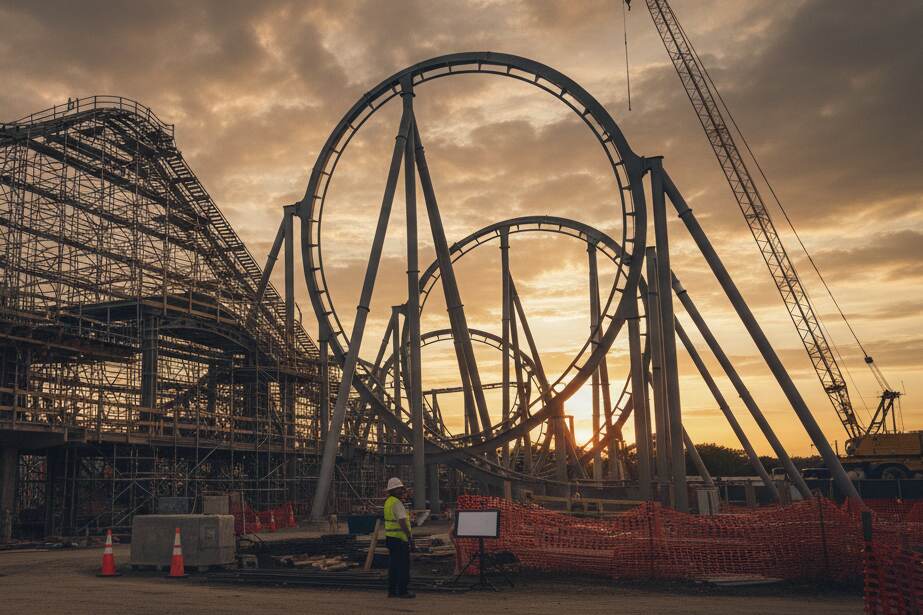
Quick Answer: Why Do Roller Coaster Openings Get Delayed?
Roller coaster openings are delayed when any part of the project is not yet ready for public operation. That can include construction finishing work, control system tuning, sensor and brake calibration, ride vehicle issues, parts delays, documentation and inspection requirements, staff training, or final commissioning and acceptance testing. Even if the track is complete, a coaster can remain closed until the park, manufacturer, and inspectors are satisfied it will run reliably and safely under real operating conditions.
First, A Reality Check: “Track Complete” Is Not “Ride Ready”
Coaster fans love the moment the last piece of track goes in. It is the most visible milestone, and it makes a new ride feel inevitable. But track completion is closer to “the skeleton is assembled” than “the ride is ready.”
After track is up, the project still needs:
- Electrical and control system integration
- Brake system tuning and verification
- Sensor calibration and fault testing
- Train commissioning and wheel/assembly checks
- Station hardware testing (gates, restraint checks, dispatch logic)
- Evacuation access verification and procedures
- Operator and maintenance training
- Documentation, inspections, and sign-offs
And that is before you get into theming, queue completion, landscaping, accessibility details, and guest-flow finishing work, which can also affect whether a ride can open even if the coaster itself is mechanically ready.
What “Commissioning” Means (And Why It Takes So Long)
Commissioning is the phase where a coaster transitions from “built” to “operational.” It is a mix of technical verification, tuning, and proving that the ride behaves correctly across the range of conditions it will face in daily operation.
In practical terms, commissioning often includes:
- Running trains repeatedly to confirm consistent performance
- Testing how the ride behaves with different train weights
- Verifying braking distances and timing
- Confirming the ride’s control logic responds correctly to faults
- Checking that sensors read accurately and consistently
- Confirming restraints, gates, and interlocks behave as designed
This is also where parks discover the difference between “it works” and “it works every time, in heat, in cold, in wind, in light rain, with a full train, with an empty train, with a slow dispatch, with a fast dispatch.”
That difference is the gap where delays live.
The Most Common Reasons A Coaster Opening Gets Delayed
There are dozens of possible causes, but most delays fall into a few repeat categories. Some are dramatic. Most are boring. Boring is normal in engineering.
1) Parts And Supply Chain Delays (The Unsexy Reality)
A coaster is a giant system made of thousands of components, and not all of them are custom track. Some are specialized sensors, control cabinets, braking components, wheel assemblies, restraint parts, or station hardware that must meet specific specifications.
If one critical part is delayed, the park cannot simply “open anyway.” Many systems are interdependent. A missing component can block commissioning, inspections, or training.
Sometimes the ride is physically complete, but the park is waiting on:
- Replacement parts for a component that failed during early testing
- A revised part after a manufacturer design tweak
- Specialized electronics or control components
- Final hardware for the station or transfer track
And because parks rarely want to announce “we’re waiting on a specific sensor assembly,” the public messaging becomes vague.
2) Control System Tuning And Sensor Calibration
Modern coasters are heavily instrumented. They rely on sensors and control logic to monitor train position, speed, spacing, and system status. That is part of what makes them safe and repeatable, but it also means there are more “no-go” conditions that can prevent opening.
A coaster can be delayed because the ride is throwing faults that need to be resolved, even if nothing looks wrong to a guest watching from the midway.
Common examples include:
- Sensor readings that are inconsistent
- Brake timing that needs adjustment
- Control logic that needs refinement for real-world operation
- Communication issues between subsystems
This is one of the biggest reasons parks often cannot give a confident opening date. Debugging is not linear. One fix can reveal another issue, and the only way through it is methodical testing.
3) Brakes And Block System Verification
Coasters are designed around controlled train spacing. That spacing is managed through block sections, brakes, and control logic. Before opening, the park and manufacturer need to confirm the ride can safely and consistently handle the operating scenarios it will face.
That includes verifying that the coaster can:
- Stop trains where it is supposed to stop them
- Maintain safe spacing between trains
- Respond correctly to slow dispatches or operational pauses
- Handle variations in speed caused by weather and load
If brake performance is not consistent, the ride does not open. It is that simple.
4) Train And Wheel Assembly Issues
Trains are not just “cars.” They are complex assemblies with wheels, bearings, restraint systems, sensors, and mechanical interfaces that must behave correctly under repeated high forces.
During testing, parks can discover issues like:
- Wheel wear patterns that are not acceptable
- Vibration that needs mitigation
- Restraint components that require adjustment or replacement
- Train-to-track interactions that need tuning
Sometimes the fix is straightforward. Sometimes it requires redesigning or reworking a component. Either way, the ride stays closed until it is resolved.
5) Weather And Environmental Factors
Weather affects coaster construction and commissioning more than most people realize. High winds can stop crane work. Heavy rain can slow site work. Temperature can affect how a coaster runs, especially during early testing when the park is building its baseline understanding of performance.
Even after construction is complete, weather can delay the final proving phase if the park needs to test across certain conditions or if the ride’s behavior changes enough that additional tuning is required.
6) Theming, Queue, And Guest Safety Infrastructure
Sometimes the coaster itself is ready, but the ride cannot open because the guest-facing infrastructure is not complete or not approved.
This can include:
- Queue railings and gates
- Accessibility features
- Stairways, catwalks, and evacuation routes
- Lighting, signage, and safety messaging
- Landscaping and pathways that affect crowd flow
Parks do not want to open a ride that creates a guest-flow hazard, even if the coaster is technically ready to run.
7) Staffing And Training (The Human Side Of “Ready”)
A coaster does not open because it can run. It opens because it can run as an operation.
That means training operators and supervisors on:
- Dispatch procedures and communication protocols
- Restraint checking standards
- How to respond to faults and stops
- Evacuation procedures
- Daily inspection routines
If staffing is not ready, the ride is not ready. This is especially true for rides with unusual loading procedures, complex stations, or new restraint systems that require consistent checks.
8) Inspections, Documentation, And Sign-Offs
Globally, amusement ride regulation varies by country and region. Some places have government inspections. Some rely heavily on third-party inspection bodies. Many parks also follow widely recognized industry standards and best practices.
One of the most influential standards organizations in the amusement ride world is ASTM International’s Committee F24 on Amusement Rides and Devices, which has been developing standards in this space for decades. ASTM describes Committee F24 as having been formed in 1978 and notes its global membership and role in standards for amusement rides and devices.
You can read ASTM’s overview of the committee here: ASTM Committee F24 on Amusement Rides and Devices.
Even when a park is not legally required to follow a specific standard in a specific way, the broader reality remains: opening a coaster involves documentation, inspections, and formal acceptance processes. If any part of that chain is incomplete, the ride does not open.
Why Parks Often Won’t Give A New Opening Date
This is the part that frustrates fans the most, and it is also the part that makes the most sense once you understand commissioning.
Parks avoid giving hard dates during technical delays because:
- They do not control the manufacturer’s timeline for fixes or parts
- Debugging can reveal additional issues
- Inspections and approvals can have scheduling constraints
- They would rather under-promise than miss another date publicly
When a park says “we’ll share more when we can,” it is often because they genuinely cannot predict whether the remaining work is a two-week problem or a two-month problem. They may have a best guess internally, but they do not want that guess to become a headline.
What “Soft Openings” And “Previews” Really Mean
When a park does open a coaster in previews, it is not always a victory lap. It can be part of the final proving process.
Soft openings can help parks:
- Test real guest loading and dispatch rhythm
- See how restraints, gates, and procedures work at scale
- Identify operational bottlenecks
- Confirm the ride behaves consistently during full-day operation
That is why preview phases can be inconsistent. The ride might open for a few hours, close, open again, then disappear for a week. That does not necessarily mean something is “wrong.” It can mean the park is working through the last layer of tuning and operational learning.
How To Read The Signs As A Fan (Without Inventing Drama)
If you are watching a delayed coaster like a hawk, here are the most reliable “signals” of what stage it is in, without turning into conspiracy brain.
- Track complete, no trains: still in construction and installation mode.
- Trains on track, no cycling: likely still integrating systems, waiting on components, or not ready to begin full testing.
- Empty cycling for days: commissioning and tuning, often a good sign.
- Weighted testing: deeper performance verification, usually closer to readiness.
- Operators training in the station: operations prep, often late-stage.
- Preview days that are inconsistent: final proving and operational debugging.
And the biggest truth: a coaster can look “done” for a long time because the remaining work is mostly invisible.
The Bottom Line
Roller coaster openings get delayed because “finished construction” is not the same thing as “ready for the public.” The last phase of a coaster project is commissioning: testing, tuning, documentation, inspections, and training that prove the ride can operate safely and reliably in real conditions.
Most delays are not dramatic failures. They are the normal friction of bringing a complex engineered system online. It is frustrating as a fan, but it is also part of why modern coasters can run thousands of cycles a season with layered safety systems and consistent performance.

Leave a Reply