Roller coasters look like pure gravity and chaos: a train crests a hill, drops, screams through turns, and somehow ends up back in the station at the perfect speed. But behind the scenes, there is one quiet force that constantly tries to ruin the party.
That force is friction.
Friction is why coasters do not run forever. It is why a ride feels faster in the morning than late in the day. It is why wheels get replaced. It is why designers cannot just draw a layout and assume gravity will “handle it.”
In this post, we are going to break down friction in a coaster context in a way that is accurate, but still readable. We will talk about where friction comes from, how it changes the ride experience, how engineers plan for it, and why some coasters feel like they are crawling into the brake run while others slam into it like they are late for a meeting.
First: What Is Friction, in Plain Theme Park Language?
Friction is the force that resists motion when two things touch or when something moves through a fluid (like air). On a roller coaster, friction is basically the “tax” you pay for moving.
Every time the train rolls, slides, compresses a wheel, spins a bearing, or pushes air out of the way, it loses energy. That lost energy usually turns into heat, vibration, and sound.
And here is the key idea that explains almost everything in coaster physics:
A roller coaster is an energy conversion machine. It starts with potential energy (height). It converts that into kinetic energy (speed). Friction steals some of that energy the entire time.
If friction steals too much, the train does not make it through the course at the intended speed, or in extreme cases, it can valley (get stuck in a low point). If friction steals too little, the train hits the brakes too fast and the ride becomes uncomfortable, harder to control, and harder on the hardware.
The Two Big Categories: Rolling Resistance vs Air Resistance
When people say “friction,” they often picture two rough surfaces scraping. On coasters, the biggest everyday losses are usually more subtle.
1) Rolling resistance (wheel and track losses)
Even though coaster wheels roll, rolling is not friction-free. Wheels deform slightly at the contact patch where they meet the rail, and that deformation eats energy. This is called rolling resistance.
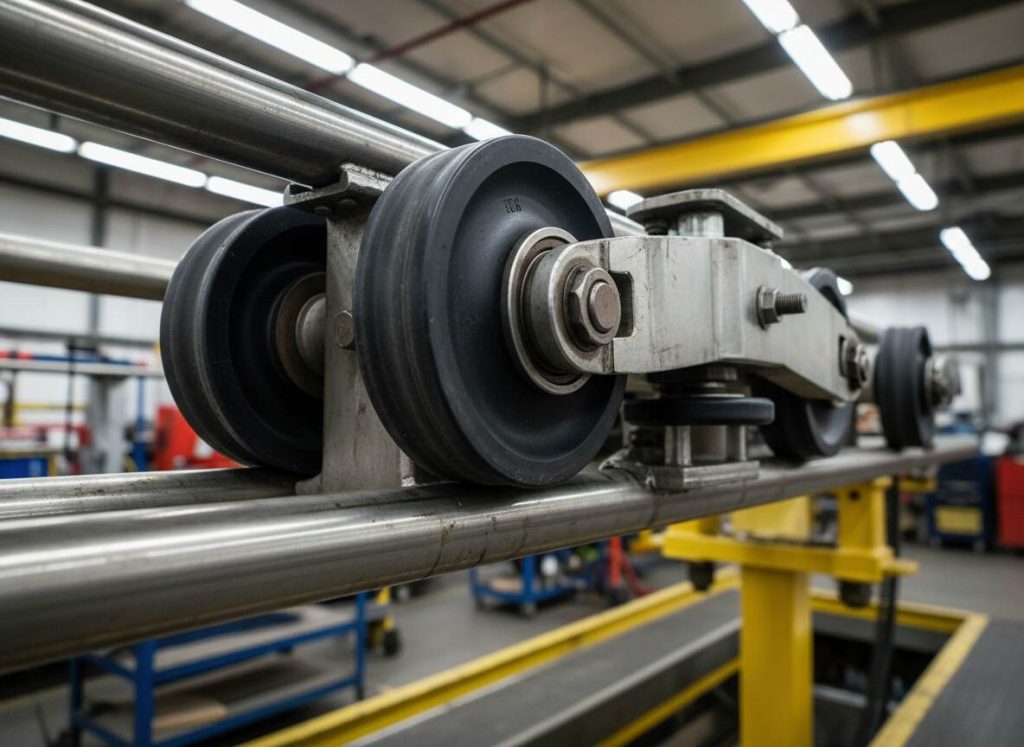
Coaster wheels are typically an aluminum hub with a polyurethane tire bonded to the outside, and the wheel assembly spins on a bearing around an axle. That design is great for smoothness, but it introduces energy losses through deformation and bearing friction.
Coaster101 describes rolling resistance as being caused by the deformation of the tire at the point where it meets the rail. They also give a simple engineering-style way to estimate the rolling resistance force:
F = R * M * gs
Where:
- R is the rolling resistance coefficient
- M is the mass of the train
- g is gravity (about 9.81 m/s²)
They note a typical rolling resistance coefficient could be in the range of about 0.009 to 0.018 of the supported loads. That is not a tiny number when you are talking about a fully loaded train and a long layout.
2) Air resistance (aerodynamic drag)
Air resistance is the “invisible wall” that gets stronger the faster you go. You feel it on a bike when you stop pedaling. Coasters feel it too, especially at high speeds.
Drag is why the second half of a coaster often feels slower even if the track is still doing interesting things. The train has already spent a lot of its height energy, and now it is fighting air more than it is gaining speed from gravity.
Drag is also why weather matters. Cold air is denser than hot air, which can increase drag slightly. Wind direction matters too. A headwind can noticeably slow a ride, especially on exposed sections.
Where Friction Shows Up on a Roller Coaster (The Practical Map)
Let’s get very specific. On a modern coaster, friction and energy losses come from multiple places at once.
Wheel-to-rail contact (rolling resistance)
The road wheels (also called load wheels) carry the weight of the train. They are under the biggest loads, and they are constantly deforming slightly as they roll. That deformation is a major source of energy loss.
Side friction wheels (guiding losses)
Side friction wheels, also called guide wheels, keep the train aligned with the track. On steel coasters, these wheels are often spring-loaded against the sides of the rail, and they are forced to steer to follow the track.
Every time the train enters a turn, transitions through banking, or hits a slight misalignment, those side wheels can scrub and add friction. This is one reason why a coaster can feel like it “bleeds speed” in a long, twisty section even if it is not climbing much.
Upstop wheels (under-rail contact)
Upstop wheels sit under the rail to keep the train from lifting off the track over airtime hills or in inversions. Even if the ride is not generating huge lift forces, safety requirements still demand a device capable of withholding a significant portion of the fully loaded vehicle weight.
Upstops can add friction too, especially in high negative-G moments where they are doing more work.
Bearings and mechanical friction in the wheel assemblies
Every wheel spins on a bearing. Bearings are designed to reduce friction, but they do not eliminate it. And as bearings wear, get contaminated, or heat up, friction can increase.
This is one reason maintenance matters so much. A coaster can run “fine” but still be losing performance because the rolling system is not as efficient as it should be.
Track joints, welds, and surface condition
Even small imperfections matter. Wheels have to absorb track tolerances, dirt, and debris. That absorption is part of what makes the ride smooth, but it also costs energy.
On wooden coasters, joints and surface variability can be a bigger deal. Historically, wooden coaster cars had fixed axles with a gap between side wheels and the track, which caused the cars to “shuffle” through turns. That shuffling can increase vibration and energy loss.
Brakes (intentional friction)
This is the obvious one: brakes are designed to remove energy. Some brakes use friction directly, and some use magnetic systems that create resistance without physical contact. Either way, braking is the coaster intentionally converting kinetic energy into heat or electromagnetic losses so the train can stop safely.
But here is the important point: brakes are not the only reason a coaster slows down. A coaster is slowing down the entire ride due to rolling resistance and drag. Brakes are just the controlled, planned slowdown at the end (and sometimes mid-course).
Why Friction Is Not Just “Bad”: It Is Part of the Design
It is tempting to think friction is the enemy. And yes, designers try to minimize unnecessary losses. But friction is also part of what makes a coaster manageable.
Without friction and drag:
- trains would hit brake runs at much higher speeds
- valleys and low points would be more dangerous because speed would stay high
- the ride would be harder to control consistently across different weather and loading conditions
Design is about balance: enough efficiency to complete the circuit reliably, enough natural loss to keep speeds within a safe, comfortable window.
How Friction Changes the Ride Experience (What Riders Notice)
1) Morning rides can feel faster
Many coaster fans swear rides run faster later in the day when wheels warm up. That can happen too. But the broader truth is: performance changes throughout the day because friction-related variables change.
Wheel material temperature, bearing temperature, lubrication behavior, and even track temperature can influence rolling resistance. A coaster is a mechanical system, not a perfectly consistent physics demo.
2) Fully loaded trains often run differently than empty trains
A heavier train has more potential energy at the top of the lift (because it has more mass), but it also experiences higher rolling resistance because rolling resistance scales with load.
In practice, heavier trains often carry speed better through certain elements because they have more momentum, but they can also lose more energy to rolling resistance. The net effect depends on the ride design.
3) Trim brakes exist because friction alone is not enough to control speed
Some coasters are designed to run very fast under ideal conditions. If the ride is running too hot, trim brakes remove extra energy mid-course to keep forces within limits and to keep the train from hitting later sections too fast.
Trims are basically the park saying: “Today, friction and drag are not stealing enough energy, so we are going to help.”
4) A coaster can feel “floaty” or “punchy” depending on how friction is managed
Two coasters can have similar heights and still feel completely different. One reason is how efficiently they hold speed through turns and transitions. If a layout has lots of tight curves and the train is scrubbing speed through side wheels, it may feel more controlled and less wild. If it holds speed cleanly, it can feel more aggressive and snappy.
Wheel Material: The Smoothness vs Speed Tradeoff
This is one of the most interesting friction-related choices in coaster design and operation: wheel material affects both ride comfort and energy loss.
Coaster101 notes that many steel coasters use nylon or polyurethane wheel materials, each with tradeoffs:
- Nylon wheels: harder, can be a bit faster (lower rolling resistance), but can vibrate more and contribute to a rougher feel and more track wear.
- Polyurethane wheels: softer, smoother, absorbs vibration better, but increases rolling resistance and can slow the ride down.
They also note parks may mix and match wheels to keep a ride within its intended performance window, and that new rides may test with one type and later switch after break-in and testing.
This is a big deal because it shows friction is not just a physics concept. It is an operational knob. Parks can tune performance.
Friction and Safety: Why “Energy Loss” Is a Feature, Not a Bug
From a safety perspective, friction and drag help keep speeds predictable. But because friction varies, designers and operators build in margins.
That is why you see things like:
- block systems that prevent trains from entering a section unless it is clear
- brake runs designed to stop a train even under worst-case conditions
- trim brakes to control peak speeds
- maintenance schedules that keep wheel and bearing friction within expected ranges
In other words: friction is part of the safety model, but it is not trusted blindly. Coasters are designed assuming conditions change.
Common Questions People Ask (and the Real Answers)
Do roller coasters slow down because of friction or because of brakes?
Both. Friction and air drag are slowing the train the entire time. Brakes are the controlled, intentional slowdown at specific points, especially at the end.
Why do some coasters feel faster than others with similar height?
Track shaping, element sequencing, and how much speed is scrubbed in turns all matter. Wheel material and maintenance condition can also affect rolling resistance.
Can friction cause a coaster to get stuck?
Yes. If the ride loses more energy than expected (cold weather, headwind, higher rolling resistance, mechanical issues), it can valley in a low point. Designers try to prevent this with conservative energy modeling and testing, but it is still a known phenomenon.
Conclusion: Friction Is the Coaster’s Invisible Editor
Gravity writes the first draft of a roller coaster. Friction edits it.
Friction decides how much speed you keep after the first drop. It decides whether a long layout still feels alive in the second half. It decides how hard the brakes have to work. It decides how often wheels need replacing. It even influences whether a ride feels smooth or rattly.
And the most interesting part is that friction is not just something engineers fight. It is something they plan for, model, and sometimes even use as a tuning tool to keep a coaster running exactly the way it is supposed to.

Leave a Reply