If you have ever watched a coaster train flip riders upside down and thought, “Okay, that’s a loop,” you are not alone. But in coaster design, inversion is a bigger concept than “loop de loop.” It includes corkscrews, rolls, stalls, pretzel-shaped monsters, and a whole family of elements that can look similar from the midway but feel wildly different in your seat.
This post explains what inversions are, how they work, why they do not leave you “hanging upside down,” and how designers choose different inversion shapes to control speed, comfort, and intensity.
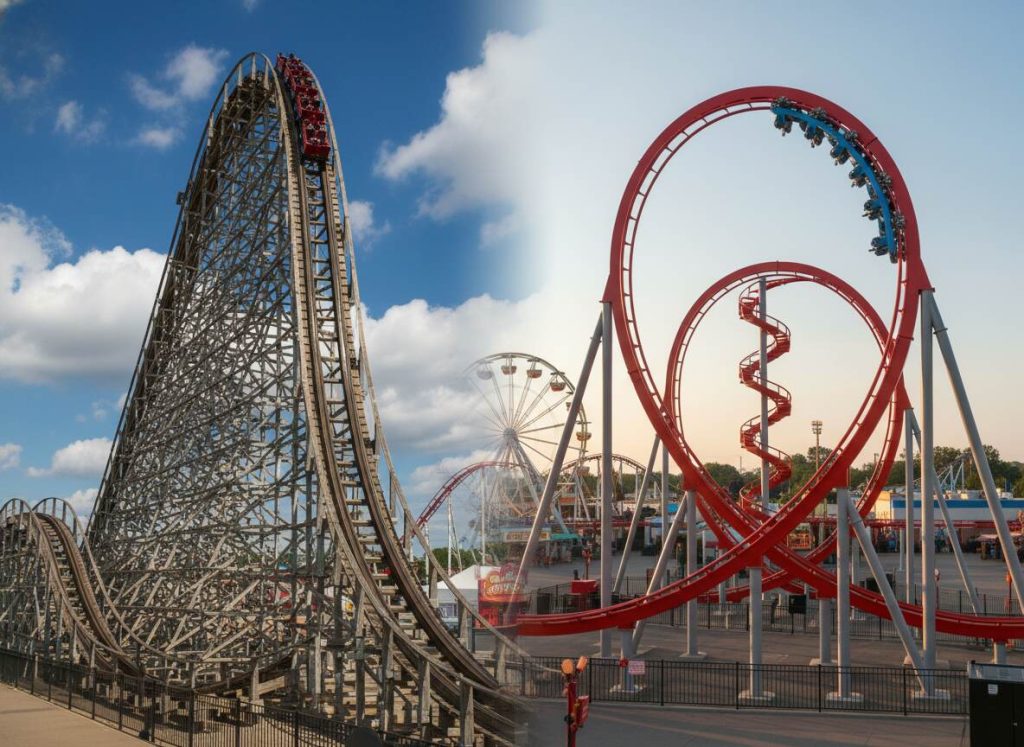
Definition: What Is an Inversion?
An inversion is a roller coaster element that turns riders upside down. That is the clean definition, and it is the one American Coaster Enthusiasts uses in their explainer: inversions are elements of coasters that turn riders upside down, and each type is designed so guests reach certain speeds and experience certain forces for a thrilling, disorienting effect.
Two quick clarifications that matter:
- Not every upside-down moment is the same. Some inversions are fast and “whippy,” some are slow and floaty, and some are intense enough to make even seasoned riders go quiet for a second.
- Not every inversion is a “loop.” A loop is one type of inversion. A corkscrew is another. A zero-G roll is another. A stall is another.
Why Inversions Exist: It’s Not Just for Bragging Rights
Inversions started as a spectacle. They were a visual statement: this ride does something that looks impossible. But modern inversions are not just “look what we can do.” They serve real design goals.
1) They create controlled disorientation
Coasters are thrill machines, but the thrill is not only speed. It is also the feeling of your body being reoriented in space. Inversions give designers a way to create that “where am I?” moment without needing a taller lift hill.
2) They manage energy and pacing
Inversions can be used like punctuation. A fast roll can keep momentum. A larger loop can bleed speed. A stall can create a slow, dramatic moment before the ride snaps you back into motion.
3) They shape the ride’s personality
Two coasters can have the same height and speed, but if one has a graceful loop and the other has a violent snap roll, they will feel like completely different animals.
Will an Inversion Leave You Hanging Upside Down?
This is one of the most common fears, and it makes sense because it is easy to imagine a train stopping at the top of a loop like a cartoon.
In reality, modern coasters are engineered with multiple layers of safety and operational control. Trains are designed to maintain enough speed to complete elements, and rides use braking systems and block systems to manage train spacing and speed. If a train stops, it is far more likely to stop in a safe, non-inverted section designed for evacuation access.
Could a coaster ever stop in an inversion? It is extremely rare, and the systems are designed to prevent it. The bigger point is: designers do not treat inversions as “hope it works.” They treat them as engineered elements with margins.
How Inversions Work: The Physics Without the Headache
When you go upside down on a coaster, you do not “fall out” because you are not relying on gravity to hold you in. You are held in by restraints, and you are also experiencing forces from the train’s motion through the track shape.
There are three concepts that explain most inversion sensations:
- Centripetal acceleration: when you move in a curve, you are constantly being accelerated toward the center of that curve. This is what creates the feeling of being pressed into your seat during loops.
- G-forces: how strongly you feel pushed into your seat (positive Gs) or lifted out of it (negative Gs). Different inversions are designed to hit different G ranges.
- Heartlining: designers try to rotate the track around the rider’s centerline (roughly chest/heart area) so the inversion feels smooth rather than jerky. Heartlined inversions are a huge reason modern coasters can invert repeatedly without feeling like they are trying to twist your neck off.
The Big Families of Inversions (and What They Feel Like)
There are dozens of named inversion elements, and coaster fans love debating the fine print. But for understanding, it helps to group them into a few families.
Vertical loops (the classic “loop”)
A vertical loop is the iconic inversion: you go up, over, and back down in a vertical plane.
ACE notes the vertical loop as the classic loop shape, and they also highlight the clothoid loop, which is more oval than circular. That shape is not just aesthetic. It is designed to be more comfortable because it manages forces more smoothly than a perfect circle.
How it feels: sustained positive Gs at the bottom, then a lighter feeling near the top, then strong forces again as you exit.
Corkscrews (the “slinky” inversion)
A corkscrew is like a stretched, twisting inversion. ACE describes it as drawn out so riders experience the twist through multiple angles.
How it feels: a rolling twist that can be quick and snappy or longer and floatier depending on the design.
Rolls and twists (fast rotations, often designed for weightlessness)
This is where modern coaster design gets really fun.
- Zero-G roll: ACE explains these are designed to make riders feel weightless by hitting a G-force of zero, while the track twists 360 degrees. These often feel “whippy” and clean.
- In-line twist: ACE describes this as a 360-degree spin where the track twists around the train’s center point, creating a slower, hang-time style rotation on some rides.
How they feel: either quick and snappy (a punchy roll) or floaty and suspended (a slower twist), depending on how the track rises, falls, and rotates.
Stalls (the “hang there for a second” inversion)
A zero-G stall is essentially a roll that pauses while you are upside down. ACE describes it as an elongated inversion where the twist is “stalled” so riders feel like they are hanging upside down for a few seconds.
How it feels: less like being whipped, more like being held in a moment. It can feel surreal, especially if the track is high and you have a clear view of the ground.
Half-loop plus twist elements (direction-changing inversions)
Some inversions are designed to reverse or redirect the train’s path while still flipping you upside down. ACE highlights a few of the most common:
- Immelmann: you rise into a half-loop shape and then twist out, changing direction rather than continuing forward.
- Dive loop: described by ACE as the inverted version of an Immelmann, often seen on inverted coasters where the train hangs beneath the track.
How they feel: dramatic, because you are not just flipping, you are also being redirected. These can feel more disorienting than a simple loop because your brain loses its “forward” reference.
Double-inversions (two inversions fused into one element)
A cobra roll is a famous example. ACE describes it as a double-inversion formed by an Immelmann merging into a dive loop. It is called a cobra roll because, from the side, it resembles a cobra’s head.
How it feels: you invert, twist, invert again, and come out facing a new direction. It is a lot of upside-down in a short time, and the pacing can feel relentless.
Pretzel loops (the flying coaster beast)
The pretzel loop is one of the most intense inversion experiences out there, and ACE notes it is rare and found only on flying coasters. On a flying coaster, riders are positioned face-down, and the pretzel loop creates a heavy, forceful sensation that many riders remember as one of the strongest moments on any coaster.
How it feels: intense, heavy, and very physical. This is not a “cute little upside-down moment.” This is an inversion that can feel like it pins you to the track.
Why Some Inversions Feel Smooth and Others Feel Rough
If you have ever ridden an older coaster with inversions and felt headbanging or neck strain, you have felt the difference between eras of design.
Here are the biggest factors that change inversion comfort:
- Track shaping and heartlining: smoother rotation around the rider’s center reduces jerkiness.
- Restraint style: older over-the-shoulder restraints combined with tight transitions can create headbanging; modern vests and lap-bar-focused designs often feel freer.
- Speed through the element: too slow can feel floaty and strange, too fast can feel aggressive; designers aim for a specific force profile.
- Train and wheel condition: wear, vibration, and maintenance can change how “clean” an inversion feels over time.
Do Inversions Make a Coaster More Dangerous?
Inversions look scary because upside down feels like it should be unsafe. But in coaster engineering, inversions are normal, modeled, tested elements. The forces involved are understood, and the ride systems are designed to keep trains secured to the track and riders secured to the train.
The more useful way to think about it is this: inversions are not “extra risk,” they are “extra design complexity.” That complexity is managed through engineering, testing, and maintenance.
Inversion Counting: What “Has 7 Inversions” Actually Means
When a coaster advertises “7 inversions,” it usually means there are seven distinct moments where riders are turned upside down by a named element or a clear inversion segment.
But inversion counting can get messy because some elements blend together, and some rides have extended rolls that could be counted differently depending on how you define a “separate” inversion. Enthusiasts love arguing about edge cases. Parks love big numbers. Reality is sometimes in the middle.
If you are writing for a general audience, it is usually best to keep it simple: count the major, obvious inversion elements and do not overcomplicate it unless the post is specifically about coaster stats.
Why Inversions Are Still Evolving
Inversions are not a solved problem. Designers keep inventing new ways to flip riders because:
- parks want marketable “new” sensations
- modern track shaping allows more precise force control
- manufacturers compete on signature elements and ride identity
That is why you see modern coasters using stalls, rolls, and weird off-axis inversions that feel less like “a loop” and more like “the track is doing gymnastics.”
Conclusion: Inversions Are a Language, Not a Gimmick
Inversions are one of the clearest ways coaster designers communicate with riders. A loop says classic thrill. A corkscrew says twisty chaos. A zero-G roll says weightless fun. A stall says “hang here and think about your life choices.” A pretzel loop says “welcome to the deep end.”
And the best part is that inversions are not just there to look cool. They are engineered shapes designed to create specific force profiles, specific sensations, and specific memories.

Leave a Reply