If you have ever watched a train click up a lift hill and thought, How is this even allowed?, you are already asking the right question. Roller coasters look chaotic, but they are engineered systems: controlled speed, controlled forces, controlled stopping, and a whole lot of planning around what can go wrong.
At the simplest level, a roller coaster is a ride where a train of cars moves along a fixed track, using gravity and momentum (and sometimes a launch) to create drops, turns, and inversions. The thrill is not randomness. It is carefully designed changes in speed and direction that your body feels as acceleration.
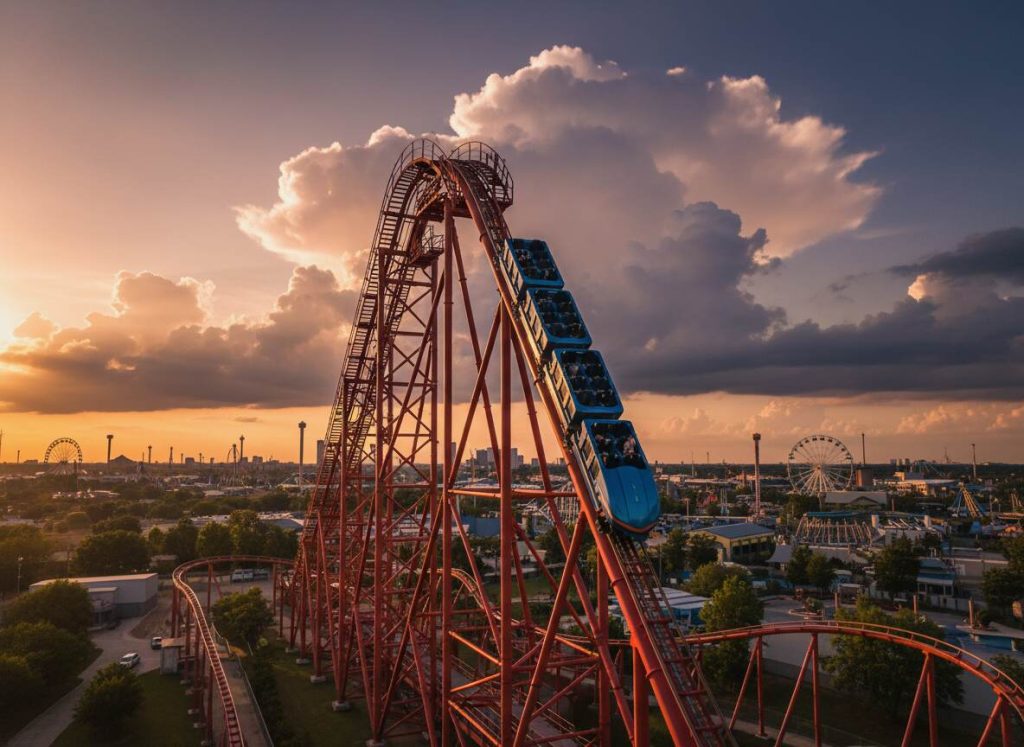
A clear definition (without the textbook stiffness)
A roller coaster is a track-guided amusement ride that moves passengers through a planned course of hills, curves, and elements using a combination of stored energy (usually from a lift hill or a launch), gravity, and braking systems. The train stays on the track because of its wheel assembly and the track’s shape, not because it is “stuck” to it.
That last part matters because a lot of coaster myths start with the idea that the train is barely hanging on. In reality, modern coaster trains are designed to wrap the track with multiple wheels so they cannot simply fly off during normal operation.
A quick history overview (what came before the modern coaster)
Roller coasters did not appear out of nowhere. They evolved from earlier gravity rides and scenic railways, and they grew alongside industrial engineering. You will often see claims about “the first roller coaster,” but that question depends on what you count as a coaster: a gravity slide, a railway-style ride, or a purpose-built amusement attraction.
What is safe to say is this: the modern roller coaster as we recognize it developed over time as designers learned how to shape track, manage speed, and keep riders secure while still making the experience feel wild.
Early coasters leaned heavily into the railway idea. They were often scenic, sometimes rough, and usually focused on hills and turns rather than the intense inversions and launches we associate with today’s biggest rides.
Then steel changed everything. Steel track allowed smoother curves, tighter shaping, and more complex elements. It also made it easier to build taller structures with consistent performance. Wood coasters kept evolving too, and modern wooden coasters can be surprisingly aggressive, especially with updated track technology.
How roller coasters work (the physics, explained like a human)
Most coaster physics can be explained with three ideas: energy, momentum, and forces.
1) Energy: lift hill or launch gives the ride its “budget”
A coaster needs energy to move. Traditionally, that energy comes from a lift hill. The chain lift (or cable lift) pulls the train up, storing energy as height. The higher you go, the more potential energy you have. When you drop, that height turns into speed.
Launch coasters do the same thing in a different way. Instead of slowly saving energy by climbing, they inject energy quickly by accelerating the train forward. The ride still uses gravity and momentum after that, but the start is a punch instead of a climb.
2) Momentum: why the train keeps going after the big drop
Once the train is moving, it wants to keep moving. That is momentum. Designers use it like a tool. A big first drop can give the train enough speed to complete multiple elements. Later in the ride, you may notice smaller hills or tighter turns. That is partly because the train is losing energy to friction and air resistance, so the layout is tuned to what the train can still afford.
3) Forces: what you feel is acceleration, not “speed”
People say “that coaster has crazy G-forces,” but what your body feels is acceleration: changes in speed and direction.
- Positive Gs are the heavy feeling, like you are being pushed into your seat.
- Negative Gs are airtime, when you feel light or lifted.
- Lateral forces are side-to-side pushes, which modern coasters try to reduce by banking turns.
A well-designed coaster is basically a choreography of forces. It is supposed to feel intense, but it is also supposed to stay within limits that are comfortable and safe for most riders.
Major types of roller coasters (the ones people actually mean)
There are a few ways to categorize coasters. The simplest is by track material, then by train style, then by how they get their speed.
Wood vs steel
Wooden coasters use a wooden support structure, and traditionally a wooden track running surface. They are famous for a lively, sometimes rattly feel, and for airtime hills that can feel sharp and snappy. Modern wooden coasters can be smoother than the stereotypes, especially with updated track systems.
Steel coasters use steel track and supports. Steel allows more precise shaping, which is why you see more inversions, smoother transitions, and more extreme geometry on many steel rides.
Sit-down, inverted, flying, wing, stand-up
Sit-down coasters are what most people picture: you sit in a seat above the track.
Inverted coasters hang riders beneath the track, with legs dangling. The sensation is different because you can see the track above you and the supports whipping past.
Flying coasters position riders face-down (or transition into that position), creating a “superman” style flight feeling. The restraint system is more complex because it has to support you in a prone position.
Wing coasters place seats on either side of the track, so nothing is directly above or below you. The near-misses and open sides are a big part of the appeal.
Stand-up coasters have riders in a standing position, supported by a bicycle-style seat and restraints. They are less common today, partly because comfort is tricky.
Lift hill vs launch
Lift hill coasters build suspense. You hear the clicks, you see the view, you feel the height.
Launch coasters skip the slow climb and go straight to acceleration. Launch systems vary, but the rider experience is usually about the suddenness: you go from calm to fast in a breath.
Key components (what a coaster is actually made of)
A roller coaster is not just track and trains. It is a system of parts that each have a job, and most safety comes from redundancy and controlled operation.
Track and supports
The track is the guided path. Supports hold the track in the exact geometry engineers designed. On steel coasters, the track is typically a tubular or box-style structure. On wooden coasters, the track is layered and supported by a wooden frame.
Trains and the wheel assembly
Coaster trains use multiple wheels to hold the train to the track.
- Road wheels sit on top of the rail and carry the weight.
- Side friction wheels press against the sides to keep the train centered.
- Upstop wheels run under the rail to prevent the train from lifting off.
This is one of the biggest aha moments for new coaster fans. The train is not balancing on the track. It is hugging it.
Restraints
Restraints vary by ride type and intensity. Common ones include lap bars and over-the-shoulder restraints. The goal is not to clamp you like a vise. The goal is to keep you in the safe riding position during the forces the ride is designed to create.
Brakes
Coasters do not stop by running out of speed. They stop because brakes tell them to stop.
You will often see brake fins on the train and brake assemblies on the track. Brakes can slow the train mid-ride (for spacing and control) and stop it at the end.
Block zones (the traffic system)
A key safety concept is the block system. The track is divided into sections called blocks. Only one train is allowed in a block at a time. If a train does not clear the next block, the system can stop the following train in a controlled way.
This is part of how parks can run multiple trains safely without them ever catching up to each other.
Safety systems (what keeps it safe, beyond “trust us”)
Roller coaster safety is a mix of design standards, testing, maintenance, and operational rules.
It is common industry practice to design rides with conservative safety margins, to test them extensively before opening, and to inspect them regularly. Many regions also have regulations and third-party oversight. In the United States, manufacturers and parks often reference ASTM standards as part of the broader safety framework, but the exact regulatory setup varies by location.
From a practical rider perspective, here is what safety usually looks like on the ground:
- Trains are designed to stay on the track through wheel assemblies and track geometry.
- Restraints have locking mechanisms and checks before dispatch.
- Sensors monitor train position and system status.
- Block zones manage train spacing.
- Operators follow procedures, including height requirements and restraint checks.
- Maintenance teams inspect wheels, brakes, track, and control systems on routine schedules.
If you want to be extra honest in your writing, you can say this: coasters are not risk-free, but they are engineered to make serious failures rare, and the industry learns aggressively from incidents.
Common myths (and what is actually true)
Myth: “The coaster is held on by gravity and hope”
Reality: the wheel assembly holds the train to the track from above, the sides, and below.
Myth: “If you lose your hat, you might fly out too”
Reality: loose items fly because they are not restrained. You are.
Myth: “The safest seat is always the middle”
Reality: different seats feel different forces, but safety is designed across the whole train. Pick based on comfort and the experience you want, not fear.
Myth: “Loops are dangerous because you are upside down”
Reality: modern inversions are shaped to manage forces smoothly. The feeling of being upside down is often brief. The forces are what matter, and those are engineered.
Glossary (short, useful, not pretentious)
- Airtime: The light, floating feeling when negative forces lift you from your seat.
- Block zone: A track section that only one train can occupy at a time.
- Brake run: The section near the end where the train slows and stops.
- Chain lift: A mechanism that pulls the train up the first hill.
- Inversion: Any element where riders go upside down (loop, corkscrew, roll).
- Launch: A system that accelerates the train quickly instead of using a lift hill.
- Restraint: The lap bar or harness that keeps riders in position.
- Train: The connected cars that carry riders.
FAQ
What are roller coasters made of?
Most are made of steel or wood structures with steel components, plus trains, wheels, restraints, brakes, and control systems. Even wooden coasters rely on a lot of steel hardware.
How do roller coasters stay on the track?
They use a wheel assembly that grips the track from multiple directions, including wheels underneath the rail.
Are roller coasters safe?
They are designed with multiple layers of safety: engineering margins, restraint systems, block controls, inspections, and operating procedures. Like any machine, they require maintenance and rules to stay safe.
Why do roller coasters make you feel like you are floating?
That is airtime. It happens when the train’s path creates negative forces, briefly reducing the normal push into your seat.
What is the difference between a wooden coaster and a steel coaster?
Wood and steel coasters can both be intense, but steel track allows tighter shaping and often smoother transitions. Wooden coasters are known for a more organic, lively feel.

Leave a Reply