If you have ever watched a coaster train flip upside down and thought “that’s a loop,” you are not wrong, but you are also not even close to the full story.
“Inversion” is the umbrella term for any roller coaster element that turns riders upside down on purpose. Loops are inversions. Corkscrews are inversions. Rolls, stalls, pretzel-shaped nightmares on flying coasters, and a bunch of weird modern hybrids all count too.
This post is a Coaster Me This style field guide: thorough, practical, and written so you can actually identify what you’re looking at. It also includes the annoying truth that coaster fans love to argue about: there is no single official master list that every park, manufacturer, and database agrees on. Names overlap, parks market the same thing differently, and manufacturers keep inventing new variations.
So here’s the best way to do “every inversion type” honestly: define what counts, then list the full set of widely used inversion names, including common synonyms and variants.
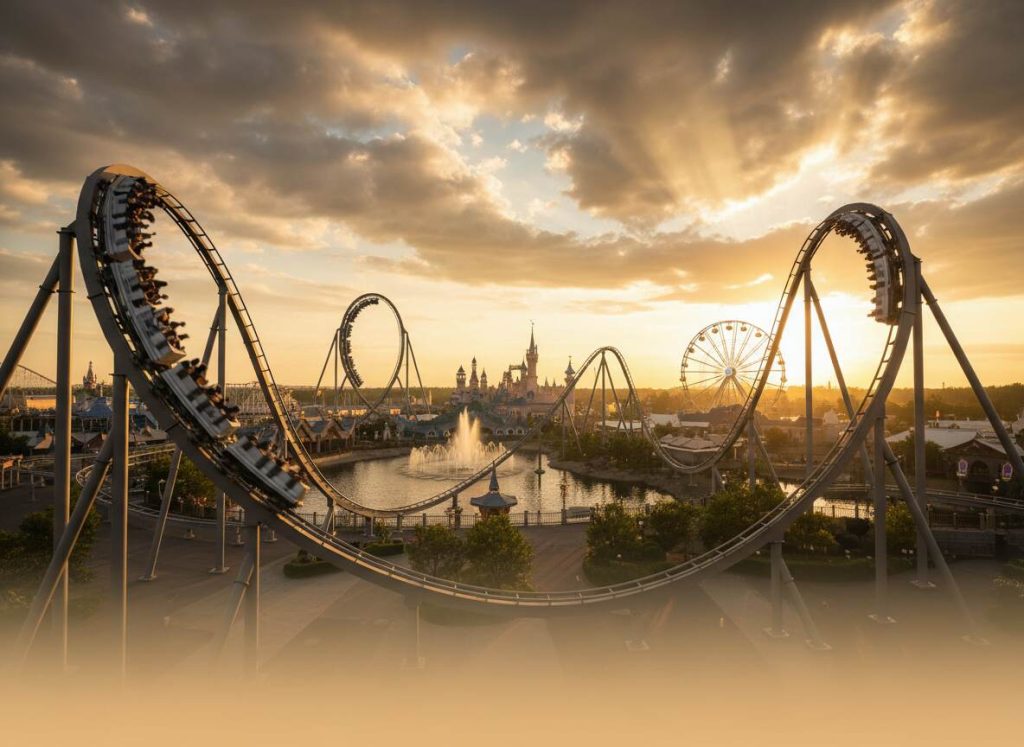
What Counts as an Inversion (So This List Makes Sense)
Most people count an inversion when riders are rotated fully upside down and return upright as part of the intended track shape.
Where it gets messy is in the gray zones:
- Some elements contain two upside-down moments but are marketed as one “signature element.”
- Some modern turns roll past 135 degrees and feel like you’re basically inverted, but you might not be fully upside down long enough for everyone to count it.
- Some parks count “inversions” as moments (every time you’re upside down), while others count elements (one named element may include two inversions).
For this guide, I’m using the most common enthusiast and industry-friendly approach:
- If an element clearly turns riders upside down, it’s in.
- If an element is widely named and recognized as an inversion type, it’s in.
- If a term is used inconsistently, I’ll say so and include it as a “naming note” rather than pretending the world agrees.
The Big Families of Inversions (The Fast Mental Map)
If you want a quick way to understand the whole inversion universe, most inversions fall into these families:
- Loop family: classic vertical-plane loops (and their modern shapes)
- Corkscrew family: helical twists that feel like a stretched spring
- Roll family: heartline rolls, zero-G rolls, inline twists, barrel-roll style elements
- Half-loop + twist family: immelmanns, dive loops, cutbacks
- Double-inversion combos: cobra rolls, batwings/boomerangs, sidewinders, sea serpents
- Flying coaster exclusives: pretzel loops and their cousins
- Modern “signature” inversions: stalls, banana rolls, beyond-vertical roll drops, and manufacturer-specific named elements
Now let’s do the full list.
Loop Family (The “Classic Upside Down” Inversions)
Vertical Loop (Circular Loop)
What it is: The classic loop in a vertical plane, historically close to a circle on early steel coasters.
What it feels like: Strong positive forces at the bottom, lighter near the top, then strong again on exit.
Why it matters: Circular loops are mostly historical now because they can be uncomfortable at modern speeds.
Clothoid Loop (Teardrop Loop)
Also called: teardrop loop, oval loop (informally)
What it is: A loop whose radius changes through the element, usually tighter near the top and broader at the bottom.
What it feels like: Smoother and more comfortable than a perfect circle.
Why it matters: This is the modern standard loop shape.
Tilted Loop
What it is: A vertical loop whose plane is tilted relative to the ground.
What it feels like: Like a loop with a sideways lean, often more disorienting.
Twisted Loop
What it is: A loop that includes a roll component so the entry and exit are not aligned the same way.
What it feels like: Loop forces plus a twist, often used to reposition the track.
Double Loop (Back-to-Back Loops)
What it is: Two vertical loops in sequence.
What it feels like: Repeated sustained forces, very classic old-school intensity.
Corkscrew Family (The “Slinky Twist” Inversions)
Corkscrew
What it is: A helical inversion that rotates riders 360 degrees while the track advances forward.
What it feels like: A twisting flip that can be smooth on modern designs or rough on older, non-heartlined ones.
Double Corkscrew
What it is: Two corkscrews in a row, often mirrored left-right.
What it feels like: A fast one-two twist.
Roll and Twist Family (Modern Smooth Flips, Often Built for Float)
This is where modern coaster design gets really interesting, because many of these are designed around heartlining.
Heartlining means the track rotates around the rider’s centerline (roughly chest/heart area) so your head and shoulders are not being yanked sideways during the roll.
Heartline Roll
What it is: A roll shaped specifically to rotate around the rider’s centerline.
What it feels like: Smooth, controlled rotation.
Zero-G Roll
What it is: A heartlined roll designed to create near-weightlessness (around 0 G) through the inversion.
What it feels like: Floaty, airy, like you’re gently tumbling.
Barrel Roll (Coaster Context)
What it is: A roll where the track follows a barrel-roll-like path, often with a rise and fall.
What it feels like: Similar to a zero-G roll, but not always tuned for true 0 G.
Naming note: Parks sometimes use “barrel roll” and “zero-G roll” interchangeably even when the force profile differs.
In-Line Twist
What it is: A 360-degree roll where the track twists around the train’s center, often feeling like you rotate “in place.”
What it feels like: Can be slow and hangy or quick and snappy depending on shaping.
Stall Family (The “Hang There Upside Down” Inversions)
Zero-G Stall
Also called: stall, hangtime stall
What it is: A roll that stalls at the apex so riders are held upside down briefly, often with near-zero G.
What it feels like: Suspended, surreal, like the ride pauses mid-flip.
Half-Loop + Twist Family (Inversions That Also Change Direction)
These are some of the most common “modern coaster” inversions because they do two jobs at once: flip you and redirect the track.
Immelmann
What it is: A half-loop up followed by a half-twist, changing direction.
What it feels like: You crest upside down and unwind into a new heading.
Common on: Dive coasters, wing coasters, modern steel layouts.
Dive Loop
What it is: Often described as the inverted counterpart to an immelmann, twisting riders into a descending half-loop.
What it feels like: A twisting drop, like you’re being poured out of the sky.
Cutback
What it is: A half-loop up into inversion combined with a twist that redirects the train back the way it came (commonly on inverted coasters).
What it feels like: A dramatic up-and-over direction change.
Norwegian Loop
What it is: A compact loop-like element with twist and direction change characteristics.
What it feels like: Complex and disorienting, with a unique “swerve.”
Naming note: Less common, but recognized in element catalogs and enthusiast usage.
Double-Inversion Combo Family (Two Upside-Down Moments in One Named Element)
These are the elements that make inversion counting messy, because one named element often contains two inversions.
Cobra Roll
What it is: A double inversion formed by an immelmann merging into a dive loop (or vice versa), creating a cobra-head silhouette from the side.
What it feels like: Two inversions with a strong sense of redirection.
Counts as: 2 inversions
Sidewinder
Also called: butterfly (in some regions)
What it is: Two half-loops connected by a half-twist in a compact footprint.
What it feels like: Quick up-and-over with a direction change.
Counts as: 2 inversions
Sea Serpent Roll
What it is: A stretched, flowing double-inversion element, often described as a cobra roll variant with different pacing and geometry.
What it feels like: Two inversions that can feel smoother and more drawn out.
Counts as: 2 inversions
Naming note: Sometimes used as a manufacturer or park-specific label.
Batwing / Boomerang Element
Important naming note: This is where coaster terminology gets chaotic. Many people call this element a batwing. Others call it a boomerang element. Both are common.
What it is: A classic double inversion: half-loop up, twist, half-loop down, mirrored in a way that reverses direction through the element.
What it feels like: Dramatic, forceful, and very “signature element” energy.
Counts as: 2 inversions
Flying Coaster Exclusive Inversions (Different Body Position, Different Intensity)
Flying coasters deserve their own section because rider orientation changes everything. When you’re face-down, forces can feel heavier and more intense.
Pretzel Loop
What it is: A signature flying coaster inversion shaped like a pretzel fold.
What it feels like: Extremely intense, heavy forces. For many riders, it’s one of the strongest inversion sensations on any coaster.
Counts as: 1 inversion
Pretzel Knot
What it is: A more complex pretzel-shaped inversion/roll combination.
What it feels like: Tangled, disorienting, and often relentless.
Counts as: Varies by design, often treated as 2 inversions if it includes two distinct upside-down moments.
Lie-to-Fly / Fly-to-Lie Transition Inversions (Flying Dutchman)
What they are: Transition elements on certain flying coaster models that rotate riders between face-up and face-down orientations, often passing through inversion.
What they feel like: Controlled, rotating flips that are as much about changing body orientation as thrill.
Counting note: Often counted as inversions because riders pass upside down during the transition.
Modern Signature and “Marketing Name” Inversions (Where Names Multiply)
This is the part of the inversion world that changes the fastest. Manufacturers create signature elements, parks market them with unique names, and enthusiasts try to map them back to the closest “standard” category.
These are still real inversion types, but you’ll see naming variation.
Banana Roll
What it is: A curved, banana-shaped roll element, often used on modern steel coasters, where the track rolls riders while also curving laterally.
What it feels like: A graceful, arcing roll rather than a straight flip.
Counts as: 1 inversion
Roll Drop / Barrel Roll Drop
What it is: A drop that includes a roll so riders invert during the descent.
What it feels like: Falling while rotating, high adrenaline, often surprisingly smooth.
Counts as: 1 inversion (when it fully inverts riders)
Wing Over Drop (When It Fully Inverts)
What it is: A drop combined with a roll, often on wing coasters, where the train rotates during the descent.
What it feels like: A floating tip-over into a falling roll.
Counts as: 1 inversion if it goes fully upside down.
Under-Flip (General Category)
What it is: A compact inversion where the train flips under a crest or through a tight roll path.
What it feels like: Quick, surprising, often with a directional change.
Naming note: This term is used broadly and can overlap with other roll families depending on the exact geometry.
Step-Up Under-Flip (Manufacturer-Specific)
What it is: A modern inversion where the track steps upward and then flips riders through a compact under-flip motion.
What it feels like: A pop upward followed by a snappy inversion with floaty moments.
Naming note: Often tied to specific manufacturer catalogs; parks may not use the same term.
The Gray Zone: Elements That Are Sometimes Counted as Inversions
These are worth including because readers will see them called “inversions” in some places, but they are not consistently counted.
Overbanked Turns (Sometimes Past Inversion Angles)
What they are: Overbanked turns can roll very far, sometimes approaching or briefly passing inversion angles.
What they feel like: Sustained sideways hang and strong disorientation.
Counting note: Many are not true inversions. Some borderline examples get counted depending on how far the roll goes.
Stengel Dive (Usually Not a True Inversion)
What it is: A steeply banked, diving turn that can feel like you’re being twisted downward.
What it feels like: A diving spiral sensation.
Counting note: Typically not counted as an inversion unless the roll angle truly inverts riders.
Raven Turn (Inversion-Adjacent)
What it is: A heavily banked, twisting turn that can approach inversion angles.
What it feels like: Sideways, diving twist.
Counting note: Usually not counted as an inversion, but some designs flirt with the boundary.
Why Some Inversions Feel Smooth and Others Feel Brutal
Two coasters can have the same inversion “type” and still feel completely different. The biggest reasons:
- Heartlining: Modern inversions rotate around your centerline, reducing head and neck snap.
- Transition shaping: The entry and exit curves matter as much as the upside-down part.
- Speed through the element: Faster can mean more force, but it can also mean a smoother roll if the shaping is designed for it.
- Restraints: Older over-the-shoulder restraints plus tight transitions can cause headbanging. Modern vests and lap-bar-focused designs often feel freer.
- Maintenance and wheel condition: Vibration and track wear can change how “clean” an inversion feels over time.
The Practical Cheat Sheet: If You Want to Identify Inversions Fast
If it’s a full vertical circle or teardrop shape: vertical loop / clothoid loop
If it’s a stretched helical twist: corkscrew
If it’s a smooth 360 roll that feels floaty: zero-G roll / heartline roll
If it holds you upside down for a beat: zero-G stall
If it’s half-loop up plus twist out: immelmann
If it twists you into a descending half-loop: dive loop
If it’s a big S-shaped double inversion: cobra roll / sea serpent
If it’s compact and looks like two quick flips: sidewinder
If it’s on a flying coaster and looks like a pretzel fold: pretzel loop
The Bottom Line
“Inversions” are not one thing. They’re a whole vocabulary of upside-down elements that designers use to control forces, pacing, and personality. A loop is about sustained forces and classic spectacle. A roll is about rotation and often weightlessness. A stall is about time and suspension. A double-inversion combo is about redirection and disorientation.
And that’s why two coasters can both advertise “6 inversions” and still feel like they belong in completely different universes.

Leave a Reply