When you think about the oldest roller coaster in the United States, you’re thinking about more than just a ride. You’re thinking about a piece of American history that has survived over 120 years of wear, neglect, restoration efforts, and the changing landscape of amusement parks. The answer is Leap-The-Dips, a wooden side-friction coaster built in 1902 at Lakemont Park in Altoona, Pennsylvania. But the story of this coaster, and how it came to be the oldest surviving roller coaster in America, is far more interesting than just the date it opened.
What Makes Leap-The-Dips the Oldest?
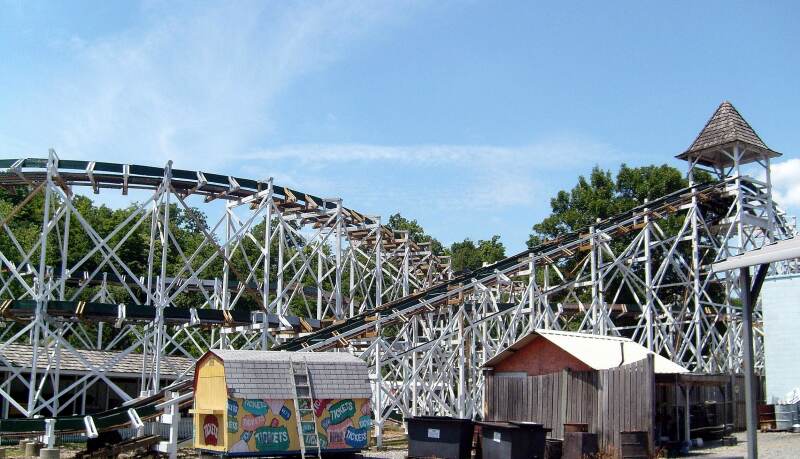
Leap-The-Dips holds the distinction of being the oldest standing roller coaster not just in the United States, but in the entire world. Built in 1902 by the Federal Construction Company and designed by Edward Joy Morris, this coaster has been operating (with some interruptions) for over 124 years. It’s the last surviving example of the side-friction roller coaster design, a technology that was once extremely common but is now completely obsolete.
The coaster’s name comes from its figure-eight track layout, which was the dominant design for roller coasters in the early 1900s. Riders would experience a series of dips and turns as the train navigated the figure-eight pattern, creating the sensation of leaping from one section to another. This design was revolutionary for its time, allowing coasters to operate at higher speeds and without the need for a brakeman riding along to control the train.
The Technical Innovation: Side-Friction Technology
To understand why Leap-The-Dips is so historically significant, you need to understand the side-friction technology that makes it unique. In the early days of roller coaster design, engineers faced a fundamental problem: how do you keep a train on the track at high speeds and through sharp turns?
The solution that emerged was the side-friction system. Rather than using wheels underneath the track (as modern coasters do), side-friction coasters used special wheels mounted on the sides of the train cars. These wheels would press against the sides of the track, guiding the train through turns and preventing it from derailing. This design was incredibly innovative and allowed coasters to achieve speeds and maneuvers that were previously impossible.
Leap-The-Dips features the classic side-friction design with flanged wheels underneath the track and unflanged wheels projecting to each side. The train cars resemble sleighs, a design that was common in the early 1900s. The track itself is mounted on wooden trestles and arranged in a figure-eight pattern that occupies a rectangular area measuring 84 by 229 feet.
The side-friction design became obsolete after World War I, when engineers developed under-track mechanisms that offered better vehicle security and support for greater speeds. These new designs were safer and more reliable, and they quickly became the industry standard. By the 1930s, virtually all new coasters were using under-track wheel systems. This is why Leap-The-Dips is so remarkable – it’s the last surviving example of a technology that was once universal but is now completely extinct.
The Coaster’s Humble Specifications
By modern standards, Leap-The-Dips is an incredibly tame ride. The coaster reaches a maximum height of just 41 feet and a top speed of only 10 miles per hour. The entire ride lasts about one minute, with the train traversing two and a half circuits of the figure-eight pattern. There are no inversions, no extreme G-forces, and no heart-stopping drops. In fact, many modern family coasters are far more intense than Leap-The-Dips.
But that’s precisely what makes it so special. Leap-The-Dips is a window into what thrills meant to people in 1902. For riders of that era, experiencing a 41-foot drop at 10 miles per hour was genuinely terrifying. The coaster represents a moment in time when roller coasters were still relatively new and exciting, before the industry began its relentless pursuit of bigger, faster, and more extreme rides.
The Rise and Fall of the Figure-Eight Coaster
When Leap-The-Dips opened in 1902, the figure-eight coaster design was at the height of its popularity. These coasters reached peak popularity during the Roaring Twenties, when amusement parks were booming and roller coasters were the main attraction that drew crowds. Nearly 400 figure-eight coasters were built during this era, scattered across amusement parks throughout the United States and around the world.
The design was so popular that identical versions of Leap-The-Dips were built at other parks. Most notably, an identical coaster called Leap the Dips was constructed at Mounds State Park in Anderson, Indiana. However, that coaster closed in 1929 and was eventually demolished, making the Pennsylvania version the sole survivor of its kind.
By the 1930s and 1940s, the figure-eight design had fallen out of favor. Newer coaster technologies offered better performance, greater safety, and more exciting rides. Park operators began tearing out their old figure-eight coasters and replacing them with modern designs. By the time Leap-The-Dips closed in 1985, it was the last remaining figure-eight coaster in the world.
The Decline and Near-Demolition
For most of the 20th century, Leap-The-Dips operated continuously at Lakemont Park. The coaster became a beloved local attraction, and many generations of Altoona residents rode it as children. However, by the 1980s, the coaster was showing its age. Decades of operation had taken their toll on the wooden structure, and maintenance costs were mounting. In 1985, Lakemont Park made the difficult decision to close Leap-The-Dips due to structural integrity concerns and lack of maintenance funds.
For the next 14 years, the coaster sat idle. The wooden structure continued to deteriorate, exposed to the elements and neglect. Many people assumed that Leap-The-Dips would eventually be demolished, like so many other historic coasters before it. The coaster seemed destined to become just another forgotten piece of amusement park history.
But Leap-The-Dips had passionate advocates. The American Coaster Enthusiasts organization, a group dedicated to preserving historic roller coasters, recognized the historical significance of the ride and launched a fundraising campaign to save it from demolition. The effort led to the formation of the Leap-The-Dips Foundation, which accepted private donations and worked with eight local banks and the Progress Fund to raise the money needed for restoration.
The Restoration: Bringing History Back to Life
In 1997, restoration work finally began on Leap-The-Dips. The restoration effort was led by P. Joseph Lehman, Inc., Consulting Engineers, and it was an incredibly delicate undertaking. The engineers had to balance the need for modern safety standards with the desire to preserve the coaster’s historical authenticity.
What made the restoration particularly challenging was the decision to use the original carpentry techniques that were employed during the coaster’s original construction in 1902. The restoration team painstakingly studied historical records and photographs to understand exactly how the coaster was built over a century earlier. They then used those same techniques to rebuild damaged sections of the wooden structure.
Remarkably, over 70 percent of the original wood from 1902 remained intact and was incorporated into the restored coaster. The team selectively replaced only the portions that had deteriorated beyond repair. Where possible, they used the same types of wood and the same construction methods as the original builders. The lift chain was converted to steel for safety and reliability, and a ratchet system was added to prevent cars from rolling backwards in the event of a chain failure. But the overall character and appearance of the coaster remained faithful to the original design.
The restoration took two years to complete. On May 31, 1999, Leap-The-Dips officially reopened to the public. The event was a celebration of American ingenuity, historical preservation, and the dedication of coaster enthusiasts who refused to let a piece of history disappear.
Historic Designations and Awards
The restoration of Leap-The-Dips was recognized by the historical preservation community. In 1993, before the restoration even began, the coaster was added to the National Register of Historic Places. In 1996, it received the even more prestigious designation of National Historic Landmark, placing it in the same category as structures like the Statue of Liberty and the Golden Gate Bridge.
Following its reopening in 1999, the American Coaster Enthusiasts organization awarded Leap-The-Dips two major honors: the Coaster Landmark Award and the Coaster Classic Award. These awards recognize coasters that have made significant contributions to the history and development of roller coaster design and technology.
The Current Status: A Complicated Future
The story of Leap-The-Dips doesn’t end with its triumphant reopening in 1999. In 2017, Lakemont Park announced ambitious plans for a complete restoration and transformation of the entire park. The park closed for the 2018 season to undergo renovations, with plans to reopen in 2019 as a “family entertainment location with some amusements.”
The park did reopen in 2019, but the situation for Leap-The-Dips became complicated. In 2023, the park announced that it would suspend operations of its amusement rides due to financial constraints. This meant that Leap-The-Dips, after nearly a century of operation and a heroic restoration effort, was closed once again.
As of 2026, Leap-The-Dips remains non-operational. The coaster that survived over 120 years of history, a 14-year closure and near-demolition, and a major restoration effort now faces an uncertain future. Preservation advocates continue to work toward finding a solution that would allow the coaster to operate once again, but the financial challenges facing Lakemont Park have proven difficult to overcome.
Other Historic Coasters: The Broader Context
While Leap-The-Dips is the oldest roller coaster in the United States, it’s not the only historic coaster still operating in America. Understanding the broader context of historic coasters helps us appreciate just how rare and valuable these rides are.
The Coney Island Cyclone in New York, which opened in 1927, is one of the most famous roller coasters in the world. Built by the legendary coaster designer Harry Baker, the Cyclone is still operating and remains one of the most thrilling wooden coasters ever built. The ride’s legendary layout became the template for countless coasters built in subsequent decades.
The Giant Dipper in Santa Cruz, California, opened in 1924 and is the oldest operating roller coaster on the West Coast. This classic wooden coaster has been thrilling riders for over 100 years and remains one of the most beloved coasters in America.
The Wild One at Six Flags America in Maryland originally opened in 1917 as “The Giant Coaster” at Paragon Park in Massachusetts. It’s the oldest roller coaster at any Six Flags park and one of the oldest continuously operating coasters in the country.
Jack Rabbit at Kennywood in Pittsburgh opened in 1927 and is the second oldest continuously operating roller coaster in the United States. This coaster is notable for being the world’s oldest coaster to incorporate under-friction (upstop) wheels, representing the technological transition from side-friction to modern wheel designs.
Why Leap-The-Dips Matters
Leap-The-Dips represents far more than just the oldest roller coaster in America. It’s a tangible connection to the early days of the amusement park industry, when roller coasters were still relatively new and thrilling. It’s a testament to the ingenuity of early engineers who developed innovative solutions to the challenges of coaster design. It’s a symbol of the importance of historical preservation and the dedication of enthusiasts who work to keep these attractions alive.
The coaster also tells the story of technological obsolescence. The side-friction design that made Leap-The-Dips revolutionary in 1902 became completely outdated by the 1920s. Yet the coaster survived, not because it was the best design or the most advanced, but because it was well-built and because people cared enough to preserve it. This is a lesson that applies far beyond roller coasters – it’s a reminder that historical artifacts deserve to be preserved even when they’ve been superseded by newer technology.
The Future of Historic Coasters
The story of Leap-The-Dips raises important questions about how we preserve industrial heritage and amusement park history. Roller coasters are expensive to maintain, and parks operating on tight budgets often struggle to justify the cost of keeping older rides operational. Yet these coasters represent irreplaceable pieces of American history.
The preservation of Leap-The-Dips in 1999 demonstrated that it’s possible to save historic coasters, but it requires significant financial resources and community support. As more historic coasters age and face potential closure, the question of how to preserve them becomes increasingly urgent. Some parks have found success by marketing their historic coasters as attractions in their own right, drawing enthusiasts from around the world. Others have partnered with preservation organizations to share the financial burden of restoration and maintenance.
The future of Leap-The-Dips remains uncertain, but its historical significance is undeniable. Whether or not the coaster operates again, its legacy as the oldest roller coaster in the United States and the last surviving example of side-friction technology will endure. For coaster enthusiasts, historians, and anyone interested in American industrial heritage, Leap-The-Dips represents a crucial piece of our shared history.
