Ring Racer was a high-speed steel launch roller coaster built at the Nürburgring in Nürburg, Germany, as part of an entertainment complex intended to turn the famous racetrack into a broader year-round destination. The coaster was designed to match the Nürburgring’s brand: speed, engineering, and motorsport adrenaline.
On paper, Ring Racer sounded like a modern classic: a launched coaster with a top speed marketed around the 100 mph range, a sleek layout, and a theme that practically wrote itself. In reality, it became infamous because it rarely operated, and for long stretches it did not operate at all.
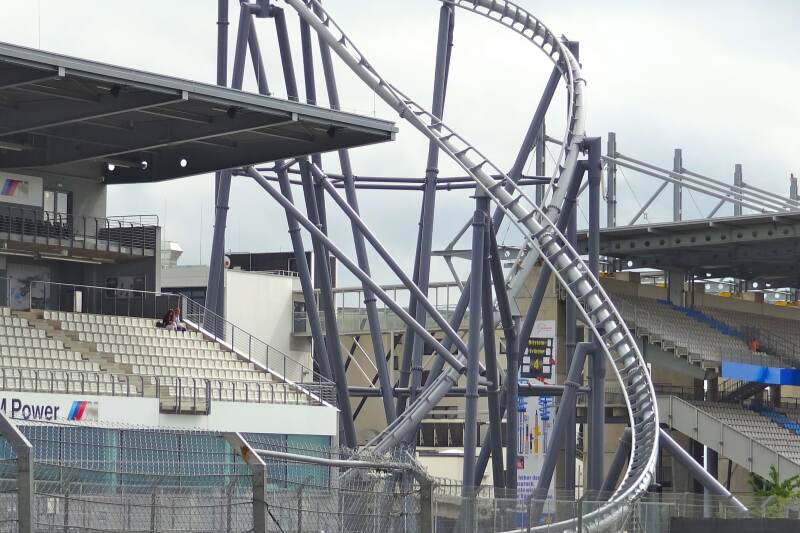
Where It Was Built: Nürburgring and the Failed “Ring” Entertainment Expansion
Ring Racer was not built inside a traditional theme park. It was built at one of the most iconic racing venues in the world. The Nürburgring already attracts motorsport fans globally, but the site also has a long history of trying to expand beyond racing into attractions, museums, hotels, and entertainment.
Ring Racer was part of a major expansion project often referred to as the Nürburgring’s leisure and entertainment development. The idea was to create a multi-attraction complex that would pull in visitors even when major races were not happening.
This context matters because Ring Racer’s fate is tied to the fate of that larger project. When the broader complex ran into financial trouble, the coaster became collateral damage.
The Manufacturer and Ride Type: A High-Speed Launch Coaster
Ring Racer was built by S&S Worldwide, a company known for high-thrill rides and several prominent launch coaster projects. S&S launch coasters are often associated with compressed-air or pneumatic launch technology in earlier generations, and later with other launch approaches depending on the project.
The core identity of Ring Racer was simple: launch, speed, and a racing vibe. It was marketed as a coaster that would feel like being fired down a straightaway, the way a race car surges when it hits full acceleration.
The Big Selling Point: Speed, Records, and Marketing Hype
Ring Racer is often remembered for the way it was marketed. It was promoted as an extremely fast coaster, sometimes framed in record-chasing language. The Nürburgring brand almost demands that kind of marketing, because the entire place is about speed records and performance.
But speed claims can be tricky in the coaster world. Parks and projects sometimes announce a target top speed early in development, then adjust it later due to engineering realities, reliability concerns, or operational constraints. With Ring Racer, the speed narrative became part of the coaster’s mythology, especially because so few people actually got to ride it consistently.
What Actually Happened: Why Ring Racer Didn’t Become a Regular Operating Coaster
Ring Racer’s story is a mix of technical issues and business collapse.
1) A Launch System That Was Difficult to Operationalize
High-speed launch coasters are demanding machines. The launch system has to be consistent in all conditions, the control systems must be extremely reliable, and the ride must be able to cycle repeatedly without overheating, faulting, or requiring constant resets.
When a coaster is built to be “very fast,” the margin for error narrows. Forces increase, wear increases, and the safety systems become more sensitive because they are monitoring a more extreme operating envelope.
Ring Racer reportedly struggled to reach stable, everyday operation. It is the kind of ride where even small reliability problems can turn into big downtime, because the ride’s safety logic will always choose the safest option: stop the ride, fault out, and require inspection or reset.
2) The Nürburgring Entertainment Complex Ran Into Financial Disaster
This is the piece that turns Ring Racer from “temperamental coaster” into “legendary failed attraction.” The broader Nürburgring leisure project ran into major financial trouble and became politically controversial. When the overall complex failed financially, attractions associated with it suffered from ownership changes, restructuring, and uncertainty about what would even remain open.
A coaster needs consistent staffing, maintenance budgets, parts supply, and operational priority. When a larger project collapses, a coaster can quickly go from “headline attraction” to “expensive problem.” Even if the ride could be fixed, the question becomes: who pays, and why?
Operations: The Coaster That Was There, But Not Really There
Ring Racer became known for being physically present but functionally absent. Coaster fans would visit the Nürburgring, see the track, see the station, see the infrastructure, and then discover it was not operating. Or it would operate briefly and then stop again.
This is why Ring Racer has such a strange reputation. Many coasters are famous because they are great rides. Ring Racer is famous because it is a ghost of a great ride, a coaster that looked like it should be iconic but never got the chance to build a stable legacy through regular operation.
Why Ring Racer Still Matters (Even If You Never Rode It)
Ring Racer is a cautionary tale, but it is also genuinely fascinating for coaster history.
It Shows the Risk of Building a Coaster Outside a Traditional Park Model
Theme parks are built around ride operations. They have the staffing pipelines, the maintenance culture, the spare parts planning, and the daily rhythm that keeps rides running. When you build a coaster as part of a mixed-use entertainment complex, you have to recreate that operational culture from scratch, and that is harder than it sounds.
It Highlights the Gap Between Marketing and Operations
Ring Racer is a reminder that “fastest” and “most extreme” are marketing words, not operational guarantees. A coaster can be engineered to hit a number, but if it cannot do it reliably day after day, the number stops mattering.
It Became a Modern Coaster Myth
Coaster enthusiasts love oddities: rides that were built and removed quickly, rides that never opened, rides that had one season and vanished. Ring Racer sits in that category. It is a coaster people talk about because it feels like a mystery you can still go see in person.
What It Would Have Felt Like to Ride (Based on the Design Intent)
Even though consistent public operation was limited, the design intent is clear: Ring Racer was meant to feel like a motorsport launch. The launch would be the star of the show, with the rest of the layout serving as a high-speed follow-through rather than a long, sprawling sequence of elements.
That kind of coaster experience is very specific. It is not about airtime marathons or inversion collections. It is about acceleration, speed, and the psychological thrill of being launched hard in a setting that already screams “performance.”
Ring Racer in the Bigger Coaster Conversation
If you are building a mental map of coaster history, Ring Racer sits at the intersection of three trends:
- The rise of high-speed launch coasters as a mainstream thrill category
- Destination entertainment complexes trying to add theme-park style attractions outside traditional parks
- Record-driven marketing that sometimes outpaces operational reality
It is not the only coaster to struggle with reliability or to be caught in a larger project’s collapse, but it is one of the most memorable examples because of where it was built and how loudly it was marketed.
Conclusion: A Coaster That Became Famous for Not Being Rideable
Ring Racer should have been a perfect match: a high-speed launch coaster at one of the world’s most famous racing venues. Instead, it became a symbol of how complicated it is to turn ambitious plans into stable operations.
That does not make Ring Racer a joke. It makes it interesting. It is a reminder that roller coasters are not just rides, they are systems: engineering, maintenance, staffing, budgeting, and business stability all have to work together. If one part collapses, even the coolest coaster in the world can become a silent track in the background.

Leave a Reply