If you have been around coaster fans for more than five minutes, you have heard the same argument in a hundred different outfits: record coasters are the point of theme parks. They are the sport. They are the headline. They are the reason people buy plane tickets.
And then, weirdly often, they are also the rides that age the fastest.
Not always, not universally, and not because “big is bad.” But if you look at the modern era of height records, you start to notice a pattern: the tallest coaster in the world tends to have a shorter, messier, more complicated life than the park’s best-loved “normal” coaster. Sometimes it is reliability. Sometimes it is cost. Sometimes it is the park’s brand changing. Sometimes it is the uncomfortable truth that a record is an opening-day marketing strategy, not a 30-year operating plan.
This post is about why.
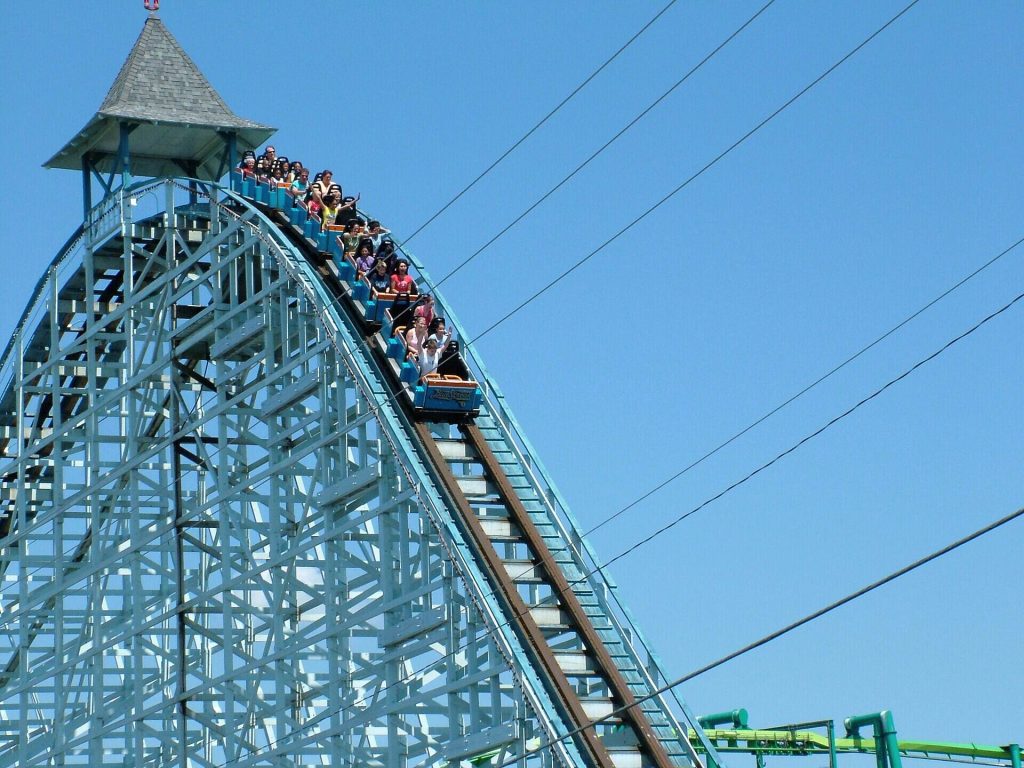
What Counts As A “Record Coaster” In This Conversation
When people say “record coaster,” they usually mean a ride that is marketed around a clean, measurable superlative. Height is the most obvious, but speed, length, and inversion counts can function the same way, especially when the park can put a single number on a billboard and let the internet do the rest. In this article, I am focusing mostly on the “tallest” category, because height records tend to come with the most brutal tradeoffs. Wind becomes a daily variable. Structural loads become a constant background pressure. Evacuation complexity becomes a real operational consideration, not a theoretical safety manual paragraph.
Even if we keep the conversation mostly on height, the broader point still applies: when a coaster’s identity is “the most,” it is often being asked to do two jobs at once. It has to be a ride, and it has to be a marketing product.
The Dirty Secret: A Record Is A Marketing Product
A height record is not just a measurement. It is a product the park sells to the public.
When a park announces “the tallest coaster in the world,” they are buying a kind of attention that is hard to get any other way. News coverage writes itself because the headline is already built into the attraction. Social media does the distribution for free because people like sharing extremes. Fans plan trips because there is a clear reason to go this year, not someday. Even casual guests understand the pitch instantly, because “tallest” is a universal language.
That is the upside, and it is real. A record coaster can change a park’s reputation overnight. It can turn a regional park into a destination. It can create a signature skyline that becomes the park’s identity.
The downside is that the record itself does not guarantee a ride that is easy to operate, easy to maintain, or easy to love for decades. In fact, chasing the record can push a design into the exact zone where long-term operations get painful. A park can build a coaster that wins the opening day news cycle and still end up with a machine that is expensive, temperamental, and increasingly out of step with what guests want.
Why Tallest Coasters Often Have Shorter Lifespans
They Live In The Wind, And Wind Is Not A Vibe
Tall coasters are not just tall. They are tall in open air, and open air is where weather stops being background scenery and starts being an operating condition.
Wind is the most obvious problem, because it is both common and unpredictable. Even when a coaster is structurally safe, wind can change how the train behaves at the top of the structure. It can affect comfort, especially on exposed seats where riders feel every gust. It can push operations into conservative territory where the park chooses to close the ride rather than gamble on borderline conditions.
The guest experience of a wind closure is not neutral. Guests do not experience it as a reasonable engineering decision. They experience it as a broken promise. If the ride was marketed as the big reason to come, and it is down for weather that feels “fine” at ground level, the ride’s reputation takes a hit that is hard to recover from.
Temperature can matter too, especially for certain ride systems and wheel compounds, and storms can shut down any outdoor ride. But height amplifies the impact of every weather variable. The taller the ride, the more likely it is to be the first to close and the last to reopen.
The Maintenance Curve Is Steeper, And The Parts Are Not Normal
A lot of coasters share common parts and common knowledge. Tall record coasters often do not.
When a ride is built to be the tallest, it is frequently built with custom solutions. The structure is not just a scaled-up version of a normal coaster. The trains may be unique. The lift or launch system may be tuned to a specific set of forces and speeds. The braking and control logic can be more complex because the consequences of a stop in the wrong place are more complicated.
Custom does not automatically mean bad. Custom can be brilliant. But custom can also become a long-term headache. Replacement parts can take longer to source. Specialist knowledge can be narrower. Vendors can change. Corporate ownership can change. The ride becomes “that one machine” that always needs the most attention.
Height also makes every maintenance task more expensive in a very literal way. You are not swapping something at ground level. You are doing it on a tower. Access is harder, time is longer, and the margin for error feels smaller. Even routine inspections can take more labor hours when the ride is a vertical landmark.
Evacuation And Rescue Are Harder, So Operations Get Conservative
Every coaster has evacuation procedures, and every coaster is designed with the assumption that, at some point, a train might stop somewhere that is not the station. That is not a scandal. It is a normal part of operating complex machinery.
Tall coasters make that reality more intimidating, and not just for guests. If a train stops on a lift hill, you can usually walk guests down stairs. If a train stops on a massive tower or a high-speed launch element, the options can get more limited and more complicated. The procedures may still be safe and well-practiced, but they are not quick, and they are not easy to make look calm.
This is one of the reasons parks often run tall coasters more conservatively. Conservative operations can look like longer checks, more cautious dispatching, and more frequent pauses when something is slightly off. From the park’s perspective, that caution is smart. From the guest’s perspective, it can look like the ride is unreliable.
The Guest Experience Can Age Faster Than The Hardware
This is the part coaster fans hate to admit, because it sounds like an insult, but it is not. A record coaster can be a one-trick legend, and that can still be a great ride.
If the ride’s identity is “tallest,” then the experience is built around a small number of peak moments. The climb is the suspense. The view is the flex. The drop is the payoff. The speed is the story you tell later.
That can be incredible, but it can also be less re-rideable than a coaster with a dense layout, multiple airtime moments, a strong theme, and a ride experience that feels good at different times of day. A record coaster can be the ride you must do once, while another coaster becomes the ride you do five times.
When the record gets beaten, the ride’s identity can feel hollow to casual guests. They do not say, “This is still historically important.” They say, “Oh, it used to be the tallest.” That is a rough sentence for a ride that cost a fortune.
The Cost To Run It Can Stop Making Sense
Record coasters are expensive to build. That part is obvious. What is less obvious is how expensive they can be to keep running at the level guests expect.
Tall rides can require more staffing, more specialized maintenance, longer downtime windows, and more frequent inspections. They can also experience higher wear on certain components simply because the ride is operating at the edge of what the design is trying to do. If the park wants the ride to feel smooth and confident, it may need more frequent refurbishments than a smaller coaster.
At some point, the park has to ask a brutal question: is this ride still earning its footprint?
A record coaster takes up space, skyline, and marketing attention. If it is not delivering consistent capacity and guest satisfaction, it becomes a candidate for retirement earlier than a smaller, easier ride.
Corporate Strategy Changes, And Records Stop Being The Goal
Theme parks are not static. Ownership changes. Management changes. The park’s target audience changes.
A park that once chased records might pivot toward family attractions, themed lands, festivals, IP-based rides, or resort expansion. In that world, a towering record coaster can feel like a relic of a different era. Not because it is bad, but because it is not aligned with what the park is trying to sell now.
A record coaster is a statement. If the park no longer wants to make that statement, the ride can become awkward, even if it is still technically impressive.
Why Some Record Coasters Do Last
It is not all doom. Some record coasters become long-term icons because they manage to be more than a record.
The ones that last tend to have reliability that keeps them available, re-rideability that makes them fun beyond the headline moment, comfort that ages well, and integration that makes the ride feel like it belongs in the park’s identity. They also tend to be maintainable in a way that is realistic for the park’s budget and staffing.
When those factors line up, the coaster can outlive its record status and still matter.
The “Tallest” Arms Race Has A Built-In Expiration Date
Height records are a ladder. Someone is always climbing it.
That means the marketing value of “tallest” is temporary by design. Even if your ride is perfect, the record will eventually be taken.
So the real question is not, “Can we build the tallest coaster?” It is, “Can we build a coaster that still makes sense after it is no longer the tallest?”
If the answer is no, the ride is already on a shorter clock.
What Parks Are Learning Right Now
If you look at the last decade of major coaster investments, you can see parks making different choices. They are chasing the marketing pop without inheriting a maintenance monster. They are prioritizing reliable capacity, comfort, and re-rideability. They are also putting more emphasis on theming and storytelling, even for thrill coasters, because a ride that is emotionally memorable can stay relevant after the record fades.
Records are not dead. They are just being treated more cautiously, because parks have learned that the opening-year headline is not the same thing as a 20-year asset.
The Takeaway: Records Are Fun, But Longevity Is A Different Skill
Record coasters are not mistakes. They are bold bets.
Sometimes the bet pays off for decades. Sometimes it pays off for a few years of headlines and then becomes a complicated asset the park has to manage.
If you love record coasters, you do not have to stop loving them. Just understand what they are: a mix of engineering ambition, marketing strategy, and operational reality.
Operational reality always gets the final vote.
FAQ
Why Do Tall Coasters Close More Often?
They close more often because height amplifies weather sensitivity, maintenance complexity, and operational caution. Wind and temperature can affect how the ride runs, and any issue at height is harder to resolve quickly.
Are Record Coasters Less Safe?
Not inherently. They are engineered with safety margins like other coasters. The bigger issue is operational complexity and the difficulty of evacuations and maintenance, which can lead to more downtime.
Why Do Parks Stop Chasing Height Records?
Because the marketing value is temporary, while the operating costs and complexity are long-term. Many parks find better returns in rides that are reliable, high-capacity, and broadly appealing.
Can A Tall Coaster Be Relocated?
It is possible in theory, but it is often impractical. The structure is massive, custom, and expensive to disassemble, transport, and rebuild. Many tall coasters are retired through demolition and recycling instead.

Leave a Reply