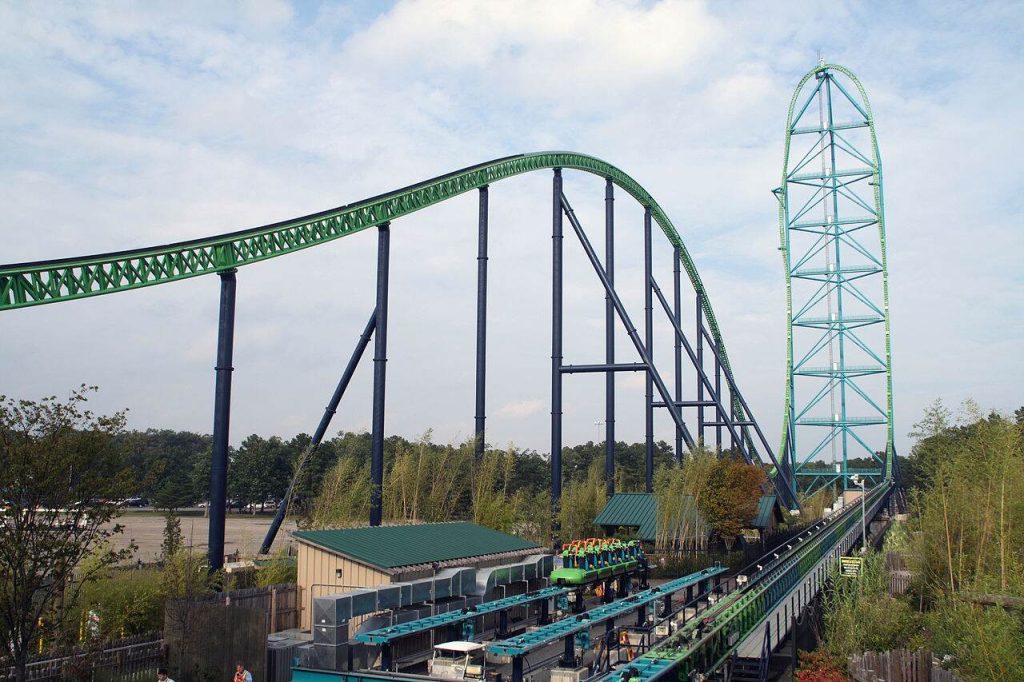
Kingda Ka was the kind of roller coaster that stopped being “a ride” and turned into a landmark. Even if you never rode it, you knew where you were the second you saw that green track and that 456-foot tower punching straight into the New Jersey sky.
So when people ask, “Where is Kingda Ka now?” they usually mean three different things at the same time:
1) Where did the physical coaster go after it was torn down, and what happens to something that big when it dies?
2) Where was it in the park, and what does that area look like now that the skyline is gone?
3) What is replacing it, and what does the park do with a plot of land that used to hold one of the most extreme coasters ever built?
You asked for all three, in that order, and you also asked for extensive research because this is a recent event. I’m going to ground this in what has been publicly reported, then I’m going to fill in the blanks with the practical reality of how ride removals work, because the truth is: parks rarely publish a neat “here’s where every bolt went” breakdown.
Part 1: Where did the physical Kingda Ka coaster go?
Let’s start with the most literal version of the question. When a coaster is torn down, does it get stored? Sold? Shipped somewhere? Does it sit in a mysterious boneyard behind the park like a dinosaur skeleton?
Usually, the answer is less romantic: it gets cut up, hauled out, and recycled, with a handful of components potentially saved, sold, or repurposed.
Kingda Ka’s teardown was not a “take it apart gently” situation
Kingda Ka did not come down like a LEGO set. Multiple news reports described a controlled implosion bringing down the structure, with the tower reduced to rubble and steel beams. One report described the tower coming down just before 7 a.m., earlier than a scheduled window, and noted that SkyFOX captured the aftermath as broken track pieces and massive steel beams remained on site.
That matters because it tells you what kind of removal this was. A ride that is imploded is not being preserved for a second life in another park. An implosion is what you do when the structure is not being “relocated,” it is being eliminated.
So what happens to the steel?
Steel coaster track and supports are valuable as scrap metal, and the most common end-of-life path for a coaster like this is:
– The structure is brought down (or dismantled in sections)
– Large pieces are cut into transportable sizes
– Material is loaded onto trucks
– Steel is sent to a recycling facility
This is not unique to Kingda Ka. It is the standard lifecycle for large steel structures when they are not being preserved or sold whole.
In Kingda Ka’s case, reporting and secondary documentation have pointed to the remains being sent to a New Jersey recycling operation. The exact “where did it go” answer most people are looking for is essentially: it went to scrap and recycling, in pieces.
Were any parts saved?
This is the part coaster fans obsess over, and it’s also the part parks are often quiet about. There are a few categories of components that sometimes get saved, even when the structure is scrapped:
1) Trains
Coaster trains can be removed before demolition and stored off-site. Sometimes they are sold, sometimes they become display pieces, sometimes they are parted out, and sometimes they are simply kept until the park decides what to do with them.
2) Control system components
PLC cabinets, sensors, wiring, and control hardware can be salvaged, but on a ride this custom, it is not like swapping a toaster. Some components are reusable, many are not worth the hassle.
3) Launch system hardware
Kingda Ka used a hydraulic launch system. That system is complex, expensive, and maintenance-heavy, and it is not something you casually transplant into a new coaster unless the new coaster is designed around it. In many retirements of hydraulic-launch strata coasters, the launch system is a big part of why the ride becomes economically painful over time.
4) Track sections as memorabilia
Parks sometimes cut a piece of track for display, auction, or museum-style preservation. This is the easiest “fan-facing” way to let a ride live on without preserving the whole thing.
At the time of writing, what we can say confidently from public reporting is that the ride was brought down and the site was left with broken track pieces and steel beams, which strongly supports the conclusion that the bulk of Kingda Ka became scrap and recycling rather than relocation.
Why it probably was not sold to another park
People love the idea that a coaster gets shipped overseas and rebuilt somewhere else. It does happen sometimes, especially with smaller rides or rides designed to be moved. Kingda Ka is not that kind of ride.
Here is why relocation is unlikely for a ride like this:
– The structure is enormous and custom to the site
– The foundation work is major and expensive
– The ride’s signature systems are specialized and costly to maintain
– A controlled implosion is not a “we’re preserving it” move
So if you want the simplest answer to “where is it now?” in the physical sense: most of Kingda Ka is now scrap metal, recycled after demolition, with the possibility that select components (like trains or small track pieces) may have been removed and stored or saved.
Part 2: Where was Kingda Ka located in Six Flags Great Adventure, and what does that area look like now?
Now for the second meaning of “where is it.” Not “where did the steel go,” but “where was it in the park, and what do you see when you stand there now?”
Kingda Ka was located at Six Flags Great Adventure in Jackson Township, New Jersey. It was a skyline ride. You could see it from far away, and it functioned as a visual compass inside the park. Even if you were lost, you could usually orient yourself by that tower.
When a ride like that disappears, the park does not just lose an attraction. It loses a landmark. The park’s visual identity changes overnight.
What replaces the “landmark effect”?
There are a few ways parks handle the empty feeling left behind by a removed icon:
1) Temporary fencing and backstage views
Right after demolition, the area often looks worse than people expect. You get fencing, construction walls, and the awkward reality that theme parks are also industrial sites.
2) A cleared pad that looks too big
Kingda Ka’s footprint was not just the tower. It was the launch track, the station, the queue, and the surrounding infrastructure. When it is gone, the land can feel strangely empty, like a missing tooth.
3) The “what used to be here” pilgrimage
Fans will still go stand in the general area and try to line up photos, because the emotional attachment does not vanish just because the steel is gone.
What you can still identify on-site
Even after a major coaster is removed, you can often still identify the former location by:
– Remaining pathways and queue routing
– Utility access roads and service gates
– The shape of the cleared land
– Nearby rides that used to share the same “neighborhood”
In Kingda Ka’s case, it was also tied to another major attraction: Zumanjaro: Drop of Doom, which was integrated into the structure. Reporting noted that Six Flags announced Kingda Ka and Zumanjaro would be retired. That means the entire zone is not just “a coaster plot,” it is a major redevelopment opportunity.
Part 3: What is replacing Kingda Ka, and what comes next?
This is the third meaning of “where is Kingda Ka now?” It is really: “What is going there, and what is the park trying to become without it?”
According to FOX 5’s reporting, Six Flags said the demolition was to make room for a new roller coaster, but did not share details about what would be built in its place. That is extremely common. Parks often want the old ride gone, the site cleared, and the hype cycle controlled before they give specifics.
Why parks stay vague at first
There are a few reasons you will see “it’s being replaced” without a clear announcement:
– Permits and final engineering details may not be ready to publicize
– The park may be negotiating with manufacturers and contractors
– The park may want to avoid backlash if plans change
– The park may want the demolition to be the end of one story before the start of the next
What kind of replacement makes sense?
Kingda Ka was a record coaster. Replacing a record coaster is tricky because there are two competing goals:
1) Replace capacity and “headline energy”
The park needs something that feels important. It does not necessarily need to be taller, but it needs to feel like a reason to visit.
2) Replace reliability and economics
One of the repeated themes in coverage of Kingda Ka’s lifespan is operational complexity and downtime. A modern replacement is likely to prioritize a more sustainable maintenance profile.
That is why many parks in the 2020s have moved away from the most maintenance-intensive systems and toward rides that are still thrilling but easier to keep running day after day.
What to watch for as “proof” of what is coming
If you want to keep this post updated as new information drops, here are the signals that matter most:
– Local permit filings and planning board documents
– Vertical construction (footers, rebar cages, concrete pours)
– Manufacturer rumors that line up with visible construction style
– Utility work, because big rides require big infrastructure
Once the park starts pouring foundations, the replacement stops being rumor and becomes geometry.
The emotional truth: Kingda Ka is gone, but the question is not really about steel
When people ask “where is Kingda Ka,” they are not just asking where the track went. They are asking where the feeling went.
Kingda Ka represented an era when parks were willing to do something borderline ridiculous just to say they did it. It was part of the late-stage coaster wars mindset: taller, faster, louder, and unapologetically extreme.
Its demolition is not just the end of a ride, it is a symbol of a shift. Parks still build huge coasters, but the industry is more cautious now about rides that are spectacular on paper and punishing in maintenance reality.

Leave a Reply