Before Disneyland opened in 1955, amusement parks were dirty, dangerous, and disreputable. They were places where adults went to gamble and drink, not destinations where families felt safe bringing their children. Then Walt Disney came along and completely revolutionized the industry. He didn’t just build a theme park; he invented an entirely new category of entertainment that would reshape how people vacation, spend money, and experience stories. Let me break down exactly how Disney changed everything.
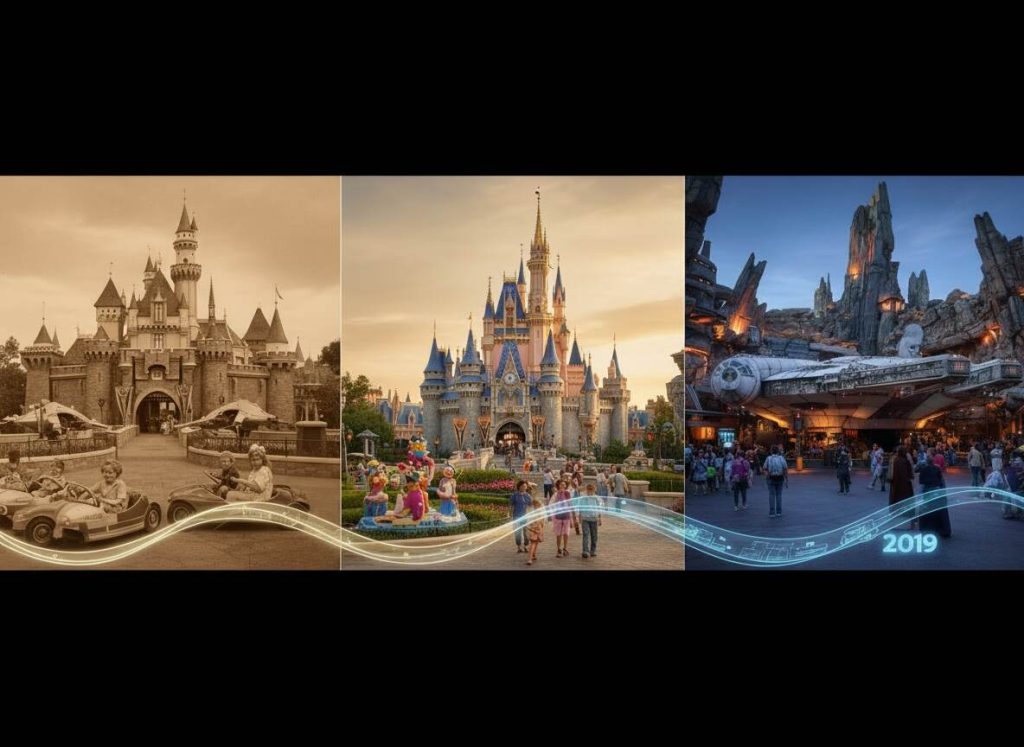
The Problem With Pre-Disney Amusement Parks
To understand Disney’s revolution, you need to understand what came before. In the early 20th century, amusement parks like Coney Island were chaotic, poorly maintained, and often dangerous. They were known for their seediness, their lack of cleanliness, and their association with vice. Parents didn’t want to take their families to these places. The rides were often unsafe, the grounds were littered, and the atmosphere was rowdy and unpredictable.
Amusement parks were also fragmented. Each attraction was independent, with no cohesive theme or narrative. You’d have a roller coaster next to a freak show next to a gambling den. There was no story, no immersion, and no sense of being transported to another world.
This was the landscape Walt Disney entered when he decided to build Disneyland. And he fundamentally rejected everything that had come before.
Disneyland: A Completely New Concept
When Disneyland opened on July 17, 1955, it wasn’t just a new amusement park—it was a completely new category of entertainment. Walt Disney called it a “theme park,” and that term would define an entire industry.
Disneyland was designed to be family-friendly, clean, safe, and immersive. Every detail was carefully considered. The park was divided into themed lands—Adventureland, Frontierland, Fantasyland, and Tomorrowland—each with its own distinct aesthetic, attractions, and story. When you walked into Adventureland, you weren’t just seeing jungle-themed decorations; you were transported to an exotic jungle world. The theming was comprehensive and immersive.
Disney also introduced the concept of a “vacation destination.” Before Disneyland, amusement parks were day trips. You’d go for a few hours and leave. But Disney envisioned Disneyland as a place where families would spend entire days, where they’d stay in nearby hotels, where they’d eat meals, buy souvenirs, and create lasting memories. This was revolutionary.
The park was also meticulously maintained. Disney understood that cleanliness and safety were paramount. He hired staff to constantly clean the park, maintain the attractions, and ensure that guests felt safe and comfortable. This was a stark contrast to the dirty, dangerous parks that had come before.
The Omnimover: A Technological Revolution
One of Disney’s most important innovations was the Omnimover system, which debuted with the Haunted Mansion in 1969. This ride system allowed Disney to move large numbers of guests through an attraction continuously, without stopping. The Omnimover was a technological breakthrough that solved a major problem in theme park design: how to move large crowds through attractions efficiently while maintaining immersion.
The Omnimover system became a template for countless other attractions. Modern dark rides, from Pirates of the Caribbean to Jungle Cruise to Haunted Mansion, all use variations of this system. The technology allowed Disney to create attractions that were both efficient and immersive—a combination that had never been achieved before.
Immersive Storytelling and Theming
Disney didn’t just build attractions; he created immersive stories. Every land, every attraction, every detail was part of a larger narrative. When you rode Splash Mountain (now reimagined as Tiana’s Bayou Adventure), you weren’t just experiencing a water ride; you were part of a story set in the American South. When you walked through Fantasyland, you weren’t just seeing decorations; you were stepping into a fairy tale world.
This approach to immersive storytelling became the gold standard for theme parks worldwide. Every major theme park that came after Disneyland adopted Disney’s philosophy of comprehensive theming and narrative integration. Universal, Cedar Point, and other parks all learned from Disney’s approach and incorporated immersive storytelling into their own designs.
The level of detail in Disney parks is legendary. Imagineers—Disney’s creative team—obsess over every detail, from the architecture to the landscaping to the music to the smell of the air. This attention to detail creates an atmosphere of immersion that’s difficult to replicate.
The Integration of Intellectual Property
Disney understood something that other park operators didn’t: intellectual property is valuable. Disney didn’t just build generic themed lands; it built lands based on its own characters and stories. Fantasyland was built around Disney’s animated films. Tomorrowland was built around Disney’s vision of the future. Later, lands like Star Wars: Galaxy’s Edge and Pandora—The World of Avatar were built around Disney’s most valuable intellectual properties.
This integration of IP with theme park design became a defining characteristic of Disney parks. By building attractions around beloved characters and stories, Disney created an emotional connection that generic themed lands couldn’t match. Guests didn’t just come to Disneyland to ride attractions; they came to step into the worlds of their favorite stories.
This strategy also created a powerful feedback loop. Disney’s movies promoted the theme parks, and the theme parks promoted the movies. A family would watch a Disney movie, become excited about visiting the theme park, spend money at the park, buy merchandise, and then go home and buy the movie on home video. This integrated approach to entertainment and merchandising was revolutionary.
The Business Model: Vacation Destination
Before Disneyland, amusement parks were not vacation destinations. They were day trips. But Disney envisioned Disneyland as the centerpiece of a complete vacation experience. Guests would stay in hotels, eat meals, buy souvenirs, and spend multiple days in the park. This required a completely different business model.
Disney built hotels, restaurants, and retail shops. He created a comprehensive vacation experience where guests could spend a week and never leave the Disney ecosystem. This model was so successful that it became the standard for major theme parks worldwide. Today, theme park resorts like Walt Disney World, Universal Orlando, and others are designed as complete vacation destinations with hotels, restaurants, shopping, and entertainment.
The financial impact of this model cannot be overstated. By creating a complete vacation destination, Disney was able to capture far more of the guest’s spending than traditional amusement parks. Guests didn’t just pay for park admission; they paid for hotels, meals, merchandise, and entertainment. This multiplied Disney’s revenue and made theme parks far more profitable than traditional amusement parks.
Safety and Cleanliness Standards
Disney established new standards for safety and cleanliness in amusement parks. Before Disneyland, amusement parks were often dirty and unsafe. But Disney understood that families would only visit if they felt safe and comfortable. He implemented rigorous safety standards, regular maintenance schedules, and comprehensive cleaning protocols.
These standards became the norm for the industry. Today, all major theme parks maintain high standards of safety and cleanliness, largely because Disney established the expectation that theme parks should be safe and clean. This was a fundamental shift in how the industry operated.
Guest Experience and Operations
Disney also revolutionized how theme parks operated. He understood crowd psychology and designed the park to manage crowds efficiently. He created systems for moving guests through the park, managing wait times, and maximizing the number of guests who could experience attractions.
Disney also pioneered the concept of “guest experience.” Every interaction with staff, every detail of the park, every aspect of the visit was designed to create a positive experience. This focus on guest experience became a defining characteristic of Disney parks and influenced how other parks operated.
The Influence on the Industry
Disney’s influence on the theme park industry cannot be overstated. Every major theme park that came after Disneyland was influenced by Disney’s approach. Universal Studios adopted Disney’s philosophy of immersive theming and IP integration. Cedar Point, while focused on roller coasters, also adopted Disney’s standards for cleanliness and guest experience. Regional parks and international parks all learned from Disney’s model.
The financial success of Disney parks also influenced the industry. As Disney parks became more and more profitable, other companies invested in building their own theme parks. The theme park industry grew exponentially, largely because Disney proved that theme parks could be incredibly profitable.
The Global Expansion
Disney didn’t stop with Disneyland. The company expanded to Florida with Walt Disney World, which opened in 1971. This was an even more ambitious project than Disneyland, with multiple parks, hotels, and attractions. Walt Disney World became the most visited vacation destination in the world.
Disney then expanded internationally, opening parks in Tokyo, Paris, Hong Kong, and Shanghai. Each park adapted Disney’s model to local cultures and preferences, but the core philosophy remained the same: immersive storytelling, comprehensive theming, and a complete vacation experience.
The global expansion of Disney parks demonstrated the universal appeal of Disney’s model. People around the world wanted to experience immersive, themed entertainment. Disney’s approach transcended cultural boundaries and became a global phenomenon.
The Modern Era: Technology and Innovation
Disney continues to innovate and push the boundaries of what’s possible in theme parks. Recent attractions like Star Wars: Rise of the Resistance and Guardians of the Galaxy: Cosmic Rewind represent the cutting edge of theme park technology and storytelling. These attractions combine advanced animatronics, projection mapping, motion simulation, and immersive environments to create experiences that are genuinely groundbreaking.
Disney’s investment in technology and innovation has kept the company at the forefront of the industry. While other parks struggle to compete, Disney continues to invest billions in new attractions and experiences that push the boundaries of what’s possible.
The Verdict: Disney’s Lasting Impact
Disney changed theme parks in fundamental ways. He transformed amusement parks from disreputable day-trip destinations into family-friendly vacation destinations. He pioneered immersive storytelling and comprehensive theming. He created a business model that integrated hotels, restaurants, retail, and entertainment. He established standards for safety, cleanliness, and guest experience. He demonstrated the value of intellectual property in theme park design. And he proved that theme parks could be incredibly profitable.
Every theme park that exists today was influenced by Disney’s innovations. The immersive lands, the detailed theming, the focus on guest experience, the integration of IP, the comprehensive vacation model—these are all Disney’s legacy.
Walt Disney didn’t just build a theme park. He invented an entirely new form of entertainment that has shaped how millions of people spend their vacations and create memories. He transformed amusement parks from disreputable places into beloved destinations. He proved that entertainment could be both profitable and meaningful.
That’s how Disney changed theme parks. And the impact of that change continues to reverberate through the industry today.
