If you are visiting a theme park with a baby, toddler, or a kid who is not ready for bigger rides, you run into the same problem over and over: you either split up and one adult misses the ride, or you wait in the same line twice.
Rider swap exists to fix that.
Rider swap (also called child swap, rider switch, or parent swap) is a free system many theme parks use to let adults take turns riding while someone stays with the non-rider. The point is simple: your group only does the main wait once, and everyone who wants to ride still gets a turn.
This guide explains rider swap in a way that actually helps in the real world: what it is, how it usually works, the rules that surprise people, and the strategies that keep your day from turning into a stroller-and-meltdown marathon.
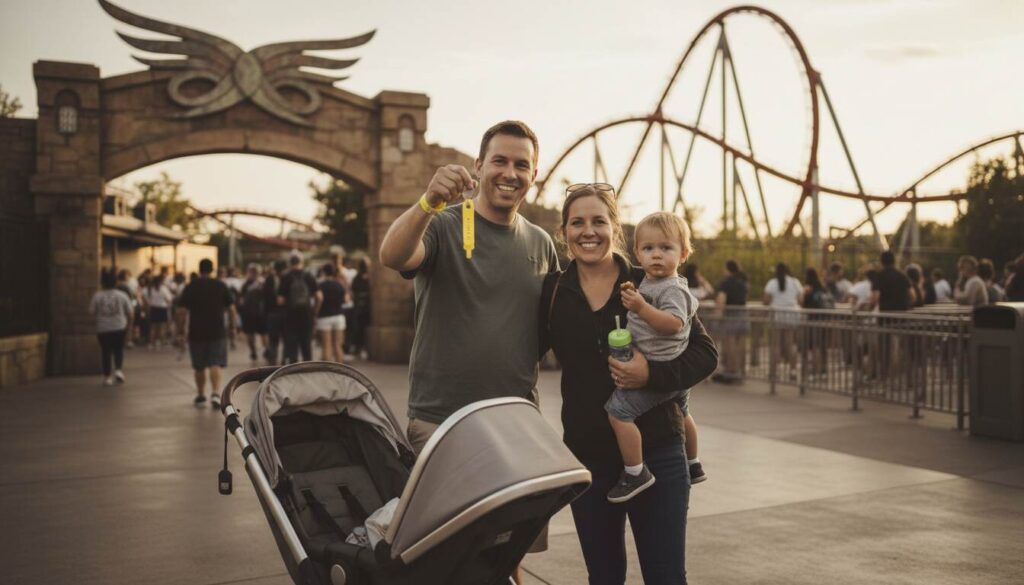
What Rider Swap (Child Swap) Means
Rider swap is a guest service that lets your group split into two parties for an attraction:
- Party A rides first while Party B waits with the non-rider(s).
- When Party A finishes, Party B gets to ride without waiting in the standard line again.
It is most commonly used when a child is too short to ride, too scared to ride, asleep in the stroller, or just not interested. It can also apply when someone in your group cannot ride due to sensory needs, motion sensitivity, pregnancy, anxiety, or other personal reasons. The core requirement is the same: there is a legitimate non-rider in your party.
If you are dealing with a height restriction question specifically, you may also want to read Can Infants Ride Roller Coasters? so you have a realistic baseline for what “kid-friendly” actually means at most parks.
The Basic Rider Swap Flow (Works At Most Parks)
Every park has its own terminology and its own mechanics, but the flow is usually consistent:
- Confirm the attraction offers rider swap. Not every ride participates.
- Bring your full group to the attraction entrance. Many parks want everyone present when you request it, including the non-rider.
- Tell the employee you want rider swap. Use the exact phrase “rider swap” or “child swap” and they will know what you mean.
- Split into Party A and Party B. Party A enters the queue and rides. Party B waits outside the queue with the non-rider.
- Swap when Party A is done. Party B returns to the designated point and rides using the rider swap process for that attraction.
Some parks do this with a digital scan, some with a paper pass, and some simply direct you to a specific entrance when it is time. The details vary, but the strategy stays the same.
If you want an official example of how this works in practice, Disney explains the process on their Rider Switch page, including how the second party is handled after the first party rides.
What Rider Swap Is Not (So You Don’t Get Side-Eyed At The Entrance)
Rider swap is not a “hack” to skip lines. It is a family logistics tool for groups with a non-rider.
- It is not a replacement for Express, Lightning Lane, or other paid line products. Rider swap is separate.
- It does not override ride restrictions. Height, health warnings, loose article rules, and restraint requirements still apply.
- It is not guaranteed on every attraction. Some rides have no practical way to do it, especially smaller attractions.
If you approach it as “we have a non-rider and we want to take turns,” you will almost always have a smooth interaction. If you approach it like a loophole, you are more likely to get a hard no.
Also, rider swap does not change the reality that some rides are just intense. If someone in your group is anxious about coasters in general, Overcome Roller Coaster Phobia is a better starting point than forcing a “we waited, so you have to ride” moment.
The Rules That Surprise People (Common Across Many Parks)
These are the rider swap details that cause the most confusion, because people assume the system works like it does at their home park.
The Non-Rider Often Has To Be Present When You Request It
Many parks want to see the child or non-rider at the entrance when you ask for rider swap. This is partly fairness and partly logistics. It prevents someone from sending one adult to request rider swap while the rest of the group is somewhere else.
There Is Often A Limit On How Many People Can Ride In Party B
Some parks allow the waiting adult plus one or two additional riders in the second group. This is the “re-ride” magic that makes rider swap feel worth it, because an older child can ride twice, once with each adult.
Disney’s published Rider Switch instructions, for example, note that after Party A rides, up to two people from Party B may ride using Rider Switch (details on the official Rider Switch page).
Rider Swap Is Usually Ride-By-Ride, Not A Park-Wide Pass
Even when a park has a formal rider swap program, the exact process can vary by attraction. The ride entrance team is the source of truth for what happens on that ride on that day.
Sometimes Party A Waits The Main Line, Sometimes Everyone Enters Together
Disney’s published Rider Switch description says one party waits outside the queue while the remainder waits in the queue. Other parks sometimes have both parties enter and split later, depending on how the queue is built. Always ask what the process is at that attraction.
How To Use Rider Swap Smoothly (The “No Drama” Strategy)
Decide Your Parties Before You Walk Up
Do this while you are still approaching the ride entrance:
- Who is riding first (Party A)?
- Who is waiting with the non-rider (Party B)?
- If the park allows a re-ride buddy, who is that person?
This matters because some systems involve scanning tickets or confirming names. If you are changing your mind at the entrance, it slows everything down.
Use Rider Swap On The Longest Waits First
Rider swap saves the most time when the standby line is long. If a ride is a walk-on, it may be faster to simply take turns normally.
If you are trying to reduce time spent in lines overall, it also helps to plan your day around crowd patterns. Your crowd-calendar guides like Best Time To Visit Universal Orlando (2026 Crowd Calendar) can pair really well with rider swap strategy, because rider swap works best when you are not doing it during the worst peak waits.
Keep Party B Close (Do A “Non-Rider Loop”)
The biggest rider swap fail is when Party A exits and Party B is nowhere to be found. The fix is a simple “non-rider loop” that stays close to the attraction:
- Bathroom break
- Water refill
- Snack
- Shade break
- A nearby low-commitment attraction only if it is truly next door
Think of it like this: Party B is not “killing time.” Party B is staying regulated and ready.
Text When You Are Almost Off The Ride
If your group is splitting up, agree on one simple communication rule: Party A texts Party B when they are close to boarding or close to exiting (depending on the ride). That gives Party B time to pack up the stroller, finish the snack, and move toward the swap point without rushing.
Rider Swap With Babies And Toddlers (What Actually Works)
Rider swap is most valuable with babies and toddlers, because they cannot ride many attractions and they also cannot “just wait” calmly for long stretches.
Do A Height Check Early, Before You Commit
If your child is borderline for a height requirement, check early in the day. Many parks have height check stations, and ride entrances always have the posted requirement. It is emotionally easier to pivot at 10:15 a.m. than after a 70 minute line.
Bring A Tiny “Swap Kit” So You Are Not Digging Through The Backpack
- One non-messy snack
- Water
- Wipes
- One comfort item (small, replaceable)
- Cooling towel or portable fan in hot weather
Party B’s job is not just “wait.” Party B’s job is “keep the non-rider okay.” A swap kit makes that possible.
Plan Your Swap Around Nap And Heat
If your toddler naps in the stroller, rider swap can be perfect. One adult rides while the other keeps the stroller moving in shade. But if it is peak heat and your toddler is already fried, rider swap can backfire because it locks you into a long wait window.
In other words: rider swap is a tool, not a requirement. If the non-rider is not doing well, it is okay to skip the big ride and come back later.
Rider Swap For Sensory Needs, Anxiety, And Motion Sensitivity
Not every non-rider is a toddler. Sometimes the non-rider is a teen or adult who wants to be part of the day but cannot handle certain rides.
Rider swap can still help, because it keeps the group together and reduces the “either you ride alone or you miss it” problem.
- Use simple language at the entrance. “We have a non-rider and need rider swap” is usually enough.
- Ask about the waiting area. If the non-rider needs a calmer spot, ask if there is a quieter place to wait nearby.
- Remember rider swap is not the same as disability accommodations. Many parks also have separate accessibility services. Rider swap is specifically about taking turns riding when someone is not riding.
If the non-rider is pregnant, it can help to ground the decision in safety reality (not vibes). Your guide Roller Coasters And Pregnancy Safety pairs well with rider swap planning, because it helps groups avoid last-minute arguments at the ride entrance.
For a general example of how parks talk about accessibility and guest needs, you can also reference IAAPA’s discussion of accessibility in the attractions industry as a high-authority, industry-level resource.
Common Rider Swap Mistakes (And How To Avoid Them)
- Mistake: Sending Party A into the queue before asking about rider swap. Fix: Ask at the entrance first, with your full group present.
- Mistake: Assuming every ride offers it. Fix: Confirm on a ride-by-ride basis.
- Mistake: Not deciding who rides in Party B. Fix: Decide your re-ride buddy before any scanning or instructions.
- Mistake: Wandering too far while waiting. Fix: Keep your non-rider loop close and boring on purpose.
- Mistake: Treating rider swap like a loophole. Fix: Use it only when you truly have a non-rider.
FAQ: Rider Swap And Child Swap
Do We All Wait In Line Together?
Sometimes. Some parks have one party wait outside the queue while the other waits in the queue. Other parks may have you enter together and split later. Always ask the employee at the entrance what the process is for that attraction.
Does The Child Have To Be Present To Get Rider Swap?
Often, yes. Many parks require the non-rider to be present when you request rider swap. It helps prevent misuse and keeps the system fair.
How Many People Can Ride In The Second Group?
It depends on the park and the ride. Disney’s published Rider Switch instructions note that after Party A rides, up to two people from Party B may ride. Other parks may allow the waiting adult plus one additional rider, sometimes two. Confirm at the entrance.
Can My Older Kid Ride Twice?
Often, yes. Many rider swap systems allow one or more riders from the first group to ride again with the second adult, as long as it stays within the attraction’s rider swap limits.
Can We Use Rider Swap If My Child Is Tall Enough But Too Scared?
Many parks still allow rider swap when a child chooses not to ride, but it can vary by attraction. Ask at the entrance and be ready to pivot if the answer is no for that ride.
Is Rider Swap The Same As A Skip-The-Line Pass?
No. Rider swap is meant to prevent your group from waiting in the standard line twice when you have a non-rider. It is not designed to replace paid line skipping products.
Quick Rider Swap Checklist
- Confirm rider swap is available for that attraction
- Bring your full group to the entrance, including the non-rider
- Ask where the swap happens and what you need to scan or show
- Decide Party A, Party B, and any re-ride buddy before you start
- Keep Party B close so the swap is fast and calm
Used well, rider swap is one of the best family planning tools in any theme park. It turns “we can’t do big rides this trip” into “we can, we just need a system.”

Leave a Reply