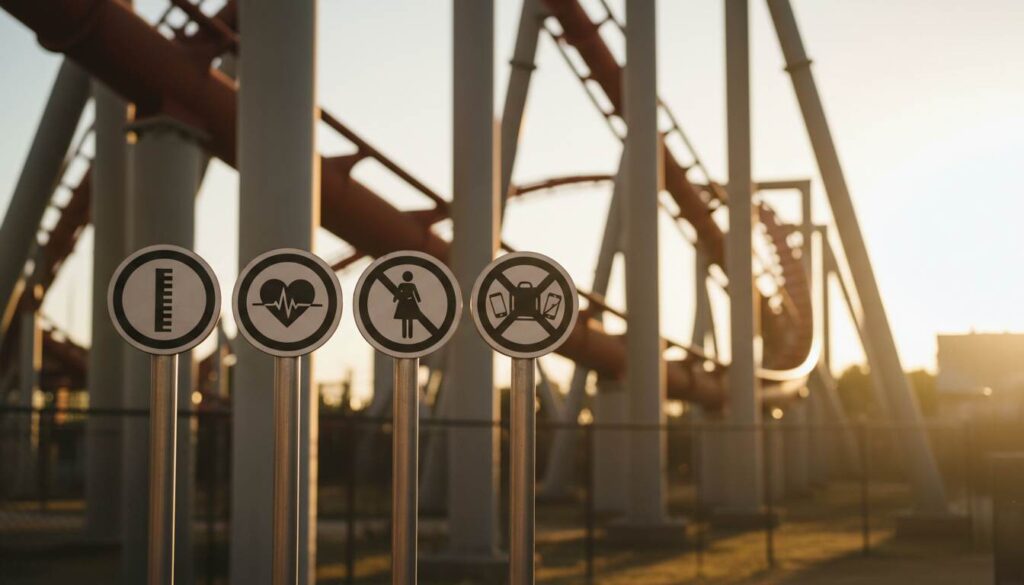
Theme park warning signs look simple: a height number, a few icons, a list of medical conditions, a blunt “no loose articles” line. But those signs are doing a lot of work at once. They are trying to translate engineering limits, human behavior, and emergency planning into something you can understand in about three seconds, often in a second language, often while you are excited, distracted, and moving.
This guide is a “safety translator.” It explains what the most common ride signs are actually telling you, why the wording can feel vague or overly strict, and how to make a smart decision fast without spiraling into fear. I’m also going to myth-bust a little, because some warnings are misunderstood so consistently that they’ve basically become theme park folklore.
One important note up front: this is not medical advice. Parks are not diagnosing you either. They are warning you about categories of risk. Your job is to decide whether those risks apply to you today.
The One Sentence Rule For Understanding Any Ride Sign
If you remember nothing else, remember this:
A ride warning sign is not a moral judgment. It is a risk-control tool.
Every line on that sign exists because the park is trying to prevent one of these outcomes:
- Restraint mismatch (you cannot be held securely in the designed riding position)
- Clearance strikes (a body part or object can hit something it should not)
- Force intolerance (the ride’s acceleration, vibration, or restraint pressure can worsen a condition)
- Unsafe behavior (standing, filming, reaching, switching seats, ignoring instructions)
- Evacuation problems (if the ride stops, can you safely get out and move where staff need you to move)
Once you know which bucket a warning belongs to, the sign stops feeling random. It becomes readable.
Why Ride Signs Are Often Vague (And Why That’s On Purpose)
Guests usually assume signage is vague because parks are lazy. In reality, it’s vague because parks are trying to communicate in a way that is:
- Fast (you are not going to read a wall of text in a queue)
- Universal (icons and short phrases work across languages)
- Legally defensible (they need to show they warned you about known categories of risk)
- Medically non-specific (they cannot tell you what your body can tolerate)
- Operationally consistent (the same ride model can be installed in different parks with different policies)
This is also why you will sometimes see “not recommended for” instead of “do not ride.” In plain English, “not recommended” still means “there is a meaningful risk here.” It often means the park is warning you without pretending they can judge your individual medical situation.
Globally, you’ll also see differences in style. Some regions lean heavily on pictograms. Some parks list a long set of conditions. Some keep it short and rely on staff to do verbal checks. The risks are similar. The communication style changes.
How To Read A Sign In The Real World (A 20-Second Method)
Here is a practical method you can use while walking up to an attraction:
- Step 1: Identify the sign type. Is this a height/fit sign, a health warning, a behavior rule, or an accessibility/evacuation notice?
- Step 2: Translate it into one risk sentence. Example: “No loose articles” really means “objects can become projectiles or cause a shutdown.”
- Step 3: Ask one targeted question if you are unsure. Not “is it safe,” but “does this ride have inversions,” “is there a test seat,” “is evacuation stairs required,” “are phones allowed in zip pockets.”
- Step 4: Decide early. The safest time to opt out is before you are locked into the station and embarrassed.
If you tend to get anxious, this method helps because it gives your brain a job. You are not catastrophizing, you are translating.
Height Signs (And Why They Matter More Than People Think)
Height restrictions are not about age. They are about geometry and physics.
Minimum Height
What it really means: “Below this height, the restraint may not contact the right parts of the body in the right way, and the guest may be able to slip into a dangerous position.”
Minimum height is usually about one or more of these:
- Restraint fit (lap bar, shoulder harness, seatbelt routing)
- Body control (ability to stay seated upright, hold posture, keep limbs inside)
- Clearance envelope (where legs, arms, and head sit relative to the vehicle)
Global note: You may see inches (US) or centimeters/meters (most other places). Parks often round. A “1.20 m” sign is not always exactly the same as “48 inches.” If your child is right on the edge, measure with shoes on and accept that staff will use the park’s measuring stick, not your memory.
Maximum Height
What it really means: “Above this height, your legs, head, or arms may be in a clearance zone where contact is possible, or the restraint may not close correctly.”
Maximum height is less common, but you’ll see it on:
- some enclosed dark rides with tight vehicles
- some older coasters with smaller trains
- some transport rides with low clearance areas
“Must Fit Securely In Restraint” And Test Seats
This is one of the most emotionally loaded signs in any park, because it can feel personal. It is not personal. It is mechanical.
What it really means: “The restraint must lock within a specific range to function as designed. If it cannot lock, you cannot ride.”
Why parks use test seats:
- to avoid repeated station delays
- to reduce embarrassment at the platform
- to prevent unsafe “let’s just try to force it” situations
Myth-bust: A test seat is not a “fat check.” It is a restraint-lock check. People of many body types can fail a test seat depending on where they carry weight, torso length, shoulder width, thigh shape, and flexibility. Some very tall, muscular, or broad-shouldered guests fail shoulder harnesses. Some smaller guests fail if they cannot sit in the required posture.
If you want the most practical advice: use the test seat early, and if you are close, ask whether there is a specific row or seat that fits differently. Some rides have slightly different seats, but staff will only offer that if the park’s policy allows it.
Health Warning Signs (The “Laundry List” That Scares Everyone)
Health warnings are the hardest to read because they combine real risk with broad language. The key is to translate the condition list into “what kind of stress does this ride create.”
Most health warnings exist because of one or more of these ride characteristics:
- High acceleration (launches, sudden starts, sudden stops)
- High “jerk” (rapid changes in acceleration, common on some older rides and some intense coasters)
- Vibration and rattling (older wooden coasters, some older steel coasters, some flat rides)
- Restraint pressure (tight lap bars, shoulder harness pressure, restraint locking force)
- Inversions and disorientation (loops, rolls, intense spinning)
- Head movement risk (rides where your head can whip side-to-side)
Heart Conditions And High Blood Pressure
What the sign really means: “This ride can cause a spike in heart rate and blood pressure, and it can create sudden stress that is unsafe for some cardiovascular conditions.”
Why the warning is broad:
- people have undiagnosed heart issues
- medications change tolerance
- panic responses can mimic cardiac symptoms
Practical translation: if a ride has a launch, a big drop, intense sustained forces, or a tight restraint, the park is warning you that your cardiovascular system is going to feel it.
Back And Neck Problems
What the sign really means: “This ride can compress your spine, snap your head, or repeatedly jolt your body.”
This warning is common on:
- older wooden coasters and rougher rides
- coasters with strong lateral forces
- flat rides with rapid direction changes
- rides with over-the-shoulder restraints where headbanging can happen
If you have a sensitive neck, one of the best questions you can ask is: “Is this ride smooth or does it whip your head around.” Staff will often answer honestly, because they have heard it a thousand times.
Pregnancy
What the sign really means: “We cannot ethically or legally take responsibility for the risk of jostling, restraint pressure, falls, or sudden force changes during pregnancy.”
This warning is nearly universal, globally, even on rides that look mild. It is about:
- sudden force changes
- abdominal restraint pressure
- unpredictable stops
- slip and fall risk during boarding and unloading
If you want a deeper dive on this topic, here is the dedicated post: Roller Coasters And Pregnancy Safety.
Motion Sickness, Vertigo, Migraines, And Seizures
What the sign really means: “This ride can overwhelm your balance system or visual processing, and it may include flashing lights or intense spinning.”
Common triggers include:
- spinning rides (teacups, rotors, some pendulums)
- screen-based rides (motion simulation)
- dark rides with strobes
- coasters with rapid transitions and inversions
If you are migraine-prone, the “warning sign” you should look for is not always medical text. It is the combination of darkness, screens, and flashing effects. Some parks post separate warnings for strobes, but not all do.
Recent Surgery, Injuries, Casts, And “Do Not Ride If You Have A Medical Condition”
What it really means: “If something is healing, unstable, or painful, this ride can make it worse, and an emergency stop or evacuation could be physically demanding.”
People underestimate the evacuation part. If a ride stops, you may need to:
- climb stairs
- step over gaps
- walk on narrow catwalks
- move quickly when staff instruct you
If you want to understand why parks emphasize evacuation readiness, this post helps: What Happens If A Roller Coaster Gets Stuck?.
“Not Recommended For Guests With Anxiety” (Rare, But Real)
Some rides (especially intense enclosed experiences) will warn about claustrophobia, panic, or intense sensory effects.
What it really means: “If you panic, you may try to exit, fight restraints, or be unable to follow instructions, which creates a safety problem for you and for staff.”
This is where the myth-busting needs to be blunt: if you are actively panicking, the safest choice is to step out before dispatch. That is not weakness. That is good judgment.
If you want a supportive, practical approach to fear, this post pairs well: Overcome Roller Coaster Phobia.
Loose Articles Signs (Phones, Hats, Glasses, And The “Why Are They So Strict” Question)
Loose articles rules have gotten stricter worldwide for one reason: phones.
What “No Loose Articles” really means: “Anything that can leave your body can become a projectile, injure someone, damage the ride, or force a shutdown.”
Loose articles are not just a “you might lose your hat” issue. They are a “someone below you could take a phone to the face” issue.
“Secure All Loose Articles” Vs “No Loose Articles”
These phrases are not the same.
- Secure all loose articles usually means zip pockets, buttoned pockets, or tight storage may be acceptable.
- No loose articles usually means nothing in pockets, even zip pockets, because the ride’s forces or inversions make ejection likely.
If lockers are mandatory, it usually means the park has had repeated incidents or the ride manufacturer/operator policy is strict for that model.
Glasses And Hats
What “remove glasses” really means: “Wind and acceleration can pull them off, and then they become a projectile.”
Some parks allow glasses with a strap. Some do not. If you see “no glasses,” assume the ride has enough wind or enough head movement that straps are not considered reliable.
Filming, Cameras, And Selfie Sticks
What “no filming” really means: “Holding an object changes your riding posture, increases the chance you will reach out, and increases the chance you will drop something.”
Selfie sticks are usually banned because they extend into clearance zones. Even if you think you can control it, the ride does not care about your confidence. It cares about geometry.
Accessibility And Rider Eligibility Signs (The Ones People Misread The Most)
Accessibility signage is often misunderstood as “the park is being unfair.” In reality, much of it is about evacuation and restraint function.
“Must Transfer Independently”
What it really means: “In normal operation and in an emergency, staff cannot safely lift you. You must be able to move from your mobility device into the ride seat with limited assistance.”
This is not a judgment about worthiness. It is a staffing and safety reality. Evacuations can involve narrow walkways, stairs, and time pressure.
“Must Be Able To Maintain Upright Position” Or “Must Have Upper Body Control”
What it really means: “This ride’s restraint assumes you can hold posture. If you cannot, you may slump into a dangerous position.”
This often appears on rides with:
- lap bars without additional upper-body support
- seats that require bracing
- rides with sudden starts and stops
Service Animals
Policies vary globally and even park-to-park. Most rides will not allow service animals on the ride vehicle for obvious reasons. Many parks have specific waiting areas or alternate procedures. If you see signage about service animals, it is usually about keeping the animal safe, not excluding the guest.
Queue And Platform Signs (The “Operator Control” Layer)
These signs are less about your body and more about keeping the loading area safe and predictable.
“Wait For Attendant”
What it really means: “The platform is a controlled hazard zone. If you move early, you can be in the wrong place when gates open, vehicles move, or restraints are checked.”
“Do Not Cross Gates” And “Keep Clear Of Closing Gates”
What it really means: “Pinch points and timing hazards exist here.”
Many ride incidents are not about the ride itself, they are about loading and unloading. Gates, moving platforms, and dispatch timing are where parks need strict compliance.
Seat Assignment Rules
Sometimes you will see signs about where children can sit, where larger groups should sit, or which row is reserved for accessibility needs.
What it really means: “The ride’s operation depends on predictable loading, and sometimes weight distribution matters.”
On some rides, row assignment is also about restraint type. Some rows may have modified seats.
On-Ride Behavior Signs (What They’re Actually Preventing)
On-ride rules are the ones people roll their eyes at, right up until they see a ride stop because someone tried to retrieve a hat mid-course. These signs exist because the ride is designed around one assumption: you will stay in the intended riding position for the entire cycle.
“Keep Hands, Arms, Feet, And Legs Inside The Vehicle At All Times”
What it really means: “There are clearance zones where your body can be struck.”
This warning shows up on everything from coasters to dark rides to transport rides because clearance issues are universal. Even if you do not see anything close to you, you are moving through a space that was engineered with the assumption that your limbs stay inside the envelope of the seat and restraint.
Myth-bust: “It’s fine if I just put my hand out for a second” is one of the most common unsafe thoughts in parks. The problem is not the second. The problem is that you cannot predict when the ride will turn, dip, brake, or pass a structure.
“Remain Seated” And “Do Not Stand Up”
What it really means: “Standing changes your center of gravity and can defeat the restraint system.”
Even on rides that feel slow, standing can cause you to shift into a position the restraint was not designed to hold. It also increases fall risk during stops and unload.
“Do Not Unbuckle Seatbelt / Do Not Tamper With Restraints”
What it really means: “The restraint is part of a system. If you change it, you can create an ejection risk and force an emergency stop.”
Many rides have sensors that detect restraint position. Tampering can trigger a shutdown. A shutdown is not just inconvenient. It can create a complicated evacuation scenario, especially on coasters and elevated rides.
“Keep Head Back”
What it really means: “Your head can snap forward or sideways during acceleration, braking, or transitions.”
This is common on rides with:
- launches
- hard braking
- rougher track profiles
- over-the-shoulder restraints where head movement can create impacts
If you have any neck sensitivity, “keep head back” is a clue that the ride has moments where your head wants to move in ways you may not love.
“No Eating Or Drinking”
What it really means: “Choking risk, spill risk, and cleanup risk.”
This is not just about keeping the ride clean. It is about preventing choking during sudden movement and preventing liquids from creating slip hazards on platforms and vehicles.
Water Ride Signs (It’s Not Just About Getting Wet)
Water ride signage often looks playful, but the risks are real and surprisingly practical.
“You May Get Wet” Vs “You Will Get Wet”
What it really means: “Expect unpredictable water exposure.”
“May” usually means the splash varies by boat weight, wind, where you sit, and how the ride is running that day. “Will” usually means you should assume you are leaving soaked, not misted.
That matters because being wet changes your day in ways people don’t plan for:
- wet shoes increase blister risk and slip risk
- wet clothing can cause chill in cooler weather
- wet phones and medical devices are a real problem
Footwear Warnings
What it really means: “Slip risk is higher here.”
Water rides create wet platforms. Wet platforms plus flip-flops plus stairs is a classic injury recipe. If a water ride sign tells you to secure footwear or avoid loose shoes, take it seriously.
“Remain Seated” On Water Rides
What it really means: “Boat movement is unpredictable, and standing increases fall risk.”
Even if the ride looks calm, the boat can bump, shift, or stop abruptly. Water rides also have unique evacuation challenges. If a boat stops in a channel, staff procedures matter a lot.
Transport Ride Signs (Monorails, Trains, Sky Rides, Ferries)
Transport rides are often treated like “not real rides,” which is exactly why signage matters. People drop their guard. The ride still has moving parts, pinch points, and evacuation realities.
“Hold Children’s Hands” And “Keep Children Seated”
What it really means: “Open sides, gaps, and movement create fall risk.”
On trains and open-air vehicles, kids can lean. On some systems, doors and gates can close with force. The sign is telling you that the environment is not forgiving.
“Do Not Rock The Cabin” (Common On Sky Rides)
What it really means: “Sway is normal, but intentional rocking increases risk and can trigger an emergency stop.”
Sky rides are sensitive to wind. You will often see weather-related notices because wind changes the system’s safe operating envelope.
Weather Shutdown Notices
What it really means: “This system has environmental limits.”
Lightning, wind, and heavy rain can trigger shutdowns. This is not the park being dramatic. It is the park following safety thresholds.
“Not Recommended” Vs “Do Not Ride” (How To Interpret The Language)
Globally, you’ll see a spectrum of warning language. Here’s the plain-English translation.
| Sign Wording | What It Usually Means In Practice | How To Treat It |
|---|---|---|
| Do Not Ride If… | The park is drawing a hard line for safety and liability reasons. | Treat as a firm restriction. |
| Not Recommended For… | The park is warning you about meaningful risk but cannot assess your individual situation. | Treat as serious. If it applies to you, pause and decide intentionally. |
| Guests With (Condition) Should Consult A Physician | The park is acknowledging risk but pushing the decision to medical guidance. | If you already know you’re in a risk category, assume the ride may not be a good idea without clearance. |
| Must Be Able To… (transfer, brace, maintain posture) | The ride and evacuation procedures assume certain physical abilities. | Treat as an operational requirement, not a suggestion. |
Myth-bust: “Not recommended” does not mean “basically fine.” It means “we are warning you, and we want it documented that we warned you.”
Common Warning Icons And What They Usually Mean
Pictograms exist because parks are multilingual environments. But icons can also be inconsistent across parks. Here are the ones you’ll see most often, and what they typically imply.
| Icon | Common Meaning | What It’s Really Pointing To |
|---|---|---|
| Height ruler / child silhouette | Minimum or maximum height | Restraint geometry and clearance zones |
| Heart / ECG line | Heart conditions warning | Acceleration and stress response risk |
| Pregnant figure | Pregnancy warning | Force changes, restraint pressure, fall risk |
| Back / spine icon | Back/neck warning | Compression, whiplash-like movement, vibration |
| Camera with slash | No filming | Projectile risk and unsafe posture |
| Loose items / bag with slash | No bags or loose articles | Projectile risk, ride damage, shutdown risk |
| Wheelchair symbol | Accessibility info | Transfer needs, evacuation realities, restraint fit |
The “What They’re Not Saying” Part (The Subtext Of Warning Signs)
Sometimes the most useful information is what the sign implies, not what it literally says.
If A Ride Has Extremely Strict Loose Article Rules
It often implies:
- inversions or strong negative forces (the “lift out of your seat” feeling)
- high speed with open-air exposure
- a history of guest noncompliance causing shutdowns
If A Ride Has A Very Long Medical Warning List
It often implies:
- high intensity, not just “thrilling” but physically demanding
- rapid transitions, launches, or strong restraint pressure
- the park is standardizing signage across multiple rides (so it becomes a broad template)
If A Ride Emphasizes “Must Be Able To Evacuate” Or “Must Be Able To Climb Stairs”
It often implies:
- the ride is elevated
- evacuation may involve catwalks, stairs, or uneven surfaces
- the park is being honest that evacuation is physically real, not theoretical
What To Ask Staff (The Questions That Actually Get Useful Answers)
Most guests ask staff questions that are impossible to answer, like “is it safe for me.” A better approach is to ask questions about the ride’s characteristics.
- “Does this ride have inversions?” (helps with vertigo, anxiety, some medical concerns)
- “Is there a test seat?” (restraint fit)
- “Is this ride smooth or rough?” (back/neck sensitivity)
- “Do you allow items in zip pockets or is it lockers only?” (loose articles)
- “If the ride stops, is evacuation stairs required?” (mobility and confidence)
Staff usually can answer these clearly without stepping into medical advice.
When You Should Treat A Warning As A Hard Stop (Even If You Want To Push Through)
Here are a few situations where “I’ll just try it” is not a great plan:
- You cannot get the restraint to click/lock normally. Do not ask staff to force it. If it doesn’t lock in the designed range, it’s not safe.
- You are actively dizzy, faint, dehydrated, or overheated. Many ride incidents start with a guest who should have sat down and cooled off first.
- You are panicking before dispatch. Panic can lead to unsafe behavior mid-ride. Step out early and reset.
- You have a condition the sign explicitly calls out and you already know you’re not cleared for intense forces. That sign is there for a reason.
If you want a reality-based look at risk (without fear-mongering), this post adds helpful context: Roller Coaster Accidents And Safety Statistics.
How Warning Signs Connect To Restraints (And Why That Matters)
A lot of signage makes more sense once you understand restraints. “Must fit securely,” “keep head back,” “no loose articles,” “remain seated,” and many medical warnings are all downstream of restraint design.
If you want the deep dive on why restraints vary and what that implies about ride forces and movement, this is the best internal link for it: Why Roller Coasters Have Different Restraints.
A Global “Translation Table” For Common Ride Sign Phrases
This is the cheat sheet section. If you want to skim, skim here.
| What The Sign Says | What It Usually Means | What You Should Do |
|---|---|---|
| Secure All Loose Articles | Items may fly out, but some secured storage may be acceptable | Use zip pockets if allowed, otherwise use lockers |
| No Loose Articles | Even pockets may not be allowed due to intensity | Assume lockers are required |
| Remove Glasses | Wind/forces can pull them off and turn them into projectiles | Use a strap only if the park explicitly allows it |
| Must Fit Securely In Restraint | Restraint must lock within a designed range | Use the test seat early, opt out if it doesn’t lock |
| Keep Head Back | Head movement can become unsafe or painful | Brace properly, avoid if you have neck sensitivity |
| Not Recommended For Guests With Back/Neck Problems | Ride may jolt, whip, compress, or vibrate | Ask if it’s smooth, choose a milder option if needed |
| Do Not Ride If You Have Heart Conditions / High Blood Pressure | Ride can spike stress response and cardiovascular load | Take seriously, especially for launches and intense rides |
| Do Not Ride If You Are Pregnant | Force changes and restraint pressure create avoidable risk | Skip, even if the ride looks mild |
| Remain Seated Until Instructed | Platform timing and gates create hazards | Stay seated, wait for the all-clear |
| Keep Hands And Feet Inside | Clearance zones can injure you | Do not test it, keep limbs in |
The Bottom Line (A Calm, Honest Take)
Ride warning signs are not there to ruin your fun. They are there because rides are engineered systems with real limits, and parks need guests to behave in predictable ways for those systems to stay safe.
If you learn to translate the sign into the risk it’s trying to prevent, you stop feeling like the park is shouting random rules at you. You start seeing the logic. And once you see the logic, you can make better choices faster, with less anxiety and less ego involved.
The most “experienced” theme park guests are not the ones who ignore warnings. They’re the ones who can read a sign, understand what it implies, and pivot without making it a whole dramatic thing.
Extra Deep-Dive: What Warning Signs Reveal About The Ride Type
This section is for the readers who want to go beyond “follow the rules” and actually understand what the ride is telling you about itself.
If A Ride Emphasizes Loose Articles More Than Anything Else
That usually points to one of these realities:
- High speed + open exposure (wind will rip things out of pockets)
- Negative forces (moments where you feel lifted, even briefly)
- Inversions (gravity is not consistently “down”)
- Past incidents (the park learned the hard way that guests will not self-regulate)
In other words, “no loose articles” is often a more honest intensity warning than the marketing is.
If A Ride Emphasizes “Keep Head Back” Or “Keep Head Against Headrest”
That often signals:
- hard acceleration or braking
- rapid transitions (your body changes direction quickly)
- potential for head movement that can become uncomfortable or unsafe
It can also be a subtle clue that the ride is not especially forgiving if you ride “loose” (not bracing at all). Some rides want you relaxed. Some rides want you positioned and braced.
If A Ride Has A Very Specific Height Requirement (Not A Rounded Number)
When you see a very specific number, it often means the park is using a manufacturer or regulator-driven threshold rather than a rounded “easy to remember” number. It can also mean the ride’s restraint geometry is more sensitive than average.
Practical takeaway: if you are right on the edge, do not argue. Either you meet it today or you don’t. Come back when you do. The ride will still be there.
If A Ride Has A Strong Warning About “Ability To Follow Instructions”
This is common on:
- rides with moving walkways or moving platforms
- rides where loading timing is tight
- rides where evacuation requires calm compliance
What it really means: “If you freeze, panic, or refuse instructions, you can create a safety issue for yourself and for staff.”
This is also why some parks are strict about intoxication. It’s not just “behavior.” It’s compliance under pressure.
Flat Rides: Why Their Signs Can Look “Scarier” Than Coaster Signs
This surprises people: some flat rides can be more physically punishing than a lot of coasters, especially for necks, backs, and motion sickness.
Flat rides often involve:
- repeated spinning
- sustained lateral forces
- fast direction changes
- less predictable motion than a track-based coaster
So if you see a long medical warning list on a spinning ride, don’t assume it’s overkill. The ride may be short, but it can be intense in a concentrated way.
Dark Rides And Screen Rides: The Signs People Ignore (Then Regret)
Dark rides and screen-based attractions often have warnings that feel optional, because the ride looks “gentle.” But the triggers are different.
Photosensitivity And Strobe Warnings
What it really means: “Flashing effects may trigger seizures or migraines.”
Not every park posts this consistently. If you are sensitive, you should treat darkness + special effects as a sign category of its own, even if the sign is minimal.
Motion Simulation Warnings
What it really means: “Your eyes and inner ear may disagree, and that can cause nausea, dizziness, or panic.”
These rides can also be rough on people with certain vestibular disorders. If you’ve ever gotten sick from VR, treat simulator warnings as serious.
Weather And Operational Signs (Why “Temporarily Closed” Is Sometimes A Safety Message)
Some signage is not about you at all. It’s about the ride’s operating envelope.
Common examples:
- wind limits (especially for sky rides and tall structures)
- lightning policies (tall rides, open areas, transport systems)
- temperature limits (some rides have performance thresholds)
Guests sometimes interpret weather closures as “the park being dramatic.” In reality, these are often hard thresholds tied to engineering, manufacturer guidance, and risk management.
How To Use Warning Signs To Plan Your Day (Not Just Survive The Queue)
Once you can read signs, you can use them strategically.
If You Get Motion Sick
Use signage to build a “safe sequence”:
- start with non-spinning rides
- avoid stacking multiple intense spinning/simulator rides back-to-back
- watch for warnings about dizziness, nausea, or disorientation
If You Have Back Or Neck Sensitivity
Use signage as a filter:
- avoid rides that warn about back/neck issues, especially if they also look rough
- prioritize smoother coasters and rides with more supportive restraints
- ask staff “smooth or rough” early, before you commit
If You’re With Kids
Use height signs to reduce disappointment:
- measure once early in the day at the park’s official measuring point
- treat the park’s measurement as final for the day
- build your plan around what they can ride now, not what they “almost” can ride
If You’re With A Mixed Group (Different Comfort Levels)
Use signs to prevent pressure dynamics:
- normalize opting out as “smart” not “scared”
- use rider swap / child swap rules where available
- pick meet-up points so nobody feels trapped into riding
If you want a broader guide to keeping groups functional, this internal link fits naturally: Theme Park Planning For Large Groups.
FAQ: Quick Answers To The Questions People Actually Ask
Are Ride Warning Signs Standardized Worldwide?
Not perfectly. Many parks use similar icon language and similar medical categories, but wording and strictness vary by operator, region, and ride model. The risks are broadly consistent. The communication style is not.
If I Ignore A Warning, Will Staff Stop Me?
Sometimes. Height and restraint fit are usually enforced strictly because they are visible and measurable. Medical warnings are harder to enforce because they rely on self-reporting. That doesn’t make them optional. It just means the park cannot police your health history.
Why Do Some Mild Rides Still Have Pregnancy Warnings?
Because pregnancy risk is not only about intensity. It’s also about unpredictable stops, restraint pressure, and fall risk during boarding/unloading. Parks choose the safest, broadest policy because the downside is too serious.
Why Do Some Rides Ban Phones Even In Zip Pockets?
Because pockets fail. Zippers open. Items fall out during negative forces. And even one phone on the track can cause damage or shutdowns. Strict policies are often a response to repeated incidents.
What If I’m Between Height Markers?
Use the park’s official measurement. If you are on the edge, accept that different shoes, posture, and hair can change the result. It’s frustrating, but it’s better than riding when you’re not securely within the ride’s designed range.
Suggested External Sources For A Citation Pass (If You Want It)
If you want to do a formal citation pass for this post, these are the types of sources that pair well with this topic:
- Industry safety education organizations that discuss ASTM and operational best practices (example: AIMS International resources page: https://www.aimsintl.org/resources/)
- ISO pages describing safety sign standards and symbol systems (for general sign design and pictograms)
- Major park accessibility guides (Disney, Universal, Merlin, etc.) for examples of transfer language and rider eligibility phrasing
I’m keeping this section general because many standards documents are paywalled, and I don’t want to pretend we’re quoting text we can’t quote. But the big idea is simple: ride signs are a mix of engineering limits, operational policy, and risk communication principles.
Final Take
Ride warning signs are not there to scare you. They are there to keep the ride operating within its safe envelope and to keep guests behaving in predictable, safe ways. Once you learn to read them, you stop feeling like you’re being bossed around and start feeling like you understand the system you’re stepping into.
And honestly, that’s the real theme park power move: not bravado, not ignoring warnings, not pushing through discomfort. It’s knowing what the sign means, making a clean decision, and saving your energy for the rides that are actually right for you.

Leave a Reply