Every time a video goes viral of people walking down a roller coaster, the internet reacts like it just discovered a new fear. The comments are always the same. People assume the ride “almost fell apart,” they assume the restraints will unlock, and they assume the park is improvising a rescue with no plan.
What is actually happening is usually much less dramatic, and in a weird way, much more reassuring. A roller coaster stopping because of a power issue is not the ride “failing” in the way people imagine. In most cases, it is the ride doing exactly what it was designed to do: stop safely, hold itself in a stable state, and wait for trained staff to either restart it or evacuate it.
The Titan evacuation at Six Flags Over Texas is a perfect example of how this works in real life. Riders were stopped high on the structure during a broader power interruption and were escorted down evacuation stairs. It looked terrifying on camera, because height always looks terrifying on camera. Operationally, it was a controlled, rehearsed outcome.
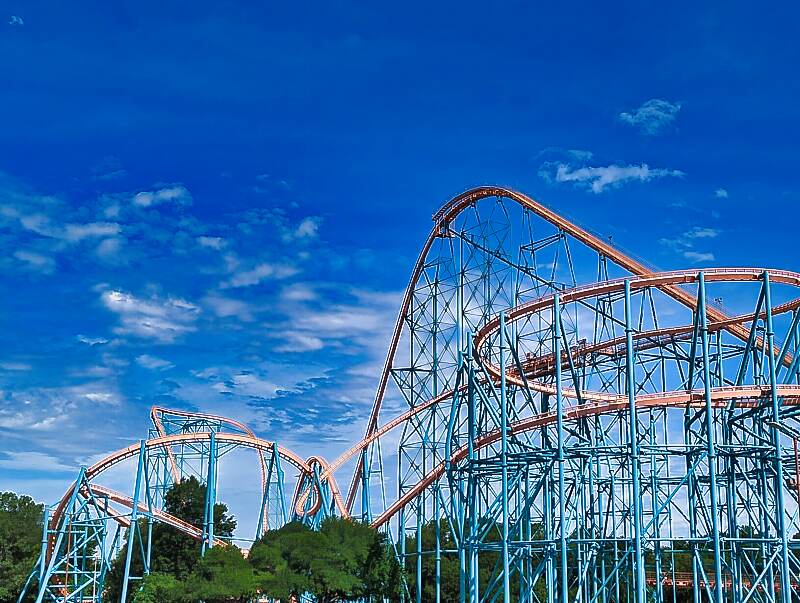
What Happened on Titan (What We Know From Reporting)
Based on news reporting and park statements quoted by outlets, Six Flags Over Texas experienced a power interruption described as an internal technical issue that affected power across the park. Titan riders were stopped and later evacuated using the ride’s evacuation pathway, which is why you see people walking down in a line, holding handrails, moving slowly, and being guided by staff.
That visual is important, because it tells you something specific. It tells you the park was not telling guests to climb down the track like a mountain. They were using a built-in egress route designed for exactly this scenario. Most large coasters have some form of evacuation access on lifts and high points, because the industry assumes that at some point, something will stop somewhere inconvenient. The plan is not “hope it never happens.” The plan is “when it happens, do it safely.”
Sources for the Titan incident coverage include Fox News and other outlets describing the stop as occurring during a broader technical power issue, with evacuation completed safely.
First, the Big Misconception: “Losing Power” Does Not Mean the Coaster Becomes Uncontrolled
When people hear “power outage,” they picture a coaster like a car that suddenly shuts off on the highway and starts rolling backward. That is not how roller coasters are designed.
A coaster is not held together by electricity. The structure does not need power to remain stable. The train does not need power to stay on the track. Most importantly, the ride’s safety-critical systems are designed around the assumption that power can be lost, and the safe state is usually a stopped state.
On many coasters, the train is moved by gravity for most of the course. The lift hill is the main place where power is actively doing work, because it is pulling the train upward. If power is lost on a lift, the system is designed to prevent rollback. That is what anti-rollback devices are for. They are mechanical, not a “software promise.” You have probably heard the clicking sound on a chain lift. That sound is part of the anti-rollback system doing its job.
On launch coasters, the launch system is more power-dependent, but those systems also have braking and control logic designed to fail safe. The ride does not just “freewheel” into chaos because the lights flickered.
What Actually Happens Inside the Ride System When Power Drops
To understand why a power loss usually ends in a safe stop, it helps to understand how coasters think. A modern coaster is a combination of mechanical engineering and industrial control systems. It has sensors, programmable logic controllers (PLCs), and a set of rules that determine whether the ride is allowed to dispatch, continue, or must stop.
When power is interrupted, one of two broad things happens.
The first possibility is a true loss of power to ride systems, which can cause the ride to stop where it is. In that case, the ride’s brakes are typically designed to default to a safe condition. In many industrial systems, brakes are “fail safe,” meaning they engage when power is removed rather than releasing. This is the same philosophy used in many elevators and industrial machines. You do not want a brake that requires continuous power to stay engaged.
The second possibility is that the ride still has some power, but the control system detects an abnormal condition. That could be a voltage drop, a communication fault, a sensor disagreement, or a system not confirming a safe position. In that case, the ride may stop even if power is not fully gone, because the control logic is choosing the safest option. This is why some “power outage” stories are actually “the ride stopped because the system detected a power quality issue.” From the rider perspective, it feels the same. From the engineering perspective, it is a deliberate safety response.
Why Evacuations Look Scary Even When They Are Routine
Evacuations look scary because they are slow and high up. They are also one of the only times guests see the backstage reality of a coaster. You are not supposed to be walking on a lift hill in normal operation, so when you see it, your brain labels it as an emergency, even if it is controlled.
In most evacuations, the goal is not speed. The goal is stability and preventing secondary incidents. Staff will typically secure the area, communicate clearly, and move people in a controlled line. They will often prioritize guests who are panicking, guests with mobility issues, and children. They will also be watching for heat stress, because standing still in the sun can be harder than the walk itself.
If you ever watch an evacuation video and notice that people are not running, that is a good sign. It usually means staff are in control and the evacuation route is appropriate for the situation.
How Likely Is This to Happen? The Probability Question (What We Can Say Honestly)
This is the section everyone wants, and it is also the section where a lot of articles start making up numbers. I am not going to do that.
There is no single global, public, standardized statistic that tells you, “A coaster loses power once every X rides,” because parks do not publish operational incident rates in a way that can be aggregated cleanly. Even within one country, reporting standards vary by state or region, and many stoppages are not “incidents” in a reportable sense. They are operational stops that are resolved without injury.
What we can say is this: relative to the total number of coaster ride cycles that run every day, power-related stoppages that require evacuation are uncommon. They feel common because they are highly shareable. A normal day where 200 trains run without issue does not go viral. A day where one train is evacuated from a high point absolutely goes viral.
If you want a practical probability framework instead of a fake number, here is the honest way to think about it.
Power-loss stoppages are more likely when: the park is dealing with storms in the area, grid instability, extreme heat that stresses electrical infrastructure, or known maintenance issues in the park’s internal distribution systems. They are also more likely on days when the park is operating at maximum load, because more systems are drawing power at once.
Evacuations are more likely when: the train stops in a location that cannot be restarted easily, or when the park chooses evacuation as the safest and fastest resolution even if a restart might be possible. Parks often prefer evacuation over repeated restart attempts if conditions are unstable, because the priority is getting guests off safely, not proving the ride can recover.
So the probability is not best described as “X percent.” It is best described as “rare, but normal enough that parks design for it and train for it.”
What Usually Causes a Coaster to Stop During a “Power Outage” Event?
People imagine one cause: the city power went out. In reality, there are several common categories, and they do not all mean the same thing.
Park-wide power interruption (grid issue or internal distribution issue)
This is the classic scenario that the Titan story appears to fit, based on reporting that described a broader park interruption tied to an internal technical issue. In this case, multiple rides and systems can stop at once. The park may close early because it is not just one ride that needs resetting, it is the whole operational environment.
These events can be caused by external grid problems, storms, or failures in the park’s internal electrical infrastructure. Parks are essentially small cities in terms of power distribution, and internal issues can cascade quickly.
Localized electrical fault on the ride (not a full outage)
Sometimes the park has power, but the ride does not. A breaker trips. A drive motor faults. A voltage irregularity triggers a safety stop. From the rider perspective, it feels like “the power went out.” From the maintenance perspective, it is a contained fault that needs troubleshooting and reset procedures.
Control system detects an unsafe or unknown state
This is extremely common, and it is often misunderstood. A coaster can stop because a sensor does not confirm a position, a restraint system does not confirm locked status, a block zone does not clear, or a communication link drops. None of these necessarily mean something is broken in a catastrophic way. They mean the system cannot prove it is safe to continue, so it stops.
This is the same logic that makes modern aviation safe. The system refuses to proceed when it cannot confirm the required conditions.
Weather-related operational stops that get labeled “power issues” online
Sometimes a ride stops because of wind thresholds, lightning protocols, or rain conditions, and the internet calls it a power outage because that is the easiest story to tell. Parks often stop rides preemptively when weather approaches, and guests may experience that as a sudden stop with no visible cause.
What Happens Next: Restart vs Evacuation (How the Decision Is Made)
After a stop, the park’s team will assess whether the ride can be restarted safely. This is not a guess. There are procedures. There are checklists. There are conditions that must be met before motion resumes. Industry standards like ASTM guidance for amusement ride design include requirements around providing recommended evacuation and restart procedures to owners and operators, which is part of why parks can respond consistently rather than improvising.
A restart may be possible if power is stable and the ride can be brought back into a known safe state. However, evacuation is often chosen when it is the clearest, safest path to resolution, especially if the train is stopped in a location where a restart would be complex or would require multiple system confirmations that are not available yet.
Evacuation is not a failure. It is a normal safety outcome.
What You Should Do If You Are Stuck on a Coaster During a Power Loss
This is the advice section people actually need, because panic makes everything harder. If you ever find yourself stopped on a coaster, here is what will help you most.
Assume the restraints are still doing their job, because they are
Restraints are designed to remain locked through stops, including power interruptions. Do not fight them. Do not try to “test” them. Do not wiggle them aggressively. Your job is to stay seated and stable.
Listen for staff instructions, even if you cannot see staff yet
It can take time for staff to reach a stopped train, especially if the stop is high on a lift or in a location that requires accessing catwalks. That delay feels longer than it is. Use that time to breathe and stay calm.
Manage your body temperature early
Heat and dehydration are the most realistic risks during a prolonged stop, especially on a sunny day. If you have water, sip it. If you have a hat, use it. If you can safely adjust your posture to reduce sun exposure without unbuckling anything, do it. If you start feeling faint, tell someone immediately. Parks take this seriously because it is one of the most common evacuation complications.
Do not try to self-evacuate
This is the big one. Even if the ground looks “close,” even if you see stairs, even if you think you know the way down, do not move until staff instruct you. Evacuation routes are designed to be used in specific ways, often with staff positioned at key points. Self-evacuation is how minor problems become serious incidents.
If you have a panic response, name it and slow it down
I am going to be blunt here, because it helps. Your brain will try to tell you you are in danger because you are high up and you are not moving. That does not mean you are in danger. That means your body is reacting to uncertainty.
Slow breathing helps more than people expect. A simple pattern like breathing in for four seconds and out for six seconds can reduce the adrenaline spiral. It is not magic. It is physiology.
What to do during the walk-down evacuation
If you are evacuated and asked to walk down stairs, treat it like a slow hike, not a race. Keep one hand on the rail. Look where you are stepping, not at the height. If you are afraid of heights, focus on the steps and the person in front of you. If you feel shaky, tell staff. They would rather slow the line than deal with someone freezing mid-staircase.
If you are with kids, keep them close and keep your voice calm. Kids mirror adult tone. If you narrate it like it is normal and safe, they are more likely to stay regulated.
How to Reduce Your Odds of Being on a Ride During a Power Event
You cannot control the power grid, but you can reduce your exposure to the most common conditions that trigger park-wide stops.
If storms are forecast, especially lightning, expect interruptions. If you are anxious about getting stuck, prioritize indoor attractions or lower-elevation rides during unstable weather windows. If you see the park clearing pools or closing tall rides, take that as a signal that protocols are being activated.
If you are visiting during extreme heat, understand that electrical systems and mechanical systems are under more stress. That does not mean rides are unsafe, but it does mean parks may be more conservative about stops and resets.
If you are someone who worries about this a lot, ride earlier in the day when conditions are calmer and crowds are lighter. Crowds do not cause power outages, but heavy operational load can make the day more complex, and complexity is where delays happen.
The Bottom Line: A Stop Is Not a Disaster, It Is a Safety Feature
The Titan evacuation looked scary because it was high and because it was unusual for guests to see. In reality, it was a controlled outcome to a power interruption. The ride stopped in a safe state, and guests were escorted down a built-in evacuation route.
If you are reading this because you saw the video and it freaked you out, here is the most comforting truth I can offer. Roller coasters are designed with the assumption that things will stop. They are designed with the assumption that power can drop. They are designed with the assumption that a train may need to be evacuated from an inconvenient place. That is why the procedures exist, and that is why the outcome is usually boring from an engineering perspective, even when it looks dramatic on TikTok.
Most coaster rides end normally. Some rides stop. A tiny fraction of those stops become evacuations. When evacuations happen, they are slow, controlled, and built into the safety culture of the industry.
FAQ: Power Outages, Stalled Coasters, and Evacuations (The Questions Everyone Asks)
Do roller coaster restraints unlock if the power goes out?
In normal operation, no. Restraints are designed to remain locked through a stop, including a power interruption. Parks and manufacturers design restraint systems so that the safe state is “locked,” not “unlocked.” That is why, in evacuation videos, you almost never see riders simply lifting their own lap bars and stepping out. Staff typically have to reach the train and follow a procedure before restraints are released, and that procedure is designed to prevent accidental releases at height.
It is also why you should not fight the restraint or try to “test” it aggressively while you are stopped. The restraint is doing its job, and the safest thing you can do is stay seated and stable until staff instruct you.
Can a roller coaster roll backward if it loses power on the lift hill?
On a traditional chain lift, the ride is designed to prevent rollback. That is what anti-rollback systems are for. If you have ever heard the clicking sound as a train climbs, that is part of the anti-rollback mechanism engaging. The point is that if the chain stops pulling, the train does not simply slide backward down the hill.
There are different lift types and different designs, but the general safety philosophy is the same. A lift hill is one of the most obvious “what if power fails?” scenarios, so it is one of the places where designers build in mechanical protections and conservative control logic.
Is it dangerous to be stuck high up on a coaster during a power outage?
It can feel dangerous, but the biggest realistic risks are usually not the ones people imagine. The structure is stable, the train is stable, and the restraint system is designed to hold you. The more common concerns are things like heat stress, dehydration, dizziness, or panic, especially if the stop lasts a long time in direct sun.
This is why parks take evacuations seriously and why they move slowly and deliberately. The goal is to prevent a secondary problem, like someone fainting on stairs or trying to self-evacuate.
Why do parks evacuate instead of just restarting the ride?
Sometimes they can restart, and sometimes they cannot. Even when a restart is technically possible, evacuation can be the safer and faster choice if power is unstable, if the control system cannot confirm a safe state, or if the train is stopped in a location where a restart would require multiple checks and resets.
Parks also have to consider guest comfort and time. If the ride might restart in five minutes, they may attempt it. If the ride might not restart for an hour, evacuation is often the better option. The key point is that evacuation is not improvisation. It is a planned procedure that rides are designed to support.
How long does it take to evacuate a roller coaster?
It depends on where the train is stopped, how many trains are affected, weather conditions, and the makeup of the riders. Evacuations can be relatively quick if the train is on a lift with easy access and the guests are mobile. They can take longer if the train is in a harder-to-reach location, if there are multiple trains to clear, or if staff need to manage guests who are panicking or have mobility limitations.
In general, evacuations are intentionally slow because rushing is how people get hurt on stairs and catwalks.
What should I do if I panic while stuck on a coaster?
The most helpful thing you can do is name what is happening and slow your body down. Your brain is reacting to height, uncertainty, and lack of control, which is a normal human response. It does not mean the ride is about to fail.
Focus on controlled breathing, keep your body still, and look at a fixed point rather than scanning the height below you. If you feel like you might faint, tell someone immediately. Parks would rather respond early than deal with a medical issue mid-evacuation.
Should I ride coasters if I am afraid of being stuck?
If this fear is intense for you, it does not mean you can never ride. It means you should plan in a way that reduces anxiety triggers. You can ride earlier in the day when weather is calmer and crowds are lighter. You can avoid days with storm forecasts. You can start with coasters that have lower lift hills or more sheltered layouts. You can also remind yourself that a stop is not a catastrophe. It is a safety outcome that the industry plans for.
If you want a practical approach, treat this like exposure. You do not have to jump straight to the tallest ride in the park. You can build confidence gradually.
Is walking down a coaster during an evacuation safe?
It is designed to be safe when done under staff instruction. Evacuation routes, stairs, and catwalks exist because designers assume evacuations will happen sometimes. The walk is slow, and it can be scary if you do not like heights, but the procedure is built around stability. You keep a hand on the rail, you follow staff directions, and you move at a controlled pace.
The biggest danger is not the height itself. The biggest danger is someone rushing, ignoring instructions, or trying to self-evacuate. That is why parks emphasize order and calm.
Does a power outage mean the park is unsafe or poorly maintained?
Not automatically. Power interruptions can be caused by external grid issues, storms, or internal electrical distribution problems. A power event can happen even at well-run parks, because parks are complex facilities with huge electrical loads. What matters more is how the park responds. A controlled stop, clear procedures, and a safe evacuation are signs of a safety culture doing what it is supposed to do.
What is the most common reason coasters stop, if not power outages?
In many cases, coasters stop because the control system detects something it cannot verify as safe. That can be a sensor not confirming position, a block zone not clearing, a restraint confirmation issue, or a communication fault. These stops can be frustrating, but they are often the system being conservative, not the system being reckless.
It is the same basic idea as a modern car throwing a warning light and limiting performance. The system is choosing caution because it cannot confirm normal conditions.
What should I pack or do to be more comfortable if a stop happens?
If you are someone who worries about this, small preparation can make you feel much better. Hydrate before you ride. Wear sunscreen and bring a hat on hot days. Avoid riding while already overheated or lightheaded. If you are prone to panic, practice a breathing pattern before you get on the ride so it is easier to use if you need it.
Most importantly, remind yourself that stops are not rare in the sense of “unthinkable,” but evacuations are uncommon, and injuries from evacuations are not the normal outcome. The normal outcome is inconvenience and a story you tell later.

Leave a Reply