You know the moment. The train tips over the edge, your brain goes “oh no,” and your stomach feels like it just fell through your body.
That “stomach drop” feeling is real, it’s common, and it’s not your organs literally falling. It’s your body reacting to a fast change in forces, especially when the coaster creates negative Gs (airtime) or a sudden reduction in the force that normally presses you into your seat.
In plain language: your stomach drop is your body noticing weightlessness, plus your inner ear and nervous system trying to make sense of it.
Quick Answer
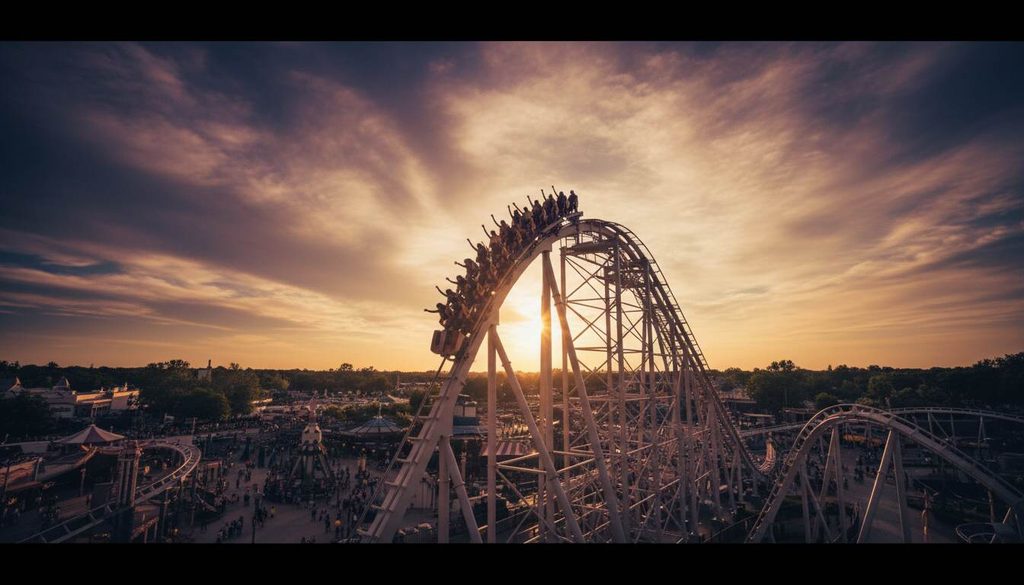
Roller coasters feel like a stomach drop because, at the top of a hill or over an airtime bump, the coaster can accelerate downward in a way that reduces the normal “seat pressure” you’re used to. Your body briefly experiences a light or weightless sensation, and your brain interprets that sudden change as falling.
It’s the same basic reason you feel that lurch in an elevator when it starts going down, just more dramatic and more sustained.
The Simple Physics Behind The Feeling
Most of your everyday life is spent under a steady force: gravity pulling you down, and the ground (or your chair) pushing you back up. That upward push is what makes you feel “normal weight.”
On a coaster, the train changes speed and direction constantly. When you go over the crest of a hill, the train starts accelerating downward. If the train’s downward acceleration is close to the acceleration of gravity, the seat doesn’t have to push up on you as much to keep you moving with the train.
That reduced seat pressure is what your body reads as:
- lightness
- floating
- stomach drop
- butterflies
- that “my insides are trying to levitate” feeling
This is also why different coasters feel different. A tall, slow crest can create a long, suspenseful drop feeling. A sharp airtime hill can create a quick pop of weightlessness. A ride designed for sustained airtime can make you feel like you’re floating repeatedly.
If you want the deeper engineering explanation of how coasters manipulate speed, height, and energy to create these moments, this is the best companion post: how roller coasters work (engineering + physics).
Why Your Stomach Specifically Feels It
People always ask why it’s the stomach, not your elbow or your shoulder.
A few reasons:
- Your gut is sensitive. The digestive tract has a lot of nerve signaling, and it’s closely tied to stress and motion response.
- Your diaphragm and breathing change. When you anticipate a drop, many people hold their breath or tighten their core. That can amplify the sensation.
- Your brain uses your torso as a “center” reference. When your body feels light, your torso is where you notice it most.
It’s also why two people can ride the same coaster and have totally different experiences. One person feels pure joy. Another feels nausea. Another feels fear. The forces are the same, but the nervous system response isn’t.
The Inner Ear Part (Why It Feels Like Falling Even When You’re Safe)
Your inner ear has a balance system that helps you sense acceleration and orientation. It’s great for walking, running, and not falling over in daily life.
On a coaster, it gets fed information it doesn’t experience often:
- rapid changes in direction
- weightlessness moments
- high-speed crests and valleys
- visual cues that scream “DROP” even before the forces hit
Your brain tries to combine inner ear signals with what your eyes see. When those signals don’t match what you’re used to, your body can interpret it as falling, even though you’re fully contained and the ride is doing exactly what it’s designed to do.
If this is the part that freaks you out, you’ll probably get a lot out of how to overcome roller coaster phobia. A huge chunk of coaster fear is your brain mislabeling unfamiliar sensations as danger.
Anticipation Makes It Stronger (The “Click Click Click” Effect)
The lift hill is basically a fear amplifier. Not because it’s dangerous, but because it gives your brain time to build a story.
While you’re climbing:
- you can see the height
- you can hear the chain
- you can feel the slow movement
- your body has time to tense up
Then, when the drop happens, the physical sensation hits on top of the mental buildup. That combination is why the first drop often feels like the biggest stomach drop of the ride, even when later airtime moments are technically stronger.
Why Some Drops Feel Worse Than Others
Not all drops are created equal. The “stomach drop” feeling is usually strongest when you get a fast shift into negative Gs or a sudden reduction in seat pressure.
These design factors can make it feel more intense:
- steeper drop angle (your brain reads it as more extreme)
- faster entry (less time to adapt)
- sharp crest (quick transition into airtime)
- front row vs back row (different timing and pull over the top)
- visual exposure (open track, clear view of the ground)
If you’re curious how ride design choices evolved to create specific sensations (including airtime-focused design), you can also connect this to the bigger story in roller coaster facts (uncommon and surprising).
Is The Stomach Drop Feeling Dangerous?
For most healthy people, the stomach drop feeling is not dangerous. It’s a sensation created by forces the ride is designed to produce.
That said, there are a few practical caveats:
- If you’re prone to motion sickness, it can trigger nausea.
- If you’re dehydrated, overheated, or underfed, the intensity can feel worse.
- If you have a medical condition that makes intense rides risky, follow the ride warnings and talk to your doctor.
If you’ve ever felt lightheaded or close to fainting after a big drop (especially on a hot day), this is a genuinely helpful read: how to prevent passing out on rides. A lot of “the coaster did something to me” is actually heat, dehydration, and adrenaline stacking up.
And if you’re pregnant or might be, coaster warnings aren’t optional. This is the best place to start: roller coasters and pregnancy safety.
How To Make The Stomach Drop Feel Less Intense
If you love coasters but hate the stomach drop, you’re not alone. Here are a few things that can reduce the intensity without ruining the fun:
- Breathe on purpose. Slow exhale over the crest helps keep your body from locking up.
- Keep your head back. It can reduce some of the sensory chaos.
- Start with milder coasters. Build tolerance like you would with anything else.
- Eat and hydrate smart. Not too heavy, not totally empty, and don’t do caffeine plus heat plus no water.
If you’re working your way up, you might like starting with something like a “least intense” list for a specific park, because it gives you a plan instead of a panic decision in the queue. For example: least intense roller coasters at Disneyland or least intense roller coasters at Magic Kingdom.
Bottom Line
The stomach drop feeling is your body reacting to a sudden change in forces, especially when a coaster creates moments of weightlessness (negative Gs) over a crest or airtime hill. Your inner ear, your nervous system, and your anticipation all pile onto the same moment, which is why it can feel so intense even when you’re completely safe and properly restrained.
Once you understand what your body is reacting to, the sensation often gets less scary. It stops being “something is wrong” and becomes “oh, that’s airtime.”

Leave a Reply