Passing out on a ride is one of those things people joke about until it happens to them. And when it does, it is usually not some dramatic movie moment. It is more like: your vision narrows, your body feels weirdly heavy or floaty, you get a wave of nausea or heat, and then your brain decides it is done for a second.
The good news is this: most “almost fainting” at theme parks is preventable with boring, practical choices that do not ruin your day. You do not need to turn your park trip into a medical routine. You just need to stop accidentally stacking the biggest fainting triggers on top of each other: dehydration, low blood sugar, overheating, anxiety breathing, and riding the most intense stuff back to back with no reset.
If you want the deep science on why fainting happens on coasters (G-LOC, blood pressure, vagal response, and all the fun body mechanics), start here: Why Do People Faint on Roller Coasters?. This post is the practical companion: what to do before, during, and after rides so you can keep the thrills and skip the floor nap.
First: Know What “Passing Out” Usually Means at a Theme Park
Most people who “pass out” on rides are dealing with one of a few common scenarios:
G-LOC (G-induced loss of consciousness): High positive G-forces push blood toward your legs and away from your brain. If your body cannot keep blood pressure up, you get tunnel vision and can black out briefly. This is the classic coaster faint.
Vasovagal syncope (fear or stress faint): Your nervous system overreacts to stress, pain, or panic and drops your heart rate and blood pressure. You can faint even on a ride that is not especially forceful if your body hits the panic switch.
Heat syncope / heat illness: Standing in the sun, sweating, and not replacing fluids and salt can drop blood volume and blood pressure. Heat also dilates blood vessels, which can make you feel faint.
Low blood sugar: Your brain needs glucose. If you are running on fumes and then you spike adrenaline, you can crash hard.
Hyperventilation: People do this all the time without realizing it. Fast, shallow breathing can make you lightheaded, tingly, and dizzy, and it can spiral into panic.
These are not rare in the sense of “nobody experiences them.” What is rare is truly dangerous outcomes from fainting on a ride, because restraints do their job. Still, it is miserable, it can ruin your day, and it can be a sign you should stop riding for a while.
For general medical background on fainting (syncope), here is a solid overview from Mayo Clinic: Fainting (syncope) symptoms and causes.
The “Do Not Ruin The Fun” Rule: Fix The Big 4 Before You Overthink Anything
If you only do four things all day, make them these:
1) Drink water consistently. Not “chug a bottle once you feel bad.” Consistent. Small amounts, often.
2) Eat something with salt and carbs. You do not need a huge meal. You need fuel and electrolytes.
3) Cool your body down. Shade, indoor shows, AC gift shops, mist fans, wet towel on your neck, whatever works.
4) Breathe normally on rides. No breath-holding, no panic breathing.
Most fainting risk at parks comes from ignoring those four things while trying to “maximize rides.” The irony is that doing those four things usually lets you ride more, not less.
Before You Even Enter The Park: Set Yourself Up Like A Person Who Wants To Stay Conscious
Eat A Real Breakfast (Or At Least A Functional One)
Riding intense coasters on an empty stomach is a classic mistake. You do not need a heavy meal, but you do want something that gives you steady energy for a few hours.
Good theme park breakfast logic: carbs + protein + a little salt. Think: bagel and eggs, oatmeal with peanut butter, yogurt with granola, breakfast sandwich, rice and eggs, whatever fits your body.
If you are someone who gets nauseous easily, keep it simple and bland. The goal is stable blood sugar, not culinary excellence.
Hydrate Before You Arrive, Not After You Are Already Behind
If you show up already dehydrated, you are playing catch-up all day. Start drinking water in the morning. If it is hot, you sweat a lot, or you are walking miles, consider adding electrolytes.
NHS guidance on dehydration is a good quick reference for symptoms and prevention: Dehydration.
Plan Your Bag Like You Actually Want Your Day To Go Smoothly
One underrated fainting trigger is “I did not bring what I needed, so now I am stuck in the sun, hungry, and stressed.” Bring the basics so you can fix problems fast.
For the practical side of what you can bring and how lockers work, this is worth reading: Theme Park Locker Rules (And What To Bring).
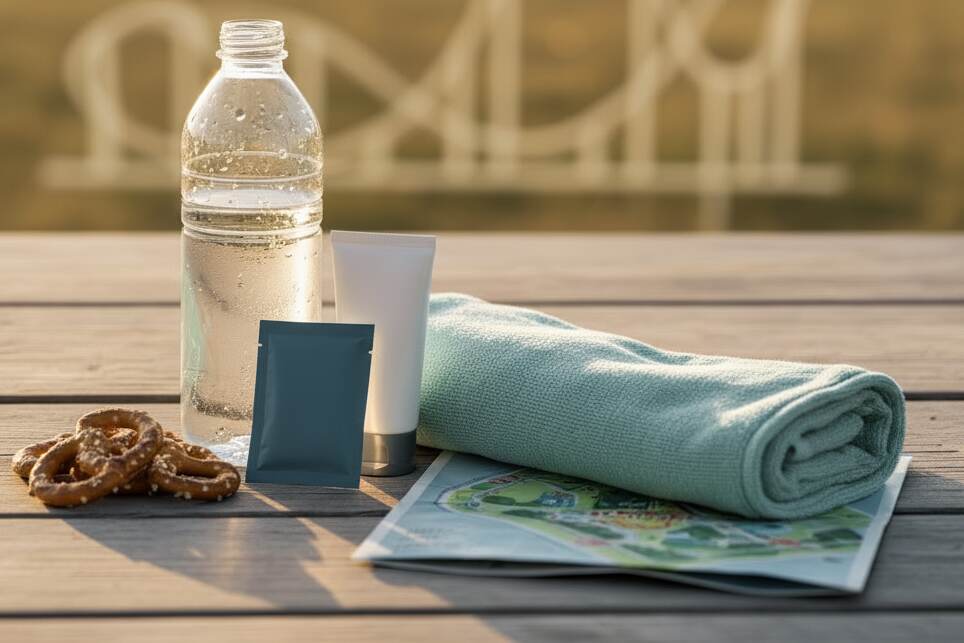
My personal “stay upright” essentials are boring but effective: water bottle (if allowed), electrolyte packets, a small salty snack, sunscreen, and something you can use to cool down (hat, cooling towel, or even a spare shirt you can wet).
All-Day Prevention: The Park-Day Rhythm That Keeps You From Crashing
Use The 30-30 Rule For Hydration (Simple, Not Perfect)
Every 30 minutes, take a few sips of water. Every 30 to 90 minutes, have a few bites of something. You do not need to track ounces. You just need to stop going two hours with nothing and then wondering why you feel like a ghost.
If it is very hot or you are sweating heavily, alternate water with electrolytes or salty foods. Hyponatremia (low sodium) is rare, but “I drank only water, sweated all day, and now I feel weird” is not rare.
Do Not Let Heat Build Up Quietly
Heat problems sneak up because you are distracted. You are in line, you are excited, you are trying to get to the next ride, and your body is slowly cooking.
CDC has clear, practical guidance on heat stress and warning signs: Heat and Health.
Theme park reality: you need deliberate cool-down breaks. Not because you are weak. Because you are a mammal walking on asphalt in the sun, and your body has limits.
Easy cool-down resets that do not feel like “wasting time”:
Go watch an indoor show. Eat indoors. Ride a dark ride. Do a gift shop loop in the AC. Sit in shade for 10 minutes and drink something. You will come back stronger.
Be Smart About Line Strategy
The worst fainting combo is: long outdoor line + no water + no food + then immediately a high-G coaster. If you know you are about to do something intense, treat the line like prep time.
Drink while you wait. Snack while you wait. If you are stuck in sun, create shade with your body position, a hat, or even a small umbrella if your park allows it. If you are starting to feel off, step out of line. I know it hurts. It hurts less than passing out.
Do Not Stack The Most Intense Rides Back To Back Without A Reset
Your body is not a machine. If you do a high-G coaster, then sprint to another high-G coaster, then do a spinning flat ride, you are basically asking for dizziness, nausea, and faint feelings.
Mix your day. Alternate intensity. If you want a guide to “gentle thrill” pacing, these can help you build a softer ramp-up:
Least Intense Roller Coasters at Magic Kingdom
Least Intense Roller Coasters at Disneyland
Even if you are not at Disney, the concept matters: start moderate, let your body adapt, and do not go from “standing in heat” straight into “sustained positives” as your first big hit.
On-Ride Techniques That Actually Help (Without Turning You Into A Fighter Pilot)
Stop Holding Your Breath
This is the biggest “I did not realize I was doing that” issue. People brace, tense, and hold their breath through the scariest parts. That can drop oxygen delivery and make you lightheaded. It also increases panic feelings because your body reads breath-holding as stress.
Instead: steady breathing. In through your nose if you can, out through your mouth. If you scream, that is fine. Screaming is basically forced exhale and it can actually keep you breathing.
Keep Your Head Back and Let The Restraint Do Its Job
Whipping your head around can add dizziness and can trigger that “my body is confused” feeling. Keep your head against the headrest when there is one. Look forward. Let the ride move you, not the other way around.
If you are curious about why restraints feel so different from ride to ride, and how they are designed to manage forces, this is a good read: Why Do Roller Coasters Have Different Restraints?.
Use A Light “Leg Tense” During High Positive G Moments
I am not telling you to do a full anti-G straining maneuver like a pilot. But a light, controlled leg and core tension during the most intense positive G sections can help keep blood from pooling in your legs.
Here is what I mean in normal-person language:
When you feel the ride pin you into the seat (bottom of a drop, tight high-speed turn), gently tense your calves, thighs, and core like you are bracing to stand up. Keep breathing. Do not lock up your whole body. Do not hold your breath. Think “firm,” not “rigid.”
If you do this and you feel worse, stop. Everyone’s body is different, and anxiety can make tension backfire.
Do Not Close Your Eyes If You Are Prone To Dizziness
Some people feel calmer with eyes closed. Some people get instantly more disoriented. If you are prone to dizziness, keeping your eyes open and looking at a stable point (forward, horizon when visible) can help your brain keep orientation.
If dizziness is a big issue for you, this post is relevant: Why Do Roller Coasters Make You Dizzy?.
Food, Water, and Electrolytes: The Unsexy Trio That Saves Your Day
Water Is Necessary, But Salt Is Often The Missing Piece
When you sweat, you lose water and electrolytes (including sodium). If you replace only water, you may still feel weak, headachy, or lightheaded, especially in heat.
Easy fixes: pretzels, fries, salted nuts, electrolyte drink, sports drink diluted with water, or electrolyte packets in water.
If you have medical conditions that require sodium restriction, obviously follow your medical guidance. But for the average sweaty theme park human, salt is your friend.
Do Not Wait Until You Feel Bad To Eat
Once you are shaky, nauseous, and lightheaded, eating can feel harder. Snack earlier. Aim for small, steady intake: half a sandwich now, a banana later, a handful of trail mix, whatever works.
If you need park food ideas that are more allergy-friendly or less likely to wreck your stomach, this can help: Vegan and Allergy-Friendly Theme Park Eats.
Anxiety and Panic: How To Keep Your Nervous System From Pulling The Plug
Some fainting is not about G-forces at all. It is about your nervous system deciding the situation is too intense and hitting the emergency off switch.
If you have ever felt faint in a doctor’s office, during blood draws, during stressful moments, or when you are overwhelmed, you might be prone to vasovagal episodes. Coasters can trigger that, especially if you are already dehydrated or hungry.
Do A “Pre-Ride Reset” Instead of White-Knuckling The Whole Queue
White-knuckling in line for 45 minutes is exhausting. Try this instead:
In the last few minutes before boarding, do slow breathing. Drop your shoulders. Unclench your jaw. Remind yourself of something factual: “This ride is engineered to be safe. I can handle 90 seconds. I can stop after this if I want.”
If coaster anxiety is a recurring thing for you, these two posts are directly relevant:
How To Overcome Roller Coaster Phobia (Fear)
Overcome Coaster Anxiety: A Practical Guide
Do Not Hyperventilate In The Station
People do this right before dispatch: fast shallow breaths, shoulders up, body tense. That can make you lightheaded before the ride even starts. Slow it down. Longer exhales. If you need a simple pattern: inhale 4 seconds, exhale 6 seconds, repeat a few times.
If you feel tingling in your fingers or lips, that is a classic hyperventilation sign. Slow down immediately.
Know The Rides That Are More Likely To Trigger Fainting (So You Can Plan Around Them)
Not all “intense” rides stress your body the same way.
High Positive G Coasters
These are the big fainting candidates: sustained, forceful turns and valleys that pin you down. If you are already dehydrated or low on fuel, these can push you over the edge.
If you want to understand how coasters create these forces, and why some designs feel “heavier,” this is useful background: How Roller Coasters Work (Engineering and Physics).
Spinning Rides and Anything That Messes With Your Inner Ear
Even if you do not faint, dizziness can trigger nausea, panic, and a vasovagal response. If you are prone to motion sickness, be selective about spinning flats and spinning coasters.
Heat-Soaked Outdoor Coasters
This is not about the ride itself. It is about the line and the platform. If you are baking in the sun, your fainting risk is higher before you even sit down.
Warning Signs: The “Stop Now” List
If you feel any of these, do not push through. This is your body giving you a chance to fix it before it escalates:
Tunnel vision or “gray-out”
Sudden sweating that feels different from normal heat sweat
Nausea + lightheadedness together
Ringing in ears
Feeling weirdly detached or confused
Shakiness or weakness
The move is simple: sit down, get shade, drink water, eat something salty, and give it 10 to 20 minutes. If you are not improving, get first aid. Theme parks have medical staff for a reason.
For basic first aid guidance on fainting, the Red Cross is a solid reference: Fainting: First Aid.
If You Almost Pass Out or You Do Pass Out: What To Do Next
First, do not be embarrassed. Park staff see this constantly. It is not a moral failing. It is physiology.
Step 1: Stop Riding For A Bit
Your body is telling you it is at its limit. Even if you feel “fine” five minutes later, you are more likely to have a repeat episode if you keep hammering intense rides.
Step 2: Cool Down, Rehydrate, and Eat
Shade or AC. Water plus electrolytes. A snack with carbs and salt. Sit down. Let your heart rate settle.
Step 3: Decide If You Are Done For The Day (Sometimes The Answer Is Yes)
If you fully fainted, I am going to be blunt: you should probably be done with intense rides for the day. Your body took a hit. You can still enjoy the park. Do gentler attractions, shows, food, photos, whatever. But chasing another blackout is not a flex.
Step 4: If You Have Chest Pain, Shortness of Breath, or Ongoing Confusion, Get Medical Help
Most coaster fainting is brief and resolves quickly. But if symptoms persist, do not self-diagnose. Use first aid. If needed, seek emergency care.
Special Cases: When You Should Be Extra Cautious (Or Skip Certain Rides)
Some people are simply at higher risk of fainting or complications. This is not fear-mongering. It is just reality.
If you have a history of fainting, known heart rhythm issues, blood pressure disorders, anemia, diabetes with frequent lows, or you are on medications that affect blood pressure, talk to a clinician about what is reasonable for you.
If pregnancy is part of your situation, this is relevant: Are Roller Coasters Safe for Pregnant Women?.
If you are dealing with a kidney stone situation and you are wondering about ride safety, this is also a real topic: Do Roller Coasters Cause Kidney Stones?.
And if you are traveling with kids and trying to figure out what is appropriate, this one is helpful: Roller Coaster Height Requirements.
A Practical “Stay Conscious” Park Plan (Example Day)
If you want a simple structure that works for most people, here is a realistic rhythm:
Arrival: water + snack, sunscreen, pick your first moderate ride.
First 90 minutes: warm-up rides, not the most intense coaster in the park. Drink while in line.
Mid-morning: do your first big coaster. After it, sit for 5 minutes and drink water. Check in with your body.
Lunch: eat an actual meal, ideally indoors or in shade. Salt is good.
Early afternoon (hottest time): indoor attractions, shaded areas, slower pace. This is where people crash if they try to brute force it.
Late afternoon: another big coaster block if you feel good. If you feel even slightly off, shift to gentler stuff.
Evening: cooler temps, your body is happier, you can often handle intensity better if you stayed on top of hydration and food.
FAQ
Can you actually faint from G-forces on a roller coaster?
Yes. It is called G-LOC, and it happens when positive G-forces reduce blood flow to the brain. It is usually brief, but it is real. For the detailed breakdown, read: Why Do People Faint on Roller Coasters?.
What is the fastest way to stop feeling faint at a theme park?
Sit or lie down in shade, drink water, get electrolytes or something salty, eat a small carb snack, and cool your body. If symptoms do not improve quickly or you have severe symptoms, go to first aid.
Does closing your eyes help prevent passing out?
It depends. For some people it reduces anxiety. For others it increases dizziness and disorientation. If you are prone to dizziness, keeping your eyes open and looking forward often helps.
Should I ride again after I faint?
If you fully fainted, I would not ride intense rides again that day. At minimum, take a long break, rehydrate, eat, cool down, and reassess honestly. If you fainted due to heat illness or dehydration, riding again without fixing the cause is asking for a repeat.
Bottom Line
You do not have to choose between “ride everything” and “baby yourself all day.” The middle path is the best one: fuel your body, manage heat, breathe normally, and pace intensity. Most people who pass out on rides did not get unlucky. They got depleted, overheated, underfed, over-anxious, or all of the above, and then they asked their cardiovascular system to perform a magic trick.
Stay ahead of the basics, and you can keep the fun part of thrill rides: the adrenaline, the laughter, the “what just happened,” and the immediate sprint to do it again, while still staying upright.

Leave a Reply