Getting stuck on a roller coaster is one of those fears that lives in the back of a lot of people’s minds, even if they love coasters. And when it does happen, it looks dramatic. The train stops. People start waving. Phones come out. Someone yells “we’re stuck!” like they just discovered the concept.
But most coaster stoppages are not mysterious, and they are not a sign the ride “almost failed.” In many cases, a coaster gets stuck because the ride’s safety systems did exactly what they were designed to do: stop the ride when something is out of spec, then keep it stopped until trained staff can resolve it.
This is the full, research-driven, guest-friendly explanation of why roller coasters get stuck, the most common places it happens, what parks do next, and what it means for safety.
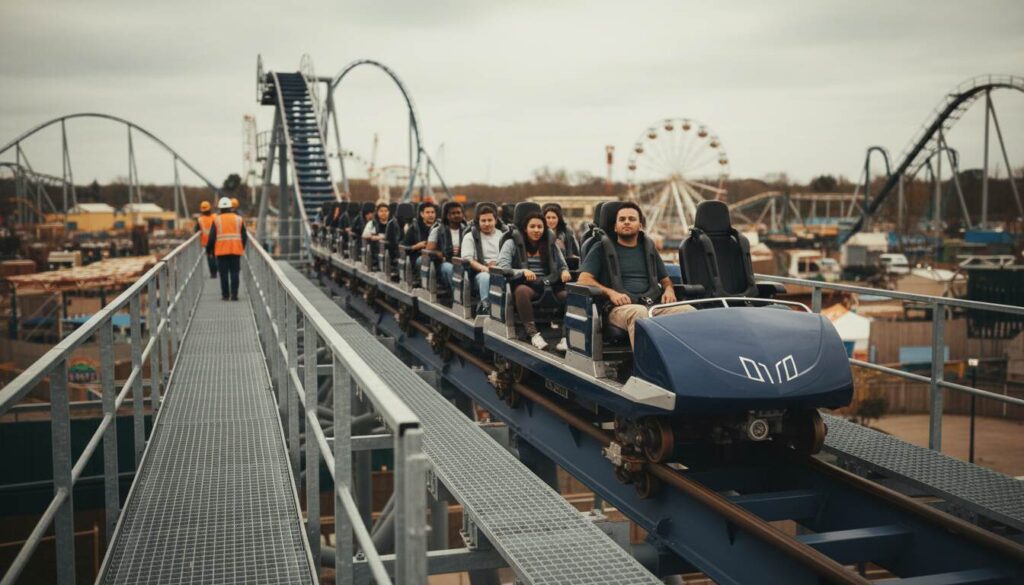
Quick Answer: Why Do Roller Coasters Get Stuck?
Roller coasters get stuck when the ride stops intentionally due to safety systems detecting an issue (such as a sensor fault, restraint check fault, or block system condition), or when the train does not have enough momentum to complete a section of track (often called “valleying”). Coasters can also stop due to station dispatch issues, power interruptions, weather-related operating limits, or mechanical problems. Most stoppages are controlled stops, and parks have procedures to restart the ride or evacuate riders safely.
Most “Stuck” Moments Are Controlled Stops, Not Breakdowns
Here is the key mindset shift: a coaster stopping is not automatically a failure. Modern coasters are designed to be conservative. They would rather stop than guess.
That means a lot of “stuck” incidents are actually the ride saying:
- “A sensor reading is off.”
- “A restraint check did not confirm properly.”
- “A train is not where it should be yet.”
- “The station is not ready to dispatch.”
To riders, it feels like the ride broke. To operators, it is often a routine fault condition that requires a reset, a check, or a short delay.
The Block System: The Most Common Reason Coasters Stop On Purpose
One of the most important safety concepts in coaster operation is the block system. A coaster track is divided into sections called blocks. Only one train is allowed in a block at a time. Sensors confirm when a train clears a block, and brakes can stop a train if the next block is not available.
This is how multi-train operation works safely. It is also why coasters can stop in places that look random to guests.
Common block-related stop scenarios include:
- A train ahead has not cleared the next block yet.
- A train is stopped in the station longer than expected (slow loading, restraint re-checks, accessibility procedures).
- A sensor does not confirm a train’s position correctly, so the system refuses to proceed.
From the outside, it can look like the ride is “stuck on the brakes.” In reality, it is doing its job: preventing trains from getting too close to each other.
Restraint And Station Interlocks: When The Ride Refuses To Dispatch
A huge percentage of coaster interruptions start in the station. Riders often do not think of the station as part of the ride’s safety system, but it absolutely is.
Coasters use interlocks to prevent dispatch if something is not correct, such as:
- A restraint does not register as locked
- A gate is not closed
- An operator panel condition is not satisfied
- A sensor in the station reads incorrectly
Sometimes this results in a train sitting on the brake run or stopped just before the station, waiting for the station to be ready. Riders on that train feel “stuck,” but the real issue is often a station check or reset.
Sensor Faults: The Ride Is Being Picky On Purpose
Modern coasters are loaded with sensors. They monitor train position, speed, brake status, and system health. Sensors are essential for safe operation, but they can also be the source of nuisance stops if a reading is inconsistent or out of tolerance.
Important nuance: a sensor fault does not automatically mean something dangerous is happening. It often means the system cannot confirm something it needs to confirm, so it stops and waits for human verification.
This is why parks sometimes have to send maintenance or supervisors to check a condition physically before restarting the ride.
Power Interruptions And Electrical Issues
Coasters rely on electrical power for control systems, station systems, lifts, and many braking components. If there is a power interruption, the ride can stop. Depending on the coaster design, it may stop in a safe “hold” position and require a controlled restart procedure.
Power-related stops can look dramatic because they can happen mid-course, but they are a known scenario with established procedures.
Valleying: When A Train Does Not Have Enough Momentum
Now for the type of “stuck” that coaster fans love to talk about: valleying.
Valleying happens when a train does not have enough speed to crest the next hill or complete an element, and it settles into a low point of the track. This is more common on certain types of coasters and under certain conditions.
Reasons a train might valley include:
- Weather: cold temperatures can change wheel behavior and reduce speed
- Wind: headwinds can slow a train more than people expect
- Train weight: a lightly loaded train may not carry momentum the same way in some layouts
- Trim brakes: if trims hit harder than expected, they can reduce speed enough to affect later elements
- Mechanical drag: wheel condition and bearing drag can influence performance
Valleying is not the most common reason coasters stop, but it is one of the most memorable because it can require a more involved recovery process.
Weather Holds: The Ride Is Not Broken, It’s Waiting
Sometimes a coaster “gets stuck” because it is placed on a weather hold. Parks set operating limits for wind, lightning, heavy rain, extreme cold, and other conditions. Those limits are not arbitrary. They are part of safe operations and risk management.
Weather holds can lead to:
- Trains being held in brake runs
- Dispatch pauses in the station
- Temporary shutdowns that require clearing trains
To guests, it can feel like the ride is unreliable. To the park, it is a normal operational decision.
Mechanical Issues: The Least Common, But The Most Obvious
Yes, sometimes something actually breaks or wears out. Coasters are machines that experience repeated stress cycles. Components wear. Parts fail. That is why maintenance and inspections are constant.
Mechanical issues can include:
- Lift system issues (chain lift, drive tires, anti-rollback components)
- Brake system component issues
- Train component issues (wheels, sensors, restraint components)
- Station hardware issues (gates, tires, transfer systems)
When a mechanical issue is suspected, the ride will stay stopped until it is diagnosed and corrected. Parks do not rush this. They cannot.
Where Coasters Most Commonly Get Stuck
Not all “stuck” locations are equal. Some are designed holding points. Others are more unusual.
- Brake runs: common and usually intentional
- Just before the station: often waiting on station readiness
- On the lift hill: can be a lift pause, a sensor check, or a power issue
- Mid-course brake run: often block spacing or fault response
- In a valley: less common, usually requires a recovery procedure
It is not an accident that many stops happen on brake runs. Brake runs are designed to be safe places to hold a train.
What Happens After A Coaster Gets Stuck?
After a stop, the park typically follows a decision tree:
- Can it be restarted safely? If yes, operators and maintenance follow restart procedures.
- Does it require a manual check? If a sensor or restraint condition is unclear, staff verify it.
- Does it require evacuation? If the ride cannot be restarted quickly, evacuation procedures begin.
Evacuations are not improvised. Parks train for them. Coasters are built with catwalks, stairs, and access points specifically because stoppages are expected scenarios, not unimaginable disasters.
Does Getting Stuck Mean A Coaster Is Unsafe?
Most of the time, no. In many cases, a stop is evidence that the safety system is conservative and functioning. A coaster that never stops is not automatically “better.” It might simply be less sensitive, or it might be operating in a way that hides issues until they become bigger.
The more useful question is: how does the park respond? A good operation treats stoppages seriously, follows procedures, and does not rush restarts.
How To Stay Calm If You Get Stuck
If you ever find yourself stopped on a coaster, here is the practical advice that actually helps:
- Stay seated and keep restraints as they are.
- Listen for operator instructions.
- Assume it is a controlled stop unless you are told otherwise.
- If you feel faint, overheated, or panicky, tell staff as soon as you can.
Most stuck moments end with a restart. If it becomes an evacuation, it will be handled by trained staff using established access routes.
The Bottom Line
Roller coasters get stuck for a handful of repeat reasons: block system holds, station interlocks, sensor faults, power interruptions, weather holds, mechanical issues, or the rare but memorable valleying event. Most stops are controlled and intentional. Parks plan for them, train for them, and build rides with evacuation access because “the ride might stop” is part of normal coaster reality.
It is inconvenient, sometimes uncomfortable, and occasionally scary. But in most cases, it is not a sign that the coaster was close to failing. It is a sign that the ride is designed to stop when it cannot confirm safe conditions, and it will not proceed until it can.

Leave a Reply