When you walk through the gates of a modern theme park, you don’t just enter a collection of rides scattered randomly across a landscape. Instead, you step into a carefully crafted world. You might find yourself in a futuristic space station, a medieval castle town, a tropical island paradise, or a recreation of a classic American frontier. Each area has its own architecture, music, food, and atmosphere. This is the power of themed lands, and it’s one of the most important innovations in amusement park design.
The concept of themed lands didn’t emerge fully formed from Walt Disney’s imagination. Instead, it evolved gradually over more than a century, building on ideas that originated at Coney Island, developed through the mid-twentieth century, and reached their full potential with the opening of Disneyland in 1955. Understanding the history of themed lands is understanding the history of how we entertain ourselves, how we create immersive experiences, and how we use architecture and design to tell stories.
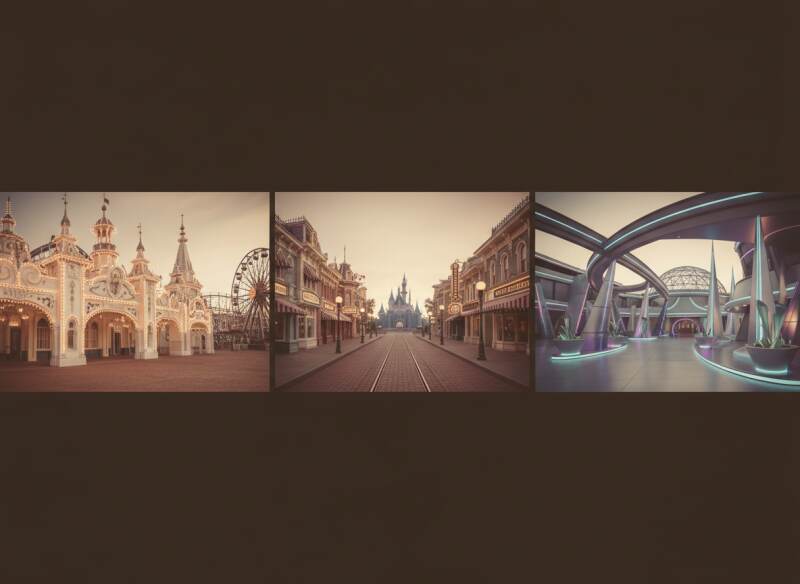
The Roots of Themed Entertainment: Coney Island and the Birth of the Amusement Park
To understand themed lands, we need to start at Coney Island in Brooklyn, New York, at the end of the nineteenth century. Coney Island wasn’t the first amusement park in America, but it was the first to achieve massive popularity and to establish many of the principles that would define amusement parks for generations to come.
In the 1880s and 1890s, Coney Island was a beach resort that attracted thousands of visitors from New York City. The beach itself was the main attraction, but entrepreneurs quickly realized that they could make money by providing additional entertainment. They built rides, games, and attractions. They built restaurants and hotels. They created a destination that offered something for everyone.
What made Coney Island revolutionary wasn’t any single ride or attraction. Instead, it was the concept of creating a destination where people could escape from their everyday lives and experience something different. Coney Island offered excitement, novelty, and a sense of freedom that was rare in the late nineteenth century. For working-class New Yorkers, a day at Coney Island was an escape from the crowded, polluted, industrial city.
The first major amusement park at Coney Island was Steeplechase Park, which opened in 1897. Steeplechase Park was designed by George Tilyou, a visionary entrepreneur who understood that people wanted more than just rides. They wanted an experience. Tilyou created a park that was designed to be fun and exciting from the moment you entered. He filled the park with attractions that were designed to make people laugh and have a good time. He created a sense of community and shared experience.
Steeplechase Park wasn’t a themed land in the modern sense. It didn’t try to transport visitors to another world or tell a coherent story. But it did establish the principle that an amusement park should be more than just a collection of rides. It should be a destination where people could spend an entire day and have a complete experience.
Following the success of Steeplechase Park, two more major parks opened at Coney Island: Luna Park in 1903 and Dreamland in 1904. Luna Park was designed to evoke the beauty and mystery of distant lands. The park featured exotic architecture, elaborate decorations, and attractions with names like the “Trip to the Moon” and the “Dragon’s Gorge.” Dreamland was designed to showcase the wonders of the world, with recreations of famous landmarks and exotic locations.
Luna Park and Dreamland were early attempts at themed entertainment. They used architecture, decoration, and attraction names to create a sense of place and atmosphere. They tried to transport visitors to exotic locations and to evoke a sense of wonder and discovery. While they weren’t as sophisticated as modern themed lands, they established the principle that an amusement park could use design and theming to enhance the visitor experience.
The Golden Age of Amusement Parks: 1920s-1950s
After the success of Coney Island, amusement parks began to spread across America. Nearly every city of significant size had an amusement park. Some were small, with just a few rides and attractions. Others were large and elaborate, with dozens of rides and attractions.
During the 1920s and 1930s, amusement parks became increasingly sophisticated. Parks began to invest in larger and more elaborate rides. They began to think more carefully about park design and layout. They began to create attractions that told stories and evoked specific moods and atmospheres.
However, most amusement parks of this era were still organized around the rides themselves rather than around themed lands. The park would have a roller coaster here, a Ferris wheel there, a fun house somewhere else. The rides were the main attraction, and everything else was secondary.
There were exceptions. Some parks began to experiment with themed areas. For example, Kennywood Park in Pittsburgh had an “Old Mill” attraction that was designed to evoke a specific time and place. Cedar Point in Ohio had a “Midway” area that was designed to recreate the atmosphere of a carnival or fair.
But these themed areas were relatively small and isolated. They didn’t dominate the park’s design or organization. The parks were still primarily organized around the rides themselves.
The post-World War II era saw a decline in many traditional amusement parks. The Great Depression had damaged many parks financially, and World War II had diverted resources and attention away from amusement parks. After the war, many parks struggled to compete with new forms of entertainment, such as movies and television.
However, some parks survived and thrived. These parks were the ones that invested in new rides, modernized their facilities, and thought creatively about how to attract visitors. They were also the parks that began to think more seriously about theming and atmosphere.
Walt Disney’s Vision: The Birth of Disneyland and the Modern Themed Land
Walt Disney was not the first person to think about creating themed lands in an amusement park. But he was the first person to fully realize the potential of the concept and to create a park that was entirely organized around themed lands.
Disney’s vision for Disneyland began in the late 1940s. Disney was frustrated with existing amusement parks. He felt that they were dirty, chaotic, and poorly designed. He wanted to create a park that was clean, well-organized, and family-friendly. He wanted to create a park where parents could have as much fun as their children.
Disney’s key insight was that the park should be organized around themed lands, not around individual rides. Each land would have its own distinct character, architecture, and atmosphere. Each land would tell a story and evoke a specific mood. The rides and attractions within each land would be designed to fit the theme and enhance the story.
When Disneyland opened on July 17, 1955, it featured five themed lands: Main Street USA, Adventureland, Frontierland, Fantasyland, and Tomorrowland. Each land was designed to transport visitors to a different world.
Main Street USA was designed to evoke the feeling of a small American town in the early twentieth century. The architecture was based on real American towns, and the shops and restaurants were designed to feel authentic and nostalgic. Main Street USA served as the hub of the park, the place where visitors entered and where they could navigate to the other lands.
Adventureland was designed to evoke the feeling of exotic, distant lands. The architecture was inspired by tropical and colonial styles. The attractions, such as the Jungle Cruise, were designed to take visitors on adventures to distant places.
Frontierland was designed to evoke the feeling of the American frontier in the nineteenth century. The architecture was based on frontier towns and settlements. The attractions, such as the Davy Crockett Explorer Canoes, were designed to celebrate the spirit of exploration and adventure that defined the frontier era.
Fantasyland was designed to evoke the feeling of a fairy tale world. The architecture was inspired by medieval castles and storybook illustrations. The attractions, such as Cinderella’s Castle and Peter Pan’s Flight, were based on classic Disney films and fairy tales.
Tomorrowland was designed to evoke the feeling of the future. The architecture was futuristic and space-age. The attractions, such as Space Mountain and the Carousel of Progress, were designed to celebrate technological innovation and progress.
Each land was carefully designed down to the smallest detail. The architecture, the landscaping, the music, the food, and even the cast member costumes were all designed to reinforce the theme. When you walked from one land to another, you felt like you were entering a completely different world.
The success of Disneyland was immediate and overwhelming. The park attracted millions of visitors in its first year and has continued to attract millions of visitors every year since. The park’s success demonstrated that the concept of themed lands was incredibly powerful. Visitors loved the sense of immersion and escapism that the themed lands provided.
The Spread of Themed Lands: From Disneyland to the Modern Theme Park
Following the success of Disneyland, other parks began to adopt the concept of themed lands. Walt Disney himself created new parks with themed lands, including Magic Kingdom in Florida, EPCOT, and Disney’s Hollywood Studios.
Magic Kingdom, which opened in 1971, was designed as an improved version of Disneyland. It featured the same basic themed lands as Disneyland, but with refinements and improvements based on years of experience. The park was larger and more elaborate than Disneyland, with more attractions and more sophisticated theming.
EPCOT, which opened in 1982, took the concept of themed lands in a new direction. Rather than creating fictional worlds, EPCOT created themed lands based on real countries and real cultures. The park featured lands representing Mexico, China, Germany, Italy, Japan, Morocco, France, United Kingdom, Canada, and the United States. Each land was designed to showcase the culture, architecture, food, and attractions of that country.
Other companies also began to create theme parks with themed lands. Universal Studios created theme parks that were organized around movie and television themes. SeaWorld created parks organized around marine life and ocean themes. Six Flags created parks organized around comic book and cartoon themes.
The concept of themed lands spread beyond American theme parks. Theme parks with themed lands were created in Japan, Europe, and other parts of the world. Each park adapted the concept to fit local cultures and preferences.
The Evolution of Theming: From Simple Decoration to Complex Storytelling
Over the decades, the concept of theming has become increasingly sophisticated. Early themed lands, like those at the original Disneyland, used architecture, decoration, and attraction names to create a sense of place. But they didn’t tell complex stories or create deeply immersive experiences.
Modern themed lands are far more sophisticated. They use multiple layers of storytelling to create complex narratives. They use cutting-edge technology to create immersive experiences. They use careful attention to detail to create authentic atmospheres.
For example, consider the Harry Potter themed lands that Universal Studios has created. These lands don’t just use architecture and decoration to evoke the Harry Potter universe. They use every element of the park to tell the story. The shops sell products that exist in the Harry Potter universe. The restaurants serve food that is mentioned in the books. The attractions are designed to tell stories from the books and films. Even the music and ambient sounds are carefully designed to enhance the immersion.
The level of detail and sophistication in modern themed lands is extraordinary. Every element, from the architecture to the landscaping to the music to the food, is designed to reinforce the theme and create an immersive experience.
The Psychology of Themed Lands: Why They Work
Why are themed lands so effective at creating immersive experiences? There are several psychological factors at work.
First, themed lands work because they provide a sense of escape. In our everyday lives, we are surrounded by familiar sights and sounds. We see the same buildings, the same streets, the same people. Themed lands provide an escape from this familiarity. They transport us to different worlds where everything is new and unfamiliar.
Second, themed lands work because they provide a sense of coherence and order. In our everyday lives, we are surrounded by chaos and disorder. Different architectural styles sit next to each other. Different time periods are mixed together. Themed lands provide a sense of coherence and order. Everything in a themed land is designed to fit together and to tell a coherent story.
Third, themed lands work because they provide a sense of narrative and meaning. Humans are storytelling creatures. We understand the world through stories. Themed lands provide narratives that help us understand and interpret what we see. When we walk through a themed land, we are not just experiencing a collection of sights and sounds. We are experiencing a story.
Fourth, themed lands work because they provide a sense of community and shared experience. When we visit a themed land with other people, we are all experiencing the same story and the same narrative. This creates a sense of community and shared understanding. We can talk to other visitors about what we experienced, and we all understand what each other is talking about.
The Impact of Themed Lands on Park Design and Visitor Experience
The introduction of themed lands has had a profound impact on how theme parks are designed and how visitors experience them.
First, themed lands have made theme parks more accessible to a wider audience. Early amusement parks were often chaotic and overwhelming. Visitors could easily get lost or confused. Themed lands provide a sense of organization and structure. Visitors can easily navigate from one land to another. They can understand where they are and where they are going.
Second, themed lands have made theme parks more family-friendly. Early amusement parks were often designed primarily for adults. Themed lands have made theme parks more appealing to families with children. Parents can enjoy the theming and storytelling, while children can enjoy the rides and attractions. The entire family can have a good time together.
Third, themed lands have increased the amount of time visitors spend in parks. Early amusement parks were primarily about rides. Visitors would come to ride a few rides and then leave. Themed lands have created destinations where visitors want to spend an entire day or even multiple days. Visitors want to explore each land, eat at the themed restaurants, shop at the themed shops, and experience the themed attractions.
Fourth, themed lands have increased the amount of money visitors spend in parks. Because visitors spend more time in parks, they spend more money on food, merchandise, and attractions. Themed lands have also made visitors more willing to pay premium prices for food and merchandise because they feel that they are part of the themed experience.
The Future of Themed Lands: Technology and Immersion
As technology advances, themed lands are becoming increasingly immersive and sophisticated. Virtual reality, augmented reality, and other advanced technologies are being integrated into themed lands to create new types of experiences.
For example, some parks are experimenting with augmented reality experiences that allow visitors to see virtual elements overlaid on the real world. A visitor might use their phone or a special device to see virtual creatures or objects that appear to be in the themed land.
Other parks are experimenting with virtual reality experiences that allow visitors to enter completely virtual worlds. A visitor might put on a VR headset and experience a completely immersive virtual environment.
These technologies are still in their early stages, but they have the potential to revolutionize themed lands. In the future, themed lands might combine physical environments with virtual elements to create experiences that are even more immersive and engaging than anything that exists today.
However, there is also a risk that technology could detract from the magic of themed lands. The most powerful themed lands are those that create a sense of immersion through careful attention to physical detail and atmosphere. If parks rely too heavily on technology, they might lose the sense of authenticity and craftsmanship that makes themed lands special.
Conclusion: The Enduring Power of Themed Lands
From the exotic recreations of Luna Park to the carefully crafted worlds of modern Disney parks, themed lands have become one of the most important elements of amusement park design. They have transformed amusement parks from collections of rides into immersive destinations that tell stories and transport visitors to different worlds.
The concept of themed lands evolved gradually over more than a century. It began with the early attempts at theming at Coney Island, developed through the mid-twentieth century, and reached its full potential with the opening of Disneyland in 1955. Since then, the concept has continued to evolve and become increasingly sophisticated.
Themed lands work because they appeal to fundamental human desires: the desire to escape from everyday life, the desire for order and coherence, the desire for narrative and meaning, and the desire for community and shared experience. As long as these desires exist, themed lands will continue to be a powerful tool for creating immersive entertainment experiences.
The future of themed lands is uncertain. Technology will continue to advance, and parks will continue to experiment with new ways to create immersive experiences. But the fundamental principle that will guide the evolution of themed lands is the same principle that guided Walt Disney when he created Disneyland: the principle that an amusement park should be more than just a collection of rides. It should be a destination where visitors can escape from their everyday lives and experience something magical.
