Imagine being one of the first people brave (or foolish) enough to ride a roller coaster that turns you upside down. No safety standards, no computer modeling, no decades of engineering knowledge to draw from. Just a wooden track, a circular loop, and the hope that you’ll survive the experience. This was the reality for riders of the Flip Flap Railway, the world’s first successful looping roller coaster, which opened in 1895 at Sea Lion Park on Coney Island.
The Flip Flap Railway is one of the most fascinating and terrifying chapters in roller coaster history. It represents the moment when engineers first proved that inversions were possible, but it also showed just how dangerous and uncomfortable they could be. The story of this ride is a story of innovation, ambition, and the willingness to push boundaries, even when the consequences were painful and sometimes dangerous.
The Visionary Behind the Loop: Lina Beecher
The Flip Flap Railway was designed by Lina Beecher, an American inventor and roller coaster engineer who was born in 1841. Beecher was a pioneering figure in the early coaster industry, and she understood something that most engineers of her time didn’t: that a loop was theoretically possible if you designed it correctly.
Beecher’s career in coaster design began in the 1880s, when she was already experimenting with innovative track designs and mechanical systems. She wasn’t just trying to build a loop for the sake of building a loop. She was genuinely interested in the engineering challenge of creating a safe, functional inversion. Her approach was methodical and scientific, which was unusual for the time.
The Toledo Test: Beecher’s First Loop Attempt
Before the Flip Flap Railway opened at Coney Island in 1895, Beecher had already tested her looping coaster design in Toledo, Ohio, in 1888. This earlier version proved that the concept could work, but it also revealed significant problems. Riders experienced extreme discomfort, and the design needed substantial refinement before it could be considered safe or practical.
The Toledo test was crucial because it gave Beecher real-world data about how her design performed. She learned about the forces involved, the stresses on the structure, and most importantly, how the human body reacted to inversion. This information allowed her to make improvements for the Coney Island version.
The Setting: Sea Lion Park and the Coney Island Boom
To understand the significance of the Flip Flap Railway, you need to understand Coney Island in the 1890s. Coney Island was the epicenter of American amusement park culture. It was a place where entrepreneurs competed fiercely to build the most thrilling, most innovative attractions. The public was hungry for new experiences, and parks were willing to take risks to attract visitors.
Sea Lion Park, owned by Captain Paul Boyton, was one of the major parks on Coney Island. Boyton was known for his willingness to embrace new attractions and technologies. When he decided to install Beecher’s Flip Flap Railway in 1895, he was making a bold statement: his park was on the cutting edge of innovation.
The Competitive Landscape
Coney Island in the 1890s was dominated by a few major parks, each competing for visitors and prestige. The competition drove innovation at a rapid pace. Parks were constantly trying to build something bigger, faster, or more thrilling than their competitors. In this environment, the Flip Flap Railway represented a major achievement. It was the first of its kind in the United States, and possibly in the world since a French attempt in 1848.
The installation of the Flip Flap Railway at Sea Lion Park was a statement of ambition and confidence. Boyton was betting that riders would be willing to experience something completely new and unprecedented, even if it meant taking a risk.
The Technical Specifications: A 25-Foot Loop
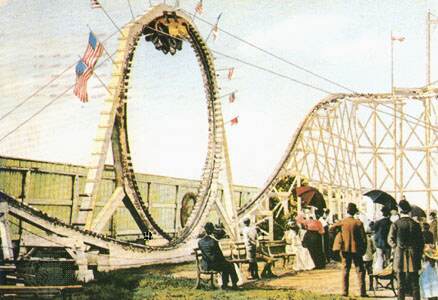
The Flip Flap Railway featured a single vertical loop that was 25 feet in diameter. By modern standards, this is quite small. A typical modern loop might be 50, 80, or even 100 feet in diameter. But in 1895, a 25-foot loop was enormous and terrifying.
The coaster used a single-rail track design with straddling wheels, a system that Beecher had developed to keep the cars stable through the inversion. This was a crucial innovation because it solved the fundamental problem of how to keep riders in their seats while upside down. The straddling wheels gripped the rail from both sides, preventing the cars from derailing during the loop.
The Circular Loop Problem
The loop was perfectly circular, which turned out to be a significant design flaw. A circular loop means that the radius of curvature is constant throughout the inversion. This creates a situation where the g-forces are most intense at the bottom of the loop, where riders are moving fastest. The result was brutal forces that caused serious discomfort and injury.
Modern loop design uses a teardrop or clothoid shape, which is wider at the bottom and narrower at the top. This distributes forces more evenly throughout the inversion. But Beecher didn’t have the mathematical tools or engineering knowledge to design a clothoid loop. She did the best she could with the knowledge available at the time.
The Ride Experience: Thrilling and Terrifying
Riding the Flip Flap Railway was an experience unlike anything available at the time. Riders would board cars that seated two people, and the train would be pulled up a lift hill by a chain mechanism. Once it reached the top, gravity would take over, and the coaster would descend toward the loop.
As the coaster entered the loop at high speed, riders would feel the intense g-forces as the train curved upward. At the bottom of the loop, where the forces were most intense, riders reported feeling crushed into their seats. As the train climbed through the loop, riders would be inverted, experiencing the unique sensation of being upside down while moving at high speed.
At the top of the loop, riders would experience a moment of weightlessness or even negative g-forces, creating the sensation of being lifted out of their seats. Then, as the train descended the back side of the loop, the forces would reverse, and riders would be pressed back into their seats as the train exited the loop and returned to the normal track.
The Physical Toll
The problem was that the forces involved were simply too intense for the human body to handle comfortably. Riders reported severe headaches, neck pain, and back strain. Some riders experienced whiplash. The ride was so physically demanding that many people refused to ride it more than once. There were even reports of riders losing consciousness during the inversion, though the accuracy of these reports is debated by historians.
The Flip Flap Railway was not a financial success because of these issues. While people were curious about the ride and wanted to experience the novelty of a loop, the physical toll kept them from becoming repeat riders. Word spread quickly that the Flip Flap was dangerous and painful, and ridership declined over time.
Testing and Safety: Sandbags and Monkeys
Before allowing human riders on the Flip Flap Railway, engineers tested the ride with sandbags and monkeys. This was a common practice in the early days of coaster design, when safety standards didn’t exist and engineers had to rely on improvisation and experimentation.
The sandbag tests helped identify structural problems and allowed engineers to understand how the forces would affect the ride. The monkey tests were more controversial, but they provided some insight into how living creatures would react to the inversion. The fact that the monkeys survived the tests (though they were presumably not happy about the experience) gave engineers enough confidence to allow human riders.
This testing process, primitive as it was, represented a genuine attempt to ensure safety. Engineers understood that they were pushing into unknown territory, and they wanted to minimize the risk to human riders. The testing wasn’t perfect, but it was better than simply throwing people on the ride and hoping for the best.
The Legacy of the Flip Flap Railway
The Flip Flap Railway operated at Sea Lion Park for a number of years before being dismantled. It was never a major financial success, but it was hugely significant from an engineering and cultural perspective. It proved that loops were possible, even if the execution was flawed.
The Flip Flap Railway demonstrated that engineers could overcome the fundamental challenge of keeping riders in their seats during an inversion. The single-rail track with straddling wheels was an innovative solution that worked, even if the overall ride experience was uncomfortable.
The 80-Year Gap
Interestingly, the Flip Flap Railway’s failure to become a popular attraction led to a long period where loops essentially disappeared from roller coasters. For nearly 80 years after the Flip Flap, no major coaster manufacturer seriously attempted to build a looping coaster. The ride had proven that loops were possible, but it had also proven that they were uncomfortable and potentially dangerous.
It wasn’t until the 1970s, with the development of steel coasters and the teardrop loop design, that engineers figured out how to make loops that were both safe and enjoyable. The Flip Flap Railway had opened the door to inversions, but it took decades of additional engineering knowledge and technological advancement before that door could be walked through successfully.
Comparing the Flip Flap to Modern Loops
If you were to ride the Flip Flap Railway today (which you can’t, since it no longer exists), and then ride a modern looping coaster, the difference would be staggering. Modern loops are smooth, comfortable, and thrilling without being painful. The g-forces are carefully controlled, and the ride experience is designed to be enjoyable.
The Flip Flap Railway, by contrast, was brutal. The forces were uncontrolled, the discomfort was significant, and the ride was genuinely dangerous. But this comparison shouldn’t diminish what Beecher and her team accomplished. They were working with limited knowledge and primitive tools, and they still managed to create a functional loop. That’s an impressive achievement, even if the result wasn’t particularly pleasant.
The Evolution of Loop Design
The journey from the Flip Flap Railway to modern loops represents a massive leap in engineering knowledge and technological capability. The Flip Flap used a circular loop because that was the simplest shape to design and build. Modern loops use complex mathematical curves (clothoid loops) that are calculated to distribute forces evenly throughout the inversion.
The Flip Flap used mechanical systems to lift the train up the hill and relied on gravity for the rest. Modern coasters use sophisticated braking systems, magnetic launch systems, and computer-controlled speed management. The Flip Flap had minimal safety restraints. Modern coasters have over-the-shoulder harnesses, lap bars, and other restraint systems that are engineered to handle the forces of multiple inversions.
The Cultural Impact: From Curiosity to Icon
The Flip Flap Railway was a cultural phenomenon, even if it wasn’t a financial success. It captured the public imagination in a way that few rides have. The idea of a roller coaster that turned you upside down was thrilling and terrifying in equal measure. Newspapers covered the ride extensively, and it became a symbol of the cutting edge of amusement park innovation.
The Flip Flap Railway represented something important about American culture in the 1890s: the willingness to embrace new technologies and experiences, even when they were risky or uncomfortable. It was part of a broader trend of innovation and experimentation that characterized the era.
The Influence on Future Design
Although loops disappeared from coaster design for 80 years after the Flip Flap, the ride had proven that they were possible. When engineers finally figured out how to design comfortable loops in the 1970s, they were building on the foundation that Beecher had laid. The Flip Flap Railway had answered the fundamental question: can you safely invert a roller coaster? The answer was yes, even if the execution was flawed.
Conclusion: A Bold First Step
The Flip Flap Railway was the first looping roller coaster in the United States, and it represents a crucial moment in coaster history. Lina Beecher’s design proved that inversions were possible, even if the execution was uncomfortable and potentially dangerous.
The ride was a commercial failure and a physical ordeal for those brave enough to experience it. But it was also a triumph of engineering ambition and innovation. Beecher and her team had tackled a problem that most engineers thought was impossible, and they had found a solution.
Today, we take loops for granted. Modern coasters feature multiple inversions that are smooth, comfortable, and thrilling. But none of that would have been possible without the Flip Flap Railway. This crude, uncomfortable, terrifying ride opened the door to a whole new dimension of coaster design. Every smooth, perfectly engineered loop you experience today owes a debt to Lina Beecher’s bold experiment in 1895.
The Flip Flap Railway reminds us that innovation often comes with a cost. It reminds us that the first attempt at something new is rarely perfect. And it reminds us that sometimes the most important achievements are the ones that pave the way for future success, even if they’re not successful themselves.
