Impulse roller coasters represent one of the most innovative and unique designs in amusement park history. Manufactured exclusively by Intamin, these coasters launch riders forward and backward along a single rail at speeds up to 72 mph, creating multiple vertical spikes where riders experience weightlessness and intense reversals. If you’ve ever wondered what it feels like to be launched backward up a 215-foot spike, an impulse coaster is your answer.
What Is an Impulse Roller Coaster?
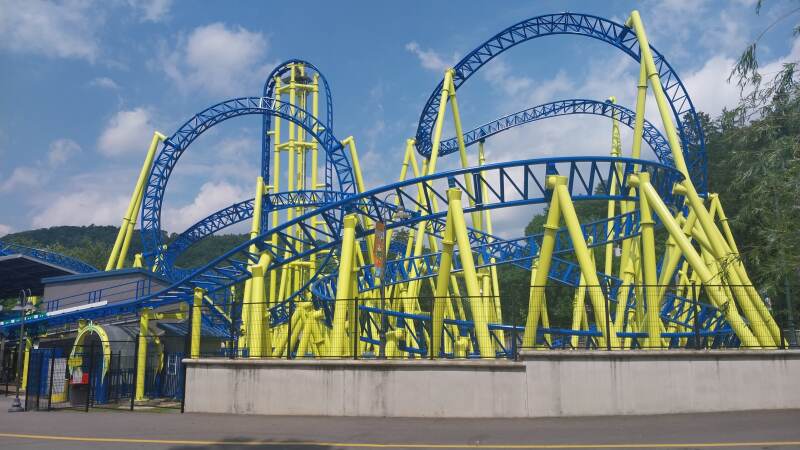
An impulse coaster is a launched inverted roller coaster that uses a linear induction motor (LIM) or linear synchronous motor (LSM) launch system to propel riders forward and backward along a single-rail track. Unlike traditional coasters that rely on gravity and momentum, impulse coasters are powered throughout the ride, creating a completely different experience.
The defining characteristic of an impulse coaster is its vertical spikes. Instead of traditional hills and loops, the coaster climbs nearly vertical (90-degree) spikes, pauses momentarily at the top, and then reverses direction, launching riders backward down the spike at high speed. This cycle repeats multiple times throughout the ride, creating a unique sensation of weightlessness and intense acceleration.
Impulse coasters are also inverted, meaning riders sit above the track with their legs dangling freely. This adds to the sensation of weightlessness and creates a more intense, exposed feeling compared to traditional coasters where riders sit in enclosed cars.
The History of Impulse Coasters
The impulse coaster concept was developed by Intamin in the late 1990s, representing a radical departure from traditional coaster design. The first impulse coaster opened in Japan in 1997, called Linear Gale at Nagashima Spa Land. This groundbreaking ride introduced the world to the unique sensation of forward-backward launches and vertical spikes.
The concept gained significant attention when Cedar Point in Ohio opened Wicked Twister in 2002. At 215 feet tall and 72 mph, Wicked Twister was the world’s tallest and fastest impulse coaster at the time. The ride featured double-twisting towers, adding an extra element of rotation to the vertical spikes. Wicked Twister became iconic and helped popularize the impulse coaster concept.
Other notable impulse coasters opened around the world, including Steel Venom at Valleyfair in Minnesota (2003) and Possessed at Geauga Lake in Ohio (2005). However, the impulse coaster concept proved to be niche. While revolutionary and thrilling, these coasters didn’t become as widespread as other coaster types. Many parks opted for different types of thrill rides, and several impulse coasters have since closed or been converted to other models.
As of 2024, only a handful of impulse coasters remain in operation worldwide. Steel Venom at Valleyfair is the only fully functional Intamin Impulse Coaster still operating in the United States. This makes impulse coasters increasingly rare and valuable from a historical perspective.
How Impulse Coasters Work: The Engineering
Understanding how an impulse coaster works requires understanding the LIM (Linear Induction Motor) or LSM (Linear Synchronous Motor) launch system that powers these rides.
The LIM Launch System
The LIM system works by creating a magnetic field that propels the train forward and backward. The train has special fins that interact with the magnetic field, creating the launch effect. This system is incredibly precise and powerful, capable of accelerating the train from 0 to 72 mph in just a few seconds.
The LIM system is what makes impulse coasters unique. Instead of relying on gravity to propel the train down a hill, the LIM system actively launches the train in both directions. This allows for the forward-backward launching and the vertical spikes that define the impulse coaster experience.
The Single-Rail Track Design
Impulse coasters use a unique single-rail track design. The train straddles a single rail, with wheels on both sides of the rail. This design allows the coaster to move in both directions without needing to turn around, which is essential for the forward-backward launching concept.
The single-rail design also allows for the inverted seating arrangement, where riders sit above the track with their legs dangling. This creates a more exposed, intense feeling compared to traditional coasters.
The Vertical Spikes
The vertical spikes are the signature element of impulse coasters. The track angles up toward vertical (90 degrees), and the LIM system launches the train up the spike. At the top, the train pauses momentarily before reversing direction and launching back down.
The vertical spikes create a unique sensation of weightlessness. At the top of the spike, riders feel almost like they’re floating, suspended in mid-air. The sensation is exhilarating and unlike anything experienced on traditional coasters.
Restraint Systems
Impulse coasters use specialized restraint systems designed for the inverted seating arrangement and the intense forces of the ride. Riders are typically held in place with lap bars and seat belt restraints. Some newer impulse coasters use more advanced restraint systems that provide additional security while still allowing riders to feel the airtime and weightlessness.
The Rider Experience
So what’s it actually like to ride an impulse coaster? The experience is intense, unique, and unlike any other coaster type.
You begin by sitting in an inverted seat, suspended above the track with your legs dangling freely. This alone creates a sense of exposure and vulnerability. You’re not enclosed in a car—you’re sitting on top of the track, held in place only by your restraints.
Then the launch begins. The LIM system engages, and you’re launched forward at high speed. The acceleration is intense—you feel pressed back in your seat as the coaster accelerates rapidly. The wind rushes past your face.
Then you’re climbing. The track angles up toward vertical, and you’re going nearly straight up. Your stomach drops as you feel the sensation of climbing at an extreme angle. The ground falls away beneath you. At 215 feet, you’re higher than most buildings in most cities.
At the top of the spike, there’s a moment of weightlessness. You’re suspended at the peak, feeling almost like you’re floating. It’s a moment of pure adrenaline and anticipation.
Then gravity and the LIM system take over. The coaster reverses direction, and you’re launched backward down the spike at the same intense speed you climbed it. The wind rushes past your face. Your vision blurs slightly from the speed and the Gs pressing down on you.
But it doesn’t stop there. Impulse coasters have multiple spikes, and each one creates a similar experience—launch, climb, weightlessness, reversal, descent. Some impulse coasters also feature twists on the towers, adding an extra element of rotation to the experience.
Throughout the ride, you’re experiencing forces that push and pull your body in different directions. The LIM launch system creates a unique sensation that’s different from traditional coasters. It’s more mechanical, more intense, and more unpredictable than a gravity-based coaster.
By the time you reach the brake run, you’re breathless, exhilarated, and probably ready to ride it again immediately.
Types of Impulse Coasters
While all impulse coasters share the same basic concept, there are variations in design and configuration.
Straight Spike Impulse Coasters
The first impulse coasters, like Linear Gale in Japan, featured straight vertical spikes with no twists. The coaster launches forward and backward along a straight track, creating a straightforward but intense experience.
Twisted Spike Impulse Coasters
Later impulse coasters, like Wicked Twister at Cedar Point, featured twists on the towers. The track spirals as it climbs the spike, adding an extra element of rotation to the experience. This creates a more complex and intense ride experience.
Suspended Impulse Coasters
Some impulse coasters feature suspended trains, where the train hangs below the track rather than straddling it. This creates an even more exposed feeling and adds to the sensation of weightlessness.
LSM-Powered Impulse Coasters
Newer impulse coasters use LSM (Linear Synchronous Motor) technology instead of LIM. LSM systems are more efficient and powerful than LIM systems, allowing for faster launches and higher spikes.
Notable Impulse Coasters Around the World
Wicked Twister at Cedar Point (Ohio, USA) – 2002-2021
Wicked Twister was the world’s tallest and fastest impulse coaster when it opened in 2002. At 215 feet tall and 72 mph, it featured double-twisting towers and became iconic in the coaster community. The ride operated for nearly 20 years before being removed in 2021 to make way for a new attraction.
Steel Venom at Valleyfair (Minnesota, USA) – 2003-Present
Steel Venom is the only fully functional Intamin Impulse Coaster still operating in the United States. At 185 feet tall and 70 mph, it remains a must-ride for coaster enthusiasts and a living piece of coaster history.
Legendary Twin Dragon at Chongqing Sunac Land (China) – 2021-Present
Legendary Twin Dragon is the world’s tallest impulse coaster, reaching 235 feet. It opened in 2021 and holds the current height record for impulse coasters.
Possessed at Dorney Park (Pennsylvania, USA) – 2005-Present
Possessed is an impulse coaster that operates at Dorney Park. At 185 feet tall and 70 mph, it shares similar specs to Steel Venom and represents another surviving example of the impulse coaster concept.
Linear Gale at Nagashima Spa Land (Japan) – 1997-Present
Linear Gale is the world’s first impulse coaster, opening in 1997. At 170 feet tall and 65 mph, it remains in operation and represents the original impulse coaster concept.
Why Impulse Coasters Are Rare
Despite their revolutionary design and unique experience, impulse coasters have never become mainstream. Several factors contribute to their rarity:
Niche Appeal
Impulse coasters appeal to a specific type of thrill-seeker—those who want an intense, unique experience. They’re not as universally appealing as traditional coasters, which limits their market.
High Cost
Impulse coasters are expensive to build and maintain. The LIM/LSM launch system is complex and requires specialized expertise. This high cost makes them less attractive to parks with limited budgets.
Maintenance Challenges
The LIM/LSM launch system requires rigorous maintenance and specialized expertise. Parks need trained technicians to keep the system running properly. This adds to the operational cost and complexity.
Space Requirements
While impulse coasters have a relatively compact footprint compared to some coasters, they still require significant space for the vertical spikes and the launch system.
Changing Industry Trends
The amusement park industry has shifted toward other types of thrill rides, including hypercoasters, giga coasters, and launched coasters with different designs. Parks have invested in these newer concepts rather than impulse coasters.
The Future of Impulse Coasters
As impulse coasters become rarer, questions arise about their long-term future. Will they eventually disappear, becoming a forgotten piece of coaster history? Or will they experience a resurgence?
The reality is that impulse coasters are likely to remain niche. The industry has moved on to other concepts, and new parks are unlikely to invest in impulse coasters when other options are available.
However, the remaining impulse coasters—particularly Steel Venom at Valleyfair—have become increasingly valuable from a historical perspective. Coaster enthusiasts recognize the importance of preserving these unique rides, and there’s a strong community dedicated to keeping them operational.
It’s possible that some impulse coasters could be preserved as historical attractions, similar to how some parks maintain classic wooden coasters. But it’s also possible that as these rides age, they’ll eventually be removed and replaced with newer attractions.
Why Impulse Coasters Matter
Impulse coasters matter because they represent a unique moment in coaster history. They were bold, innovative, and different. While they didn’t become the dominant coaster type, they created a unique and memorable experience that remains unmatched.
For coaster enthusiasts, riding an impulse coaster is a pilgrimage. It’s an opportunity to experience a coaster type that’s becoming extinct, to feel sensations that only an impulse coaster can provide, and to be part of coaster history.
Impulse coasters also represent the creativity and innovation of the amusement park industry. Intamin took a bold risk in developing a completely new coaster concept, and while it didn’t become mainstream, it created something truly unique.
Planning Your Impulse Coaster Visit
If you’re interested in riding an impulse coaster, your options are limited. Steel Venom at Valleyfair in Minnesota is the most accessible option in the United States.
Steel Venom at Valleyfair
Location: Shakopee, Minnesota (about 30 minutes southwest of Minneapolis) Height: 185 feet Speed: 70 mph Opening Date: May 17, 2003 Status: Still operating
Valleyfair is a regional amusement park owned by Cedar Fair. The park offers a complete amusement park experience, with family rides, water attractions, and a variety of dining options. Steel Venom is the main attraction for coaster enthusiasts.
International Options
If you’re willing to travel internationally, you might consider visiting:
- Legendary Twin Dragon at Chongqing Sunac Land in China (world’s tallest impulse coaster)
- Possessed at Dorney Park in Pennsylvania
- Linear Gale at Nagashima Spa Land in Japan (world’s first impulse coaster)
Final Thoughts
Impulse roller coasters represent a unique and innovative chapter in coaster history. They were revolutionary, thrilling, and different. While they never became mainstream, they created an experience that remains unmatched and unforgettable.
If you’re a coaster enthusiast, riding an impulse coaster should be on your bucket list. It’s an opportunity to experience a coaster type that’s becoming extinct, to feel sensations that only an impulse coaster can provide, and to be part of coaster history.
Steel Venom at Valleyfair is the most accessible impulse coaster in the United States. If you’re planning a trip to Minnesota, or if you’re a serious coaster enthusiast willing to travel, Steel Venom is absolutely worth the visit.
Impulse coasters stand as a testament to the creativity and innovation of the amusement park industry. They remind us that sometimes the best innovations are the ones that take bold risks and try something completely different. As long as impulse coasters continue to operate, they’ll remain a unique and thrilling piece of coaster history.
