When you ride a roller coaster, you’re experiencing the culmination of centuries of innovation, engineering breakthroughs, and the vision of countless inventors and engineers. But who actually invented the roller coaster? The answer is more complex and fascinating than you might expect.
The roller coaster didn’t spring into existence fully formed. Instead, it evolved gradually over centuries, with contributions from inventors across the globe. From ancient Russian ice slides to 19th-century French railways to American engineering innovations, the roller coaster represents a truly international effort spanning multiple disciplines and cultures.
This comprehensive guide traces the complete history of the roller coaster’s invention, exploring the key figures, innovations, and moments that transformed a simple idea into one of the world’s most thrilling attractions. You’ll discover the surprising origins of the coaster, the visionary engineers who pushed the boundaries of what was possible, and how the roller coaster evolved from a novelty attraction into a sophisticated engineering marvel.
The Ancient Origins: Before the Modern Roller Coaster
While the modern roller coaster is a relatively recent invention, the concept of riding down a steep slope for thrills dates back centuries. Understanding these early precursors helps explain how the roller coaster eventually came to be.
Russian Ice Slides: The Earliest Precursor
The earliest known precursor to the roller coaster is the Russian ice slide, which dates back to at least the 15th century. These attractions were simple but ingenious: wooden structures built on hillsides, with ice-covered slides that riders would descend on sleds or small carts.
Russian ice slides were popular entertainment during winter months in Russia and Eastern Europe. The slides were typically 70-80 feet tall, with steep angles that created thrilling descents. Riders would experience significant speed and the sensation of weightlessness as they descended.
What made Russian ice slides significant was that they demonstrated the appeal of riding down a steep slope for entertainment. They showed that people were willing to pay for the thrill of speed and descent. This concept would eventually evolve into the modern roller coaster.
However, Russian ice slides had a significant limitation: they only worked in winter when ice was available. This seasonal limitation meant they couldn’t operate year-round, which prevented them from becoming major commercial attractions.
The Transition from Ice to Wheeled Tracks
By the 18th century, innovators began experimenting with ways to create ice slide-like experiences year-round. The solution was to replace ice with wheeled carts that could run on wooden or metal tracks.
In France, during the 1700s, engineers began constructing “Montagnes Russes” (Russian Mountains)—wooden structures with wheeled carts that descended steep slopes. These attractions combined the thrilling descent of Russian ice slides with the year-round operability of wheeled carts.
The first documented Montagnes Russes was constructed in Paris around 1804. The attraction featured a wooden structure with a wheeled cart that descended a steep slope, then climbed another slope on the other side. This basic design—descend, climb, repeat—would become the fundamental design of roller coasters.
These early Montagnes Russes were primitive by modern standards. The carts were hand-pushed to the top of the first hill, then gravity pulled them down. The design was simple, but it demonstrated the core concept that would eventually evolve into the modern roller coaster.
The Birth of the Modern Roller Coaster: The 19th Century
The modern roller coaster emerged in the 19th century, driven by technological advances and the rise of amusement parks. This era saw rapid innovation and the development of many fundamental coaster technologies.
The Railway Connection: How Trains Inspired Coasters
The development of railways in the early 19th century had a profound impact on coaster design. Railway engineers developed technologies like steam power, braking systems, and track designs that would eventually be adapted for roller coasters.
The connection between railways and coasters is more than conceptual—it’s literal. Many early coaster designers were railway engineers who applied their expertise to coaster design. The technologies developed for railways—steam power, braking systems, coupling mechanisms—were adapted and modified for coasters.
This cross-pollination of technology accelerated coaster development. Engineers could leverage existing railway technology rather than starting from scratch.
The First True Roller Coaster: Gravity-Powered Innovation
The first true roller coaster—a gravity-powered attraction with a complete circuit—is generally credited to John Miller, an American engineer. However, the story is more complex, with several inventors contributing to the development of the first true coaster.
In the mid-1800s, several inventors experimented with gravity-powered coasters. The key innovation was understanding that gravity alone could power a coaster if the track was designed correctly. A coaster that descended from a high point could gain enough speed to climb subsequent hills, creating a continuous circuit.
The first successful gravity-powered coaster in America was the “Switchback Railway,” which opened at Coney Island in 1884. Designed by John Miller, the Switchback Railway was a simple but revolutionary design: a wooden track with a wheeled cart that descended from a 50-foot height, then climbed back up to a similar height on the other side.
The Switchback Railway was not the first coaster ever built, but it was the first to achieve commercial success and demonstrate the viability of the gravity-powered coaster concept. The attraction was wildly popular, with riders paying 5 cents for a 600-foot ride that lasted about two minutes.
John Miller: The Father of the Modern Roller Coaster
While John Miller didn’t invent the roller coaster single-handedly, he is widely recognized as the “Father of the Modern Roller Coaster” because of his fundamental contributions to coaster design and engineering.
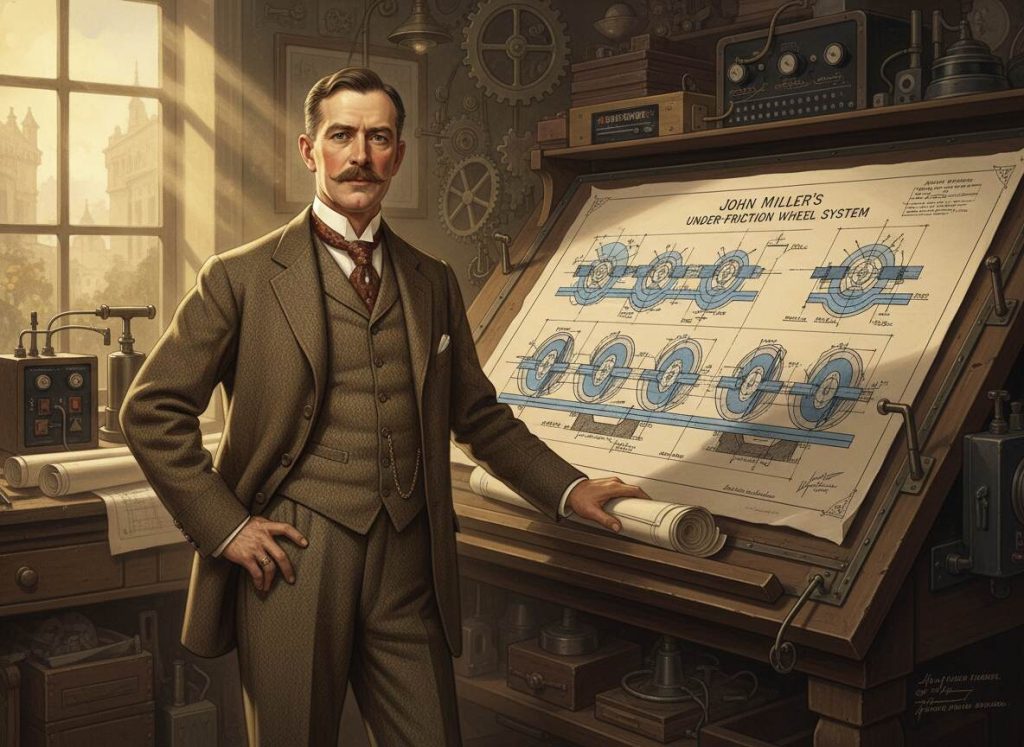
John Miller was an American engineer and inventor who made several crucial innovations that transformed roller coaster design. His most important contribution was the development of the under-friction wheel, a wheel that rides under the track and prevents the coaster train from lifting off the track during inversions or steep maneuvers.
Before Miller’s innovation, coaster trains were simply placed on top of the track, held in place by gravity and friction. This design severely limited what coasters could do. Trains couldn’t go upside down or perform steep maneuvers without risk of derailing.
Miller’s under-friction wheel solved this problem. By adding wheels that gripped the track from below, Miller’s design allowed coasters to perform inversions and steep maneuvers safely. This innovation opened up entirely new design possibilities for coaster engineers.
Miller also developed other crucial innovations, including:
Guide wheels that keep the train centered on the track, preventing side-to-side movement and improving safety.
Improved braking systems that allow for smooth, controlled deceleration.
Better understanding of the physics and forces involved in coaster design, allowing for more precise calculations and safer designs.
Miller’s innovations were so fundamental that modern coasters still use the basic wheel assembly he developed over a century ago. The three-wheel system (road wheels on top, guide wheels on the sides, and brake wheels) is standard on most coasters today.
Miller patented his innovations and licensed them to coaster manufacturers, which helped spread his designs throughout the industry. His influence on coaster design cannot be overstated.
The Coney Island Era: The Birth of the Amusement Park Coaster
Coney Island, New York, became the epicenter of coaster innovation in the late 19th and early 20th centuries. The combination of a large population, beach location, and entrepreneurial spirit created the perfect environment for coaster development.
Several iconic coasters opened at Coney Island during this era:
The Switchback Railway (1884) – The first successful gravity-powered coaster, designed by John Miller.
The Cyclone (1927) – A legendary wooden coaster that remains operational today and is considered one of the greatest wooden coasters ever built.
The Thunderbolt (1925) – Another iconic wooden coaster that demonstrated advanced design principles.
Luna Park (1903) – An amusement park that featured multiple coasters and became a model for future amusement parks.
Steeplechase Park (1897) – An amusement park that featured the Steeplechase coaster, one of the first coasters to feature multiple inversions.
Coney Island’s coasters pushed the boundaries of what was possible. Engineers competed to build taller, faster, and more thrilling coasters. This competitive spirit drove rapid innovation and led to many of the fundamental coaster designs that are still used today.
The Inversion Revolution: Making Coasters Turn Upside Down
One of the most significant innovations in coaster history was the development of inversions—elements where the coaster train flips riders upside down. This innovation opened up entirely new design possibilities and transformed what coasters could do.
The Flip Flap Railway: The First Looping Coaster
The first looping coaster was the Flip Flap Railway, which opened in 1888 at Sea Lion Park in Coney Island. Designed by Lina Beecher, a pioneering engineer, the Flip Flap Railway featured a single circular loop that riders would pass through.
The Flip Flap Railway was revolutionary, but it had a significant problem: the circular loop created extreme G-forces that were uncomfortable and potentially dangerous for riders. Riders reported being knocked unconscious or suffering injuries from the intense forces.
Despite its problems, the Flip Flap Railway demonstrated that inversions were possible. This knowledge drove subsequent innovation in inversion design.
Lina Beecher: The Pioneering Woman Engineer
Lina Beecher deserves special recognition as one of the earliest and most innovative coaster designers. In an era when women were largely excluded from engineering, Beecher designed and built the Flip Flap Railway, the first looping coaster.
Little is known about Beecher’s life and career—historical records are sparse and fragmented. However, her contribution to coaster history is undeniable. She demonstrated that inversions were possible, which inspired subsequent engineers to develop safer and more effective inversion designs.
Beecher’s legacy is significant not just for her technical contributions, but for breaking barriers in a male-dominated field. Her work paved the way for future women engineers in the amusement industry.
The Teardrop Loop: A Safer Inversion Design
The circular loop of the Flip Flap Railway created extreme G-forces because the radius of the loop was constant. At the top of the loop, riders experienced the most intense forces.
Engineers eventually developed the teardrop loop (also called an egg-shaped loop), which has a tighter radius at the bottom and a wider radius at the top. This design distributes forces more evenly throughout the loop, creating a more comfortable and safer experience.
The teardrop loop was a crucial innovation that made inversions practical and safe. Modern inversions are based on variations of the teardrop loop design.
Arrow Dynamics and the Modern Inversion Era
Arrow Dynamics, founded in the 1950s, revolutionized inversion design. Arrow engineers developed sophisticated mathematical models and computer simulations that allowed them to design inversions that were both thrilling and safe.
Arrow Dynamics’ innovations included:
The corkscrew inversion – A smooth, spiraling inversion that became iconic in coaster design.
The loop-the-loop – A refined version of earlier loop designs, using teardrop geometry for safety and comfort.
Multiple inversions – Arrow coasters featured multiple inversions in sequence, creating complex and thrilling experiences.
Arrow Dynamics’ influence on coaster design was profound. Many of the most iconic coasters of the 1970s and 1980s were Arrow designs, and their innovations set the standard for inversion design that persists today.
The Steel Coaster Revolution: From Wood to Steel
While wooden coasters dominated the early era of coaster design, the development of steel coasters in the mid-20th century represented a fundamental shift in coaster technology and design possibilities.
The First Steel Coaster: Matterhorn Bobsleds
The first steel roller coaster is generally credited to Matterhorn Bobsleds, which opened at Disneyland in 1959. Designed by Arrow Development (which later became Arrow Dynamics), Matterhorn Bobsleds featured a steel track and tubular design that allowed for new design possibilities.
The tubular track design was revolutionary. Unlike wooden coasters, which used flat steel rails on top of wooden support structures, tubular steel coasters featured a complete tube that the train traveled through. This design allowed for inversions and maneuvers that were impossible on wooden coasters.
Matterhorn Bobsleds demonstrated the potential of steel coasters. The attraction was popular and successful, proving that steel coasters were viable and desirable.
Arrow Development: Pioneering Steel Coaster Design
Arrow Development (founded in 1954) was instrumental in developing steel coaster technology. The company’s engineers, led by founders Karl Bacon and Ed Morgan, pioneered many of the fundamental designs and technologies used in modern steel coasters.
Arrow’s key innovations included:
Tubular track design – Allowing for inversions and complex maneuvers.
Articulated trains – Trains that could flex and adapt to the track, improving comfort and safety.
Advanced inversion designs – Including the corkscrew and loop-the-loop.
Computer-aided design – Using early computers to model and analyze coaster designs.
Arrow Development’s influence on the industry was enormous. Many of the most iconic coasters of the 1970s and 1980s were Arrow designs, and the company’s innovations set the standard for steel coaster design.
Intamin: Innovation and Record-Breaking
Intamin, a German coaster manufacturer founded in 1967, became known for innovative and record-breaking designs. Intamin engineers pushed the boundaries of what was possible, creating some of the world’s tallest, fastest, and most innovative coasters.
Intamin’s key innovations included:
Hydraulic launch systems – Allowing coasters to accelerate from 0 to high speeds in seconds, without traditional lift hills.
Hypercoasters – Tall, fast coasters with exceptional airtime and pacing.
Giga coasters – Coasters over 300 feet tall, pushing the limits of height and speed.
Strata coasters – Coasters over 400 feet tall, with extreme height and speed.
Intamin’s record-breaking coasters captured public imagination and drove industry innovation. The company’s willingness to push boundaries inspired other manufacturers to innovate as well.
Bolliger & Mabillard: Engineering Excellence
Bolliger & Mabillard (B&M), a Swiss coaster manufacturer founded in 1988, became known for engineering excellence and refined design. While B&M didn’t invent fundamentally new technologies like some other manufacturers, they perfected existing technologies and created some of the most respected coasters in the world.
B&M’s approach emphasized:
Smooth, refined designs – B&M coasters are known for their smooth, comfortable rides despite high speeds and intense elements.
Hypercoasters – B&M perfected the hypercoaster design, creating some of the most respected hypercoasters in the world.
Inverted coasters – B&M’s inverted coaster designs became the industry standard.
Attention to detail – B&M coasters are known for meticulous engineering and attention to detail.
B&M’s influence on the industry is significant. The company’s coasters are widely respected by enthusiasts and engineers alike, and their design philosophy has influenced the entire industry.
Wooden Coaster Innovation: Evolution and Refinement
While steel coasters captured much of the innovation spotlight in the late 20th century, wooden coasters continued to evolve and improve. Wooden coaster designers developed new technologies and refined existing designs to create increasingly sophisticated attractions.
The Golden Age of Wooden Coasters: The 1920s-1950s
The period from the 1920s through the 1950s is often called the “Golden Age” of wooden coaster design. During this era, wooden coaster designers pushed the boundaries of what was possible with wooden construction.
Key innovations during this era included:
Improved track design – Better understanding of track geometry and construction allowed for smoother, more efficient designs.
Advanced support structures – More sophisticated support structures allowed for taller, more complex coasters.
Better understanding of forces – Engineers developed better understanding of the forces involved in coaster design, allowing for more precise calculations.
The Cyclone (1927) at Coney Island is considered one of the greatest wooden coasters ever built and represents the pinnacle of this era’s design philosophy. The Cyclone features exceptional airtime, smooth transitions, and relentless pacing—qualities that made it legendary and that remain impressive nearly 100 years later.
The Decline and Resurgence of Wooden Coasters
By the 1970s and 1980s, wooden coasters had fallen out of favor. Steel coasters offered more design possibilities, including inversions and more extreme elements. Many parks removed their wooden coasters, and few new wooden coasters were built.
However, in the 1990s and 2000s, wooden coasters experienced a resurgence. A new generation of wooden coaster designers developed innovative designs that rivaled steel coasters in excitement and sophistication.
Key figures in the wooden coaster resurgence included:
John Miller (Dinn Corporation) – Designed classic wooden coasters that demonstrated the continued viability of wooden coaster design.
Fred Church (Dinn Corporation) – Co-founder of Dinn Corporation, pioneered wooden coaster designs that emphasized airtime and pacing.
John Fetterman (GCI) – Founded Great Coasters International and created innovative wooden coaster designs.
These designers proved that wooden coasters could be just as thrilling and sophisticated as steel coasters, leading to renewed interest in wooden coaster design.
Hybrid Coasters and the RMC Revolution
In the 2010s, a new innovation emerged: hybrid coasters that combined wooden support structures with steel track. Rocky Mountain Construction (RMC), founded by Fred Grubb, pioneered this approach.
RMC’s hybrid coasters featured:
Wooden support structures – Maintaining the classic aesthetic and character of wooden coasters.
Steel track – Allowing for inversions and complex maneuvers impossible on traditional wooden coasters.
Innovative designs – RMC created unique, artistic designs that pushed the boundaries of what coasters could be.
Steel Vengeance (2018), an RMC hybrid coaster at Kennywood, has been widely acclaimed as one of the greatest coasters ever built. The coaster transformed a classic wooden coaster into a modern masterpiece, demonstrating the potential of hybrid coaster design.
RMC’s success inspired other manufacturers to explore hybrid designs, and the hybrid coaster category has become one of the most innovative and exciting areas of coaster design.
Technological Innovations: How Engineering Advances Shaped Coaster Design
The evolution of roller coasters has been driven not just by creative designers, but by technological advances that made new designs possible.
Computer-Aided Design and Simulation
The development of computer-aided design (CAD) software and finite element analysis (FEA) simulation tools revolutionized coaster design. Engineers could now model coasters in detail and simulate how they would perform before construction began.
Early coaster designers relied on physical models, calculations, and trial-and-error. Modern designers use sophisticated computer simulations to predict performance, analyze forces, and optimize designs.
This technological advance accelerated innovation and improved safety. Engineers could test designs virtually before building them, reducing the risk of failures or safety issues.
Materials Science Advances
Advances in materials science have enabled new coaster designs. High-strength steel alloys, composite materials, and other advanced materials allow engineers to build lighter, stronger, more efficient coasters.
These material advances have enabled record-breaking coasters. Taller, faster, and more complex coasters are possible because of improved materials that can handle the stresses involved.
Manufacturing Innovations
Advances in manufacturing technology have improved coaster construction. CNC machining, robotic welding, and other advanced manufacturing techniques allow for more precise, consistent construction.
These manufacturing advances improve quality and safety. More precise construction means better performance and fewer issues during operation.
Control Systems and Automation
Modern coasters rely on sophisticated computer control systems that manage acceleration, braking, and safety systems. These control systems are far more sophisticated than the mechanical systems used in early coasters.
Advanced control systems allow for:
Precise speed control – Maintaining consistent speeds and forces throughout the ride.
Safety monitoring – Continuously monitoring the coaster’s performance and automatically addressing issues.
Optimized operation – Maximizing efficiency and reliability.
These control systems are essential to modern coaster design and operation.
Key Inventors and Engineers: The Visionaries Behind the Coaster
While the roller coaster is the product of many contributors, certain individuals made outsized contributions that shaped the industry.
John Miller: The Foundational Innovator
John Miller (1864-1941) is widely recognized as the most important figure in roller coaster history. His innovations—particularly the under-friction wheel—fundamentally changed what coasters could do.
Miller’s career spanned the transition from simple gravity-powered coasters to sophisticated attractions with inversions and complex maneuvers. His innovations enabled this transition and set the foundation for modern coaster design.
Miller patented his innovations and licensed them to manufacturers, which helped spread his designs throughout the industry. His influence persists today—modern coasters still use the basic wheel assembly he developed over a century ago.
Lina Beecher: The Pioneering Inversion Designer
Lina Beecher (dates unknown) designed the Flip Flap Railway, the first looping coaster. While little is known about her life and career, her contribution to coaster history is significant.
Beecher demonstrated that inversions were possible, which inspired subsequent engineers to develop safer and more effective inversion designs. Her work paved the way for the inversion revolution that transformed coaster design.
Beecher’s legacy is also significant for breaking barriers in a male-dominated field. Her work demonstrated that women could contribute meaningfully to engineering innovation.
Karl Bacon and Ed Morgan: Arrow Development Pioneers
Karl Bacon and Ed Morgan founded Arrow Development in 1954 and pioneered steel coaster technology. Their innovations—particularly the tubular track design and advanced inversion designs—fundamentally changed coaster design.
Arrow Development’s influence on the industry was enormous. The company’s designs set the standard for steel coaster design and inspired subsequent innovations.
Fred Grubb: The Hybrid Coaster Revolutionary
Fred Grubb founded Rocky Mountain Construction (RMC) and pioneered hybrid coaster design. His innovations—combining wooden support structures with steel track—created a new category of coasters.
RMC’s success demonstrated that there were still new approaches to coaster design waiting to be discovered. Grubb’s work inspired other manufacturers to innovate and pushed the industry forward.
Bolliger & Mabillard: Engineering Excellence
Walter Bolliger and Claude Mabillard founded Bolliger & Mabillard in 1988. While they didn’t invent fundamentally new technologies, they perfected existing technologies and created some of the most respected coasters in the world.
B&M’s approach—emphasizing smooth, refined designs and meticulous engineering—has influenced the entire industry. The company’s coasters are widely respected and have set new standards for quality and performance.
The Evolution of Coaster Types: How Different Categories Emerged
As coaster technology evolved, different coaster types emerged, each with its own characteristics and design philosophy.
Wooden Coasters: The Classic Design
Wooden coasters were the first type of coaster and remain popular today. Wooden coasters feature wooden support structures and steel rails, creating a classic aesthetic and riding experience.
Wooden coasters are known for:
Airtime – Multiple hills designed to create weightlessness.
Smooth transitions – Well-designed curves and transitions that create a flowing ride experience.
Character – The wooden structure creates a distinctive aesthetic and character.
Classic wooden coasters like the Cyclone at Coney Island and El Toro at Six Flags Great Adventure remain among the most respected coasters in the world.
Steel Coasters: The Modern Revolution
Steel coasters emerged in the 1950s and revolutionized coaster design. Steel coasters feature tubular or I-beam track and steel support structures, allowing for inversions and complex maneuvers.
Steel coasters are known for:
Inversions – Loops, corkscrews, and other elements that flip riders upside down.
Speed and intensity – Steel coasters can achieve higher speeds and more intense forces than wooden coasters.
Precision – Steel track allows for precise, consistent performance.
Steel coasters have become the dominant coaster type, with manufacturers constantly innovating to create new designs and break records.
Hypercoasters: The Tall and Fast Category
Hypercoasters emerged in the 1990s as a new category of tall, fast steel coasters. Hypercoasters typically exceed 200 feet in height and 50 mph in speed, with an emphasis on airtime and pacing.
Key hypercoaster innovations include:
Lift hill designs – Allowing for efficient climbs to extreme heights.
Airtime hills – Multiple hills designed to create sustained weightlessness.
Smooth transitions – Refined designs that create comfortable, smooth rides despite high speeds.
Hypercoasters have become one of the most popular coaster types, with parks investing heavily in these attractions.
Giga Coasters: Pushing the Limits of Height
Giga coasters emerged in the 2000s as coasters exceeding 300 feet in height. These record-breaking attractions push the limits of what’s possible in coaster design.
Key giga coaster innovations include:
Extreme height – Exceeding 300 feet, creating dramatic visual impact.
High speed – Reaching speeds of 80+ mph.
Extreme drops – Steep drops that create intense sensations.
Advanced materials – Using high-strength materials to handle the stresses of extreme height.
Giga coasters represent the cutting edge of coaster design and continue to push boundaries.
Strata Coasters: The Ultimate Height Record
Strata coasters exceed 400 feet in height, representing the ultimate in height-based coaster design. Only a handful of strata coasters exist, as they represent the extreme limit of current technology.
Strata coasters include:
Kingda Ka (Six Flags Great Adventure) – 456 feet tall, held the world record for tallest coaster for 9 years.
Top Thrill Dragster (Cedar Point) – 420 feet tall, the first strata coaster.
Strata coasters represent the pinnacle of height-based design and capture public imagination through their extreme dimensions.
Inverted Coasters: Hanging Below the Track
Inverted coasters, where riders hang below the track with feet dangling, emerged in the 1990s. These coasters create a unique sensation of exposure and vulnerability.
Key inverted coaster innovations include:
Exposed seating – Riders sit with feet dangling, creating a sensation of exposure.
Smooth inversions – Inverted coasters feature smooth, well-designed inversions.
Lateral forces – The exposed seating creates intense sensations during turns and inversions.
Inverted coasters have become a popular category, with manufacturers creating increasingly sophisticated designs.
Floorless Coasters: Removing the Platform
Floorless coasters, where the floor drops away beneath riders’ feet, emerged in the 1990s. These coasters create a sensation of exposure and vulnerability similar to inverted coasters.
Key floorless coaster innovations include:
No floor – The platform beneath riders drops away, creating exposure.
Inversions – Floorless coasters feature inversions, with riders’ feet dangling in the air.
Intense sensations – The lack of floor creates intense sensations during inversions and turns.
Floorless coasters have become a popular category, with manufacturers creating increasingly sophisticated designs.
Winged Coasters: Extending Beyond the Track
Winged coasters, where riders sit on seats that extend beyond the sides of the track, emerged in the 2010s. These coasters create a sensation of exposure and create unique visual aesthetics.
Key winged coaster innovations include:
Seats extending beyond track – Riders sit on seats that extend beyond the sides of the track, creating exposure.
Unique aesthetics – The extended seats create distinctive visual appearances.
Intense sensations – The extended seating creates intense sensations during turns and inversions.
Winged coasters represent recent innovation in coaster design and continue to evolve.
Hybrid Coasters: Combining Wooden and Steel
Hybrid coasters, combining wooden support structures with steel track, emerged in the 2010s. These coasters combine the aesthetic and character of wooden coasters with the design possibilities of steel coasters.
Key hybrid coaster innovations include:
Wooden support structures – Maintaining the classic aesthetic of wooden coasters.
Steel track – Allowing for inversions and complex maneuvers.
Innovative designs – RMC and other manufacturers create unique, artistic designs.
Hybrid coasters represent one of the most innovative and exciting areas of coaster design.
International Contributions: Coaster Innovation Around the World
While America was the birthplace of the modern roller coaster, coaster innovation has been truly international, with significant contributions from designers and manufacturers around the world.
European Innovation: Germany, Switzerland, and Beyond
Europe has been a major center of coaster innovation, with German and Swiss manufacturers leading the way.
Intamin (Germany) – Founded in 1967, Intamin became known for innovative and record-breaking designs, including hydraulic launch systems and giga coasters.
Bolliger & Mabillard (Switzerland) – Founded in 1988, B&M became known for engineering excellence and refined designs.
Mack Rides (Germany) – A historic manufacturer known for family coasters and innovative designs.
Vekoma (Netherlands) – A manufacturer known for steel coasters and family coasters.
European manufacturers have contributed significantly to coaster innovation and continue to push boundaries.
Japanese Innovation: Unique Approaches
Japan has developed its own coaster culture, with manufacturers creating unique designs and pushing boundaries.
Toshiba Corporation – A Japanese manufacturer known for innovative designs and record-breaking coasters.
Japanese parks have also been centers of innovation, with attractions like Steel Dragon 2000 (the longest coaster in the world) and Takabisha (featuring a 121-degree drop) pushing the limits of coaster design.
Chinese Innovation: Rapid Growth
China has emerged as a major center of coaster manufacturing and innovation in recent years. Chinese manufacturers have rapidly developed expertise and created innovative designs.
Chinese parks have invested heavily in coasters, creating some of the world’s most extreme attractions. The rapid growth of the Chinese coaster industry has influenced global trends and pushed innovation forward.
Safety Innovation: How Safety Concerns Drove Design Evolution
Safety has been a driving force in coaster design evolution. As accidents occurred and safety concerns emerged, designers developed new technologies and approaches to address them.
Early Safety Challenges
Early coasters had significant safety issues. The Flip Flap Railway’s circular loop created extreme G-forces that injured riders. Early coasters lacked sophisticated braking systems and safety restraints.
As accidents occurred, designers were forced to innovate. The development of the teardrop loop, improved restraint systems, and better braking technologies were all driven by safety concerns.
John Miller’s Safety Innovations
John Miller’s under-friction wheel was not just an innovation for design possibilities—it was also a safety innovation. By preventing trains from lifting off the track, Miller’s design made coasters safer.
Miller also developed improved braking systems and safety restraints, all driven by the desire to make coasters safer.
Modern Safety Standards
Modern coaster design is governed by rigorous safety standards, including ASTM standards developed by the American Society for Testing and Materials. These standards specify design requirements, testing procedures, and inspection requirements.
Modern coasters are engineered with multiple layers of safety systems, including:
Redundant braking systems – Multiple independent braking systems ensure that coasters can stop safely even if one system fails.
Block zone systems – Dividing the coaster into sections that prevent collisions between trains.
Restraint sensors – Sensors that verify that all restraints are properly secured before the coaster operates.
Computer monitoring – Continuous monitoring of coaster performance and automatic shutdown if issues are detected.
These safety innovations make modern coasters extraordinarily safe, despite their extreme speeds and forces.
The Role of Amusement Parks in Coaster Innovation
Amusement parks have played a crucial role in driving coaster innovation. Parks that invested in coasters and encouraged innovation became centers of coaster development.
Coney Island: The Innovation Epicenter
Coney Island became the epicenter of coaster innovation in the late 19th and early 20th centuries. The combination of a large population, beach location, and entrepreneurial spirit created the perfect environment for coaster development.
Parks at Coney Island competed to build the tallest, fastest, and most thrilling coasters. This competition drove rapid innovation and led to many of the fundamental coaster designs that are still used today.
Cedar Point: The Coaster Capital
Cedar Point, located in Sandusky, Ohio, became known as the “Roller Coaster Capital of the World.” The park invested heavily in coasters and became a center of coaster innovation and excellence.
Cedar Point’s commitment to coasters attracted coaster enthusiasts from around the world and made the park a destination for serious coaster fans. The park’s success demonstrated the value of investing in world-class coasters.
Disneyland: Innovation Through Theming
Disneyland, which opened in 1955, introduced a new approach to coaster design: combining thrills with immersive theming and storytelling. Matterhorn Bobsleds, the park’s first steel coaster, demonstrated that coasters could be more than just thrills—they could be immersive experiences.
Disney’s approach influenced the entire industry, leading to increased emphasis on theming and storytelling in coaster design.
Universal Orlando: Cutting-Edge Innovation
Universal Orlando has become a center of coaster innovation in recent years, investing in cutting-edge attractions that combine thrills with immersive theming. Attractions like The Incredible Hulk Coaster and Harry Potter and the Escape from Gringotts demonstrate Universal’s commitment to innovative coaster design.
Women in Coaster Design: Breaking Barriers and Making Contributions
While coaster design has been historically male-dominated, women have made significant contributions to the field, often breaking barriers in the process.
Lina Beecher: The Pioneering Designer
Lina Beecher, who designed the Flip Flap Railway, was one of the earliest women in coaster design. Her work demonstrated that women could contribute meaningfully to engineering innovation.
Modern Women in Coaster Design
In recent decades, more women have entered coaster design and related fields. While the field remains male-dominated, women engineers and designers are making significant contributions to coaster innovation.
Women in coaster design work as mechanical engineers, structural engineers, project managers, and in other roles. Their contributions are helping to shape the future of coaster design.
The Importance of Diversity in Engineering
Increasing diversity in coaster design and engineering is important for several reasons. Diverse teams bring different perspectives and approaches to problem-solving, which can lead to more innovative solutions. Additionally, diversity in engineering helps ensure that the field benefits from the talents of all people, regardless of gender or background.
The Future of Coaster Innovation: What’s Next?
Coaster design continues to evolve, with new innovations emerging regularly. What does the future hold for roller coaster design?
Virtual Reality Integration
Some parks are experimenting with VR integration on coasters, adding a digital layer to the physical experience. VR headsets can display immersive environments that complement the physical thrills of the coaster.
While VR integration is still in early stages, it represents a potential new direction for coaster design.
Sustainable and Eco-Friendly Designs
As environmental concerns grow, coaster designers are exploring sustainable and eco-friendly designs. This includes using renewable energy, reducing energy consumption, and using sustainable materials.
Future coasters may incorporate solar power, regenerative braking systems, and other sustainable technologies.
Advanced Materials and Manufacturing
New materials and manufacturing techniques will enable new design possibilities. Composite materials, advanced alloys, and other innovations will allow for lighter, stronger, more efficient coasters.
3D printing and other advanced manufacturing techniques may also revolutionize coaster construction.
Artificial Intelligence and Optimization
AI tools may assist in coaster design, helping engineers explore more design possibilities and optimize designs for performance, safety, and efficiency.
Machine learning algorithms could analyze vast amounts of coaster data to identify patterns and inform future designs.
New Coaster Categories
Just as new coaster categories have emerged throughout history, future innovations may create entirely new categories of coasters.
Designers continue to push boundaries and explore new approaches, suggesting that new and unexpected coaster types may emerge in the future.
The Legacy of Coaster Innovation: Impact Beyond the Park
The innovations developed for roller coasters have had impacts beyond amusement parks. Technologies developed for coasters have been applied to other fields.
Engineering and Materials Science
Coaster design has driven advances in engineering and materials science. The need to handle extreme forces and stresses has led to innovations in structural analysis, materials science, and manufacturing.
Computer Simulation and Modeling
Coaster design has driven advances in computer simulation and modeling. The sophisticated simulations used in coaster design have applications in other fields, from aerospace to civil engineering.
Safety Standards and Testing
The rigorous safety standards developed for coasters have influenced safety standards in other industries. The emphasis on redundancy, testing, and continuous monitoring has applications beyond amusement parks.
Conclusion: The Ongoing Story of Coaster Innovation
The roller coaster is not the invention of a single person, but rather the product of centuries of innovation, engineering breakthroughs, and the vision of countless inventors and engineers. From ancient Russian ice slides to modern hybrid coasters, the roller coaster has evolved through the contributions of many visionaries.
Key figures like John Miller, Lina Beecher, Karl Bacon and Ed Morgan, and Fred Grubb made fundamental contributions that shaped coaster design. But beyond these named individuals, countless anonymous engineers, designers, and manufacturers have contributed to the evolution of the roller coaster.
The roller coaster represents human creativity, engineering excellence, and the desire to create thrilling experiences. Each innovation—from the under-friction wheel to the teardrop loop to the hybrid coaster—represents someone’s vision of what was possible and the determination to make it real.
As coaster design continues to evolve, new innovations will emerge, and new designers will push the boundaries of what’s possible. The story of the roller coaster is not finished—it’s an ongoing narrative of innovation, creativity, and the endless human desire to create bigger, faster, and more thrilling attractions.
The next time you ride a roller coaster, you’re experiencing the culmination of centuries of innovation and the work of countless engineers and designers. You’re participating in a tradition that stretches back to Russian ice slides and forward to whatever innovations the future holds. That’s the legacy of the roller coaster—a testament to human ingenuity and our endless desire to push the boundaries of what’s possible.
