If you’re looking for the clean, simple record, here it is: the roller coaster with the most inversions in the world is The Smiler at Alton Towers, with 14 inversions.
That number is the entire point of the ride. The Smiler was designed around the idea of stacking inversion after inversion, but still keeping the pacing tight enough that it feels like a “complete experience,” not just a checklist of upside-down moments.
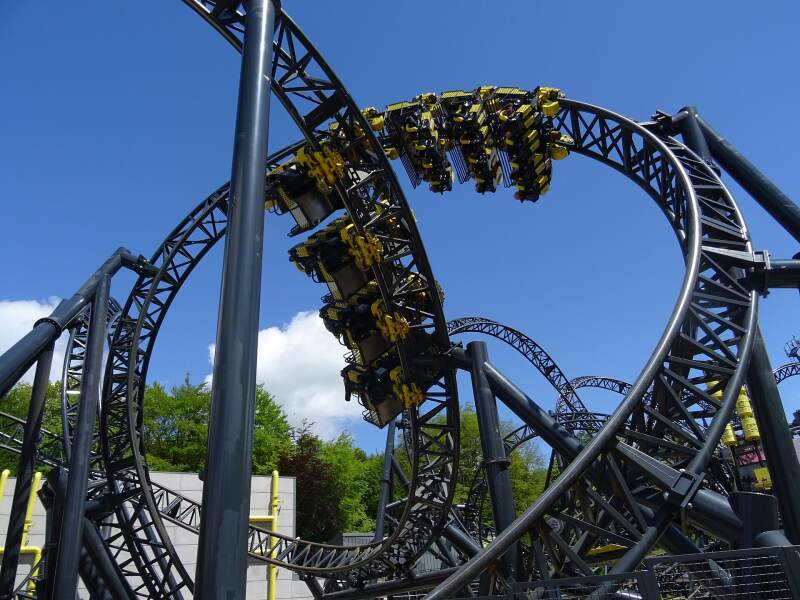
Quick Answer
The Smiler at Alton Towers is the roller coaster with the most inversions in the world, featuring 14 inversions.
What Counts As An Inversion (And What Doesn’t)
For a record like this to mean anything, “inversion” has to be defined in a strict, consistent way. In this post, an inversion means a ride element that turns riders upside down (a true 180 degrees or more of rotation).
That includes elements like:
- vertical loops
- corkscrews
- zero-g rolls
- heartline rolls
- immelmann-style elements (depending on the exact geometry)
It does not include elements that feel twisty but never fully invert riders, like overbanked turns.
If you want a simple “how is this physically possible” explainer check out How Do Roller Coasters Stay On The Tracks?
Why The Smiler Can Stack 14 Inversions Without Falling Apart (Conceptually)
When people hear “14 inversions,” they usually imagine one of two things:
- a smooth, floaty series of flips that feels almost graceful
- a brutal headbanger that leaves you wondering why you did that to yourself
In practice, how a high-inversion coaster feels comes down to a handful of design choices: pacing, transitions, and restraint style. Inversions can be fast and snappy, or drawn-out with hangtime. They can be spaced out with breathers, or stacked in clusters that feel relentless (in a fun way, if you’re the right kind of person).
This is also where restraints matter a lot. The same inversion can feel totally different depending on whether you’re in a more open modern restraint or a bulkier system that changes how your upper body moves. If you want a reader-friendly breakdown, link this section to: Why Roller Coasters Have Different Restraints
Does “Most Inversions” Mean “Most Intense”?
Not always. Inversions are only one kind of intensity. A coaster can have fewer inversions and still feel more extreme if it’s taller, faster, more forceful, or more aggressive in its transitions.
But inversions do create a very specific kind of intensity: repeated moments where your brain has to re-orient itself. Even if the forces are well-managed, the psychological effect of going upside down again and again is real. That’s why this record is such a good “bucket list” stat for coaster fans.
If you a post to calm your nerves check out: Overcome Roller Coaster Phobia
Is A High-Inversion Roller Coaster Safe?
Inversions look dramatic, but modern roller coasters are engineered for them as a normal operating condition. Safety is less about the fact that you go upside down and more about systems: restraint design, inspection routines, redundancy, and operations.
If you want to ground this with a calm, data-forward post check out Roller Coaster Accidents And Safety Statistics
And if you want the bigger historical context for readers who like the “how we got here” angle, this one pairs well too: Roller Coaster Safety Technology Evolution
FAQ: Roller Coaster With The Most Inversions
What Roller Coaster Has The Most Inversions In The World?
The roller coaster with the most inversions in the world is The Smiler at Alton Towers, with 14 inversions.
Do Only Loops Count As Inversions?
No. Loops are just one inversion type. Corkscrews and roll elements also count as inversions as long as riders go fully upside down.
Is “Most Inversions” The Same As “Scariest Coaster”?
Not necessarily. Inversions are one kind of intensity, but height, speed, and force can matter just as much (or more) depending on what scares you personally.
What If I’m Nervous About Going Upside Down?
That’s normal. If you want a practical, non-judgy way to work up to inversion coasters, start here: Overcome Roller Coaster Phobia

Leave a Reply