Roller coasters are the heart and soul of theme parks, combining wild speed, dizzying heights, and impossible-looking loops. But no matter how extreme the ride, one thing never changes: the train always stays on the track. Have you ever wondered how that’s possible? It’s not just luck or wishful thinking—it’s a brilliant blend of physics, mechanical engineering, and relentless safety systems. In this ultra-deep dive, we’ll explore every secret behind how roller coasters stay safely locked to their rails, from the earliest wooden rides to today’s record-breaking steel monsters.
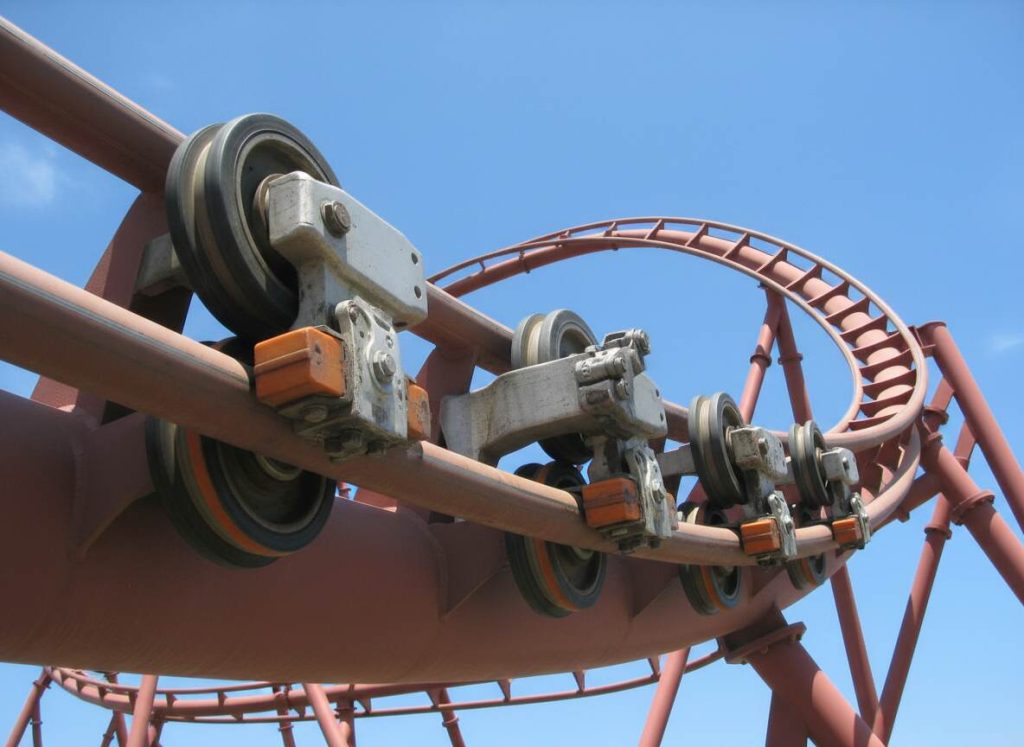
1. The Evolution of Roller Coaster Wheels: From Simple Runners to Engineering Marvels
In the earliest days of thrill rides, coasters were little more than carts riding on wooden rails. The “Russian Mountains” of the 1600s used sleds on ice, and the first American coasters in the 1800s used simple wheels on flat track—meaning sharp turns or hills were risky at best. As coasters grew faster and more ambitious, designers needed a way to keep trains from jumping the rails.
The real revolution came in 1912, when John A. Miller invented the upstop wheel. This third set of wheels, running underneath the rail, was a game-changer. Suddenly, coasters could safely include steep drops, sharp turns, and even the first inversions. The three-wheel system (running wheels on top, side-friction wheels on the sides, and upstop wheels underneath) became the industry standard—and it’s still used on nearly every coaster today.
- Running wheels: Support the weight of the train, riding on top of the rail.
- Side-friction (guide) wheels: Hug the sides of the rail, keeping the train centered and stable in curves.
- Upstop (underfriction) wheels: Clamp beneath the rail, preventing the train from lifting off during airtime or inversions.
Every car in a coaster train has several sets of these wheels, all working together to hold the train tight to the track, no matter how wild the ride gets.
2. The Physics Behind the Thrill: Gravity, Inertia, and G-Forces
At the heart of every coaster is a simple force: gravity. When a train crests the lift hill, it’s loaded with potential energy. As it plunges down the first drop, gravity pulls it toward the ground, turning that potential into kinetic energy (speed). But what keeps the train from flying off the track in a loop, or sliding sideways in a sharp turn?
- Inertia: Objects in motion want to keep moving in a straight line. When the track curves, inertia tries to pull the train outward. The side-friction wheels press against the rail, keeping the train locked to the curve.
- G-Forces: As the train speeds through hills and loops, riders feel the force of gravity change. On a fast drop or a tight loop, you might feel “weightless” (zero Gs) or squished into your seat (multiple Gs). The upstop wheels are critical here—they prevent the train from lifting off, even if the force is strong enough to make riders float out of their seats.
- Centripetal Force: In loops and turns, the track is carefully engineered to push the train inward, balancing inertia and gravity so the wheels never lose contact with the rail.
Engineers use complex calculations and computer simulations to make sure every element of the ride is safe. The speed, angle, and banking of every curve are designed so that the forces always push the train into the track—not away from it.
3. Track Design: The Art and Science of Keeping Trains on Course
The track is more than just a path for the wheels—it’s a carefully engineered structure that guides the train through every twist, turn, and drop. There are two main types of coaster track: wooden and steel, each with its own challenges and advantages.
- Wooden coaster tracks: Made from layers of laminated wood, topped with a steel running rail. The track flexes slightly, absorbing some of the forces and adding to the ride’s classic “rumble.”
- Steel coaster tracks: Built from precision-welded tubular steel, allowing for complex shapes, loops, and ultra-smooth rides. Steel can handle higher speeds and more extreme maneuvers than wood.
Key design features that keep trains on track:
- Banked turns: The track tilts into curves, so the train (and riders) are pressed into their seats instead of thrown sideways. This reduces lateral (sideways) forces and helps the wheels maintain constant contact.
- Teardrop-shaped loops: Unlike the early “circle” loops, modern loops are teardrop-shaped (clothoid), which gradually increase and decrease the G-forces, keeping the ride safe and comfortable.
- Precision alignment: Every joint, weld, and support is checked and re-checked to make sure the track is perfectly smooth and stable. Even a tiny misalignment can cause rough rides or dangerous wear on the wheels.
4. Safety Systems: The Hidden Guardians of Every Ride
While the wheel and track design do most of the heavy lifting, modern roller coasters are packed with extra safety systems that make sure nothing goes wrong. These features work silently behind the scenes, protecting riders and keeping trains locked to the rails even if something unexpected happens.
Anti-Rollback Devices
If you’ve ever listened closely on a lift hill, you’ve probably heard the rhythmic “clack-clack-clack” sound. That’s the anti-rollback device at work. As the train climbs, a ratchet-like mechanism (called a “dog” or “pawl”) engages with notches in the track. If the lift chain fails, the train can’t roll backward—the device locks it in place instantly.
Upstop and Side Friction Wheels: The Unsung Heroes
Upstop wheels (beneath the rail) and side friction wheels (hugging the sides) are constantly at work. On big drops, loops, or “airtime” hills, the upstop wheels clamp the train to the track so tightly that even negative G-forces (the kind that try to lift you out of your seat) can’t budge it. Side friction wheels keep the train perfectly centered, preventing dangerous side-to-side movement.
Restraints, Sensors, and Ride Control
Modern coasters use a combination of mechanical and electronic safety systems:
- Restraints: Lap bars, over-the-shoulder harnesses, and seat belts keep riders safely in their seats. These are checked and locked before every dispatch.
- Sensors: Many coasters have sensors on the track and trains to monitor speed, wheel position, and alignment in real time. If anything is outside safe limits, the ride system can stop the train automatically.
- Block systems: The track is divided into “blocks” or sections, with only one train allowed in each at a time. If a train stops unexpectedly, the system prevents others from entering that block, avoiding collisions.
Routine Inspections and Maintenance
Parks perform daily inspections of every inch of track and every wheel assembly. Trained mechanics walk the track, looking for loose bolts, worn parts, or anything out of the ordinary. Major maintenance (like wheel replacement or track realignment) happens during the off-season, but minor fixes are made constantly to keep everything running smoothly.
5. The Role of Computer Modeling and Testing
Before a new roller coaster ever carries a passenger, it’s been tested and simulated thousands of times. Engineers use advanced computer modeling to predict every force, stress, and possible failure point. Prototypes and test runs are conducted with empty trains, water dummies, and sometimes even sandbags to simulate weight and movement.
- Simulation software: Allows designers to “ride” the coaster virtually, spotting potential problems before construction begins.
- Test runs: Help fine-tune the speed, braking, and overall feel of the ride, ensuring the train never exceeds safe limits at any point on the track.
- Sensors and data logging: During testing, sensors collect real-time data on G-forces, wheel contact, and structural loads, confirming that the ride matches the design specs.
6. Wild Elements: How Coasters Handle Loops, Corkscrews, and Airtime Hills
Some of the most thrilling moments on a coaster are also the most challenging from an engineering perspective. How do trains stay on the track during a vertical loop, a corkscrew, or a zero-G roll?
- Loops: Teardrop-shaped loops keep G-forces positive and the train pressed into the track. The upstop wheels ensure that, even at the top of the loop when gravity wants to pull the train down, it stays securely locked to the rails.
- Corkscrews and barrel rolls: The track twists around itself, but the three-wheel system allows the train to rotate smoothly while maintaining full contact with the rails at all times.
- Airtime hills: On hills designed for “ejector” airtime, the train crests the top so quickly that riders feel weightless or even lifted out of their seats. The upstop wheels are crucial here—without them, the train could actually leave the track. With them, you get all the thrill, none of the risk.
Every wild element you experience is the result of careful calculation, rigorous testing, and the relentless pursuit of safety. The next time you’re flying through a loop or catching air, remember: there’s a world of science working to keep you safe and thrilled.
7. Maintenance in Action: The Unsung Work That Keeps Coasters Safe
The dazzling thrills of a roller coaster are only possible because of the tireless work that happens behind the scenes. Maintenance is not just a matter of fixing things when they break—it’s a daily, ongoing process that keeps every wheel, bolt, and track segment in top shape. Here’s how parks keep coasters safe, smooth, and ready for millions of rides a year.
Daily Inspections
Every morning before the park opens, trained mechanics walk the entire length of each track. They look for loose bolts, worn or cracked wood, chipped paint, and any sign of stress or movement in the supports. Each train is checked for wheel wear, proper restraint operation, and alignment. Nothing is left to chance—a single missed detail can lead to a rough ride or even a safety hazard.
Wheel Replacement and Trackwork
Wheels take a beating on every run. Parks replace them frequently, sometimes after just a few weeks of use. There are often bins of spare wheels in the maintenance shop, each tailored to a specific ride or even a specific car. For wooden coasters, sections of track are replaced or re-aligned as needed, especially in high-stress areas like the bottoms of drops and tight turns. Steel coasters may require weld repairs or new sections of tubular track.
Off-Season Overhauls
During the off-season, when parks are closed, major maintenance projects happen. This can include retracking entire sections, repainting steel, replacing trains, or upgrading control systems. Some classic coasters get completely rebuilt, preserving their historic character while adding modern safety and comfort.
Advanced Diagnostics and Technology
Many modern coasters are equipped with onboard sensors that track wheel temperature, vibration, and alignment in real time. Data from these sensors is used to predict when parts will need replacement and to spot potential problems before they become serious. Parks also use ultrasonic and X-ray inspections to check for hidden cracks or weaknesses in steel and wood.
Training and Certification
Maintenance staff undergo rigorous training and certification. They learn not only how to fix mechanical systems, but how to understand the physics of each ride, read engineering diagrams, and operate specialized diagnostic equipment. Their expertise is the backbone of coaster safety.
8. Famous Engineering Feats: The Coasters That Pushed the Limits
Some roller coasters have become legends not just for their thrills, but for the way they challenged the limits of engineering. Here are a few rides that forced designers to invent new ways to keep trains on the track:
- Kingda Ka (Six Flags Great Adventure, USA): The world’s tallest coaster uses a hydraulic launch to rocket trains up a 456-foot tower. The track’s precision and upstop wheels are tested to the extreme as the train crests the top at over 120 mph.
- El Toro (Six Flags Great Adventure, USA): A wooden coaster with prefabricated track, El Toro achieves smoothness and airtime once thought impossible for wood. The upstop wheels and tight tolerances allow for extreme hills and turns.
- Steel Vengeance (Cedar Point, USA): This hybrid coaster features more airtime than any ride in the world, with a steel track on a wooden frame. The design allows for wild inversions and rapid transitions—only possible with modern wheel and track systems.
- Smiler (Alton Towers, UK): With 14 inversions, Smiler’s trains are subjected to constant twisting and flipping. The three-wheel system and precise track alignment are essential for keeping the ride smooth and safe.
These coasters—and many more—wouldn’t exist without decades of innovation in wheel design, track engineering, and safety systems. Every new record inspires the next breakthrough, and the cycle of creativity continues.
9. The Evolution of Roller Coaster Safety: From Simple Brakes to Smart Technology
Roller coasters have come a long way from their humble beginnings. Early rides relied on gravity, simple brakes, and the hope that everything would hold together. Today, safety is engineered into every aspect of the ride—long before the first train ever leaves the station. Here’s how coaster safety has evolved over the decades:
Early Innovations
The first major leap was John Miller’s upstop wheel in 1912, which allowed for steeper drops and more dynamic layouts. Anti-rollback devices soon followed, making lift hills much safer. Manual brakes, once operated by hand, were gradually replaced by automatic systems.
Mid-Century Advances
As coasters grew taller and faster, designers introduced block systems—dividing the track into sections so only one train could occupy a block at a time. This eliminated the risk of collisions and made multi-train operations possible. Over-the-shoulder restraints and lap bars became standard, giving riders security on ever-wilder elements.
Modern Technology
- Computerized Ride Control: Today’s coasters are controlled by sophisticated computers that monitor every sensor, restraint, and train movement. If anything is amiss, the system can halt the ride instantly.
- Redundant Systems: Multiple layers of safety—mechanical, electronic, and human—work together to catch problems before they become dangerous.
- Continuous Data Monitoring: Real-time data from wheels, brakes, and track sensors help maintenance teams predict issues and schedule repairs proactively.
- Regulations and Inspections: Government agencies and independent inspectors set strict standards for construction, operation, and maintenance. Parks must pass regular audits and surprise inspections to keep their rides open.
Human Element
No amount of technology can replace the eyes, ears, and instincts of a well-trained ride operator or mechanic. Parks invest heavily in training, drills, and ongoing education to ensure everyone on the team is ready to respond to any situation.
10. Wild Facts and Myths: What Really Keeps Coasters Safe?
- Despite urban legends, it is virtually impossible for a properly maintained coaster to “jump the track” thanks to the three-wheel system and constant inspections.
- Some coasters are so precisely engineered that wheel assemblies are swapped out after just a few weeks, keeping the ride feeling new and safe.
- On high-speed launches, the force pressing the train into the track can be several tons—more than enough to keep everything secure even during extreme maneuvers.
- Roller coaster accidents are extremely rare compared to everyday activities like driving or cycling, thanks to layers of safety, technology, and human oversight.
Conclusion: The Art, Science, and Heart of Staying on Track
Roller coasters are more than just thrill machines—they’re a testament to human ingenuity, teamwork, and the relentless pursuit of fun and safety. Every time you strap in, you’re experiencing the result of centuries of evolution: from hand-built wooden tracks to computer-monitored steel giants, from simple wheels to complex three-point systems that lock every train to the rails.
The secret to staying on track isn’t just one thing—it’s a symphony of physics, engineering, daily care, and passionate people working behind the scenes. The next time you fly through a loop or catch air on a big drop, you can trust that a world of science and safety is holding you in place. And that’s what makes every ride not just thrilling, but truly amazing.
So go ahead—raise your hands, scream your heart out, and enjoy the ride. The tracks have you covered.
