Pregnancy changes a lot of things: your body, your energy levels, your relationship with certain foods. But does it have to mean giving up the thrill of a roller coaster? If you’re expecting and wondering whether you can still enjoy amusement parks, you’re not alone. Pregnant women ask this all the time, and the answer is more nuanced than a simple yes or no.
The truth is, riding a roller coaster while pregnant depends on several factors: how far along you are, your individual health, the type of coaster, and what your doctor says. This guide walks you through the medical considerations, the physics of coaster rides, which rides are safer than others, and how to make an informed decision about your pregnancy and theme park visits.
Quick takeaway: Most parks post pregnancy warnings for a reason. Even if the ride itself is unlikely to directly harm the baby, the combination of restraint pressure, sudden jolts, balance changes, and the risk of a hard bump to the abdomen is enough that many doctors recommend skipping coasters during pregnancy. If you are considering riding anyway, get your OB-GYN’s input first.
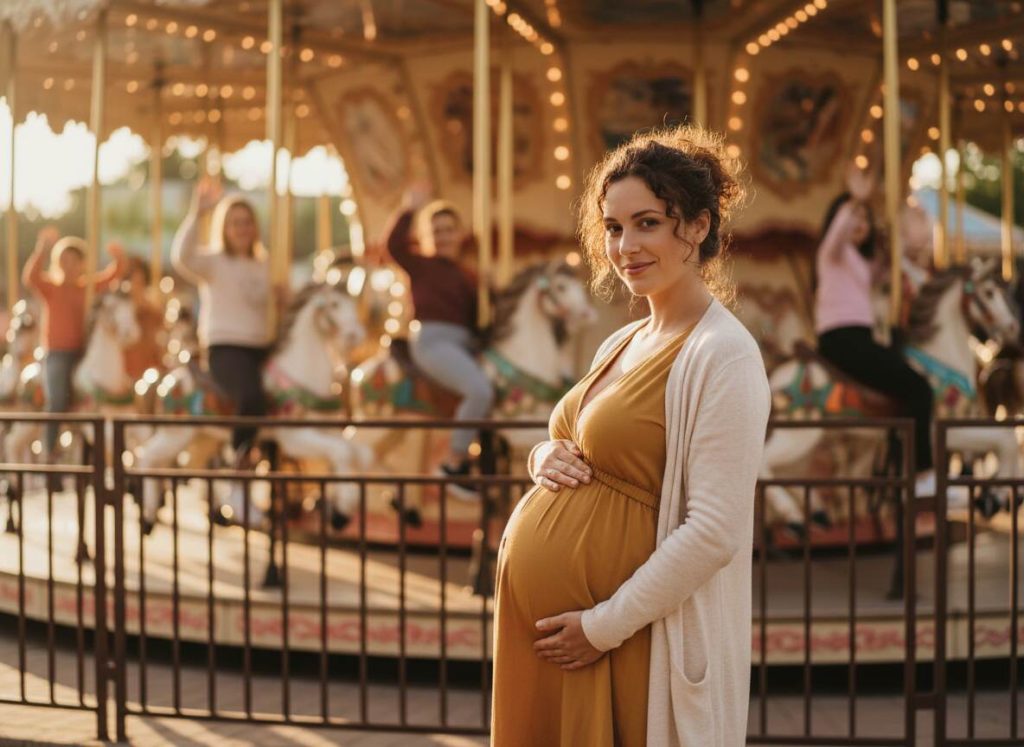
Understanding The Medical Perspective
Before we dive into which coasters might be okay, it helps to understand what medical professionals actually mean when they warn against certain activities during pregnancy. The good news is that most major medical organizations do not publish a coaster-specific rule. The less comforting news is that roller coasters fit neatly into the category of activities doctors often caution against: anything with a meaningful risk of falls, abdominal impact, or sudden forceful movement.
The American College of Obstetricians and Gynecologists (ACOG) generally encourages exercise in uncomplicated pregnancies, but recommends avoiding activities with a high risk of falling or abdominal trauma. A roller coaster is not a workout, but it can involve abrupt starts and stops, unexpected jolts, and restraint systems that may press into the abdomen. That is why the guidance is usually cautious rather than absolute.
Your OB-GYN is still your best resource. Every pregnancy is different, and factors like bleeding, placental position, blood pressure issues, history of preterm labor, and even how you personally handle motion sickness can change the recommendation. Some people get a cautious green light for very gentle rides early on. Others are advised to skip coasters entirely. The key is having an honest conversation with your doctor before you head to the park.
The Physics Of Roller Coasters And Your Body
To understand why coasters are a gray area, it helps to understand what your body experiences on a ride. Roller coasters involve rapid acceleration and deceleration, changes in direction, and varying G-forces. Those sensations can feel intense, but intensity is not the same thing as danger.
In a typical, uncomplicated pregnancy, the baby is cushioned by amniotic fluid, and the uterus provides protection. That said, coasters are not gentle on you. Pregnancy changes your center of gravity, loosens ligaments, and can make you more prone to dizziness and nausea. A ride that felt fine before pregnancy can feel dramatically different now.
Also, not all coaster forces are created equal. A smooth, floaty airtime hill on a modern steel coaster can feel comfortable to one person and awful to another. A rough wooden coaster can add sharp vibration and lateral jolts. If you want a deeper, non-medical explanation of how coasters generate forces, you may also like How Roller Coasters Work (Engineering + Physics).
The biggest practical concern is not that the coaster “shakes the baby loose.” It is the risk of abdominal impact or restraint pressure, plus the chance you get lightheaded, panic, or brace awkwardly. If you have ever wondered how coasters stay secure on the track even during aggressive maneuvers, How Do Roller Coasters Stay On The Tracks? is a good companion read.
Trimester-By-Trimester Breakdown
Your pregnancy is divided into three trimesters, and the risk calculus changes as your body changes.
First Trimester (Weeks 1-12)
During the first trimester, the embryo and fetus are developing rapidly, and nausea, fatigue, and dizziness are common. Miscarriage risk is also highest in this trimester, although most miscarriages are related to chromosomal issues rather than something you did at a theme park.
Even if you feel okay, many doctors are most conservative in early pregnancy because symptoms can change quickly, and you may not yet know whether your pregnancy will be uncomplicated. If you are considering riding anything beyond gentle attractions, talk to your doctor first.
Second Trimester (Weeks 13-27)
The second trimester is often the most comfortable stretch of pregnancy. Many people have more energy, and nausea may ease up. If anyone is going to consider a coaster during pregnancy, this is the window most people point to, but it still depends on your body, your pregnancy, and your doctor’s guidance.
If you do get a cautious green light, think “gentle and predictable,” not “I feel great so I can do anything.” This is also the stage where restraint fit starts to matter more as your belly grows.
Third Trimester (Weeks 28-40)
By the third trimester, your center of gravity is significantly shifted, your ligaments are looser, and you may be dealing with back pain, pelvic pain, swelling, or shortness of breath. Most doctors strongly advise against riding coasters in the third trimester. Even if the ride is not extreme, the combination of restraint pressure, jostling, and the risk of a hard bump to the abdomen is not worth it.
Also, if you start feeling unwell in a park environment (heat, dehydration, long walks), you want the simplest day possible. If you are planning a park day while pregnant, you may also want to follow CDC guidance on heat safety, especially if you are visiting during summer or a heat wave.
Types Of Coasters: Which Are Safer (If Any)
Not all coasters are created equal. Some are smooth and controlled. Others are rough, whippy, or built around aggressive forces. If you are pregnant, the “safer” choice is usually not a specific coaster type. It is choosing not to ride at all. But if you are evaluating risk with your doctor’s input, these distinctions matter.
Family Coasters
Family coasters are designed to be thrilling without being overwhelming. They usually have smaller drops, lower speeds, and no inversions. If you are going to ride any coaster while pregnant, this is the category most likely to be discussed as a possibility, but only with your doctor’s approval and only if the restraint fits comfortably.
Wooden Coasters
Wooden coasters can be deceptively intense. Some are smooth. Many are not. Even when the forces are not extreme, the vibration and sharp transitions can be uncomfortable, and discomfort matters during pregnancy. If you are already dealing with nausea, pelvic pain, or round ligament pain, a wooden coaster is more likely to make you miserable than happy.
Steel Coasters With Inversions
Coasters with inversions and high sustained forces are the easiest “no.” They are built around aggressive maneuvers, and the restraint systems are often tighter and more rigid. Even if you personally feel fine, most doctors will not love this idea.
Launch Coasters
Launch coasters go from zero to fast immediately. That sudden acceleration can feel jarring, and it can also trigger nausea or a panic response. If you are trying to keep your day calm and predictable, launches are not your friend.
Spinning Coasters
Even mild spinning coasters can be a nausea trap during pregnancy. If motion sickness is already part of your life right now, spinning is usually a skip.
Water Rides
Water rides are not automatically “safe,” but many are gentler than major coasters. The main issue is the drop and the jolt at the bottom, plus the risk of slipping on wet walkways. If you ride water attractions while pregnant, prioritize stable footwear and take stairs slowly.
Restraint Systems And Abdominal Pressure
Restraints are one of the most overlooked parts of this conversation. Even if a coaster is not especially forceful, a restraint that presses into the abdomen can turn a “maybe” into a hard no.
Lap bars, buzz bars, and simple belts tend to leave more room than rigid over-the-shoulder systems, but that does not automatically make them pregnancy-friendly. Some lap bars lock down tightly, and some modern lap bars are shaped in a way that can press into the belly depending on your body and the seat geometry.
If you want a deeper guide to why different coasters use different restraint styles (and what those restraints are designed to do), read Why Roller Coasters Have Different Restraints.
Practical rule: if the restraint feels wrong, do not “tough it out.” Ask to exit before dispatch. Operators deal with this all the time, and it is better to step off than spend the ride bracing and panicking.
Red Flags: When You Should Definitely Skip Coasters
Some situations make coasters a clear no, even if the ride looks gentle. If any of these apply to you, talk to your doctor and assume you will be skipping coasters.
- High-risk pregnancy (preeclampsia, gestational hypertension, significant anemia, placental concerns, cervical issues, or anything your doctor is monitoring closely)
- Bleeding, cramping, or concerning symptoms at any point
- History of preterm labor or pregnancy complications
- Placental issues (your OB-GYN will tell you if this applies)
- Severe nausea, dizziness, fainting, or vertigo
- Significant pelvic pain or mobility issues
- Third trimester (for most people, this is the easiest time to draw a hard line)
If you are looking for a broader perspective on risk and how rare serious incidents are in the coaster world (without sugarcoating), you can also read Roller Coaster Accidents And Safety Statistics.
Questions To Ask Your Doctor
Before you head to the amusement park, have a direct conversation with your OB-GYN or midwife. Helpful questions include:
- Is it safe for me to ride any roller coasters during this pregnancy?
- Are there specific ride types you want me to avoid?
- Are there symptoms that mean I should stop riding immediately and rest or seek care?
- Do any of my personal risk factors change the recommendation?
- At what point in pregnancy do you want me to stop riding even gentle rides?
If your doctor says no, it is worth respecting that boundary, even if you are disappointed. Theme parks are not going anywhere.
If Your Doctor Gives A Cautious Green Light
If your doctor says it is okay for you to ride gentle attractions, treat that as permission to be conservative, not permission to test your limits.
Choose Gentle, Predictable Rides
Stick to mild family coasters and calm attractions where you can sit comfortably and keep your body relaxed. Avoid anything with inversions, strong launches, aggressive lateral movement, or a reputation for roughness.
Check Restraint Fit Before You Commit
If the lap bar presses into your abdomen or you feel like you have to brace, step off. Discomfort is data.
Do Not Ride Alone
Bring someone who can help you move through the park at your pace, carry water, and get you to a quiet spot quickly if you feel off.
Hydrate And Avoid Overheating
Heat and dehydration can make dizziness and nausea much worse. Take shade breaks, drink water steadily, and do not push through symptoms. The CDC heat safety basics are genuinely useful for theme park days.
Eat Small, Steady Snacks
A light snack can help stabilize blood sugar and reduce nausea. Avoid riding on an empty stomach, but also avoid heavy meals right before any motion-based ride.
What To Do If You Feel Off After A Ride
If you feel dizzy, faint, unusually crampy, or just “not right” after a ride, stop and take it seriously. Sit down in shade or air conditioning, drink water, and tell your partner or a staff member how you are feeling. If you have bleeding, severe pain, or symptoms that worry you, seek medical care immediately.
If you are prone to faintness even when you are not pregnant, you may also want to read Do Roller Coasters Cause Kidney Stones? because it covers how coaster forces can affect the body in unexpected ways. It is not a pregnancy article, but it is a useful reminder that your body can react differently to the same ride depending on hydration, fatigue, and stress.
Alternative Theme Park Activities For Pregnant Women
If your doctor advises against coasters, or if you decide coasters are not worth the uncertainty, you can still have an amazing park day. In some ways, pregnancy is a great excuse to do the parts of a theme park that coaster fans usually rush past.
Gentle Rides
Dark rides, slow scenic rides, train rides, observation towers, and carousels are usually the easiest wins. Even then, follow posted warnings and listen to your body. If a ride has a lap bar that locks down hard or a sudden drop, it might be a skip.
Shows And Indoor Attractions
Shows are underrated when you are pregnant. You get shade or air conditioning, a guaranteed seat, and a real break from walking. If you are visiting during hot weather, building your day around indoor blocks is one of the simplest ways to reduce dizziness and exhaustion.
Food, Snacks, And Slow Exploring
Pregnancy cravings are real, and theme parks are basically a snack laboratory. Take your time in themed lands, try the seasonal items, and plan actual sit-down breaks instead of eating while walking.
People-Watching And Photo Spots
Sometimes the best part of a park is the atmosphere. Find a shaded bench with a good view of a coaster drop, watch trains fly by, and let the park come to you.
Real Stories: Pregnant Women And Coasters
Every pregnancy is different, so real experiences are all over the map. These stories are not medical advice, but they can help you feel less alone if you are wrestling with the decision.
Maria’s Story: Riding In The Second Trimester
Maria was a coaster enthusiast before pregnancy. When she found out she was pregnant, she was devastated at the thought of missing out. She talked to her doctor, who gave her a cautious green light to ride gentle attractions in the second trimester. Maria rode a few family coasters during weeks 16-24 of her pregnancy. “It was different than before,” she says. “I was more aware of my body, and I did not push myself. But I am glad I got to experience that. It made me feel like pregnancy was not taking everything away from me.”
Jessica’s Story: Deciding Coasters Were Not Worth It
Jessica had a high-risk pregnancy due to gestational diabetes. She wanted to ride coasters, but her doctor advised against it. “At first, I was disappointed,” she says. “But then I realized my baby’s health was more important than a few minutes of thrill. I spent the day enjoying other rides and being present with my family. It was still a great day, just different than I planned.”
Amanda’s Story: Waiting Until After Pregnancy
Amanda was a hardcore coaster fan. When she got pregnant, she decided to skip coasters entirely. “I did not want to take any chances,” she says. “I knew I would have plenty of time to ride coasters after the baby was born. It was hard to sit on the sidelines, but it was worth it for peace of mind.”
The Bottom Line: It Is Your Decision
Ultimately, whether you ride a roller coaster during pregnancy is a personal decision that should be made with your doctor. There is no one-size-fits-all answer. Some people ride gentle attractions early in pregnancy with medical approval. Many decide the uncertainty is not worth it, and that is a completely valid choice.
What matters is that you make an informed decision based on your individual health, your pregnancy circumstances, and your doctor’s guidance. Do not let anyone pressure you into riding if you do not feel comfortable. And do not feel guilty if you decide to skip coasters. Your health and your baby’s health are the priority.
If fear and pressure are a big part of this for you, you might also like Overcome Roller Coaster Phobia. It is aimed at anxious riders, but it also helps you separate “I do not want to” from “I feel like I have to,” which is a useful skill when you are pregnant and everyone has an opinion.
Conclusion: Enjoying The Park While Protecting Your Baby
An amusement park visit during pregnancy does not have to mean missing out entirely. Whether you ride nothing more intense than a dark ride, or you choose a very gentle coaster with your doctor’s approval, you can still have a full, memorable day.
Talk to your doctor, listen to your body, and prioritize comfort and safety over the idea of “keeping up.” Pregnancy is temporary, and coasters will still be there later. If you skip them this season, you are not losing part of yourself. You are making a smart call for the moment you are in.
