The claim that roller coasters can cause kidney stones has circulated for decades, often shared as a cautionary tale or urban legend among theme park enthusiasts. Some riders worry before boarding intense coasters; others avoid them entirely based on this fear. But what does the science actually say?
The short answer: there is no credible scientific evidence that roller coasters cause kidney stones. However, the myth persists because it touches on real physiological concepts—G-forces, dehydration, and fluid dynamics in the body. Understanding the actual mechanisms behind kidney stone formation, combined with what we know about the forces experienced on coasters, reveals why this myth is largely unfounded while also clarifying which riders might genuinely need to take precautions.
This post explores the science of kidney stones, the forces at play on roller coasters, the research (or lack thereof) connecting the two, and practical guidance for riders with kidney stone risk factors.
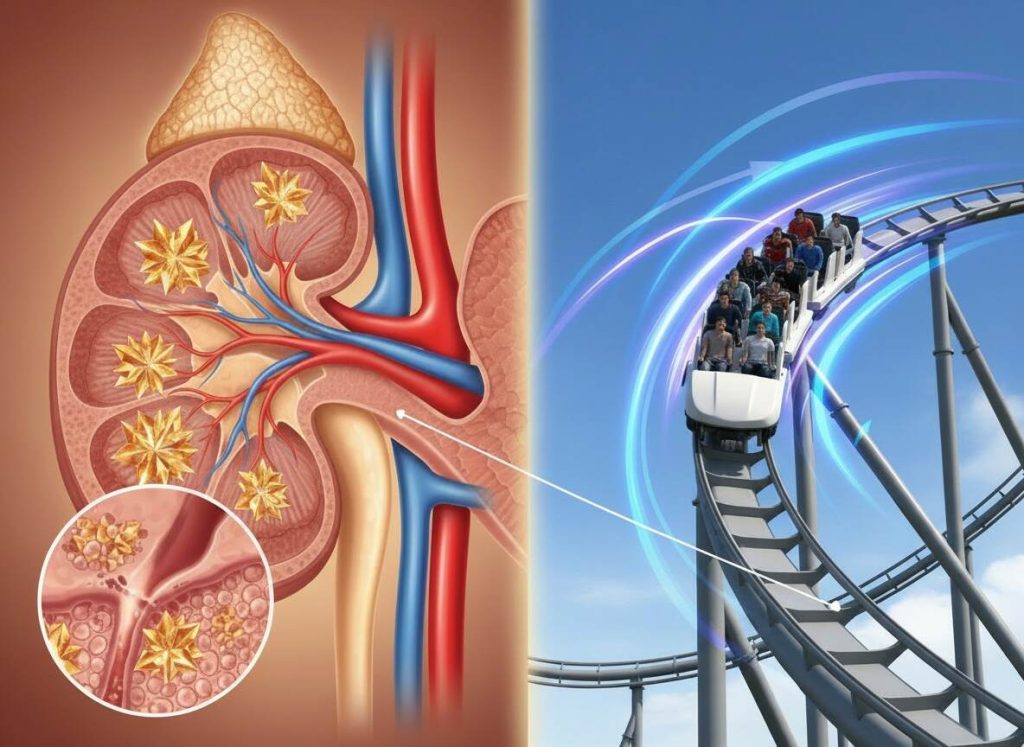
What Are Kidney Stones and How Do They Form?
Kidney stones are solid mineral deposits that form in the kidneys when certain substances in urine become concentrated enough to crystallize. Understanding their formation is essential to evaluating whether coasters could realistically cause them.
The Chemistry of Stone Formation
Kidney stones typically form from one of four mineral types: calcium oxalate (the most common, accounting for about 75 percent of cases), calcium phosphate, uric acid, or struvite (magnesium ammonium phosphate). These minerals are normally present in urine in dissolved form, but under certain conditions, they crystallize and accumulate into stones.
The process requires specific conditions: elevated concentrations of stone-forming substances, low urine volume (high concentration), and an environment favoring crystallization. It’s a gradual process that typically takes weeks to months, not minutes or hours.
Risk Factors for Kidney Stone Formation
Medical research has identified numerous established risk factors for kidney stone development:
Dehydration and low urine volume are among the strongest risk factors. When you don’t drink enough fluids, urine becomes concentrated, increasing the likelihood that minerals will crystallize. This is why kidney stone patients are universally advised to drink more water.
Dietary factors play a significant role. High sodium intake, excessive animal protein, and foods rich in oxalates (spinach, nuts, chocolate, tea) can increase stone risk. Conversely, adequate calcium intake and citrate (found in citrus fruits) actually protect against stone formation.
Genetic and metabolic factors influence stone risk. Some people have inherited conditions affecting how their bodies process calcium or other minerals. Hyperparathyroidism, cystic kidney disease, and certain genetic disorders increase stone risk substantially.
Age and sex matter. Kidney stones are most common in people aged 40–60, and men are about three times more likely to develop them than women.
Previous stone history is a strong predictor. People who’ve had one stone have a 50 percent chance of developing another within 10 years.
Certain medications can increase stone risk, including some diuretics, vitamin D supplements in excess, and antacids containing calcium.
Notably absent from this list: acute physical forces, G-forces, or brief episodes of acceleration and deceleration.
Understanding G-Forces on Roller Coasters
To evaluate whether coasters could cause kidney stones, we need to understand the forces riders experience.
What Are G-Forces?
A G-force (or gravitational force) is a unit of acceleration equal to Earth’s gravitational pull at sea level, approximately 9.8 meters per second squared. When you experience 2 Gs, you’re experiencing twice the force of gravity pulling on your body.
On roller coasters, riders experience varying G-forces depending on the ride’s design, speed, and the specific section (hills, turns, loops, etc.). Positive Gs push you into your seat; negative Gs (airtime) create the sensation of weightlessness.
Typical G-Forces on Coasters
Most roller coasters operate within a range of 2–5 Gs during normal operation. Some intense coasters push toward 4–5 Gs on sharp turns or during inversions. Extreme coasters might briefly exceed 5 Gs.
For context, fighter pilots regularly experience 6–9 Gs during combat maneuvers, and astronauts experience about 3 Gs during spacecraft launch and reentry. These are acute exposures lasting seconds to minutes.
What Happens to Your Body During High G-Forces
During high G-forces, your body experiences increased pressure. Blood tends to pool in your lower extremities due to inertia, which is why riders sometimes experience tunnel vision or lightheadedness on intense coasters. Your organs experience increased pressure, and your muscles and skeletal system bear more load.
However, these forces are brief—typically lasting only seconds to a few minutes during a coaster ride. Your body is remarkably resilient to short-term acceleration and deceleration, which is why coasters are safe for most riders.
The Kidney Stone Myth: Origins and Persistence
Where Did the Myth Come From?
The exact origin of the kidney stone-coaster connection is unclear, but it likely stems from a few sources:
Misunderstanding of G-forces: People may have assumed that high G-forces could somehow dislodge or create stones, without understanding the actual mechanisms of stone formation.
Confusion with other conditions: High G-forces can cause temporary discomfort or pain in people with existing kidney stones. Someone experiencing stone pain after riding might attribute it to the coaster, when the stone was already present.
Anecdotal reports: Isolated cases where someone rode a coaster and later developed symptoms might have been coincidental rather than causal, but the story spreads.
Dehydration connection: Dehydration is a real risk factor for kidney stones, and theme park visitors often become dehydrated. Someone might develop a stone days after a park visit due to dehydration, and the coaster gets blamed.
Why the Myth Persists
The myth persists because it sounds plausible on the surface. High forces, internal organs, minerals in the body—it creates a narrative that seems logical without deeper investigation. Additionally, kidney stones are common enough that many people have personal experience or know someone who has had one, lending credibility to anecdotal stories.
What Does the Research Actually Show?
The Surprising NASA Study
In 2016, a study conducted by researchers at the University of California, San Diego, in collaboration with NASA, examined whether roller coasters could dislodge kidney stones. The study used a kidney stone model and simulated coaster forces to test whether the G-forces and vibrations could cause stones to move.
The surprising finding: under certain conditions, coaster-like forces might actually help dislodge existing kidney stones, rather than cause them. The study suggested that the combination of G-forces and vibrations could potentially shake loose stones that were already present but asymptomatic.
This finding was widely misreported in the media as “roller coasters cause kidney stones,” when the actual research suggested the opposite—that coasters might help people with existing stones pass them. However, this is not a recommendation to ride coasters as a treatment; the effect is unpredictable and could cause pain.
Lack of Epidemiological Evidence
Despite the prevalence of the myth, there is no epidemiological evidence (large-scale studies tracking kidney stone incidence in populations) showing that roller coaster riders develop kidney stones at higher rates than non-riders. If coasters were a significant risk factor, we would expect to see this reflected in medical data, especially given the millions of coaster rides worldwide annually.
Medical Literature on Coasters and Kidney Health
A search of medical literature reveals no peer-reviewed studies documenting kidney stone formation caused by roller coaster rides. Urology and nephrology textbooks do not list coaster rides as a risk factor for stone formation. Medical organizations like the American Urological Association do not warn patients about coasters.
This absence of evidence in medical literature is telling. If coasters were a genuine risk factor, it would be documented and discussed in medical education and practice guidelines.
The Physics: Why Coasters Shouldn’t Cause Kidney Stones
Duration of Forces
Kidney stone formation is a gradual chemical process requiring sustained conditions over weeks to months. A roller coaster ride lasts minutes at most. The brief exposure to G-forces is insufficient to create the sustained concentration of minerals needed for crystallization.
Mechanism of Crystallization
Stone formation requires specific conditions: high concentration of stone-forming minerals, low urine volume, and often a specific pH environment. A few minutes of G-forces cannot replicate these conditions. The forces might temporarily shift fluids in your body, but they don’t alter the fundamental chemistry of your urine or create the sustained supersaturation needed for crystallization.
Fluid Dynamics in the Body
While G-forces do affect how fluids move through your body, they don’t fundamentally change the composition of your urine or the concentration of minerals. Your kidneys continue filtering blood and producing urine at their normal rate. The brief acceleration and deceleration of a coaster ride doesn’t change the underlying factors that lead to stone formation.
When Coasters Might Be Problematic for Kidney Stone Patients
While coasters don’t cause kidney stones, they can be uncomfortable or risky for people who already have them.
Existing Symptomatic Stones
If you have an active kidney stone causing pain, riding a coaster could exacerbate that pain. The G-forces and vibrations might move the stone slightly, intensifying discomfort. Additionally, the pain and stress could complicate medical management of the stone.
Existing Asymptomatic Stones
Some people have kidney stones that aren’t causing symptoms. As mentioned earlier, the NASA study suggested that coaster forces might potentially dislodge such stones, which could cause them to move into the ureter and cause pain. This is unpredictable and not a reason to ride coasters as a treatment.
Post-Surgical Considerations
If you’ve recently had kidney stone treatment (such as lithotripsy or ureteroscopy), your urologist will advise you to avoid strenuous activity and high-impact experiences for a period of time. This would include roller coasters.
General Recommendations for Stone Patients
If you have a history of kidney stones, the best approach is to consult your urologist before riding intense coasters. They can assess your individual risk based on your stone history, current status, and overall health. For most people with a history of stones who are not currently experiencing symptoms, coasters are likely safe, but individual circumstances vary.
Dehydration: The Real Risk at Theme Parks
While coasters themselves don’t cause kidney stones, theme parks do present a genuine dehydration risk, which is a real kidney stone risk factor.
Dehydration at Theme Parks
Theme park visitors often become dehydrated due to:
Heat and sun exposure: Outdoor parks in warm climates can cause significant fluid loss through perspiration.
Activity level: Walking, standing in lines, and physical exertion increase fluid loss.
Alcohol and caffeine consumption: Many visitors consume beer, soda, or coffee, which have mild diuretic effects.
Forgetting to drink: In the excitement of the park, people often forget to drink enough water.
Limited water access: While parks have water fountains and can sell water, some visitors don’t drink enough.
Preventing Dehydration-Related Stone Risk
If you have risk factors for kidney stones, protecting yourself at a theme park means prioritizing hydration:
Drink water consistently throughout the day, not just when you feel thirsty. Aim for at least 8–10 glasses of water daily, more in hot weather or with high activity.
Limit alcohol and caffeine, or balance them with extra water.
Take breaks in shaded areas to cool down and drink water.
Eat foods with high water content (fruit, vegetables).
Monitor your urine color; pale urine indicates good hydration, while dark urine suggests you need more fluids.
This hydration strategy is far more important for kidney stone prevention than avoiding coasters.
Medical Conditions That Warrant Caution on Coasters
While kidney stones aren’t caused by coasters, some kidney and urinary conditions do warrant caution on intense rides.
Recent Kidney Surgery or Procedures
As mentioned, post-surgical recovery typically requires avoiding high-impact activities and intense G-forces for a period of time.
Severe Kidney Disease
People with advanced kidney disease should consult their nephrologist before riding intense coasters, as the stress on the body could be problematic.
Urinary Tract Infections
Active UTIs can cause discomfort that might be exacerbated by coaster forces. It’s better to wait until the infection is treated.
Polycystic Kidney Disease
This genetic condition causes multiple cysts in the kidneys. While coasters don’t cause this condition, people with PKD should consult their doctor about whether intense rides are appropriate.
The Bottom Line: What the Evidence Says
The scientific evidence is clear: roller coasters do not cause kidney stones. The myth lacks support in medical literature, epidemiological data, or physiological mechanisms. The brief exposure to G-forces cannot create the sustained chemical conditions necessary for stone formation.
However, the myth persists because it touches on real concerns: kidney stones are common, G-forces are real, and theme parks do present dehydration risks. By understanding the actual science, riders can make informed decisions.
For most people, including those with a history of kidney stones (who are not currently experiencing symptoms), roller coasters are safe. For people with active kidney stones or recent kidney surgery, caution is warranted—not because coasters cause stones, but because they might exacerbate existing conditions.
The real strategy for preventing kidney stones at a theme park is straightforward: stay hydrated, eat a balanced diet, and consult your doctor if you have specific health concerns.
Conclusion: Enjoy the Ride with Confidence
Roller coasters are engineered with multiple layers of safety in mind, and they’ve been thoroughly tested and ridden by millions of people worldwide. The fear that they cause kidney stones is not supported by science. Instead of worrying about coasters, focus on the genuine risk factors: hydration, diet, and overall health.
If you love coasters, ride them with confidence. If you have specific health concerns, consult your doctor. But the evidence is clear: the kidney stone myth belongs in the realm of urban legend, not medical fact.
