Roller coasters are marvels of engineering, physics, and human ingenuity. To the casual rider, a coaster is simply a thrilling experience—the rush of speed, the sensation of weightlessness, the adrenaline surge. But beneath that experience lies an intricate system of mechanical, electrical, and structural engineering that has evolved over more than a century.
Understanding how roller coasters work requires exploring multiple interconnected systems: the track and support structure, the train and restraint systems, the lift and launch mechanisms, the braking systems, the computer control systems, and the physics that governs the entire experience. It also requires understanding the history of coaster design, the evolution of safety systems, and the principles of physics that make the whole thing possible.
This post provides a comprehensive exploration of roller coaster engineering and physics, from the basic principles to the cutting-edge technology that makes modern coasters possible.
The Fundamentals: Physics and Forces
Before diving into the mechanical systems, it’s essential to understand the physics that governs roller coaster operation. Several fundamental principles are at work every moment a coaster is running.
Gravity and Potential Energy
Gravity is the primary force that drives a roller coaster. When a coaster train is lifted to the top of a hill, it gains gravitational potential energy—energy stored due to its height above the ground. The higher the lift, the more potential energy is stored.
The formula for gravitational potential energy is: PE = mgh, where m is mass, g is gravitational acceleration (9.8 m/s²), and h is height. This means that a coaster train lifted 200 feet high stores significantly more energy than one lifted 100 feet high.
As the train descends from the lift hill, this potential energy is converted into kinetic energy—the energy of motion. The steeper the descent and the greater the height difference, the more kinetic energy the train gains, and the faster it moves.
Kinetic Energy and Speed
Kinetic energy is the energy of a moving object, calculated as KE = ½mv². This formula reveals an important principle: kinetic energy increases with the square of velocity. This means that doubling a coaster’s speed quadruples its kinetic energy. This is why small increases in speed create dramatically larger forces and sensations.
A coaster train at 30 mph has four times the kinetic energy of a train at 15 mph. This is why the difference between a family coaster and a hypercoaster feels so dramatic—it’s not just the speed increase, but the exponential increase in energy.
G-Forces and Acceleration
G-forces are a measure of acceleration relative to gravitational acceleration. One G is the acceleration due to gravity (9.8 m/s²). When a coaster pulls 3 Gs, it’s accelerating at three times the rate of gravity.
G-forces are experienced whenever a coaster changes direction or speed. At the bottom of a hill, as the coaster curves upward, riders experience positive G-forces—they feel heavier as they’re pushed into their seats. On the crest of a hill or in airtime, riders experience negative G-forces—they feel lighter or weightless as they’re pulled away from their seats.
The human body can tolerate significant G-forces. Fighter pilots routinely experience 6-9 Gs. Roller coaster riders typically experience 2-5 Gs, though some intense coasters can reach 6+ Gs briefly. The key to safe coaster design is ensuring that G-forces are within tolerable ranges and distributed in ways that don’t cause injury.
Centripetal Force and Circular Motion
When a coaster goes around a curve or loop, it must accelerate toward the center of the curve. This acceleration is called centripetal acceleration, and the force causing it is centripetal force.
The formula for centripetal acceleration is a = v²/r, where v is velocity and r is the radius of the curve. This reveals a critical principle: the faster a coaster goes around a curve, or the tighter the curve (smaller radius), the greater the centripetal force required.
This is why coaster designers carefully control the radius of curves and loops. A loop that’s too tight at high speed would create dangerous G-forces. A loop that’s too loose wouldn’t provide the thrilling sensation riders expect. The design must balance physics, safety, and experience.
Friction and Energy Loss
Friction is the resistance to motion between surfaces in contact. In a roller coaster, friction occurs between the wheels and the track, in the wheel bearings, and in the air as the train moves through it (air resistance).
Friction causes energy loss. Some of the kinetic energy the coaster gains from descending the lift hill is dissipated as heat due to friction. This is why a coaster cannot climb a second hill as high as the first lift hill—energy has been lost to friction.
Modern coaster designers account for friction in their calculations. They ensure that even with friction losses, the coaster has enough energy to complete the course safely. On some coasters, additional lift hills are used to restore energy lost to friction. On others, launch systems provide additional energy input.
Track Design and Support Structures
The track is the foundation of a roller coaster. It guides the train, supports its weight, and provides the surface on which the wheels roll. Track design has evolved dramatically over coaster history.
Wooden Coaster Tracks
Traditional wooden coasters use a track made of steel rails laid on top of a wooden support structure. The wooden structure—made of large wooden beams—provides the primary support and bears the weight of the train and riders.
The steel rails on top of the wooden structure are typically two parallel rails. The train’s wheels roll on top of these rails. This design is relatively simple and has been used for over a century.
Wooden coasters are built with a lattice or truss structure beneath the track. This structure is made of wooden beams arranged in triangular patterns, which provide strength and rigidity while minimizing weight. The structure must be strong enough to support the train and riders, but light enough to be economically feasible.
Steel Coaster Tracks
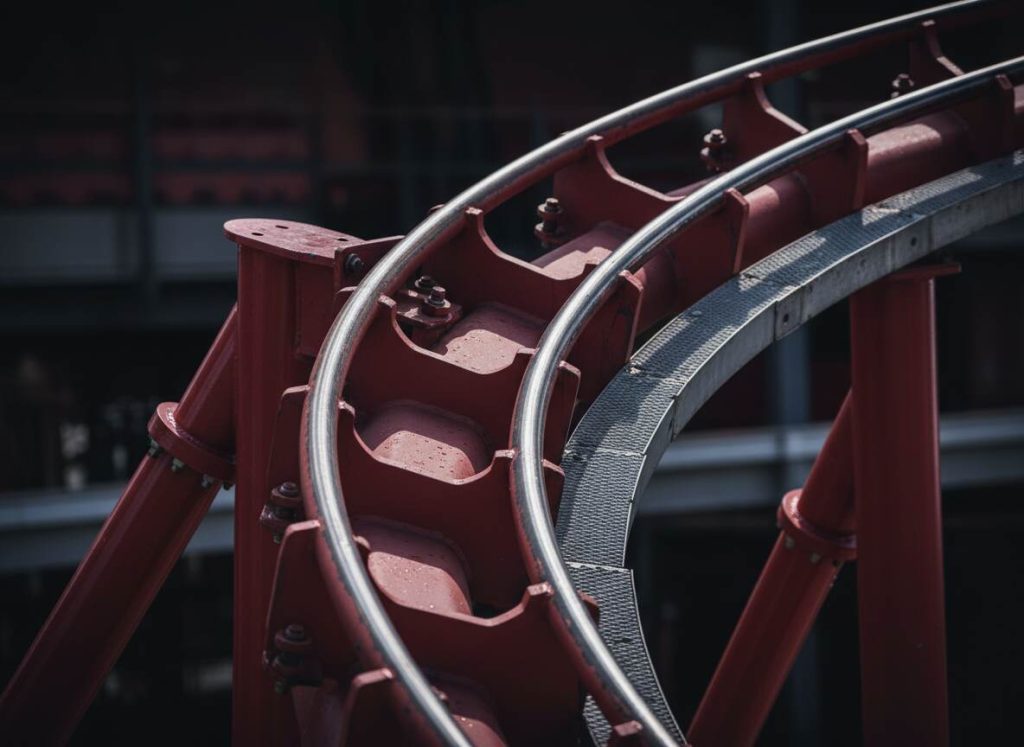
Steel coasters use a different track design. The track itself is made of steel tubes or I-beams, and the train’s wheels engage with the track in different ways depending on the coaster type.
On a traditional steel coaster (like an inverted coaster), the train has wheels on top of the track (road wheels), wheels on the sides of the track (guide wheels), and wheels underneath the track (upstop wheels). This three-point contact system ensures that the train stays on the track even during inversions.
The track itself is typically a tubular steel structure—a hollow steel tube that is both strong and relatively light. This allows for more complex shapes, tighter curves, and inversions that would be impossible with traditional wooden coaster track.
Steel support structures beneath the track are typically made of steel beams and columns arranged in a lattice or framework. The structure must support the weight of the track and train while allowing for the dynamic forces created during operation.
Track Gauge and Wheel Configuration
Track gauge refers to the distance between the rails or the width of the track. Different coaster types use different gauges. Standard gauge for many coasters is around 4-5 feet, though this varies.
The wheel configuration varies by coaster type. A traditional wooden coaster might have two sets of wheels—one on top of the track and one on the side for guidance. A steel coaster might have three sets of wheels—top, side, and bottom—to ensure secure contact during inversions.
Wheels are typically made of polyurethane or similar materials that provide good grip and durability while minimizing wear on the track. Wheels are mounted on axles and bearings that allow them to rotate smoothly.
Banking and Angle
Coaster designers use banking—tilting the track—to manage forces during curves. A banked curve is tilted inward, so the track itself is angled rather than level.
Banking allows the coaster to take curves at higher speeds while distributing forces more comfortably. Instead of all the centripetal force coming from the side of the track pushing on the wheels, some of it comes from the banking of the track itself. This reduces the lateral force riders feel and allows for faster, more thrilling curves.
Banking angles vary from slight (a few degrees) to extreme (up to 90 degrees or more on some modern coasters). A 90-degree banking means the track is completely vertical—riders are essentially sideways as they go around the curve.
The Train and Restraint Systems
The coaster train is the vehicle that carries riders around the track. Train design has evolved significantly over coaster history, and modern trains are sophisticated pieces of engineering.
Train Structure and Cars
A coaster train consists of multiple cars connected together. Each car typically seats 2-4 riders, though some coasters have larger or smaller cars. The cars are connected by articulated joints that allow them to move relative to each other, absorbing forces and allowing the train to navigate curves smoothly.
The structure of each car includes a frame (typically steel), a seat or seating area, and attachment points for wheels and restraints. Modern coaster cars are engineered for strength, light weight, and rider comfort.
The connection between cars is critical. The articulated joint must be strong enough to hold the cars together under all forces, but flexible enough to allow the cars to move relative to each other. This prevents the train from being too rigid, which would create uncomfortable jerking sensations as it navigates curves and hills.
Wheel Systems and Guidance
As mentioned earlier, coaster trains use multiple sets of wheels to maintain contact with the track. The specific wheel configuration depends on the coaster type.
Road wheels (top wheels) bear the weight of the train and riders. These wheels roll on top of the track and are the primary contact point. Guide wheels (side wheels) keep the train centered on the track and prevent side-to-side movement. Upstop wheels (bottom wheels) prevent the train from lifting off the track, which is essential for inversions and airtime.
All wheels are mounted on axles and bearings. The bearings are precision-engineered to allow smooth rotation while minimizing friction. Modern bearings use sealed designs to prevent dirt and moisture from entering, which would cause wear and increase friction.
Restraint Systems
Restraints are the safety devices that keep riders in their seats. Restraint design is critical to both safety and the rider experience.
Common restraint types include lap bars (a bar that comes down across the rider’s lap), over-shoulder harnesses (straps that go over the shoulders), seat belts, and clamshell restraints (a device that encloses the rider). Different coaster types use different restraints based on the forces involved and the design of the coaster.
Restraints must be secure enough to keep riders in their seats under all conditions, including inversions and airtime. However, they must also be comfortable enough that riders can tolerate them for the duration of the ride. This balance is achieved through careful engineering of restraint geometry, padding, and locking mechanisms.
Modern restraints use sensors to detect whether they are properly locked. If a restraint is not properly secured, the coaster will not operate. This prevents riders from being injured due to improperly fastened restraints.
Seat Design and Comfort
Coaster seats are engineered for both safety and comfort. Seats must support riders securely while distributing forces evenly across the body to prevent injury.
Seat design varies by coaster type. Some coasters have traditional bucket seats with high sides for support. Others have minimal seating to maximize the sensation of airtime. Some coasters have seats that hang below the track (suspended coasters) or sit on the sides of the track (winged coasters).
Padding and materials are chosen to provide comfort while being durable enough to withstand years of use and exposure to weather. Modern coasters often use high-quality foam padding and weather-resistant materials.
Lift Hill Systems
The lift hill is the mechanism that carries the coaster train to the top of the first hill, where it gains the potential energy needed to complete the course. Lift hill design has evolved significantly over coaster history.
Chain Lift Hills
The traditional chain lift hill uses a continuous chain running along the track. The coaster train has a hook or catch mechanism that engages with the chain. As the chain moves upward, it pulls the train up the hill.
Chain lift hills are simple, reliable, and have been used for over a century. They produce the characteristic “click-click-click” sound as the train engages with the chain. This sound is iconic to coaster enthusiasts.
The chain is driven by a motor at the top or bottom of the hill. The motor provides the power to lift the train against gravity. The speed of the chain is controlled to ensure a consistent lift speed, typically around 0.5-1.5 feet per second.
Chain lift hills are still used on many coasters today, both wooden and steel. They are reliable, relatively inexpensive, and require minimal maintenance compared to some newer systems.
Friction Wheel Lift Hills
Some coasters use friction wheel lift hills instead of chains. These systems use rotating wheels that grip the train and pull it up the hill through friction.
Friction wheel lifts are quieter than chain lifts and can lift trains more quickly. They are commonly used on modern steel coasters. The wheels are driven by motors and are designed to grip the train securely while minimizing wear on both the wheels and the train.
One advantage of friction wheel lifts is that they can be more easily controlled and adjusted. The speed and force can be varied, allowing for different lift profiles. Some coasters use variable-speed lifts that accelerate the train partway up the hill, creating a more dynamic experience.
Cable Lift Systems
Some modern coasters use cable lift systems, where a cable is pulled by a motor and the train is attached to the cable. Cable lifts can be very fast and are used on some of the tallest and fastest coasters.
Cable lifts allow for very steep angles and very fast lift speeds. Some cable lifts can pull a train up a 120-degree angle at speeds exceeding 100 mph. This allows for dramatic lift hills that are part of the coaster’s visual and experiential impact.
Multiple Lift Hills
Many coasters have multiple lift hills throughout the course. These additional lifts restore energy lost to friction, allowing the coaster to maintain speed and intensity throughout the ride.
Multiple lift hills also allow coaster designers to create more complex layouts with multiple airtime hills and inversions. Without additional lifts, the coaster would lose too much speed and wouldn’t be able to complete more ambitious designs.
Launch Systems
Some coasters use launch systems instead of (or in addition to) traditional lift hills. Launch systems accelerate the train to high speed in a short distance, creating a thrilling acceleration sensation.
Linear Synchronous Motors (LSM)
LSM launch systems use electromagnetic technology to accelerate the train. A linear motor is embedded in the track, and the train has a corresponding magnet or conductor. As the motor is energized, it creates a magnetic field that accelerates the train.
LSM systems can accelerate trains very quickly—from 0 to 100+ mph in a few seconds. They are smooth and relatively quiet compared to other launch systems. They are used on many modern coasters, including some of the fastest coasters in the world.
LSM systems are also very controllable. The acceleration profile can be programmed to create different sensations. Some coasters use gradual acceleration, while others use rapid acceleration for maximum thrill.
Linear Induction Motors (LIM)
LIM launch systems are similar to LSM systems but use a different electromagnetic principle. LIM systems use induction to create the accelerating force.
Hydraulic Launch Systems
Some coasters use hydraulic systems to launch trains. A hydraulic launch system uses pressurized fluid to drive a piston or cable that accelerates the train.
Hydraulic launches can be very powerful and can accelerate trains extremely quickly. Some hydraulic systems can accelerate a train from 0 to 120+ mph in under three seconds. This creates an intense acceleration sensation that is a major part of the ride experience.
Hydraulic systems require careful maintenance and monitoring. The hydraulic fluid must be kept clean and at the proper pressure. The system must be regularly inspected for leaks and wear. However, when properly maintained, hydraulic systems are reliable and can operate for many years.
Catapult and Slingshot Systems
Some older coasters used catapult or slingshot systems, where a train was launched by a mechanical device similar to a catapult. These systems are less common on modern coasters but are still used on some classic coasters.
Catapult systems typically used a cable or chain that was pulled back and then released, launching the train. The acceleration was rapid but not as controlled as modern launch systems.
Braking Systems
Braking systems are critical to coaster safety and operation. A coaster must be able to slow down and stop safely at multiple points: at the end of the ride, in block zones during operation, and in emergency situations.
Friction Brakes
Traditional friction brakes use friction between brake pads and a brake surface (typically a fin or rail on the train) to slow the coaster. As the brake pads clamp down on the brake surface, friction slows the train.
Friction brakes are simple and reliable. They have been used on coasters for many decades. However, they generate heat, and the brake pads wear over time and must be regularly replaced.
Friction brakes are typically used at the end of the ride to bring the train to a stop at the station. They are also used in block zones to slow the train if necessary.
Magnetic Brakes
Magnetic brakes use electromagnetic technology to slow the coaster. A magnet on the train passes through a conductive fin or rail. As the magnet moves through the conductor, it induces an electrical current, which creates a magnetic field that opposes the motion. This opposition slows the train.
Magnetic brakes are smooth and quiet. They don’t generate the heat that friction brakes do, and they don’t wear out like friction brake pads. However, they are more complex and expensive than friction brakes.
Magnetic brakes are commonly used on modern coasters, especially in block zones where smooth, controlled braking is important. They allow for precise control of train speed and position.
Eddy Current Brakes
Eddy current brakes are a type of magnetic brake that uses the principle of electromagnetic induction. As a conductive fin passes through a magnetic field, eddy currents are induced in the fin, creating a braking force.
Eddy current brakes are very smooth and provide consistent braking force across a range of speeds. They are ideal for block zones and other applications where consistent, smooth braking is needed.
Block Zone Braking
Block zones are sections of track where the coaster can be slowed or stopped if necessary to prevent collisions or manage train spacing. Block zones use braking systems to control train speed and position.
Modern coasters typically have multiple block zones throughout the course. The computer control system monitors the position of trains and activates brakes in block zones as needed to maintain safe spacing between trains.
Block zone braking allows coasters to operate multiple trains on the same track safely. Without block zones, only one train could be on the track at a time, which would significantly reduce the number of riders per hour.
Emergency Braking
Coasters have emergency braking systems that can bring the train to a stop quickly in case of an emergency. Emergency brakes are typically separate from the normal braking system and are designed to be fail-safe—they engage automatically if power is lost.
Emergency brakes might be friction brakes, magnetic brakes, or other systems. They are designed to stop the train safely without causing injury to riders, even if the train is moving at high speed.
Computer Control Systems
Modern coasters are controlled by sophisticated computer systems that monitor and manage every aspect of operation. These systems are critical to safety and efficiency.
Programmable Logic Controllers (PLCs)
Most modern coasters use Programmable Logic Controllers (PLCs) to manage operation. A PLC is a specialized computer that monitors sensors throughout the coaster and controls various systems based on programmed logic.
The PLC continuously monitors the position and speed of trains, the status of restraints, the condition of various mechanical systems, and numerous other parameters. Based on this information, the PLC makes decisions about when to launch trains, when to activate brakes, and whether to allow operation to continue.
PLCs are extremely reliable and are designed to be fail-safe. If a critical sensor fails or a critical parameter is out of range, the PLC will automatically shut down the coaster to prevent unsafe operation.
Sensor Networks
Coasters have extensive sensor networks that provide the PLC with real-time information about coaster operation. Common sensors include:
Position sensors detect the location of trains on the track. These sensors are used to manage train spacing and ensure that trains don’t collide.
Speed sensors measure the speed of trains at various points on the track. This information is used to verify that trains are operating within safe parameters and to detect any anomalies.
Restraint sensors detect whether restraints are properly locked. If a restraint is not locked, the coaster will not operate.
Brake sensors monitor the condition of braking systems and detect any malfunctions.
Temperature sensors monitor the temperature of various components, including motors, hydraulic systems, and brake systems. If temperatures exceed safe limits, the system can alert operators or shut down the coaster.
Vibration sensors detect abnormal vibrations that might indicate mechanical problems.
Weather sensors monitor conditions like wind speed and lightning. If conditions exceed safe operating parameters, the coaster can be shut down automatically.
Ride Control Systems
The ride control system manages the overall operation of the coaster. It coordinates the launch system, lift hills, brakes, and other systems to create the intended ride experience while maintaining safety.
The ride control system typically includes a queue management system that monitors how many trains are on the track and how many are in the station. It coordinates the loading and unloading of trains to maximize throughput while maintaining safety.
The ride control system also includes diagnostics and monitoring. It continuously checks the status of all systems and alerts operators to any problems. If a critical problem is detected, the system can automatically shut down the coaster.
Data Logging and Analysis
Modern coasters log operational data continuously. This data includes information about train speeds, G-forces, restraint status, brake activation, and numerous other parameters.
This data is invaluable for maintenance and troubleshooting. Operators and maintenance staff can review logs to understand what happened during any incident or anomaly. Engineers can use the data to optimize coaster performance and identify any trends that might indicate developing problems.
Data logging also provides evidence of proper operation for safety audits and regulatory compliance.
Inversions and Loop Design
Inversions—where the coaster flips riders upside down—are a signature feature of many modern coasters. Loop design is a critical aspect of coaster engineering.
The Physics of Inversions
An inversion is possible because of the three-point wheel contact system used on steel coasters. With wheels on top, sides, and bottom of the track, the train can maintain contact with the track even when upside down.
At the top of a loop, riders experience negative G-forces. They feel lighter and are pulled away from their seats. The restraint system holds them in place. The upstop wheels (bottom wheels) keep the train on the track.
The forces at the top of a loop are carefully calculated. Riders must experience enough negative G-force to feel the inversion, but not so much that they are uncomfortable or at risk of injury. Typically, riders experience 0.5-1.5 Gs of negative force at the top of a loop.
Loop Geometry and Design
Early loops were circular—a perfect circle. However, circular loops create very high G-forces at the bottom of the loop (where the radius is smallest and the speed is highest), and lower G-forces at the top (where the radius is largest).
Modern coasters use non-circular loop designs, most commonly the teardrop or clothoid loop. These designs have a smaller radius at the top and a larger radius at the bottom. This distributes G-forces more evenly throughout the loop, creating a more comfortable and safer experience.
The teardrop loop was a major innovation in coaster design. It allowed for smoother, more comfortable inversions and made possible the modern inversion-heavy coasters that are popular today.
Multiple Inversions
Modern coasters often have multiple inversions. Some coasters have 5, 6, or even more inversions. Multiple inversions are possible because modern computer-aided design allows engineers to precisely calculate the forces and geometry needed for safe, comfortable inversions.
Multiple inversions also require careful management of energy. Each inversion dissipates some energy through friction and the forces involved. Coaster designers must ensure that the coaster has enough energy to complete all inversions and the rest of the course.
Airtime and Negative G-Forces
Airtime is the sensation of weightlessness that riders experience when they are pulled away from their seats. It’s one of the most thrilling sensations in coaster riding and is a major design goal for many modern coasters.
Creating Airtime
Airtime is created when riders experience negative G-forces. This happens at the crest of a hill or at the top of an inversion when the coaster is moving fast enough that the centripetal acceleration required to follow the track is less than the gravitational acceleration pulling riders downward.
To create airtime, coaster designers use hills with a specific geometry. The hill must have a radius of curvature that, combined with the coaster’s speed at that point, creates negative G-forces.
The formula for the G-force at the top of a hill is: G = (v²/r)/g – 1, where v is velocity, r is the radius of curvature, and g is gravitational acceleration. When this value is negative, riders experience airtime.
Airtime Hill Design
Modern coasters often have multiple airtime hills designed to maximize the airtime sensation. These hills are carefully shaped to create the desired G-forces.
Some airtime hills are designed to create brief moments of airtime, while others are designed to create sustained airtime where riders are lifted from their seats for an extended period. The geometry of the hill determines the duration and intensity of airtime.
Airtime hills are typically followed by valleys that transition smoothly back to positive G-forces. The transition must be smooth enough to be comfortable for riders.
Restraint Considerations for Airtime
Airtime creates challenges for restraint design. Riders must be securely restrained even when they are being pulled away from their seats. This is why many airtime-heavy coasters use over-shoulder harnesses or lap bars with additional security features.
Some coasters use minimal restraints to maximize the airtime sensation. These coasters rely on the geometry of the seats and the speed of the coaster to keep riders secure. However, riders must still be restrained by some system to meet safety standards.
Wooden vs. Steel Coasters: Engineering Differences
Wooden and steel coasters use fundamentally different engineering approaches, each with advantages and disadvantages.
Wooden Coaster Engineering
Wooden coasters use a wooden support structure with steel rails on top. The train has wheels that roll on top of the rails, with guide wheels on the sides to keep the train centered.
Wooden coasters cannot have inversions because the train cannot be safely inverted with only top and side wheels. The train would fall off the track.
However, wooden coasters can create intense airtime and lateral forces. The track can be designed with sharp angles and quick transitions that create thrilling sensations.
Wooden coasters are typically less expensive to build than steel coasters. The wooden structure is relatively simple and uses materials that are readily available. This makes wooden coasters attractive for parks with limited budgets.
Wooden coasters require more maintenance than steel coasters. The wooden structure must be regularly inspected and treated to prevent rot and decay. The steel rails must be regularly maintained and replaced as they wear.
Steel Coaster Engineering
Steel coasters use a steel track and a steel support structure. The train has wheels on top, sides, and bottom of the track, allowing for inversions and more complex layouts.
Steel coasters can have inversions, which greatly expands the design possibilities. Modern steel coasters often feature multiple inversions, complex layouts, and intense forces.
Steel coasters are typically more expensive to build than wooden coasters. The steel structure and track require precision manufacturing and installation. However, they require less maintenance than wooden coasters.
Steel coasters can be designed with more precision than wooden coasters. Computer-aided design allows engineers to calculate exact forces and geometry, resulting in smoother, more comfortable rides.
Modern Innovations and Cutting-Edge Technology
Coaster technology continues to evolve. Modern innovations are pushing the boundaries of what’s possible in coaster design.
Winged Coasters
Winged coasters have seats that hang off the sides of the track, with no support beneath or beside the seats. This creates an intense sensation of exposure and airtime.
Winged coasters use a specialized track design with wheels on top and sides of a central rail. The seats hang off the sides, suspended over empty space. This design creates a unique and thrilling experience.
Floorless Coasters
Floorless coasters have no floor beneath the riders’ feet. Riders’ legs dangle freely as the coaster operates. This creates a sensation of exposure and vulnerability that adds to the thrill.
Floorless coasters use a specialized track design and restraint system. The train straddles the track, and riders are secured by lap bars or other restraints. The lack of a floor creates the sensation of exposure.
Hybrid Coasters
Hybrid coasters combine elements of wooden and steel coaster design. They typically use a steel track on a wooden support structure, or a wooden structure with steel track elements.
Hybrid coasters can offer the best of both worlds: the intensity and smoothness of steel coasters with some of the character and feel of wooden coasters. They have become increasingly popular in recent years.
Gerstlauer Infinity Coasters
Gerstlauer Infinity Coasters use a unique track design where the train straddles a single rail. The train has wheels on top, sides, and bottom of the rail, similar to other steel coasters, but the track is a single rail rather than a pair of rails.
This design allows for very tight, compact layouts and unique design possibilities. Infinity coasters are often used for smaller parks or in areas with space constraints.
Multi-Launch Coasters
Some modern coasters have multiple launch sections rather than a traditional lift hill. Multiple launches allow for more intense acceleration sensations and more complex layouts.
Multi-launch coasters can accelerate the train multiple times throughout the course, restoring energy and allowing for more ambitious designs. Some coasters have launches that accelerate the train to different speeds, creating varied sensations.
Rotating Coasters
Some modern coasters have rotating elements. The entire train might rotate as it goes around the track, or individual cars might rotate. This adds an additional dimension of motion and creates unique sensations that are impossible on traditional coasters.
Rotating elements require specialized engineering to ensure that the train stays on the track and that riders remain safely restrained during rotation. However, when properly designed, rotating coasters create memorable and unique experiences.
Virtual Reality and Augmented Reality Coasters
Some modern coasters incorporate virtual reality (VR) or augmented reality (AR) elements. Riders wear VR headsets that create an immersive digital experience that complements the physical coaster ride.
VR coasters can transform the experience of a coaster. A simple wooden coaster might become a space adventure, a fantasy quest, or a horror experience with VR. The physical sensations of the coaster are enhanced by the immersive digital environment.
VR coasters present unique engineering challenges. The VR headsets must be securely mounted so they don’t shift during the ride. The system must be reliable and must not cause motion sickness in riders. However, VR technology continues to improve, and VR coasters are becoming more common.
Extreme Height and Speed
Modern coasters continue to push the boundaries of height and speed. The tallest coasters exceed 500 feet, and the fastest exceed 150 mph. Engineering coasters at these extremes requires cutting-edge technology and innovative design.
Extreme height and speed create extreme forces. Coaster designers must carefully manage these forces to ensure rider safety and comfort. Materials science, computer-aided design, and advanced testing are all critical to pushing these boundaries safely.
Materials and Construction
The materials used in coaster construction are critical to safety, durability, and performance.
Steel and Alloys
Steel is the primary material used in modern coaster construction. Different grades and alloys of steel are used for different applications.
High-strength steel is used for the track and support structure. This steel must be strong enough to support the weight of the train and riders and to withstand the dynamic forces created during operation.
Stainless steel is sometimes used for components that are exposed to weather and moisture. Stainless steel resists corrosion better than regular steel, though it is more expensive.
Aluminum alloys are sometimes used for components where light weight is important. Aluminum is much lighter than steel, which can reduce the overall weight of the structure.
Wood
Wooden coasters use large wooden beams for the support structure. The wood must be strong, straight, and free of defects. Wood is typically treated to resist rot and decay.
Different types of wood are used for different applications. Some woods are stronger, some are more resistant to rot, and some are more readily available. Coaster designers choose wood based on the specific requirements of each application.
Polyurethane and Wheel Materials
Coaster wheels are typically made of polyurethane or similar materials. These materials provide good grip on the track while minimizing wear on both the wheels and the track.
Wheel material must be durable enough to withstand millions of cycles of rotation and the forces involved in coaster operation. The material must also be resistant to weather and UV exposure.
Restraint Materials
Restraints are made from a combination of materials. The structural components are typically steel or aluminum. The padding is typically high-quality foam. The covering is typically vinyl or other weather-resistant material.
All materials used in restraints must be durable, comfortable, and safe. They must withstand years of use and exposure to weather while remaining comfortable for riders.
Safety Systems and Redundancy
Safety is paramount in coaster design and operation. Modern coasters have multiple overlapping safety systems designed to prevent accidents and protect riders.
Redundant Systems
Critical systems on modern coasters are redundant. If one system fails, a backup system takes over. This ensures that coaster operation can continue safely even if a component fails.
For example, a coaster might have multiple braking systems. If the primary braking system fails, a secondary system can still stop the coaster. The computer control system might have redundant processors so that if one fails, the other takes over.
Fail-Safe Design
Coaster systems are designed to be fail-safe. If power is lost or a critical component fails, the system defaults to a safe state. For example, emergency brakes are typically designed to engage automatically if power is lost, bringing the coaster to a stop.
Fail-safe design ensures that even in the worst-case scenario, riders are protected.
Testing and Inspection
Coasters are extensively tested before they open to the public. Engineers test the structural integrity, the safety systems, the control systems, and every other critical component.
Once a coaster is operating, it is regularly inspected and maintained. Daily inspections check for obvious problems. Regular maintenance includes detailed inspections of critical components, replacement of worn parts, and testing of safety systems.
Many jurisdictions require annual or periodic inspections by independent inspectors to verify that the coaster meets safety standards.
Accident Investigation and Learning
In the rare event that an accident occurs, thorough investigations are conducted to understand what happened and how to prevent similar accidents in the future. These investigations often lead to improvements in coaster design and operation.
The coaster industry has a strong safety culture. Accidents are taken seriously, and lessons learned are shared throughout the industry to improve safety for everyone.
The Ride Experience: How Engineering Creates Sensation
All of the engineering and physics discussed above come together to create the ride experience. Understanding how engineering creates sensation helps explain why coasters feel the way they do.
Acceleration and Deceleration
Riders feel acceleration and deceleration as changes in the force pushing them into or away from their seats. A rapid acceleration creates a strong push into the seat. A rapid deceleration creates a pull away from the seat.
Coaster designers use acceleration and deceleration to create thrilling sensations. A steep drop creates rapid acceleration as gravity pulls the train downward. A sharp curve creates acceleration as the train changes direction.
Airtime and Weightlessness
Airtime is one of the most thrilling sensations in coaster riding. It’s the feeling of weightlessness as negative G-forces pull riders away from their seats. Coaster designers create airtime through carefully designed hills and curves.
The duration and intensity of airtime can be controlled through the geometry of the track. A gentle hill creates brief, mild airtime. A steep hill with a tight radius creates intense, sustained airtime.
Lateral Forces and Whipping
Lateral forces are the forces that push riders side-to-side. These forces are created when the coaster goes around a curve or when the track has a sharp angle.
Coaster designers use lateral forces to create thrilling sensations. A sharp turn creates intense lateral forces. A banked curve distributes lateral forces more evenly. Some coasters are designed to create “whipping” sensations where riders are whipped side-to-side as the train navigates curves.
Inversions and Disorientation
Inversions create unique sensations. As riders are flipped upside down, their sense of orientation is disrupted. The combination of being inverted, experiencing negative G-forces, and the visual sensation of being upside down creates a thrilling and somewhat disorienting experience.
Coaster designers carefully design inversions to create the desired sensation. Different loop shapes create different sensations. A tight loop creates intense forces and a brief inversion. A larger loop creates a longer inversion with lower forces.
Speed and Momentum
Speed is a fundamental part of the coaster experience. The sensation of speed, combined with the sounds and visual cues of the environment, creates excitement and adrenaline.
Coaster designers use speed strategically. A section with high speed and tight curves creates intense sensations. A section with lower speed might be used for a different type of sensation or to allow riders to recover from intense sections.
Coaster Design Process
Designing a roller coaster is a complex process that involves multiple disciplines and careful planning.
Concept and Vision
The design process typically begins with a concept or vision. A park might want a coaster that appeals to a specific audience, that fits in a specific location, or that achieves specific goals (height, speed, intensity, etc.).
The park works with coaster manufacturers or design firms to develop the concept. Initial sketches and ideas are developed to explore possibilities.
Computer-Aided Design (CAD)
Once the concept is developed, engineers use computer-aided design (CAD) software to create detailed designs. CAD allows engineers to precisely model the track geometry, support structure, and all other components.
CAD models can be analyzed to calculate forces, stresses, and other critical parameters. Engineers can test different designs virtually before any physical construction begins.
Finite Element Analysis (FEA)
Finite Element Analysis is a computational technique that allows engineers to analyze how structures respond to forces. FEA can identify stress concentrations, predict how materials will deform under load, and verify that the design is safe.
FEA is critical to modern coaster design. It allows engineers to optimize designs for safety and performance before construction begins.
Testing and Validation
Once a coaster is built, it undergoes extensive testing before it opens to the public. Engineers test the structural integrity, the control systems, the safety systems, and the ride experience.
Testing might include static load tests (applying weight to the structure to verify it can support the load), dynamic tests (operating the coaster and measuring forces and accelerations), and safety system tests (verifying that all safety systems function properly).
Iteration and Refinement
Based on testing results, designs might be refined or modified. If testing reveals any issues, engineers work to resolve them before the coaster opens to the public.
Even after a coaster opens, refinement continues. Operators and maintenance staff provide feedback about how the coaster performs. This feedback can lead to adjustments and improvements.
The Future of Coaster Technology
Coaster technology continues to evolve. Several trends are shaping the future of coaster design and operation.
Sustainability and Environmental Considerations
As environmental concerns grow, coaster designers are considering sustainability. This might include using renewable energy sources, designing coasters that are more efficient, or using sustainable materials.
Some parks are exploring solar-powered coasters or coasters that use regenerative braking to recover energy. These innovations can reduce the environmental impact of coaster operation.
Personalization and Customization
Future coasters might offer personalized experiences. Riders might be able to customize the intensity of their ride, or the coaster might adjust its operation based on the riders’ preferences or physical characteristics.
Technology could allow riders to experience different ride profiles on the same coaster, or to customize specific aspects of their experience.
Advanced Materials and Manufacturing
New materials and manufacturing techniques are opening up new possibilities for coaster design. Advanced composites, 3D printing, and other technologies could allow for lighter, stronger, and more efficient coasters.
These technologies could also reduce manufacturing costs and allow for more customized designs.
Integration with Digital Experiences
As mentioned earlier, VR and AR are already being integrated into some coasters. Future coasters might offer even more immersive digital experiences, or might integrate with mobile apps or other digital platforms.
Digital integration could enhance the coaster experience, provide personalization, or create entirely new types of attractions.
Autonomous and AI-Driven Systems
Future coasters might use artificial intelligence and autonomous systems to optimize operation, predict maintenance needs, or personalize the ride experience.
AI could analyze operational data to identify patterns and predict problems before they occur. Autonomous systems could optimize train dispatch and spacing to maximize throughput and safety.
Conclusion: The Complexity Behind the Thrill
A roller coaster might seem like a simple machine—a train on a track that goes up and down. But the reality is far more complex. Modern coasters are marvels of engineering that combine physics, materials science, mechanical engineering, electrical engineering, software engineering, and numerous other disciplines.
Every aspect of a coaster—the track geometry, the train design, the restraint system, the control systems, the braking systems—is carefully engineered to create a safe, thrilling, and memorable experience.
Understanding how coasters work gives appreciation for the engineering achievement they represent. The next time you ride a coaster, you can appreciate not just the thrill, but the incredible engineering that makes that thrill possible.
Coaster technology continues to evolve, and the future promises even more innovative and thrilling designs. As engineers push the boundaries of what’s possible, coasters will continue to evolve, offering new experiences and new challenges to overcome.
The coaster industry stands as a testament to human ingenuity, engineering excellence, and the desire to create experiences that thrill and delight. From the simple wooden coasters of the early 1900s to the complex, computer-controlled steel coasters of today, the evolution of coaster technology reflects the evolution of engineering itself.
