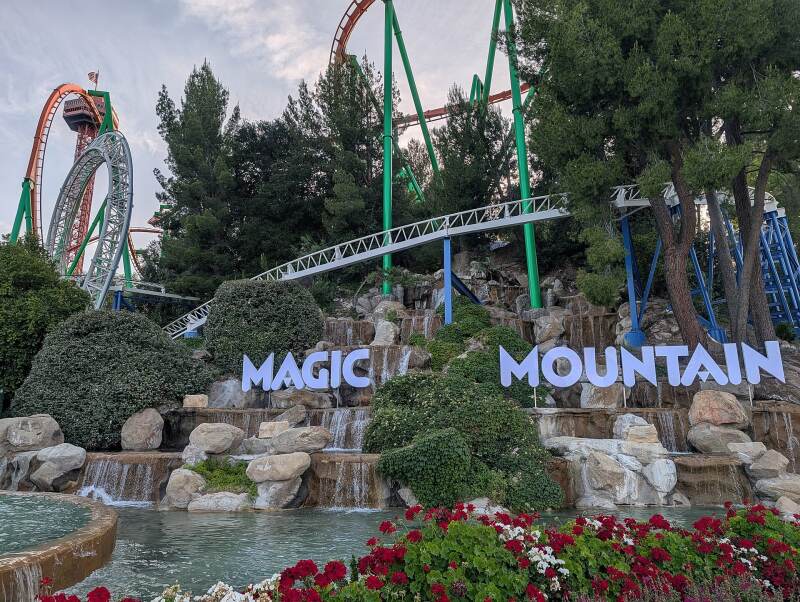
If you’ve ever tried to describe Six Flags Magic Mountain to someone who has not been, you eventually run out of normal language. It is not just “a park with a lot of coasters.” It is a park where coaster design feels like a competitive sport, and where the skyline looks like someone kept saying “yes” in every planning meeting for fifty years.
So when people ask a very specific question, “What theme park has the most roller coaster inversions,” the answer makes sense on a gut level before you ever look at a list: Six Flags Magic Mountain in Valencia, California.
Quick Answer
The theme park with the most roller coaster inversions is Six Flags Magic Mountain. Across its coaster lineup, it has the highest total number of inversion elements, which is why it ranks #1 on inversion breakdown lists.
What We Mean By “Most Inversions In One Park”
This is important, because people mix up two different records all the time.
When we say “most inversions in one park,” we are not saying one coaster has an absurd number of inversions. We are saying the park has the highest combined total of inversion elements across all of its roller coasters.
An inversion, for this purpose, is a true upside down element, where riders rotate 180 degrees or more. Think loops, corkscrews, cobra rolls, zero-g rolls, heartline rolls. We are not counting overbanked turns or other elements that feel twisty but never fully invert riders.
Check out: How Do Roller Coasters Stay On The Tracks?
Why Six Flags Magic Mountain Wins This Record
Magic Mountain is built around volume and variety. It has a huge number of major thrill coasters, and several of them are inversion-forward designs, meaning the upside down moments are not just one feature, they are a core part of the ride’s identity.
That combination is what creates the record. A park can have a single coaster with a high inversion count and still lose this category, because the “most inversions in one park” record is about depth. You need a lineup where multiple coasters contribute meaningful inversion totals.
RCDB lists Six Flags Magic Mountain as having 16 operating roller coasters, plus additional coasters that are listed as not currently operating, under construction, or defunct. Even without getting into coaster-by-coaster inversion math in this post, that sheer density is exactly how you end up with the inversion crown.
What Makes A Park “Inversion Heavy” In Real Life
There is a difference between a park that has “a lot of coasters” and a park that feels inversion heavy. Inversion heavy parks tend to have a few traits in common:
They have multiple manufacturers and coaster types. You get different inversion styles, different pacing, different sensations. Some inversions are snappy and fast. Others are slower with hangtime.
They have more than one era of coaster design. Older loopers often feel different than newer designs that focus on smoother transitions and more controlled forces.
They have enough coasters that you can build an entire day around going upside down. That sounds fun, and it is, but it also means pacing matters more than people expect.
Restraints are a big part of how inversion coasters feel, especially if you are riding a lot of them back to back. If you want a reader-friendly post that explains why one inversion coaster feels “free” and another feels “locked in,” use: Why Roller Coasters Have Different Restraints
How To Pace An Inversion Heavy Day (So You Don’t Feel Wrecked By 3 PM)
A park with the most inversions is not automatically “too intense,” but it can be surprisingly fatiguing. Inversions force your body to re-orient again and again. Even if you are not scared, you can end up feeling drained if you stack too many inversion coasters without breaks.
Three simple pacing rules that work at parks like Magic Mountain:
- Alternate ride styles: do an inversion coaster, then something that is more airtime or speed based, then go back to inversions.
- Hydrate and eat like an adult: inversion days punish people who run on sugar and vibes.
- Listen to your head and neck: if you start feeling headachy, take a reset break before you turn a great day into a miserable one.
If you are curious but anxious, this post is a good fit without being preachy: Overcome Roller Coaster Phobia
Does Having More Inversions Mean A Park Is Less Safe?
No. Inversions look dramatic, but modern roller coasters are engineered for them as a normal operating condition. Safety is about systems: restraint design, inspection routines, redundancy, and operations. A park with a lot of inversions is not inherently “riskier” than a park with fewer inversions.
If you want to ground that with a calm, data-forward post check out: Roller Coaster Accidents And Safety Statistics
And for the bigger context of how coaster safety tech evolved into what it is now, this one pairs well: Roller Coaster Safety Technology Evolution
FAQ: Theme Park With The Most Roller Coaster Inversions
What Theme Park Has The Most Roller Coaster Inversions?
Six Flags Magic Mountain has the most roller coaster inversions, meaning it has the highest total number of inversion elements across its coaster lineup.
Is This The Same As “Most Inversions On One Roller Coaster”?
No. This is a park-wide total across multiple coasters. The “most inversions on one coaster” record is a separate category.
What Counts As An Inversion?
An inversion is a ride element where riders go fully upside down, such as a loop, corkscrew, cobra roll, or roll element. Overbanked turns do not count if riders never fully invert.
How Many Coasters Does Six Flags Magic Mountain Have?
Six Flags Magic Mountain is listed as having 16 operating roller coasters, with additional coasters listed in other statuses such as under construction or not currently operating.

Leave a Reply