Roller coasters are more than just amusement park rides, they’re a celebration of human daring, creativity, and our love for adrenaline. For centuries, people have sought out thrilling experiences that push the boundaries of what feels safe, and roller coasters deliver this rush in a controlled, engineered environment. The anticipation, the drop, the speed, and the sense of flying, these sensations have made coasters an enduring symbol of fun and innovation across generations.
Early Thrill Rides in History
The desire for thrill rides isn’t new. Ancient cultures enjoyed rides and contraptions that spun, swung, or dropped their riders. However, the idea of a dedicated, gravity-powered ride designed purely for excitement didn’t truly take off until the last few centuries. Before the modern coaster, there were fairground swings, spinning wheels, and even early “gravity rides” that hinted at what was to come.
Russian Ice Slides: The True Origin
The true ancestors of roller coasters can be traced back to 17th-century Russia. During harsh winters, Russian nobles and commoners alike flocked to massive wooden structures known as “Russian Mountains” (Gorki). These were tall, steep slides constructed from wood and covered in ice, sometimes reaching heights of 70 feet (over 20 meters). Riders would sit on sleds or blocks of ice and hurtle down the slopes, sometimes at breakneck speeds.
These ice slides became wildly popular, both as a pastime and as a spectacle. The experience was both exhilarating and terrifying, and it quickly became a favorite winter entertainment in cities like St. Petersburg. The popularity of Russian Mountains even inspired Catherine the Great to build elaborate versions at her palaces.
As the concept spread, innovators began experimenting with ways to bring the thrill of the ice slide to warmer climates and all seasons, setting the stage for the first true roller coasters.
Part 2: The Dawn of the Coaster Era in Europe
Paris and “Les Montagnes Russes”
In the early 19th century, the thrill of Russian ice slides inspired European inventors to create similar rides that didn’t rely on cold weather. Paris became the birthplace of the first wheeled roller coasters, known as “Les Montagnes Russes” (the Russian Mountains). In 1817, these early rides featured wooden carts with wheels that ran along grooved wooden tracks. The cars were guided by side railings, and the tracks were undulating, mimicking the ups and downs of the Russian slides.
These Parisian coasters were a sensation. Riders paid for the chance to experience the new thrill, and crowds gathered to watch the action. The rides were simple by today’s standards, but they introduced the basic concepts of coaster design, gravity-powered movement, guided tracks, and repeatable thrills.
Early European Innovations and Spread
The popularity of “Les Montagnes Russes” quickly spread across Europe. Inventors experimented with different track layouts, materials, and safety features. Some rides added gentle curves and small hills, while others focused on longer, more elaborate courses. The idea of amusement parks began to emerge, with roller coasters often serving as their star attractions.
By the mid-1800s, roller coasters could be found in England, Germany, and other parts of Europe. Each region added its own twist, some focused on scenic views, while others prioritized speed or unique ride vehicles.
Key Differences vs. Later American Coasters
Early European coasters were typically smaller and less intense than the wooden giants that would later dominate America. They were often seen as novelties or “pleasure rides” rather than the adrenaline-fueled experiences of the 20th century. However, these European innovations laid the groundwork for what would become a global phenomenon.
The stage was set for roller coasters to cross the Atlantic, where American inventors would take the concept to new heights, literally and figuratively.
Part 3: America’s Golden Age – Wooden Coasters Take Over
Coney Island and the Switchback Railway
The roller coaster truly found its home in America during the late 19th and early 20th centuries. Coney Island, New York, became the epicenter of coaster innovation. In 1884, LaMarcus Adna Thompson debuted the Switchback Railway, the first roller coaster built as an amusement ride in the United States. Riders sat in bench-like cars that coasted down a gentle hill, then were pushed back to the start by attendants.
The Switchback Railway was an instant success, sparking a wave of coaster construction across the country. Soon, Coney Island boasted multiple competing coasters, each trying to outdo the others in speed, height, and thrills.
The Rise of Amusement Parks Across the US
The popularity of roller coasters led to the birth of the American amusement park. Parks like Luna Park, Steeplechase Park, and Dreamland made Coney Island a national destination. Across the US, cities and resort areas built their own parks, with coasters as their main attractions.
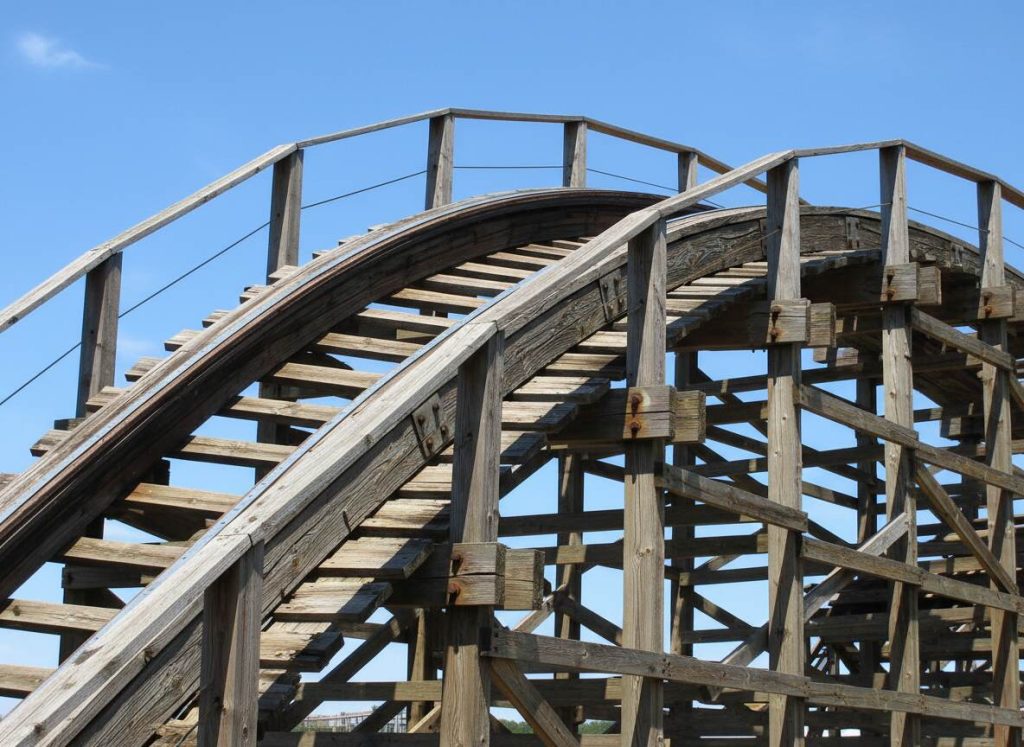
Iconic wooden coasters such as the Giant Dipper (1925) in California and the legendary Cyclone (1927) at Coney Island became symbols of American fun and engineering prowess.
Legendary Wooden Coasters and Designers
The golden age of wooden coasters brought forth legendary designers like John A. Miller, who patented safety devices such as the upstop wheel and introduced innovations that made steeper drops and faster speeds possible. Fred Church and Harry Traver also left their mark, designing coasters known for their wild layouts and intense ride experiences.
These classic rides featured rickety tracks, dramatic airtime hills, and sharp turns, some of which are still thrilling riders today.
How the Great Depression and WWII Shaped the Industry
The boom years of the 1920s couldn’t last forever. The Great Depression and World War II brought hard times for amusement parks. Many parks closed, and coaster construction slowed dramatically. However, a few classics survived, and the post-war era saw a gradual revival as Americans returned to parks for affordable, family-friendly fun.
The resilience of these wooden wonders set the stage for future innovation and the next big leap in coaster history.
Part 4: Engineering Breakthroughs & The Steel Revolution
Tubular Steel Tracks and the Matterhorn Bobsleds
The late 1950s marked a turning point for roller coasters with the introduction of tubular steel tracks. In 1959, Disneyland’s Matterhorn Bobsleds became the world’s first tubular steel roller coaster. This innovation allowed for smoother rides, tighter turns, and more creative layouts than wooden tracks could provide.
Steel tracks revolutionized the industry, paving the way for inversions, corkscrews, and new ride experiences that were previously impossible.
Arrow Development and the Inversion Era
Arrow Development, a California-based company, played a pivotal role in the steel revolution. With designers like Ron Toomer at the helm, Arrow introduced the first modern vertical loop with the Corkscrew at Knott’s Berry Farm in 1975. This opened the door to an era of multi-inversion coasters, including double loops, corkscrews, and more.
The 1970s and 1980s saw a boom in steel coaster construction, with parks competing to build the tallest, fastest, and most twisted rides.
Notable Designers: John Allen, Ron Toomer, and More
Key figures drove the evolution of coaster engineering. John Allen of Philadelphia Toboggan Company designed classic woodies and helped transition the industry to steel. Ron Toomer of Arrow engineered dozens of innovative steel coasters, including the first suspended and multi-inversion rides. Anton Schwarzkopf in Germany became famous for his portable steel coasters and smooth, forceful loops.
The Physics of Coaster Design
As designs grew more complex, understanding the physics behind roller coasters became crucial. Engineers used principles of gravity, acceleration, centripetal force, and g-forces to create thrilling yet safe experiences. The introduction of computer-aided design (CAD) in the 1980s allowed for unprecedented precision and creativity in track layouts.
Innovations in restraint systems, magnetic brakes, and launch technology further pushed the boundaries of what coasters could do, making rides safer, faster, and more exhilarating than ever before.
Part 5: Global Expansion & Regional Differences
Europe: Scenic Railways, Schwarzkopf, and Bobsled Rides
While the United States led much of the early innovation, Europe developed its own unique coaster traditions. Scenic railways, large, gently undulating wooden rides, were popular in the UK and Australia. Germany’s Anton Schwarzkopf became a legendary designer, known for portable steel coasters and the creation of the first modern looping coaster. European parks also introduced bobsled-style rides and spinning coasters, adding variety to the coaster landscape.
Japan: Compact Innovation and World Records
Japan’s densely populated cities led to the development of compact, space-saving coasters with intense layouts. Japanese parks are famous for breaking world records, Steel Dragon 2000 (Nagashima Spa Land) is the world’s longest coaster, and Fujiyama (Fuji-Q Highland) was once the tallest and fastest. Japanese designers also pioneered unique ride experiences, such as standing coasters and 4D spinning rides.
China & the Middle East: The New Frontier
In recent decades, China has rapidly emerged as a theme park powerhouse, building hundreds of new coasters and attracting international designers. The Middle East, led by the UAE, has invested in luxury parks with high-tech, record-breaking rides like Formula Rossa (fastest in the world) at Ferrari World Abu Dhabi.
These regions continue to push the boundaries of coaster design, blending global influences with their own cultural twists.
Cultural Impact and Local Adaptations
Roller coasters have become symbols of excitement and progress around the world. In some countries, coasters are tied to national celebrations or festivals; in others, they’re tourist magnets and sources of local pride. Each region adapts coaster design to its own tastes, geography, and traditions, ensuring that the evolution of roller coasters remains a truly global story.
<h2>Part 6: The Modern Marvels – Technology, Records, and Theming</h2>
<h3>Giga, Strata, and Hybrid Coasters</h3>
<p>The late 20th and early 21st centuries saw the rise of giga coasters (over 300 feet tall) and strata coasters (over 400 feet). Rides like Millennium Force (Cedar Point) and Kingda Ka (Six Flags Great Adventure) shattered height and speed records. Hybrid coasters, which combine wooden structures with steel tracks, offer the classic feel of wood with the smoothness and inversions of steel, Steel Vengeance (Cedar Point) is a prime example.</p>
<h3>Launch Technology, Magnetic Brakes, and VR</h3>
<p>Modern coasters use advanced launch systems, hydraulic, magnetic, or pneumatic, to propel trains at incredible speeds without the need for tall lift hills. Magnetic brakes replaced friction systems for smoother, safer stops. Some parks have even experimented with virtual reality headsets, overlaying digital worlds onto real coaster tracks for a new kind of thrill.</p>
<h3>Theming, Storytelling, and Immersive Experiences</h3>
<p>Today’s top coasters aren’t just about speed and height, they’re about immersion. Parks invest millions into theming, animatronics, and storytelling. Rides like Hagrid’s Magical Creatures Motorbike Adventure (Universal Orlando) and Expedition Everest (Disney’s Animal Kingdom) blend coaster thrills with narrative, special effects, and detailed environments, creating unforgettable experiences.</p>
<h3>Notable Record-Breakers and Statistics</h3>
<ul>
<li><strong>Kingda Ka:</strong> Tallest (456 ft) and second fastest (128 mph) coaster in the world</li>
<li><strong>Formula Rossa:</strong> Fastest coaster (149 mph) at Ferrari World Abu Dhabi</li>
<li><strong>Steel Dragon 2000:</strong> Longest track (8,133 ft) in Japan</li>
<li><strong>Takabisha:</strong> Steepest drop (121°) at Fuji-Q Highland, Japan</li>
<li><strong>Steel Vengeance:</strong> Most inversions on a hybrid coaster (4) and record-breaking airtime</li>
</ul>
<p>The quest for new records continues to drive innovation and attract coaster enthusiasts from around the globe.</p>
<section>
<h2>Part 7: Safety, Accessibility, and The Science of Thrills</h2>
<h3>Advances in Safety Engineering</h3>
<p>Safety is at the heart of modern roller coaster design. Early coasters relied on simple lap bars and hand brakes, but today’s rides use sophisticated restraint systems, redundant sensors, and computer-controlled safety checks. Upstop wheels (which keep cars from lifting off the track), magnetic brakes, and real-time monitoring ensure that even the most extreme rides are remarkably safe.</p>
<p>Regular inspections, strict maintenance schedules, and international safety standards have made coaster accidents exceedingly rare. Engineers constantly analyze ride data and update designs to minimize risk while maximizing excitement.</p>
<h3>Accessibility for All Riders</h3>
<p>The industry has made significant strides in making roller coasters accessible to people of all abilities. Many parks now offer transfer devices, accessible ride vehicles, and virtual queuing systems for guests with mobility, sensory, or cognitive challenges. Designers work to ensure that new rides can accommodate a wider range of body types and needs, making the joy of coasters available to more people than ever before.</p>
<h3>The Psychology and Physiology of Thrill Rides</h3>
<p>Roller coasters are designed to play with our senses and emotions. The anticipation of the climb, the sudden drop, and the feeling of weightlessness (airtime) all trigger adrenaline and endorphin rushes. G-forces press riders into their seats or lift them out, creating a sense of danger in a safe environment.</p>
<p>Designers carefully balance elements like speed, height, and inversions to create rides that are thrilling but not overwhelming. The science of ride design now includes psychological research to ensure that coasters are both exciting and enjoyable for a broad audience.</p>
</section>
<h2>Part 8: The Future of Roller Coasters</h2>
<h3>AI, Personalization, and New Materials</h3>
<p>The next generation of roller coasters is poised to leverage artificial intelligence and big data. Parks are exploring rides that adapt to individual preferences, adjusting speed, intensity, or even music and lighting for each rider. AI-driven maintenance can predict and prevent issues before they arise, making rides safer and more reliable.</p>
<p>Advances in materials science are enabling lighter, stronger, and more sustainable track and support structures. This opens the door to creative layouts, new ride types, and coasters that can be built in places previously thought impossible.</p>
<h3>Eco-Friendly Designs and Sustainability</h3>
<p>With growing focus on environmental responsibility, parks are investing in energy-efficient systems, solar-powered lift hills, and recyclable materials. Water-saving landscaping, LED lighting, and green building practices are becoming standard for new coaster installations.</p>
<p>Some parks are even exploring coasters that generate power as they operate, further reducing their environmental footprint.</p>
<h3>Virtual and Augmented Reality</h3>
<p>Virtual reality (VR) and augmented reality (AR) are being integrated into coaster experiences, allowing parks to refresh existing rides with new digital worlds or add interactive elements. Riders might soon be able to choose their own adventure or compete in real-time games while riding.</p>
<h3>What’s Next for the Global Coaster Community?</h3>
<p>As new markets in Asia, the Middle East, and beyond invest in theme parks, the roller coaster community is becoming more global and connected. Enthusiasts travel worldwide to experience record-breakers and unique regional designs, sharing their adventures online and fueling demand for ever more innovative rides.</p>
<p>The future of roller coasters is about pushing boundaries, of technology, sustainability, and imagination. As long as people crave thrills, coasters will continue to evolve, delight, and inspire.</p>
<h3>Conclusion: The Endless Quest for the Ultimate Ride</h3>
<p>From icy Russian mountains to AI-powered marvels, the evolution of roller coasters is a story of daring, creativity, and relentless pursuit of fun. Each new generation of rides builds on the past, blending cutting-edge technology with timeless thrills. Whether you’re a lifelong enthusiast or a first-time rider, the future promises even more jaw-dropping experiences, and the quest for the ultimate ride will never end.</p>

Leave a Reply