A tilting roller coaster is a coaster that uses a tilting track mechanism to create the sensation of diving straight down. Unlike traditional coasters where the track remains stationary, tilting coasters have a track section that rotates or tilts, allowing the coaster train to experience angles that would be impossible on a fixed track.
The tilting mechanism is typically located at the top of a lift hill or at a key moment in the coaster’s layout. The track tilts, rotating the coaster train to an extreme angle—often 90 degrees or beyond vertical. This creates the sensation that riders are about to plunge straight down.
Tilting coasters represent a major innovation in coaster design. They combine the thrill of a steep drop with the psychological impact of the track actually moving. The tilting mechanism adds a layer of intensity and innovation that traditional coasters can’t match.
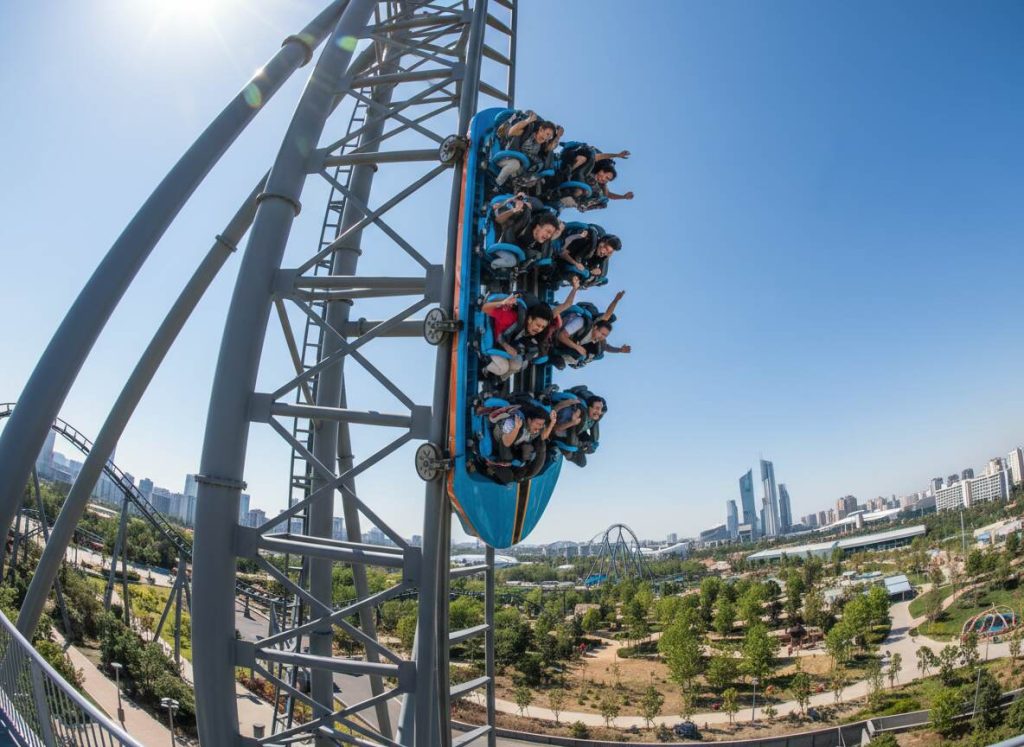
The Innovation Behind Tilting Coasters: How They Work
Tilting coasters use a motorized tilting mechanism to rotate the track section. The mechanism is controlled by computers and sensors that ensure precise timing and safety.
The Tilting Mechanism
The tilting mechanism consists of a motorized pivot point that rotates the track section. The track section is mounted on bearings that allow it to rotate smoothly. Motors drive the rotation, tilting the track from horizontal to vertical or beyond.
The tilting happens in a controlled manner, typically taking 2-5 seconds to complete. The coaster train remains on the track throughout the tilting process, held in place by multiple wheel assemblies and restraints.
Computer Control
The tilting mechanism is controlled by sophisticated computer systems. Sensors monitor the position of the coaster train and the angle of the track. The computer ensures that the tilting happens at precisely the right moment and at the correct speed.
The computer systems include multiple redundancies and safety features. If any sensor detects an issue, the system can stop the tilting or reverse it to return the track to horizontal.
Safety Systems
Tilting coasters include multiple safety systems to ensure rider safety. The track is designed to keep the coaster train secure even at extreme angles. Restraints are engineered to keep riders safely in their seats. Sensors monitor the coaster train and the track continuously.
The tilting mechanism itself includes fail-safe systems. If power is lost, the track can be manually returned to horizontal. If the tilting mechanism malfunctions, the coaster can still operate with the track in a fixed position.
The History of Tilting Coasters: From Concept to Reality
Tilting coasters are a relatively recent innovation in coaster design. The first tilting coaster didn’t open until the early 2000s, making tilting coasters one of the newest major coaster technologies.
Early Concepts and Development
The concept of a tilting coaster track emerged in the late 1990s as coaster designers looked for new ways to innovate and create more intense experiences. The idea was to use a motorized mechanism to tilt the track, creating a sensation of diving straight down.
Several coaster manufacturers explored the concept, but the engineering challenges were significant. The tilting mechanism had to be precise, reliable, and safe. The track had to be strong enough to support the coaster train at extreme angles. The restraints had to keep riders secure during the tilting process.
The First Tilting Coaster: Sheikra (2005)
Sheikra at Busch Gardens Tampa Bay in Florida was the world’s first tilting coaster, opening in 2005. Sheikra was designed by Bolliger & Mabillard (B&M), a Swiss coaster manufacturer known for innovative designs.
Sheikra featured a 200-foot lift hill followed by a tilting track section that rotated 90 degrees, creating a vertical drop. The tilting mechanism was a major innovation, and Sheikra became an instant classic.
The success of Sheikra proved that tilting coasters were viable and could be extremely popular with riders. The coaster was a massive hit and won numerous awards.
Griffon: The Second Tilting Coaster (2007)
Griffon at Busch Gardens Williamsburg in Virginia opened in 2007, just two years after Sheikra. Griffon was also designed by B&M and featured a similar tilting mechanism.
Griffon was taller and faster than Sheikra, reaching a height of 205 feet and a speed of 75 mph. Griffon also featured multiple tilting drops, creating sustained terror throughout the ride.
The success of Griffon further established tilting coasters as a major innovation in coaster design.
The Expansion of Tilting Coasters (2008-Present)
After the success of Sheikra and Griffon, other parks began installing tilting coasters. B&M continued to design tilting coasters, and other manufacturers began developing their own tilting technologies.
Tilting coasters became increasingly popular, with parks around the world installing them. The technology evolved, with newer tilting coasters featuring faster tilting mechanisms, multiple tilting drops, and more intense experiences.
Today, tilting coasters are a staple of major theme parks around the world.
Bolliger & Mabillard: The Pioneers of Tilting Coasters
Bolliger & Mabillard (B&M) is a Swiss coaster manufacturer that pioneered tilting coaster technology. The company was founded in 1988 by Bolliger and Mabillard, two Swiss engineers with a passion for coaster design.
The Company’s History
B&M quickly became known for innovative coaster designs. The company designed some of the most iconic coasters in the world, including Kumba, Montu, and Alpengeist.
When B&M designed Sheikra in the early 2000s, the company was already known for pushing the boundaries of coaster design. The tilting mechanism was a natural extension of B&M’s innovative approach.
B&M’s Tilting Coaster Designs
B&M has designed multiple tilting coasters, each with unique features and innovations. The company’s tilting coasters are known for smooth, precise tilting mechanisms and intense experiences.
B&M’s tilting coasters include Sheikra, Griffon, Alpengeist (which was retrofitted with a tilting element), and several others around the world.
B&M’s Innovation Philosophy
B&M’s approach to tilting coasters reflects the company’s broader philosophy of innovation. The company constantly pushes the boundaries of what’s possible in coaster design, creating new technologies and experiences.
B&M’s engineers work closely with parks to understand what riders want and what’s possible from an engineering perspective. This collaborative approach has made B&M one of the most respected coaster manufacturers in the world.
Sheikra: The Original Tilting Coaster
Sheikra at Busch Gardens Tampa Bay in Florida was the world’s first tilting coaster. The coaster opened in 2005 and revolutionized coaster design.
The Specifications
Height: 200 feet | Speed: 70 mph | Drop Angle: 90 degrees | Track Length: 3,081 feet | Manufacturer: Bolliger & Mabillard | Inversions: 0 | Tilting Drops: 2
The Design and Layout
Sheikra features a 200-foot lift hill followed by a 90-degree tilting drop. The track tilts from horizontal to vertical, creating the sensation of diving straight down. After the first drop, the coaster climbs a hill and then experiences a second tilting drop.
The coaster is a dive coaster, meaning it features a narrow track with riders sitting on both sides of the track. This design enhances the sensation of hanging over the edge during the tilting drops.
The Tilting Mechanism
Sheikra’s tilting mechanism was groundbreaking. The track section tilts 90 degrees in about 3 seconds, creating a smooth and controlled tilting experience. The mechanism is motorized and computer-controlled, ensuring precise timing and safety.
The tilting happens at the top of the lift hill, creating a moment of suspense as riders realize the track is tilting beneath them. The sensation of the track tilting is unique and terrifying.
The Rider Experience
Riders on Sheikra experience a unique sensation. As the lift hill approaches the top, the track begins to tilt. Riders feel the track rotating beneath them, creating a sensation of impending doom. Then, the coaster plunges down the tilted track.
The 90-degree drop creates the sensation of diving straight down. Riders experience intense airtime as they plunge down the drop. The sensation is terrifying and exhilarating.
The Impact
Sheikra was a massive success. The coaster won numerous awards and became one of the most popular coasters at Busch Gardens Tampa Bay. The success of Sheikra proved that tilting coasters were viable and could be extremely popular with riders.
Sheikra’s success inspired other parks to install tilting coasters and inspired other manufacturers to develop their own tilting technologies.
Griffon: The Evolution of Tilting Coasters
Griffon at Busch Gardens Williamsburg in Virginia opened in 2007, just two years after Sheikra. Griffon was designed by B&M and represented an evolution of tilting coaster technology.
The Specifications
Height: 205 feet | Speed: 75 mph | Drop Angle: 90 degrees | Track Length: 3,480 feet | Manufacturer: Bolliger & Mabillard | Inversions: 0 | Tilting Drops: 2
The Design and Layout
Griffon is similar to Sheikra but with some key differences. Griffon is taller and faster than Sheikra, reaching a height of 205 feet and a speed of 75 mph. Griffon also features two tilting drops, similar to Sheikra.
The coaster is a dive coaster with a narrow track and riders sitting on both sides. The design enhances the sensation of hanging over the edge during the tilting drops.
The Improvements Over Sheikra
Griffon featured several improvements over Sheikra. The tilting mechanism was faster and smoother, tilting in about 2.5 seconds compared to Sheikra’s 3 seconds. The coaster was taller and faster, creating more intense experiences.
Griffon also featured a more intense layout with sharper turns and more airtime. The overall experience was more intense than Sheikra.
The Rider Experience
Riders on Griffon experience similar sensations to Sheikra but with more intensity. The faster tilting mechanism creates a more dramatic sensation. The taller height and faster speed create more intense drops and airtime.
The two tilting drops create sustained terror. Just when riders think the ride is over, another tilting drop appears.
The Reception
Griffon was also a massive success. The coaster won numerous awards and became one of the most popular coasters at Busch Gardens Williamsburg. The success of Griffon further established tilting coasters as a major innovation in coaster design.
Other Notable Tilting Coasters
Alpengeist (Busch Gardens Williamsburg)
Alpengeist is an inverted coaster that was retrofitted with a tilting element. The coaster features a tilting drop that creates a unique sensation of diving while hanging upside down.
Height: 170 feet | Speed: 60 mph | Inversions: 7
Verbolten (Busch Gardens Williamsburg)
Verbolten is a hybrid coaster (wooden structure with steel track) that features a tilting element. The coaster features a tilting drop that creates a unique sensation.
Height: 110 feet | Speed: 50 mph | Track Length: 2,888 feet
Dive Coasters Around the World
Dive coasters with tilting elements have been installed at parks around the world, including Oblivion at Alton Towers in England, Dive Devil at Dorney Park in Pennsylvania, and others.
These coasters share the basic tilting mechanism but with unique layouts and designs specific to each park.
The Technology Behind Tilting Coasters: Engineering Excellence
Tilting coasters represent a major achievement in coaster engineering. The technology required to safely tilt a coaster track with riders on board is complex and sophisticated.
Structural Engineering
The track structure of a tilting coaster must be extremely strong to support the coaster train at extreme angles. The track is engineered using computer modeling and finite element analysis to ensure it can handle the forces involved.
The pivot point where the track tilts must be extremely precise and strong. The bearings and motors must be engineered to handle the forces and stresses involved in tilting.
Mechanical Systems
The tilting mechanism consists of multiple mechanical systems working together. Motors drive the tilting, gearboxes reduce the speed of the motors, and bearings allow smooth rotation.
The mechanical systems are engineered with redundancy. If one motor fails, backup motors can take over. If one bearing fails, the coaster can still operate safely.
Computer Control Systems
The tilting mechanism is controlled by sophisticated computer systems. The computer monitors the position of the coaster train, the angle of the track, and multiple sensors throughout the system.
The computer ensures that the tilting happens at precisely the right moment and at the correct speed. If any sensor detects an issue, the computer can stop the tilting or reverse it.
Safety Systems
Tilting coasters include multiple safety systems. The track is designed to keep the coaster train secure even at extreme angles. Restraints are engineered to keep riders safely in their seats. Sensors monitor the coaster train and the track continuously.
The tilting mechanism includes fail-safe systems. If power is lost, the track can be manually returned to horizontal. If the tilting mechanism malfunctions, the coaster can still operate with the track in a fixed position.
The Psychology of Tilting Coasters: Why Are They Terrifying?
Tilting coasters create a unique psychological experience. The sensation of the track tilting beneath riders creates a sense of danger and loss of control.
The Sensation of Movement
The key to the terror of tilting coasters is the sensation of movement. Unlike traditional coasters where the track is stationary, tilting coasters have a track that moves. Riders feel the track tilting beneath them, creating a sensation of impending danger.
The sensation of the track moving is more terrifying than a stationary track at the same angle. The movement creates a sense that something is wrong or that the coaster is malfunctioning.
Loss of Control
The tilting mechanism creates a sense of loss of control. Riders can’t predict exactly when the track will tilt or how fast it will tilt. The unpredictability creates psychological fear.
The Illusion of Danger
The tilting mechanism creates a strong illusion of danger. Riders feel like the track is malfunctioning or thatthe coaster is about to malfunction. The illusion is so strong that many riders genuinely fear that something is wrong.
In reality, the tilting is controlled and safe. But the illusion of danger is what creates the terror.
Anticipation and Dread
As the coaster approaches the tilting section, riders experience anticipation and dread. They know the track is about to tilt, but they don’t know exactly when. The anticipation builds tension and fear.
The dread is intensified by the fact that riders can see the tilting happening. On some tilting coasters, riders can see the track tilting as they approach it. This visual cue intensifies the dread.
Comparing Tilting Coasters to Traditional Coasters
Tilting coasters differ from traditional coasters in several key ways.
The Sensation of the Drop
Traditional coasters have a fixed track, so the drop angle is predetermined. Tilting coasters have a tilting track, so the drop angle changes as the track tilts. This creates a unique sensation of the drop changing as riders experience it.
The sensation of the track tilting beneath riders creates a more intense psychological experience than a fixed drop.
The Element of Surprise
Traditional coasters are predictable. Once you’ve ridden a traditional coaster, you know exactly what to expect. Tilting coasters have an element of surprise. Even if you’ve ridden a tilting coaster before, the sensation of the track tilting can still surprise you.
The Intensity
Tilting coasters are generally more intense than traditional coasters with similar specifications. A tilting drop at 90 degrees is more intense than a fixed drop at 90 degrees because of the sensation of the track tilting.
The Innovation Factor
Tilting coasters represent a major innovation in coaster design. They showcase new technology and engineering. This innovation factor makes tilting coasters more exciting and appealing to many riders.
The Rider Experience: What Does It Feel Like?
Riders on tilting coasters report a unique experience that differs from traditional coasters.
The Anticipation Phase
As the coaster climbs the lift hill, riders anticipate the tilting. They know what’s coming, but the anticipation builds tension. Some riders report that the anticipation is the most terrifying part of the ride.
The Tilting Sensation
As the track begins to tilt, riders feel the coaster rotating beneath them. The sensation is unique and terrifying. Riders report feeling like the coaster is malfunctioning or that something is wrong.
The tilting happens smoothly and gradually, but the sensation is intense. Riders feel their bodies shifting as the track tilts. The sensation of weightlessness increases as the track approaches vertical.
The Drop
Once the track is fully tilted, the coaster plunges down the drop. The sensation is intense airtime combined with the psychological impact of the tilted track. Riders experience intense G-forces and weightlessness.
The Recovery
After the drop, the coaster climbs a hill and the track returns to horizontal. The recovery is often as intense as the drop, with riders experiencing intense forces as the coaster changes direction.
The Aftermath
After riding a tilting coaster, riders often report a sense of accomplishment and relief. The experience is intense and memorable. Many riders want to ride again immediately to experience the sensation again.
Tilting Coasters Around the World
Tilting coasters have been installed at parks around the world. Here are some of the most notable tilting coasters.
North America
Sheikra (Busch Gardens Tampa Bay, Florida) – The original tilting coaster and still one of the most popular.
Griffon (Busch Gardens Williamsburg, Virginia) – An evolution of Sheikra with more height and speed.
Dive Devil (Dorney Park, Pennsylvania) – A dive coaster with a tilting element.
Oblivion (Alton Towers, England) – A dive coaster with a tilting element, though technically located in Europe.
Europe
Oblivion (Alton Towers, England) – The first dive coaster in Europe with a tilting element.
Alpengeist (Busch Gardens Williamsburg, Virginia) – An inverted coaster with a tilting element, though technically in North America.
Various parks throughout Europe have installed tilting coasters or coasters with tilting elements.
Asia
Several parks in Asia have installed tilting coasters, though specific details about Asian tilting coasters are less well-documented in English-language sources.
The Future of Tilting Coasters: What’s Next?
Tilting coaster technology continues to evolve. Coaster manufacturers are exploring new innovations and improvements to tilting coasters.
Faster Tilting Mechanisms
Manufacturers are exploring faster tilting mechanisms. Newer tilting coasters tilt faster than earlier models, creating a more dramatic sensation. Future tilting coasters may tilt even faster, creating an even more intense experience.
Multiple Tilting Elements
Manufacturers are exploring coasters with multiple tilting elements. Instead of just one or two tilting drops, future coasters may have multiple tilting sections throughout the layout.
Hybrid Tilting Coasters
Manufacturers are exploring hybrid tilting coasters that combine tilting elements with other coaster technologies. Hybrid coasters with tilting elements could create unique and intense experiences.
Inverted Tilting Coasters
Manufacturers are exploring inverted tilting coasters where riders hang upside down during the tilting. These coasters would create a unique sensation of tilting while inverted.
Launch Tilting Coasters
Manufacturers are exploring launch tilting coasters that use magnetic launch systems combined with tilting elements. These coasters would create intense acceleration combined with the sensation of tilting.
Safety and Reliability of Tilting Coasters
Tilting coasters are engineered with safety and reliability as top priorities. Despite the complexity of the tilting mechanism, tilting coasters have an excellent safety record.
Engineering and Testing
Tilting coasters undergo rigorous engineering and testing before opening to the public. Computer modeling and finite element analysis are used to ensure the coaster can handle all forces and stresses.
Physical testing is also conducted. Prototype mechanisms are tested extensively to ensure they work reliably and safely.
Inspection and Maintenance
Tilting coasters require regular inspection and maintenance. The tilting mechanism is inspected regularly to ensure it’s functioning properly. The track is inspected for wear and damage. Restraints are tested to ensure they’re secure.
Regular maintenance keeps the coaster in excellent condition and ensures rider safety.
Operator Training
Coaster operators are trained extensively on tilting coaster operation and safety. Operators understand how the tilting mechanism works and what to do if any issues arise.
Operators monitor the coaster during operation and can stop the ride if any issues are detected.
Regulatory Oversight
Tilting coasters are regulated by government agencies and industry standards organizations. These regulations ensure that coasters meet strict safety standards.
The ASTM (American Society for Testing and Materials) has standards for roller coaster design and operation. Tilting coasters must meet these standards.
The Safety Record
Tilting coasters have an excellent safety record. Despite the complexity of the tilting mechanism, there have been very few incidents involving tilting coasters. The safety record demonstrates that tilting coasters are safe and reliable.
The Cost and Complexity of Tilting Coasters
Tilting coasters are more expensive and complex than traditional coasters, which is one reason why they’re less common.
Design and Engineering Costs
The design and engineering of a tilting coaster is complex and expensive. The tilting mechanism must be designed and engineered with precision. Computer modeling and testing add to the cost.
Manufacturing Costs
The manufacturing of a tilting coaster is more expensive than a traditional coaster. The tilting mechanism requires specialized manufacturing. The track must be engineered and manufactured with precision.
Installation Costs
The installation of a tilting coaster is more complex and expensive than a traditional coaster. The tilting mechanism must be installed and calibrated with precision. The computer control systems must be programmed and tested.
Maintenance Costs
The maintenance of a tilting coaster is more expensive than a traditional coaster. The tilting mechanism requires regular maintenance and inspection. Specialized technicians are required to maintain the tilting mechanism.
The Price Tag
A typical tilting coaster costs $20-40 million to design, manufacture, install, and test. This is significantly more expensive than a traditional coaster, which might cost $10-25 million.
The higher cost is one reason why tilting coasters are less common than traditional coasters. Not all parks can afford the investment.
Why Tilting Coasters Matter: The Impact on Coaster Design
Tilting coasters represent a major innovation in coaster design. They’ve had a significant impact on how coasters are designed and how riders experience coasters.
Pushing the Boundaries
Tilting coasters pushed the boundaries of what was possible in coaster design. The technology proved that coaster tracks could move and tilt, opening up new possibilities for coaster designers.
Inspiring Innovation
The success of tilting coasters inspired other manufacturers to develop their own innovations. The tilting coaster technology inspired other technologies like magnetic launches, cable lifts, and more.
Enhancing the Rider Experience
Tilting coasters enhanced the rider experience by creating new sensations and emotions. The sensation of the track tilting beneath riders created a unique and memorable experience.
Attracting Riders
Tilting coasters attracted riders to parks. The innovation and unique experience of tilting coasters drew crowds and increased park attendance.
Establishing B&M as an Innovator
The success of tilting coasters established Bolliger & Mabillard as a leading innovator in coaster design. B&M’s reputation for innovation and quality was enhanced by the success of tilting coasters.
The Cultural Impact of Tilting Coasters
Tilting coasters have had a cultural impact beyond just coaster design. They’ve become iconic attractions that represent innovation and engineering excellence.
Iconic Status
Tilting coasters like Sheikra and Griffon have become iconic attractions. They’re recognized around the world as symbols of innovation and engineering excellence.
Bucket List Attractions
Tilting coasters have become bucket list attractions for coaster enthusiasts. Many riders consider riding a tilting coaster to be an essential experience for any serious coaster fan.
Media Attention
Tilting coasters have received significant media attention. News outlets and entertainment media have covered the opening of new tilting coasters and the technology behind them.
Social Media Presence
Tilting coasters have a strong presence on social media. Videos of tilting coasters going viral on YouTube and TikTok, attracting millions of views. The dramatic nature of tilting coasters makes them perfect for social media content.
Comparing Tilting Coasters to Other Innovative Coasters
Tilting coasters are one of many innovations in coaster design. How do they compare to other innovative coasters?
Tilting Coasters vs. Launch Coasters
Launch coasters use magnetic or cable systems to accelerate riders from 0 to high speeds in seconds. Launch coasters create intense acceleration, while tilting coasters create the sensation of tilting. Both are innovative, but they create different experiences.
Tilting Coasters vs. Inverted Coasters
Inverted coasters hang riders upside down beneath the track. Inverted coasters create the sensation of hanging, while tilting coasters create the sensation of tilting. Both are innovative, but they create different experiences.
Tilting Coasters vs. Hybrid Coasters
Hybrid coasters combine wooden structure with steel track. Hybrid coasters create a unique combination of wooden coaster airtime and steel coaster smoothness. Tilting coasters create the sensation of tilting. Both are innovative, but they create different experiences.
Tilting Coasters vs. Winged Coasters
Winged coasters have riders sitting on the sides of the track with no support beneath them. Winged coasters create the sensation of hanging over the edge, while tilting coasters create the sensation of tilting. Both are innovative, but they create different experiences.
The Rider’s Guide to Tilting Coasters: Tips and Advice
If you’re planning to ride a tilting coaster, here are some tips and advice to help you prepare.
Know What to Expect
Research the tilting coaster before you ride. Watch POV (point-of-view) videos. Know what the tilting sensation feels like. Knowing what to expect can help you prepare mentally.
Understand the Technology
Understanding how the tilting mechanism works can help reduce anxiety. The mechanism is controlled by computers and is extremely safe. Understanding this can help you feel more confident.
Manage Your Anxiety
If you’re anxious about riding, use breathing techniques to calm yourself. Deep breathing can help reduce anxiety and prepare your body for the experience.
Ride with Friends
Riding with friends can help reduce anxiety. Having someone to share the experience with can make it less terrifying.
Start with Sheikra or Griffon
If you’re new to tilting coasters, start with Sheikra or Griffon. These are the most well-established tilting coasters and have the smoothest tilting mechanisms.
Embrace the Sensation
Instead of fighting the sensation of tilting, embrace it. The sensation is unique and memorable. Allowing yourself to feel the sensation can make the experience more rewarding.
Scream and Vocalize
Don’t hold back. Scream and vocalize during the ride. This can help you process the intense emotions and make the experience more enjoyable.
The Evolution of Tilting Coasters: From Sheikra to Today
Tilting coasters have evolved significantly since Sheikra opened in 2005. The technology has improved, and new innovations have been added.
Sheikra (2005): The Original
Sheikra was the original tilting coaster. The tilting mechanism was groundbreaking, and the coaster was a massive success. Sheikra established the basic design that future tilting coasters would follow.
Griffon (2007): The Evolution
Griffon improved on Sheikra’s design. The tilting mechanism was faster and smoother. The coaster was taller and faster. Griffon represented an evolution of tilting coaster technology.
Later Tilting Coasters (2008-Present): Refinement and Innovation
After Griffon, tilting coasters continued to evolve. Later tilting coasters featured faster tilting mechanisms, more intense layouts, and additional innovations. The technology has been refined and improved over time.
Today’s tilting coasters represent the pinnacle of tilting coaster technology. They’re faster, smoother, and more intense than earlier models.
Conclusion: The Legacy of Tilting Coasters
Tilting coasters represent a major innovation in coaster design. They pushed the boundaries of what was possible and created a unique and memorable experience for riders.
Sheikra and Griffon, designed by Bolliger & Mabillard, established tilting coasters as a viable and popular coaster type. The success of these coasters inspired other parks to install tilting coasters and inspired other manufacturers to develop their own innovations.
Tilting coasters showcase the power of innovation in coaster design. They demonstrate that coaster designers are constantly pushing boundaries and creating new experiences for riders.
The sensation of the track tilting beneath you is unique and unforgettable. It’s an experience that separates tilting coasters from all other coaster types.
Whether you’re a coaster enthusiast or someone looking for a unique and intense experience, tilting coasters offer something special. They represent the cutting edge of coaster design and engineering.
Tilting coasters have earned their place in coaster history. They’re iconic attractions that represent innovation, engineering excellence, and the endless possibilities of coaster design.
If you haven’t experienced a tilting coaster yet, Sheikra or Griffon should be on your bucket list. The sensation of the track tilting beneath you is an experience you’ll never forget.
