When Vortex opened at Carowinds in 1992, it wasn’t just another roller coaster. It was a statement. Arrow Dynamics had created something that would influence hypercoaster design for decades to come, and riders would spend the next three decades lining up to experience its unique blend of speed, airtime, and pure adrenaline. Vortex wasn’t the tallest or the fastest coaster in the world, but it was something far more important: it was a masterclass in coaster engineering that proved you didn’t need record-breaking stats to create an unforgettable experience.
Today, more than three decades later, Vortex remains one of the most beloved and respected hypercoasters in North America. It’s a ride that has earned its place in coaster history not through flashy records, but through consistent, thrilling performance and the kind of loyal fanbase that keeps coming back for more.
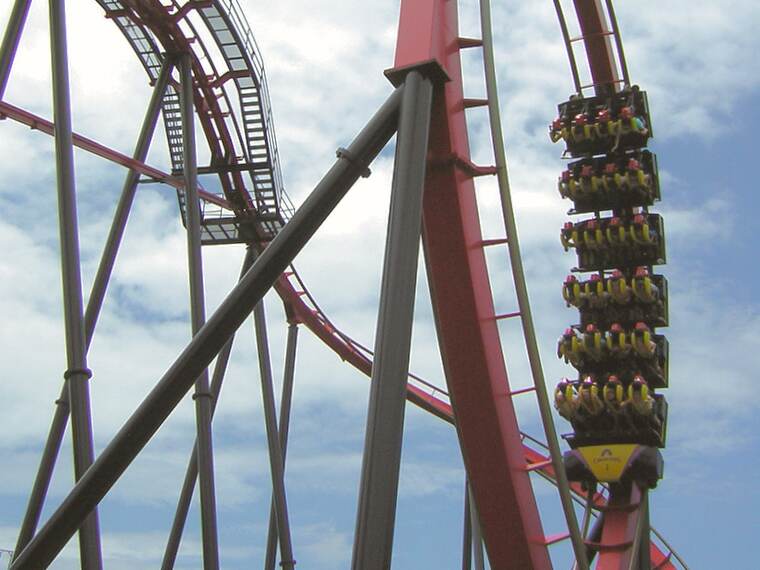
The Arrow Dynamics Story: Building the Hypercoaster Revolution
To understand Vortex, you need to understand Arrow Dynamics and the company’s vision for what a hypercoaster could be. Arrow Dynamics, founded in 1947, had already made its mark on the industry with iconic steel coasters like the Matterhorn Bobsleds at Disneyland and the log flume rides that became standard at parks worldwide. But by the late 1980s, the company was looking to push boundaries in a new direction: the hypercoaster.
A hypercoaster, by definition, is a steel roller coaster that stands between 200 and 300 feet tall. But the term means more than just height. Hypercoasters are designed to deliver sustained airtime, smooth inversions, and that perfect balance of speed and control that makes riders feel like they’re flying while still being completely safe. Arrow Dynamics understood this better than almost anyone.
The company’s approach to hypercoaster design was different from competitors. While some manufacturers focused on breaking height and speed records, Arrow emphasized the quality of the ride experience. They wanted to create coasters that would thrill riders on every lap, that would feel smooth and responsive, and that would age gracefully, maintaining their appeal for decades.
Vortex’s Origins: 1992 and the Birth of a Legend
Vortex debuted at Carowinds on April 11, 1992, as the tallest and fastest roller coaster in the Carolinas. At 148 feet tall and reaching speeds of 60 mph, it was an impressive achievement for the time. But what made Vortex truly special was how Arrow Dynamics engineered every aspect of the ride to maximize thrills while maintaining that signature smooth, controlled feel that Arrow was known for.
The ride was an immediate success. Enthusiasts and casual riders alike were blown away by the experience. Unlike some hypercoasters that felt like they were trying too hard to impress with inversions and extreme angles, Vortex felt purposeful. Every element served a function: to deliver airtime, to create moments of weightlessness, to build anticipation, and to leave riders breathless.
Carowinds, the theme park that straddles the North Carolina-South Carolina border, had chosen well. Vortex became the park’s flagship attraction and a major draw for coaster enthusiasts across the Southeast.
The Engineering Marvel: What Makes Vortex Unique
Vortex’s design is where the real genius lies. Let’s break down the key features that make this coaster so special:
The Track Configuration
Vortex uses Arrow’s signature tubular steel track design. Unlike wooden coasters, which sit on top of the track, or some steel coasters that straddle it, Vortex’s trains completely surround the track. This design allows for inversions and extreme angles that wouldn’t be possible with other track types. The trains are suspended from above and below, held in place by multiple sets of wheels that grip the track from all sides.
This configuration is crucial to Vortex’s smooth ride experience. The multiple contact points distribute forces evenly, reducing jolts and vibrations. It’s one reason why riders consistently praise Vortex for being smooth despite its age.
The Lift Hill and First Drop
Vortex’s lift hill is a straightforward chain lift that takes riders up at a steady pace, building anticipation. The first drop is a 128-foot plunge at a 65-degree angle. It’s not the steepest drop in the world, but it’s perfectly calibrated to deliver that stomach-in-your-throat sensation without being overwhelming.
The angle and height of this drop are critical. Too steep, and riders might feel uncomfortable. Too shallow, and the airtime isn’t as intense. Arrow Dynamics nailed the balance.
The Airtime Moments
Airtime is what separates a good coaster from a great one. Airtime is that weightless feeling you get when the coaster goes over a hill faster than gravity is pulling you down. For a moment, you’re literally lifted out of your seat, held in only by the restraints.
Vortex delivers sustained airtime throughout the ride. The first drop leads into a series of hills and turns that are specifically designed to maximize this sensation. Riders consistently report getting airtime on multiple occasions during the ride, which is a testament to Arrow’s design precision.
The Inversions and Turns
While Vortex isn’t an inversion-heavy coaster, the inversions it does have are smooth and well-integrated into the overall layout. The turns are banked at angles that feel natural and thrilling without being jarring. Every element flows into the next, creating a ride that feels like a carefully choreographed dance rather than a series of disconnected thrills.
The Brake Run and Finale
After nearly two minutes of sustained thrills, Vortex’s brake run brings riders back to reality. The magnetic brakes slow the train smoothly and predictably, a far cry from the abrupt stops some coasters employ. It’s a fitting end to a ride that prioritizes smoothness and control throughout.
The Rider Experience: What It Feels Like to Ride Vortex
So what’s it actually like to ride Vortex? Let’s walk through the experience from a rider’s perspective:
Loading and Anticipation
You board the train and settle into your seat. The restraint comes down—it’s a lap bar with an over-shoulder harness, the standard for Arrow hypercoasters. It’s snug but not uncomfortable. As the train moves toward the lift hill, you can hear the chain engaging. The anticipation builds.
The Climb
The chain lift pulls you steadily upward. You can see the park spreading out below you. The higher you go, the more your heart rate increases. You’re aware of the height, but you’re not scared—you’re excited. By the time you reach the top, you’re ready for what comes next.
The First Drop and Initial Rush
The train crests the top and pauses for just a moment. Then it tips forward and you’re falling. The 128-foot drop at 65 degrees feels steep, and the speed builds quickly. Your stomach lifts. This is the moment that makes coaster enthusiasts come back again and again.
The Airtime Hills
As the train levels out at the bottom of the first drop, it immediately climbs into a series of hills. Each one is designed to deliver airtime. You feel yourself being lifted out of your seat. The restraints hold you in place, but for a moment, you’re weightless. It’s exhilarating.
The Turns and Transitions
Vortex’s turns are smooth and well-banked. You feel the lateral forces pushing you into your seat, but it never feels uncomfortable or rough. The transitions between elements are smooth—there’s no jarring or sudden changes in direction. It’s a testament to Arrow’s engineering that a coaster this old still feels this refined.
The Inversions
If you’re in a seat that goes through an inversion, the experience is smooth and controlled. You’re inverted, but the forces are distributed evenly. You don’t feel like you’re being thrown around; instead, you feel like you’re part of a precisely choreographed movement.
The Final Stretch and Brake Run
As you approach the brake run, the speed is still significant, but the magnetic brakes engage smoothly. There’s no sudden jolt. Instead, you feel a gradual deceleration that brings the train back to the station at a controlled pace. You’re breathless, your adrenaline is pumping, and you’re already thinking about getting back in line.
What Riders Say: The Vortex Legacy
One of the best ways to understand a coaster’s appeal is to listen to what riders actually say about it. Vortex has a devoted fanbase, and their testimonials reveal why this coaster has remained beloved for over three decades:
Enthusiast Perspectives
Coaster enthusiasts often praise Vortex for its smoothness and airtime. Many riders who have experienced hundreds of coasters around the world still rank Vortex highly. They appreciate that it’s not trying to be the tallest or fastest, but rather the best at what it does: delivering a thrilling, smooth, and consistent ride experience.
Enthusiasts also respect Vortex’s longevity. A coaster that opened in 1992 and still feels this good in 2026 is a testament to both Arrow Dynamics’ engineering and Carowinds’ maintenance team. Many older coasters develop rough spots or lose their appeal over time. Vortex has aged gracefully.
Casual Rider Experiences
Casual riders—people who don’t ride coasters every weekend—also love Vortex. They often describe it as thrilling but not intimidating. It’s intense enough to get your adrenaline pumping, but it doesn’t feel like it’s going to hurt you. The smoothness is a big part of this appeal. A rough coaster can leave riders sore or uncomfortable. Vortex leaves them exhilarated.
First-Time Rider Reactions
For people experiencing a hypercoaster for the first time, Vortex is often a gateway drug. It’s tall enough and fast enough to feel like a “real” coaster, but it’s not so extreme that it terrifies newcomers. Many people who ride Vortex for the first time end up becoming coaster enthusiasts, and they often credit Vortex as the ride that started it all.
Common Praise
Across all rider types, certain themes emerge:
- Smoothness: This is mentioned more than any other quality. Riders are consistently amazed that a coaster from 1992 still feels this smooth.
- Airtime: The sustained weightless moments are a highlight for most riders.
- Pacing: The ride flows well from element to element. There are no dead spots or awkward transitions.
- Reridability: Many riders mention that Vortex is a coaster they want to ride multiple times. Each lap reveals new details or sensations.
- Value: Riders feel like they’re getting their money’s worth. Vortex delivers a premium experience.
The Technical Specifications: By the Numbers
For those who like the hard facts, here’s what Vortex delivers:
- Height: 148 feet
- Speed: 60 mph
- Track Length: 5,050 feet
- Ride Duration: Approximately 1 minute 50 seconds
- Train Configuration: 28-passenger trains (7 rows of 4)
- Manufacturer: Arrow Dynamics
- Opening Date: April 11, 1992
- Inversions: 2
- G-Force: Up to 3.5 Gs
These numbers might not seem record-breaking by modern standards, but they tell only part of the story. What matters is how Arrow Dynamics used these specifications to create an optimal ride experience.
