In the heart of Altoona, Pennsylvania, at Lakemont Park, stands a wooden roller coaster that has captivated riders for over 120 years. Leap-The-Dips, built in 1902, is the oldest standing roller coaster in the world and the last surviving example of a figure-eight side-friction coaster. While modern coasters break records with dizzying heights and speeds, Leap-The-Dips represents something far more precious: a direct connection to the golden age of amusement parks and the engineering ingenuity of the early 1900s.
Though the coaster currently sits dormant due to financial challenges at Lakemont Park, its historical significance and engineering brilliance remain undiminished. This is the story of a coaster that survived wars, economic depressions, and decades of neglect, only to be rescued by passionate enthusiasts and restored to its former glory—and the uncertain future it now faces.
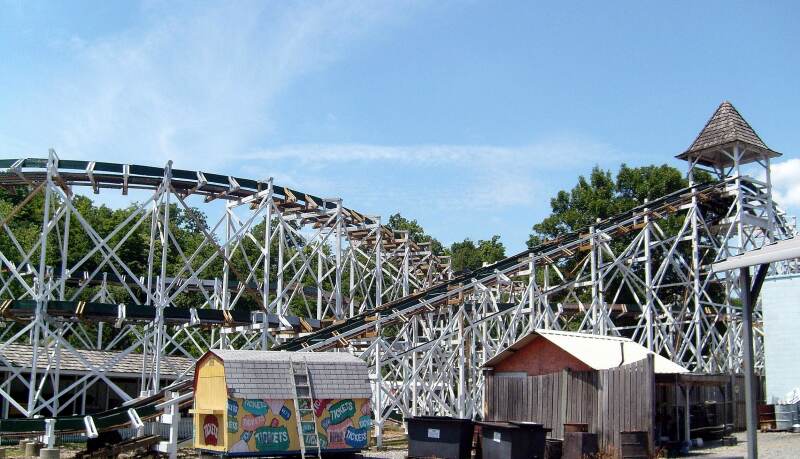
The Birth of a Legend: 1902 and the Early Days of Roller Coasters
To understand Leap-The-Dips, you need to understand the era in which it was born. The year 1902 was a pivotal moment in amusement park history. The roller coaster industry was still in its infancy, and designers were experimenting with different track configurations, restraint systems, and layouts to create thrilling yet safe rides.
Leap-The-Dips was designed by Edward Joy Morris and constructed by the Federal Construction Company for Lakemont Park, which began as a picnic area in Altoona. The coaster’s figure-eight design was cutting-edge for the time, representing the peak of side-friction roller coaster engineering.
What Made the Figure-Eight Design Revolutionary
The figure-eight layout was a clever engineering solution that allowed designers to maximize the use of limited space while creating a longer, more thrilling ride. The track literally crossed itself at different levels, creating the illusion of danger while maintaining safety. This design became wildly popular in the early 1900s, reaching peak popularity during the Roaring Twenties when nearly 400 figure-eight coasters operated across North America.
Leap-The-Dips’ figure-eight design meant riders experienced the coaster from multiple perspectives. They’d see the track ahead of them, then moments later, they’d pass underneath or over that same section. This created a sense of complexity and excitement that riders found irresistible.
The Side-Friction System: Engineering Innovation
One of the most important innovations on Leap-The-Dips was its side-friction wheel system. This was a game-changer for roller coaster design.
How Side-Friction Wheels Worked
Traditional wooden coasters had wheels that ran on top of the track, similar to a train on rails. But Leap-The-Dips used a more sophisticated system. The ride cars featured four flanged wheels underneath the track (to support the weight) and two unflanged wheels projecting to each side of the track (to guide lateral movement).
This side-friction system allowed the coaster to navigate sharper turns and more complex layouts than previous designs. It also enabled higher speeds without requiring a brakeman to ride along and manually control the train with a brake lever—a common practice on earlier coasters.
The innovation was significant enough that it became the standard for coaster design in the early 1900s. However, after World War I, the side-friction system was gradually replaced by under-track mechanisms that offered better vehicle security and support for greater speeds. By the 1980s, Leap-The-Dips was the last remaining figure-eight side-friction coaster still in operation.
The Specifications: Small But Mighty
By modern standards, Leap-The-Dips’ specifications are modest:
- Height: 41 feet
- Speed: 10 mph
- Track Length: Approximately 1,000 feet
- Layout: Figure-eight with 2.5 circuits
- Footprint: 84 by 229 feet
- Ride Duration: Approximately 1-2 minutes
- Restraints: Minimal by modern standards (lap bars)
These numbers might seem underwhelming compared to modern hypercoasters that reach 300+ feet and exceed 100 mph. But what Leap-The-Dips lacks in height and speed, it makes up for in charm, historical significance, and the quality of its engineering. A 10 mph ride on a wooden coaster from 1902 feels far more thrilling than the numbers suggest, especially when you’re aware of the coaster’s age and the engineering principles that keep it running.
The Golden Age: 1902-1985
For most of the 20th century, Leap-The-Dips was a beloved attraction at Lakemont Park. It operated continuously from its opening in 1902 through 1985—an incredible 83-year run without closure.
The Roaring Twenties and Peak Popularity
The 1920s were the golden age of amusement parks. The figure-eight coaster design reached peak popularity, with nearly 400 examples operating across North America. Leap-The-Dips was one of the most beloved, drawing crowds from across Pennsylvania and beyond.
The coaster became iconic in Altoona, a symbol of the city’s prosperity and modernity. Families made regular trips to Lakemont Park specifically to ride Leap-The-Dips. The coaster’s reputation for smoothness and thrills made it a must-ride attraction.
Surviving the Great Depression and World Wars
While many amusement parks struggled during the Great Depression of the 1930s, Lakemont Park managed to keep operating. Leap-The-Dips continued to draw riders, providing affordable entertainment during difficult times. The coaster’s durability and low operating costs made it an asset rather than a liability.
Similarly, during World War II, when many parks closed or reduced operations, Lakemont Park remained open. Leap-The-Dips continued to operate, providing a brief escape for workers and families during wartime.
The Post-War Era and Gradual Decline
After World War II, the amusement park industry transformed. New, larger parks opened with more thrilling attractions. The figure-eight coaster design fell out of favor as manufacturers developed new track systems that allowed for greater heights, speeds, and inversions.
One by one, the nearly 400 figure-eight coasters that once operated across North America closed. Parks demolished them to make room for newer attractions. By the 1980s, Leap-The-Dips was one of the last survivors—a living relic of a bygone era.
Despite the changing landscape, Lakemont Park kept Leap-The-Dips operating. The coaster had become more than just an attraction; it was a historical artifact, a connection to the park’s past and to the early days of the amusement park industry.
The Crisis: 1985 and the Fight for Survival
In 1985, after 83 years of continuous operation, Leap-The-Dips closed. The reason was heartbreaking but understandable: structural integrity concerns and lack of maintenance funds. The wooden structure, now over 80 years old, was showing its age. The park didn’t have the financial resources to restore it.
For many coaster enthusiasts, this seemed like the end. Leap-The-Dips would likely be demolished, joining hundreds of other historic coasters that had been torn down over the decades. The world would lose one of its most important pieces of amusement park history.
But then something remarkable happened.
The Rescue Mission: American Coaster Enthusiasts and the Leap-The-Dips Foundation
The American Coaster Enthusiasts (ACE), a national organization dedicated to preserving roller coaster history, launched a fundraising campaign to save Leap-The-Dips. The organization recognized the coaster’s historical significance and understood that once it was gone, it would be gone forever.
The campaign led to the formation of the Leap-The-Dips Foundation, which worked tirelessly to raise funds for restoration. The foundation accepted private donations and partnered with eight local banks and the Progress Fund to secure financing for the project.
This was a groundbreaking effort. At the time, the idea of restoring a historic roller coaster was relatively novel. But the passion of coaster enthusiasts, combined with the support of local businesses and community members, made it possible.
The Restoration: 1997-1999
Restoration began in 1997, utilizing carpentry techniques that were performed during the coaster’s original construction. The restoration team faced a unique challenge: how do you repair a structure that’s nearly 100 years old using methods that were cutting-edge in 1902?
Preserving the Original While Ensuring Safety
Over 70 percent of the original wood remained intact and was preserved. The restoration team replaced only the sections that were beyond repair, carefully matching the original materials and construction techniques. This wasn’t a modern renovation; it was a meticulous restoration that honored the coaster’s heritage.
The lift chain was converted to steel for reliability, and a ratchet system was installed to prevent cars from rolling backward in the event of a chain failure. Modern safety standards were incorporated without compromising the coaster’s historical authenticity.
The restoration was overseen by P. Joseph Lehman, Inc., Consulting Engineers, a firm with expertise in historic preservation. Every decision was made with the goal of maintaining the coaster’s integrity while ensuring it could operate safely for future generations.
Recognition and Awards
Prior to its restoration, Leap-The-Dips was added to the National Register of Historic Places in 1993. In 1996, it was designated a National Historic Landmark—one of only a handful of roller coasters to receive this honor.
Following its reopening on May 31, 1999, the American Coaster Enthusiasts awarded Leap-The-Dips two prestigious awards: the Coaster Landmark Award and the Coaster Classic Award. These recognitions cemented its status as one of the most important roller coasters in the world.
The Resurrection: 1999-2023
When Leap-The-Dips reopened in 1999, it was a triumphant moment for coaster enthusiasts and preservationists everywhere. The coaster that should have been demolished was back in operation, thrilling a new generation of riders.
For nearly 25 years, from 1999 to 2023, Leap-The-Dips operated at Lakemont Park, drawing visitors from around the world. Coaster enthusiasts made pilgrimages to Altoona specifically to ride the world’s oldest roller coaster. Families created memories on a ride that their grandparents might have experienced.
The coaster proved that historic preservation wasn’t just about museums and buildings—it was about keeping living history alive. Every person who rode Leap-The-Dips was participating in a tradition that stretched back over 120 years.
The Unique Rider Experience: What It’s Like to Ride Leap-The-Dips
Riding Leap-The-Dips is a completely different experience from modern coasters. Here’s what riders consistently report:
The Anticipation
As you board the train, you’re immediately aware of the coaster’s age. The wooden structure creaks slightly. The cars are simple, with minimal restraints—just a lap bar. There’s no over-the-shoulder harness, no complex safety systems. It feels authentic, historical, almost like stepping back in time.
The Lift Hill
The chain lift pulls you up the 41-foot hill at a steady pace. The climb is gradual, building anticipation. You can see the track ahead, the park below, and the wooden structure supporting everything. There’s a mechanical, purposeful quality to it all.
The First Drop and the Ride Experience
The first descent is gentle by modern standards—just 41 feet at a modest angle. But the speed builds quickly. The wooden track beneath you creaks and groans in a way that modern steel coasters never do. This isn’t a smooth, silent glide; it’s a living, breathing machine.
The figure-eight layout means you’re constantly turning, constantly experiencing new perspectives. You pass underneath sections of track you rode moments earlier. You see other parts of the coaster approaching. The ride feels complex and intricate in a way that modern out-and-back coasters don’t.
The Smoothness
Despite its age, riders consistently praise Leap-The-Dips for its smoothness. The side-friction wheel system distributes forces evenly, minimizing jolts. The wooden structure, though old, has been meticulously maintained. You feel safe and secure, even as you’re experiencing genuine thrills.
The Authenticity
Perhaps most importantly, riding Leap-The-Dips feels authentic in a way that few modern attractions do. You’re not experiencing a theme or a story; you’re experiencing engineering. You’re feeling the forces that coaster designers understood over 120 years ago. You’re riding a piece of history.
What Riders and Enthusiasts Say
Coaster enthusiasts who have ridden hundreds of coasters around the world consistently rank Leap-The-Dips highly. Here’s what they appreciate:
- Historical Significance: It’s the oldest standing roller coaster in the world. Riding it is like experiencing a living museum.
- Smoothness: Despite its age, it rides remarkably smoothly. The engineering has held up incredibly well.
- Authenticity: There’s no theming, no gimmicks—just pure coaster engineering from the early 1900s.
- Charm: The wooden structure, the simple cars, the mechanical sounds—it all creates an experience that modern coasters can’t replicate.
- Rarity: It’s the last of its kind. There are no other figure-eight side-friction coasters still operating anywhere in the world.
Casual riders often express surprise at how much they enjoy the coaster. They expect it to be rough or slow, but instead they find it thrilling and smooth. Many riders take multiple laps, discovering new details and sensations with each ride.
The Engineering Marvel: Why Leap-The-Dips Still Works
The fact that Leap-The-Dips still operates after 120+ years is a testament to the engineering principles that guided its construction and the maintenance efforts that have kept it running.
The Wooden Structure
The coaster’s wooden trestle structure is a marvel of engineering. The beams are carefully arranged to distribute weight and forces efficiently. The design has proven so sound that, even after over a century, the basic structure remains intact.
The restoration team found that over 70 percent of the original wood was still usable. This speaks to the quality of the materials and the design. The wood that did need replacement was carefully matched to the original specifications.
The Track System
The wooden track, with its side-friction wheel system, has proven to be remarkably durable. While portions of the track have been replaced with steel in areas of exceptionally high wear, the basic design remains unchanged from 1902.
The side-friction wheels, which seemed revolutionary in 1902, proved to be a robust design that could handle decades
The Brake System
The original brake system on Leap-The-Dips was mechanical, relying on friction and gravity to slow the train. Over the decades, this system was refined and updated while maintaining the same basic principles. The brakes are reliable and predictable, bringing the train to a smooth stop without jarring or sudden deceleration.
The Lift Mechanism
The lift hill uses a chain drive system, which was standard for coasters in 1902 and remains common today. The lift mechanism includes a ratchet system to prevent cars from rolling backward in the event of a chain failure—a safety feature that was added during the 1997-1999 restoration. This simple but effective system has proven reliable for over a century.
The Decline and Current Status: 2017-Present
In early 2017, Lakemont Park announced ambitious plans for a complete restoration and transformation. The park would close for one season to undergo major renovations and emerge as a “family entertainment location with some amusements.”
The park remained closed during the 2018 season and reopened in 2019 with updated facilities and attractions. However, the financial challenges that plagued the park didn’t disappear with the renovation.
The 2023 Closure
In 2023, Lakemont Park announced that Leap-The-Dips and other amusement rides would be suspended from operation due to financial constraints. The park claimed that the costs of maintaining and operating the rides exceeded the revenue they generated.
This was a devastating blow to coaster enthusiasts and preservationists. The coaster that had been rescued from demolition in the 1990s, meticulously restored, and celebrated as a National Historic Landmark was once again facing an uncertain future.
As of 2026, Leap-The-Dips remains closed, sitting idle at Lakemont Park. The coaster itself is structurally sound—the restoration work from the 1990s was thorough and has been maintained. The closure is purely a matter of economics, not structural integrity.
The Uncertain Future: What Happens Next?
The current situation raises important questions about the future of historic roller coasters and amusement parks. Leap-The-Dips is a National Historic Landmark, but that designation doesn’t guarantee funding for operation or maintenance. The coaster requires ongoing care, and that care costs money.
Potential Paths Forward
Several scenarios could lead to Leap-The-Dips reopening:
- Park Revitalization: If Lakemont Park’s financial situation improves, the park could resume operations of its rides, including Leap-The-Dips.
- Community or Government Support: Local governments or preservation organizations could provide funding to keep the coaster operational as a historical attraction.
- Relocation: Another park or preservation organization could potentially relocate the coaster, though this would be extremely complex and costly.
- Museum or Heritage Site: Leap-The-Dips could be preserved as a static display or museum piece, allowing people to see and learn about it even if it’s not operational.
The Broader Implications
The closure of Leap-The-Dips raises important questions about how we preserve industrial and technological heritage. Unlike buildings or artwork, historic machines like roller coasters require ongoing operation and maintenance to remain viable. Simply preserving them as static displays loses an essential part of their character and significance.
The coaster enthusiast community remains hopeful that a solution will be found. The American Coaster Enthusiasts and other preservation organizations continue to advocate for the coaster’s reopening. Fans around the world have expressed their desire to ride Leap-The-Dips again.
Comparing Leap-The-Dips to Other Historic Coasters
Leap-The-Dips isn’t the only historic roller coaster still in operation. Let’s compare it to some other notable survivors:
Leap-The-Dips vs. Coney Island Cyclone (1927)
The Coney Island Cyclone, which opened in 1927, is about 25 years younger than Leap-The-Dips. It’s taller (85 feet vs. 41 feet) and faster (60 mph vs. 10 mph), but it’s a more traditional out-and-back wooden coaster rather than a figure-eight. The Cyclone has been operating continuously since 1927 (except for brief closures) and remains one of the most beloved coasters in America.
Leap-The-Dips vs. Jack Rabbit (Kennywood, 1921)
The Jack Rabbit at Kennywood opened in 1921, making it about 19 years younger than Leap-The-Dips. It’s a classic wooden coaster that has been operating continuously since its opening. Like the Cyclone, it’s larger and faster than Leap-The-Dips, but it lacks the unique figure-eight design.
Leap-The-Dips vs. The Beast (Kings Island, 1979)
The Beast is a much newer coaster (1979) but is often compared to Leap-The-Dips in terms of historical significance and fan devotion. The Beast is larger and faster, but Leap-The-Dips has the distinction of being the oldest standing coaster in the world.
What sets Leap-The-Dips apart is its age and its rarity. It’s not just old; it’s the oldest. And it’s not just a historic coaster; it’s the last of its kind—the final surviving figure-eight side-friction coaster in the world.
The Technical Specifications Explained
Let’s dive deeper into what Leap-The-Dips’ specifications mean in practical terms:
Height: 41 Feet
At 41 feet, Leap-The-Dips is taller than many modern family coasters but significantly shorter than modern hypercoasters. However, height isn’t everything. The angle of descent and the speed at which you descend matter more than the absolute height. A 41-foot drop at a steep angle on a wooden coaster can feel more thrilling than a 100-foot drop on a modern steel coaster with a gentler angle.
Speed: 10 mph
Ten miles per hour seems slow, but on a wooden coaster from 1902, it’s plenty fast. The lack of sophisticated braking systems and the wooden structure create forces and sensations that modern riders find thrilling. Additionally, the figure-eight layout means you’re constantly turning, which creates lateral forces that add to the sensation of speed.
Track Length: Approximately 1,000 Feet
The track is relatively short by modern standards, but it’s efficiently designed. The figure-eight layout means you’re experiencing multiple circuits and perspectives within that 1,000 feet. The ride feels longer and more complex than the track length suggests.
Footprint: 84 by 229 Feet
Leap-The-Dips occupies a rectangular area at Lakemont Park. The compact footprint is one of the advantages of the figure-eight design—it allows for a longer, more complex ride within a limited space. This was crucial in the early 1900s when parks had limited land available.
The Side-Friction System in Detail
Understanding the side-friction system is key to appreciating Leap-The-Dips’ engineering innovation:
How It Works
The ride cars have seven wheels total: four flanged wheels underneath the track (to support the weight and prevent the car from lifting off) and two unflanged wheels projecting to each side of the track (to guide lateral movement and prevent the car from shifting sideways).
This configuration allows the track to be relatively simple—just a wooden beam—while the wheels handle all the forces. The flanged wheels grip the track from below, while the side wheels grip from the sides. This creates a secure, stable ride experience.
Why It Became Obsolete
After World War I, manufacturers developed under-track wheel systems that offered better security and support for higher speeds. These systems used wheels above and below the track, creating a more secure connection. The side-friction system was gradually abandoned.
However, for the speeds and forces involved in early 1900s coasters, the side-friction system was perfectly adequate. The fact that Leap-The-Dips still operates smoothly using this 120-year-old system proves its effectiveness.
The Restoration Process: How They Saved It
The 1997-1999 restoration of Leap-The-Dips was a landmark preservation project. Here’s how they did it:
Assessment and Planning
The first step was a thorough assessment of the coaster’s condition. Engineers examined every wooden beam, every bolt, every section of track. They identified which components could be salvaged and which needed replacement.
The goal was clear: preserve as much of the original structure as possible while ensuring the coaster could operate safely. This required balancing historical authenticity with modern safety standards.
Wood Replacement
Over 70 percent of the original wood was preserved. The sections that needed replacement were carefully matched to the original specifications. The restoration team used the same types of wood and the same construction techniques that were used in 1902.
This wasn’t a modern renovation where you’d use contemporary materials and methods. It was a meticulous restoration that honored the coaster’s heritage and construction history.
Track and Wheel System
The wooden track was inspected section by section. Portions that showed excessive wear were replaced with steel, which is more durable and easier to maintain. However, the basic track configuration remained unchanged.
The wheel system was serviced and updated where necessary, but the fundamental side-friction design was preserved.
Safety Upgrades
Modern safety features were incorporated without compromising historical authenticity. The lift chain was converted to steel for reliability. A ratchet system was installed to prevent cars from rolling backward. Brake systems were updated and tested.
These upgrades ensured that Leap-The-Dips could operate safely by modern standards while maintaining its historical character.
Timeline and Cost
The restoration began in 1997 and was completed in 1999, taking approximately two years. The project involved extensive fundraising, community support, and technical expertise. The total cost was substantial, but the result was the preservation of an irreplaceable piece of history.
Why Leap-The-Dips Matters: Historical and Cultural Significance
Leap-The-Dips isn’t just a roller coaster; it’s a historical artifact that tells the story of American innovation, engineering, and entertainment.
A Window Into the Past
Riding Leap-The-Dips is like stepping into a time machine. You experience the coaster the way people experienced it in 1902, 1925, or 1950. The engineering principles, the materials, the construction methods—they’re all authentic to the early 1900s.
This authenticity is invaluable. It allows us to understand how coaster designers thought, what they valued, and what was possible with the technology of their era.
A Testament to Durability
In an era of planned obsolescence, Leap-The-Dips stands as a testament to durability and quality. A structure built in 1902 is still standing, still functional, still thrilling riders over 120 years later. This speaks to the engineering principles and construction quality of the era.
A Symbol of Preservation
The rescue and restoration of Leap-The-Dips in the 1990s was groundbreaking. It demonstrated that historic industrial structures could be preserved and kept operational, not just displayed in museums. It inspired other preservation efforts and showed that community passion and support could save important pieces of history.
A Connection to Community
For residents of Altoona and the surrounding region, Leap-The-Dips is more than a historical artifact. It’s a connection to their community’s past, a symbol of the city’s industrial heritage and prosperity. Families have ridden the coaster across generations, creating memories and traditions.
The Rider Experience Across Different Perspectives
What makes Leap-The-Dips special is that it offers different experiences depending on your perspective:
For Coaster Enthusiasts
Coaster enthusiasts appreciate Leap-The-Dips for its engineering, its historical significance, and its rarity. They recognize the side-friction system as a marvel of early 1900s engineering. They understand the importance of the figure-eight design and its role in coaster history. Riding Leap-The-Dips is like visiting a museum—educational and inspiring.
For Casual Riders
Casual riders often approach Leap-The-Dips with low expectations. They expect it to be slow, rough, or boring. Instead, they find it thrilling and smooth. The simplicity of the ride—no inversions, no extreme angles—makes it accessible to riders who might be intimidated by modern coasters. Many casual riders are surprised by how much they enjoy it and take multiple laps.
For Historians and Preservationists
Historians and preservationists see Leap-The-Dips as a crucial piece of American industrial heritage. It represents a moment in time when amusement parks were new, when engineering was being pushed in new directions, when communities invested in public entertainment. The coaster is a physical manifestation of these historical forces.
For Local Community Members
For people from Altoona and the surrounding region, Leap-The-Dips is a source of pride and identity. It’s a landmark that has been part of their community for over 120 years. The coaster represents the city’s history, prosperity, and cultural heritage.
Conclusion: A Coaster That Refuses to Die
Leap-The-Dips is more than just the world’s oldest standing roller coaster. It’s a symbol of American ingenuity, a testament to quality engineering, and a bridge between past and present. Built in 1902, it survived wars, economic depressions, changing fashions, and technological obsolescence.
When it faced demolition in 1985, passionate enthusiasts and community members fought to save it. The restoration effort of 1997-1999 proved that historic industrial structures could be preserved and kept operational. For nearly 25 years, from 1999 to 2023, Leap-The-Dips continued to thrill riders and connect them to over a century of history.
Today, as the coaster sits idle due to financial challenges at Lakemont Park, the coaster enthusiast community remains hopeful. They understand that Leap-The-Dips isn’t just a ride—it’s history. And history, once lost, can never be recovered.
Whether Leap-The-Dips operates again remains uncertain. But its legacy is secure. It stands as a reminder of what’s possible when engineering, craftsmanship, and passion come together. It’s a coaster that refused to die in 1985, and the world is better for it.
