The thought of being stuck on a roller coaster is one of those fears that keeps people up at night. You’re suspended high in the air, moving at high speeds, and suddenly everything stops. What happens next? Is it dangerous? How do they get you down? These are legitimate questions, and the answer is more reassuring than you might think. Modern roller coasters are equipped with multiple safety systems designed specifically to handle situations where a ride comes to an unexpected stop, and the procedures for getting riders safely off a stuck coaster are well-established and regularly practiced.
Why Roller Coasters Get Stuck
Before we talk about what happens when a coaster gets stuck, it’s important to understand why it happens in the first place. Contrary to what many people think, a roller coaster getting stuck isn’t necessarily a sign of a mechanical failure or a dangerous malfunction. There are several reasons why a coaster might come to an unexpected stop, and many of them are completely routine.
The most common reason a coaster gets stuck is due to a sensor malfunction or a safety system activation. Modern roller coasters are covered with sensors that monitor everything from train speed to wheel position to brake function. If a sensor detects something out of the ordinary, the ride’s computer system will automatically slow or stop the train to ensure rider safety. This might be triggered by something as simple as a sensor getting dirty or misaligned, which is why you’ll often see the ride restart after a brief pause.
Another common reason for a coaster to stop is due to a block zone activation. Block zones are sections of the track where the ride’s computer can intentionally slow or stop a train to prevent collisions with other trains or to manage the flow of riders through the course. If a train ahead is moving slower than expected, the ride’s computer might activate a block zone to stop the following train, preventing a potential collision. Once the train ahead clears the zone, the stopped train will automatically resume its course.
Weather can also cause a coaster to stop. Many parks have weather protocols that automatically halt rides during lightning storms, high winds, or other severe weather conditions. These stoppages are designed to protect riders from weather-related hazards, and they’re often brief, lasting only until conditions improve.
Mechanical issues can also cause a coaster to stop, though this is less common than sensor malfunctions or block zone activations. A mechanical problem might be something like a wheel that’s not tracking properly or a brake that’s not functioning as expected. In these cases, the ride’s safety systems will detect the issue and bring the train to a stop before any danger occurs.
Finally, a coaster might stop due to human error or an operational issue. A ride operator might manually stop the train if they notice something unusual, or the ride might stop if a guest does something that violates safety protocols, like standing up or removing a restraint.
The Immediate Response: What Happens When a Coaster Stops
When a roller coaster comes to an unexpected stop, the first thing that happens is that the ride’s safety systems engage. The train will slow down and come to a complete stop, and all of the ride’s restraints will remain locked in place. This is a critical safety feature; even if the train stops, the restraints keep riders securely in their seats.
Once the train has stopped, the ride’s computer system will begin running diagnostic checks to determine why the train stopped and whether it’s safe to resume operation. This process typically takes a few minutes. During this time, riders will remain in their seats with their restraints locked, but they won’t be in any danger. The ride operators will be monitoring the situation from the control booth, and they’ll have communication with the train via the ride’s control system.
In most cases, the diagnostic checks will reveal that the stoppage was due to a minor issue like a sensor malfunction or a block zone activation. Once the issue is resolved, the ride’s computer will automatically resume the course, and the train will continue on its way. This process is so routine that many riders don’t even realize the train has stopped; they just feel a brief pause before the ride continues.
However, if the diagnostic checks reveal a more serious issue, the ride operator will need to take additional steps. The operator might manually restart the ride if they determine it’s safe to do so, or they might decide that the train needs to be manually moved to a safe location where riders can be evacuated.
Manual Evacuation: Getting Riders Off a Stuck Coaster
If a coaster stops in a location where riders can’t safely exit on their own, or if the ride can’t be restarted, the park will need to manually evacuate the riders. This is where things get more involved, but it’s important to understand that parks have well-established procedures for this exact scenario, and trained staff members are prepared to handle it.
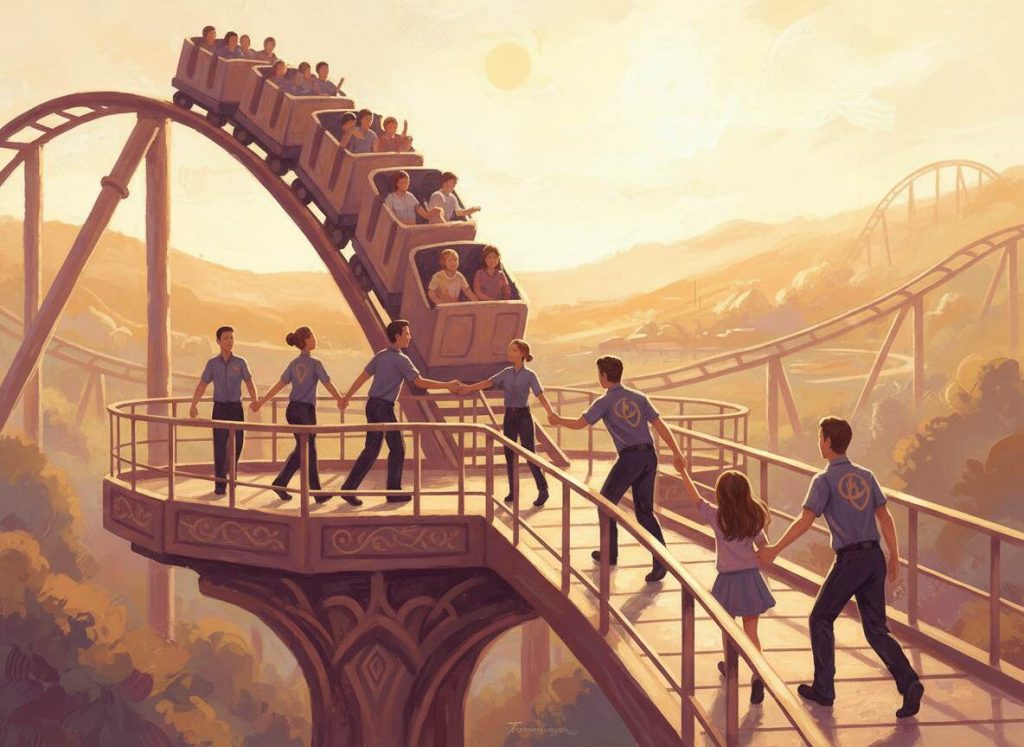
The first step in a manual evacuation is to ensure that the train is completely secure and that all restraints are locked. Once this is confirmed, ride operators and maintenance staff will assess the situation and determine the best way to get riders off the train. In many cases, this might involve moving the train to a location where riders can safely exit, such as the station or a maintenance platform.
If the train can be moved, the ride’s computer system will carefully move the train at a very slow speed to a safe location. This process is done very carefully and deliberately, with constant monitoring to ensure that the train doesn’t move too quickly or encounter any obstacles. Once the train reaches a safe location, riders can unbuckle their restraints and exit the train with assistance from staff members.
If the train can’t be moved, or if it’s stuck in a location where riders can’t safely exit even with staff assistance, the park will need to bring in additional equipment. In some cases, this might involve using a crane or lift to lower the train to a safe level, or it might involve building a platform or stairs to allow riders to safely exit the train at its current location.
In extreme cases, where the train is stuck high in the air and can’t be safely lowered, riders might need to be evacuated using a rope rescue system. This involves trained rescue personnel using ropes and harnesses to safely lower each rider from the train to the ground. This type of evacuation is extremely rare and is only used as a last resort, but parks have trained personnel and equipment on hand in case it’s ever needed.
The Experience: What It’s Like to Be Stuck on a Roller Coaster
If you’ve ever been stuck on a roller coaster, you know that the experience can be both frightening and oddly anticlimactic. One moment you’re zooming along at high speed, and the next moment everything stops. If you’re stuck on a high part of the track, the view can be spectacular, but it can also be disorienting and a bit scary.
The good news is that being stuck on a roller coaster is generally not dangerous. You’re securely fastened to your seat with multiple restraints, and the ride’s safety systems are constantly monitoring your situation. The train isn’t going anywhere, and trained staff members are working to get you safely off the ride.
Many people who have been stuck on a coaster report that the experience was less frightening than they expected. Yes, you’re suspended high in the air, but you’re also completely secure. The restraints are holding you firmly in place, and you’re not moving. In fact, many riders find the experience oddly peaceful, a chance to take in the view and appreciate the engineering that went into the ride.
The wait can be the most frustrating part of the experience. Depending on the reason for the stoppage and the complexity of the evacuation, you might be stuck on the ride for anywhere from a few minutes to an hour or more. During this time, you’ll be communicating with ride operators via loudspeaker, and they’ll be keeping you updated on the situation and what’s happening next.
Ride operators are trained to keep riders calm during these situations. They’ll explain what’s happening, reassure riders that they’re safe, and provide updates on the evacuation process. Many operators have a calm, reassuring demeanor that helps put riders at ease, even in what might otherwise be a stressful situation.
Safety Systems That Prevent Coasters from Getting Stuck
Modern roller coasters are equipped with multiple safety systems designed to prevent dangerous situations from occurring in the first place. These systems are constantly monitoring the ride and making adjustments to ensure that everything is functioning properly.
Block zones are one of the most important safety systems on a modern coaster. These are sections of the track where the ride’s computer can intentionally slow or stop a train to prevent collisions or to manage the flow of riders. Block zones are positioned throughout the course, and they’re designed to work together to ensure that trains maintain a safe distance from each other.
Brake systems are another critical safety feature. Modern coasters have multiple brake systems, including friction brakes, magnetic brakes, and hydraulic brakes. These systems work together to slow and stop the train, and they’re designed to work even if one system fails. The brakes are constantly monitored by sensors, and if a sensor detects that a brake isn’t functioning properly, the ride will automatically stop.
Restraint systems are also monitored by sensors. If a sensor detects that a restraint isn’t properly locked, the ride won’t start. This ensures that every rider is properly secured before the train leaves the station.
Wheel and track monitoring systems use sensors to monitor the condition of the wheels and track. If a sensor detects that a wheel isn’t tracking properly or that the track is damaged, the ride will automatically stop. This prevents situations where a wheel might derail or a train might encounter a damaged section of track.
Computer control systems are the brains of modern roller coasters. These systems constantly monitor all of the ride’s sensors and systems, and they make real-time adjustments to ensure that everything is functioning properly. If the computer detects any anomaly, it can automatically slow or stop the train to prevent a dangerous situation.
Historical Incidents: Learning from the Past
While modern roller coasters are incredibly safe, there have been historical incidents where coasters have gotten stuck in ways that required evacuation. These incidents have led to improvements in safety systems and evacuation procedures.
One notable incident occurred in 2015 at a theme park where a coaster train got stuck on a lift hill. The train was unable to complete the lift and came to a stop about halfway up the hill. Riders were stuck on the train for several hours while park staff worked to safely evacuate them. The incident led to improvements in the park’s evacuation procedures and in the ride’s safety systems.
Another incident occurred in 2016 when a coaster train got stuck on the track after a mechanical failure. Riders were stuck on the train for over an hour while park staff worked to safely move the train to a location where riders could exit. The incident highlighted the importance of having trained personnel and equipment on hand for emergency evacuations.
These incidents, while stressful for the riders involved, didn’t result in any injuries. They did, however, lead to improvements in safety procedures and evacuation protocols across the industry. Parks learned from these incidents and implemented new procedures to ensure that future evacuations would be handled even more safely and efficiently.
The Role of Ride Operators and Maintenance Staff
Ride operators and maintenance staff play a critical role in ensuring that coasters are safe and that any incidents are handled properly. These professionals are trained extensively on how to operate the rides, how to monitor safety systems, and how to respond to emergencies.
Ride operators are responsible for monitoring the ride during operation and for making decisions about when to start, stop, or evacuate the ride. They’re trained to recognize signs of mechanical problems or safety issues, and they’re empowered to stop the ride if they notice anything unusual. Operators are also trained in communication and customer service, and they play an important role in keeping riders calm during emergency situations.
Maintenance staff are responsible for inspecting and maintaining the rides on a daily basis. They perform routine maintenance tasks like lubricating wheels and checking brake systems, and they also perform more extensive inspections to identify any potential problems. Maintenance staff are trained to recognize signs of wear or damage, and they’re responsible for making repairs and replacements as needed.
Both ride operators and maintenance staff are trained in evacuation procedures. They practice these procedures regularly so that if an emergency evacuation is ever needed, they can execute it quickly and safely. This training includes how to communicate with riders, how to safely lower riders from the train, and how to use rescue equipment.
Modern Technology and Remote Monitoring
Modern roller coasters are increasingly equipped with remote monitoring systems that allow park staff to monitor the ride from a central location. These systems provide real-time data on the ride’s performance, including information about train speed, brake function, restraint status, and more.
Remote monitoring systems allow park staff to identify potential problems before they become serious issues. If a sensor detects that a brake is wearing out, for example, maintenance staff can schedule a replacement before the brake fails. This proactive approach to maintenance helps prevent emergency situations from occurring in the first place.
Remote monitoring systems also allow park staff to respond more quickly to emergency situations. If a train gets stuck, park staff can immediately see the train’s location and status, and they can begin planning an evacuation if necessary. This real-time information helps ensure that evacuations are handled as safely and efficiently as possible.
What to Do If You Get Stuck on a Roller Coaster
If you ever find yourself stuck on a roller coaster, here’s what you should do:
Stay calm. You’re safe. The restraints are holding you securely, and trained staff members are working to get you off the ride.
Listen to the ride operators. They’ll be communicating with you via loudspeaker, and they’ll provide updates on what’s happening and what you should expect next.
Follow all instructions from park staff. If staff members are evacuating you from the ride, follow their instructions carefully and do exactly what they tell you to do.
Don’t try to unbuckle your restraints or exit the train on your own. Wait for staff members to give you permission and assistance.
Be patient. Evacuations take time, and park staff are working as quickly as possible to get you safely off the ride.
Take deep breaths. If you’re feeling anxious or scared, take slow, deep breaths to help calm yourself.
Remember that you’re not alone. Other riders are in the same situation, and staff members are there to help you.
The Reassuring Reality
The bottom line is this: if a roller coaster gets stuck, you’re going to be okay. Modern roller coasters are equipped with multiple safety systems designed to prevent dangerous situations from occurring, and parks have well-established procedures for safely evacuating riders if necessary. Ride operators and maintenance staff are trained professionals who take safety seriously, and they’re prepared to handle any emergency situation that might arise.
While being stuck on a coaster can be an unpleasant experience, it’s not a dangerous one. You’re securely fastened to your seat, the ride isn’t going anywhere, and trained staff members are working to get you safely off the ride. Thousands of people ride coasters every day without incident, and the vast majority of those who do experience a stoppage are evacuated safely and without any problems.
So the next time you’re on a roller coaster and you feel a sudden stop, don’t panic. Take a deep breath, trust in the safety systems that are protecting you, and remember that you’re in good hands. The engineers, operators, and maintenance staff who work on these rides have done everything in their power to ensure that you’re safe, and their efforts are evident in the excellent safety record of modern amusement parks.
