How Do Roller Coasters Work? The Complete Engineering & Physics Guide
When you board a roller coaster, you're experiencing one of the most sophisticated applications of physics and engineering in the world. A modern roller coaster is a marvel of precision: it must be thrilling, safe, reliable, and capable of operating hundreds of times per day without failure.
But how does it actually work? What keeps the train on the track during a 4G turn? How does the ride know when to brake? Why does your stomach feel like it's floating at the top of a hill? The answers lie in a beautiful intersection of physics, mechanical engineering, electrical systems, and computer control.
This guide will take you deep into the mechanics of roller coasters. We'll explore the physics that makes them thrilling, the engineering that makes them safe, and the systems that make them run. Whether you're a coaster enthusiast, an engineer, or just curious about how these incredible machines work, this guide will give you a complete understanding of roller coaster technology.
Part One: The Physics Foundation
Energy: The Engine of Every Coaster
Every roller coaster operates on a fundamental principle: energy conservation. The ride doesn't have an engine that propels it around the track. Instead, it uses potential energy and kinetic energy to create motion.
Potential Energy is the energy an object possesses due to its position. When a roller coaster train is lifted to the top of a hill, it gains potential energy. The higher the hill, the more potential energy the train has.
Kinetic Energy is the energy of motion. As the train descends from the hill, potential energy converts into kinetic energy, and the train speeds up.
The relationship between these two forms of energy is expressed in a simple equation:
PE = mgh
Where:
- PE = Potential Energy
- m = mass of the train
- g = gravitational acceleration (9.81 m/s²)
- h = height above the reference point
And kinetic energy is expressed as:
KE = 1/2mv^2
Where:
- KE = Kinetic Energy
- m = mass of the train
- v = velocity of the train
Here's the crucial insight: at the top of the lift hill, the train has maximum potential energy and zero kinetic energy (it's momentarily at rest). As it descends, potential energy converts into kinetic energy. By the time the train reaches the bottom of the first drop, most of that potential energy has become kinetic energy, and the train is moving at maximum speed.
This is why the first drop is always the most important element of a coaster's layout. The height of that first hill determines the maximum speed the train can achieve on the entire ride. A 200-foot first drop will result in a faster coaster than a 100-foot first drop, all else being equal.
Friction: The Energy Thief
Of course, real-world roller coasters don't perfectly convert all potential energy into kinetic energy. Friction is constantly stealing energy from the system.
Friction occurs in several places:
- Wheel-to-track friction: The wheels rolling on the track create friction that opposes motion.
- Air resistance: As the train moves through the air, it encounters resistance that slows it down.
- Mechanical friction: Within the train's wheel assemblies and bearings, friction dissipates energy.
Engineers account for friction when designing coasters. They calculate how much energy will be lost to friction at each point on the track. This is why the second hill on a coaster is always lower than the first hill—the train has lost energy to friction and can't climb as high.
Modern coaster designers use computer simulations to model friction and energy loss with remarkable precision. They can predict the exact speed of the train at any point on the track, accounting for friction, air resistance, and train weight.
Gravity and Acceleration: Creating Sensation
Gravity is the fundamental force that makes roller coasters work. It's constantly pulling the train downward with an acceleration of 9.81 m/s². But riders don't just experience the pull of gravity; they experience the combined effect of gravity and the forces created by the track's shape.
When a train goes over the top of a hill, riders experience negative G-forces (or airtime). This happens because the track is curving away from the riders faster than gravity is pulling them down. For a moment, riders feel weightless—their bodies want to lift out of their seats.
When a train goes through the bottom of a valley or around a banked turn, riders experience positive G-forces. The track is pushing up on the train (or the banked turn is pushing inward), and riders feel heavier than normal.
G-forces are measured in units of gravitational acceleration. One G is the normal force of gravity at Earth's surface. If you're standing still, you're experiencing 1 G of force pushing you toward the ground. If a roller coaster pulls 4 Gs in a turn, you're experiencing a force four times stronger than normal gravity.
The equation for centripetal acceleration (the acceleration toward the center of a circular path) is:
a_c = v^2/r
Where:
- a_c = centripetal acceleration
- v = velocity
- r = radius of the circular path
This equation reveals something crucial: the faster you're going, or the tighter the turn (smaller radius), the higher the G-forces. A tight turn at high speed can create intense G-forces. A gentle turn at low speed creates minimal G-forces.
Inversions: Defying Gravity
Inversions are one of the most thrilling elements of a roller coaster, and they work because of centripetal force and the precise engineering of the track.
When a train goes through a loop, it's moving in a circular path. The track must provide enough centripetal force to keep the train moving in that circle. At the top of the loop, the track is upside down, but the train is moving fast enough that the centripetal force (provided by the track pushing down on the train) keeps the riders pressed into their seats.
The minimum speed required to complete a loop is determined by the radius of the loop and the force of gravity:
$$ v_{min} = \sqrt{gr} $$
Where:
- v_min = minimum velocity to complete the loop
- g = gravitational acceleration
- r = radius of the loop
Engineers design loops with specific radii to ensure that trains will have enough speed to complete them safely. They also design the lift hill to be tall enough that trains will have sufficient speed when they reach the loop.
Modern inversions come in many shapes: vertical loops, corkscrews, barrel rolls, and inverted turns. Each one is engineered to create a specific sensation while keeping riders safe.
Part Two: The Mechanical Systems
The Lift Hill: Getting to the Top
The lift hill is the first major mechanical system on a roller coaster. Its job is simple but critical: get the train to the top of the first hill with enough speed and precision to start the ride.
Chain Lift Systems
The most common lift system is the chain lift. Here's how it works:
A continuous chain runs through a steel trough beneath the track. The chain is powered by one or more electric motors positioned under the lift hill. The chain moves at a constant speed, typically 3-5 feet per second.
Underneath each train car are chain dogs—mechanical grippers that engage with the chain. As the train is positioned on the lift hill, the chain dogs engage with the moving chain, and the chain pulls the train up the hill.
The chain is incredibly strong, made of steel links that can withstand enormous forces. As the train climbs, the chain is pulling against the weight of the train plus the force of gravity acting on the incline. For a heavy train on a steep hill, the forces can exceed 100 tons.
At the top of the lift hill, the train passes over a chain stripper—a mechanical device that disengages the chain dogs from the chain. The train is now released and begins its descent under the influence of gravity alone.
Wheel Lift Systems
Some modern coasters use wheel lift systems instead of chain lifts. These systems use dozens of rotating wheels arranged in two rows. The wheels grip the train's guide rail and pull it up the lift hill.
Wheel lifts offer some advantages over chain lifts: they're quieter, they can operate at variable speeds, and they're more energy-efficient. However, they're more complex mechanically and require more maintenance.
Launch Systems
Some coasters use launch systems instead of traditional lift hills. These systems accelerate the train from 0 to top speed in a very short distance—sometimes just a few seconds.
Common launch systems include:
- Hydraulic launches: A hydraulic catapult system accelerates the train. Kingda Ka and Top Thrill Dragster use this system.
- Linear induction motors (LIM): Electromagnetic coils in the track induce a magnetic field that accelerates the train. Many modern coasters use LIM launches.
- Linear synchronous motors (LSM): Similar to LIM but with a different electromagnetic principle. Some newer coasters use LSM launches.
Launch systems can accelerate trains to 100+ mph in just a few seconds, creating an intense sensation of acceleration.
The Track: Guiding the Train
The track is the foundation of the entire ride. It must guide the train safely through every element while being strong enough to support the enormous forces involved.
Track Design
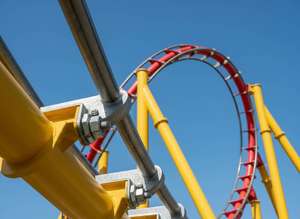
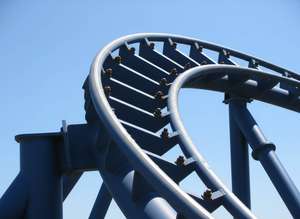
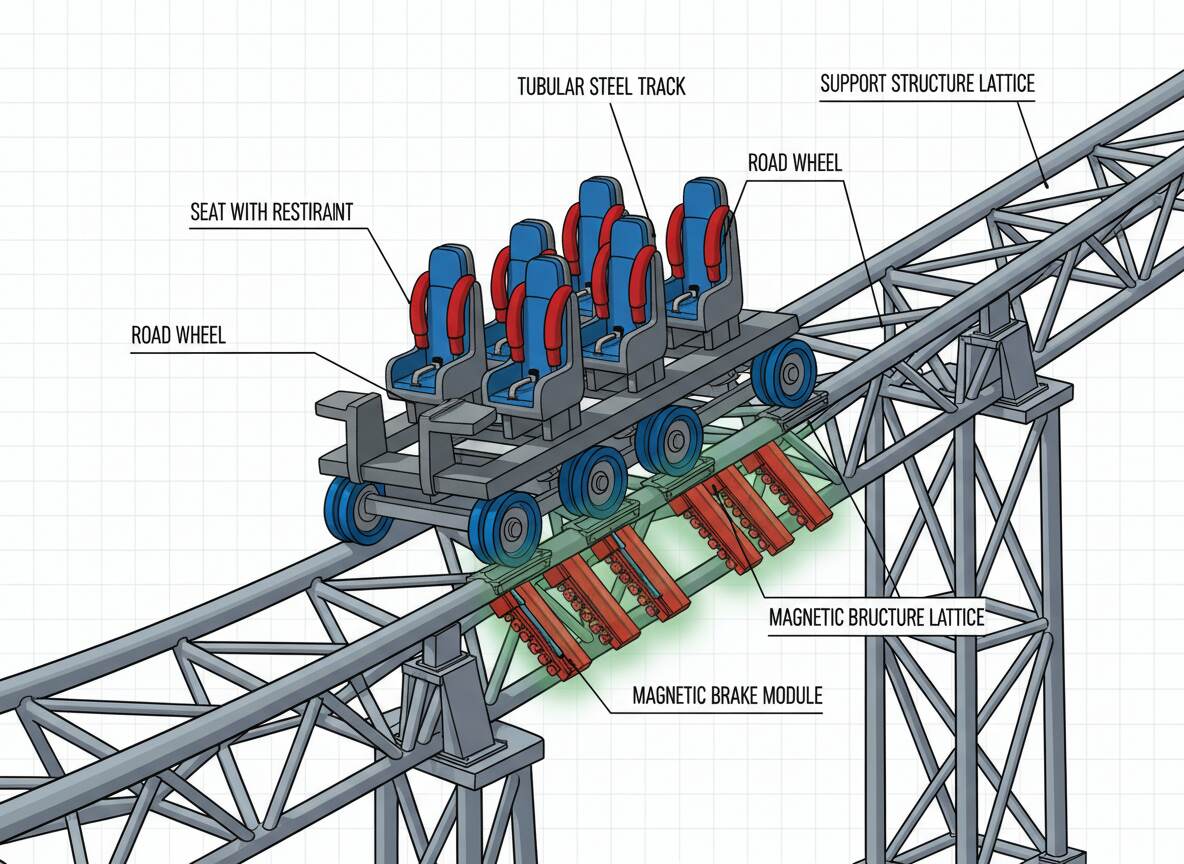
Modern steel coasters typically use a tubular track design. The train wraps around the tube, with wheels on top, underneath, and on the sides. This design allows the train to go upside down without riders falling out.
The track is made of steel, typically 1-2 inches in diameter for the main rail. The track is welded together in sections, and these sections are bolted together to form the complete circuit.
The track is supported by a steel lattice structure called the support structure. This structure transfers all the forces from the track down to the ground. The support structure must be incredibly strong—it's supporting the weight of the train, the forces of acceleration, and the lateral forces from turns.
Wheel Configuration
The train has wheels that ride on the track in three different ways:
Road wheels: These wheels ride on top of the rail. They support the weight of the train and keep it from lifting off the track during airtime.
Guide wheels: These wheels ride on the sides of the rail. They keep the train centered on the track and prevent lateral movement.
Brake fins: These are wheel-like structures that interact with the braking system. We'll discuss these in more detail in the braking section.
This three-point contact system is incredibly important. It ensures that the train stays on the track even during intense forces. If one set of wheels fails, the others can still keep the train safely on the track.
Restraints: Keeping Riders Safe
Restraints are a critical safety system. They keep riders in their seats even during intense airtime or inversions.
Types of Restraints
Different coasters use different restraint systems:
Lap bars: A bar that comes down across the rider's lap. These are common on hypercoasters and wooden coasters. They're minimally restrictive and allow for maximum airtime sensation.
Over-shoulder harnesses: Straps that come over the rider's shoulders and connect to the lap bar. These are common on coasters with inversions. They provide more security than lap bars alone.
Clamshell restraints: A single piece of restraint that comes down over the rider's lap and torso. These are common on inverted coasters and some modern thrill rides.
Seat belts: Some coasters use simple seat belts in addition to other restraints.
Restraint Design
Restraints are engineered to be as comfortable as possible while still being completely safe. Engineers calculate the maximum forces that riders will experience and design restraints that can safely contain those forces.
Modern restraints use ratcheting mechanisms that allow operators to adjust the tightness for different rider sizes. The restraint clicks into place at specific intervals, ensuring a secure fit.
Restraints also have safety sensors that detect whether they're properly fastened. If a restraint isn't properly secured, the ride won't start.
Part Three: The Control Systems
Block Zone Safety
One of the most important safety systems on a roller coaster is the block zone system. This system ensures that only one train occupies a particular section of track at any given time.
Here's how it works:
The track is divided into block zones—sections of track separated by brake points. Each block zone can safely hold one train. The control system monitors the position of each train and ensures that no train enters a block zone that's already occupied.
If a train is approaching a block zone that's occupied, the brakes in that zone activate, slowing or stopping the approaching train. Once the train in front exits the block zone, the brakes release and the following train can proceed.
This system is incredibly important for safety. It prevents collisions and ensures that trains are spaced safely throughout the ride.
How Block Zones Work
Block zones are controlled by sensors placed at the beginning and end of each zone. These sensors detect when a train enters or exits the zone.
When a train is detected in a block zone, the control system activates the brakes in the next block zone if a train is approaching. This prevents trains from getting too close to each other.
The control system also monitors the speed of trains. If a train is moving too slowly or too quickly, the system can activate brakes to adjust its speed.
Computer Control Systems (PLCs)
Modern roller coasters are controlled by sophisticated computer systems called Programmable Logic Controllers (PLCs). These systems monitor dozens of sensors and control dozens of mechanical systems to ensure safe, reliable operation.
What PLCs Monitor
A modern coaster's PLC monitors:
- Train position: Sensors throughout the track detect where each train is located.
- Train speed: Sensors measure how fast each train is moving.
- Restraint status: Sensors verify that all restraints are properly fastened.
- Brake status: Sensors verify that brakes are functioning properly.
- Motor status: Sensors monitor the lift hill motor and other mechanical systems.
- Weather conditions: Some coasters have sensors that detect wind speed, temperature, and other weather factors.
- Ride cycle status: The PLC tracks where in the ride cycle each train is.
What PLCs Control
The PLC controls:
- Lift hill motor: Starts and stops the lift hill motor, controlling the speed at which trains are lifted.
- Brake systems: Activates and deactivates brakes throughout the track.
- Block zones: Manages the block zone system to prevent collisions.
- Train dispatch: Determines when trains are released from the station.
- Restraint locks: Engages and disengages restraint locks.
- Ride cycle: Manages the entire sequence of the ride from loading to unloading.
Redundancy and Safety
Modern coaster control systems use redundant PLCs. This means there are multiple computers running the same control logic simultaneously. If one computer fails, the others take over. This redundancy ensures that the ride remains safe even if a component fails.
The control logic is also fail-safe. This means that if the system detects a problem, it defaults to the safest possible state. For example, if a sensor fails, the system assumes the worst-case scenario and activates brakes to slow or stop the train.
Braking Systems
Braking is one of the most critical systems on a roller coaster. The ride must be able to slow and stop trains safely and reliably, hundreds of times per day.
Magnetic Brakes
The most common braking system on modern coasters is the magnetic brake. Here's how it works:
Permanent magnets are mounted on the underside of the train. Metal fins are mounted on the track. As the train passes over the fins, the magnetic field induces electrical currents in the fins. These currents create a magnetic field that opposes the motion of the train, slowing it down.
The beauty of magnetic brakes is that they're completely passive. They don't require any moving parts or mechanical engagement. They work purely through electromagnetic induction. This makes them extremely reliable and low-maintenance.
Magnetic brakes can be calibrated to provide different amounts of braking force. By adjusting the strength of the magnets or the spacing of the fins, engineers can control exactly how much braking force is applied.
Friction Brakes
Some coasters use traditional friction brakes, similar to car brakes. Brake pads press against the track, creating friction that slows the train.
Friction brakes are effective but require more maintenance than magnetic brakes. The brake pads wear out over time and need to be replaced.
Wheel Brakes
Some coasters use wheels that press against the track to create braking force. These wheels are mounted on the train and can be engaged by the control system.
Hydraulic Brakes
Some launch coasters use hydraulic brakes to slow the train after launch. Hydraulic fluid is forced through restrictive passages, creating resistance that slows the train.
Sensors and Detection Systems
Sensors are the eyes and ears of a roller coaster. They constantly monitor the condition of the ride and provide data to the control system.
Proximity Sensors
Proximity sensors detect the presence of the train at specific locations on the track. They're used to track train position and manage block zones.
Speed Sensors
Speed sensors measure how fast the train is moving. They're typically inductive sensors that detect the passage of teeth on a rotating wheel.
Restraint Sensors
Restraint sensors verify that restraints are properly fastened. They're typically simple switches that detect whether the restraint is in the locked position.
Load Sensors
Load sensors measure the weight of the train and riders. This data helps the control system predict how the train will behave on the track.
Acceleration Sensors
Some modern coasters have accelerometers that measure the G-forces experienced by the train. This data is used for diagnostics and to ensure the ride is operating within safe parameters.
Temperature Sensors
Temperature sensors monitor the temperature of critical components like motors and bearings. If temperature exceeds safe limits, the system can shut down the ride to prevent damage.
Wind Sensors
Some coasters, particularly tall ones, have wind sensors. If wind speed exceeds safe limits, the ride can be shut down to prevent accidents.
Part Four: The Dynamics of Motion
Centripetal Force and Turns
When a roller coaster goes around a turn, it's moving in a circular path. To maintain that circular path, the track must provide a centripetal force—a force directed toward the center of the circle.
On a flat turn, the track provides this force by pushing sideways on the train. Riders feel pressed against the outside of the turn—this is lateral G-force.
On a banked turn, the track is tilted inward. This banking angle is carefully calculated so that a combination of the normal force from the track and gravity provides the centripetal force needed for the turn.
The banking angle is determined by the speed of the train and the radius of the turn:
$$ \theta = \arctan\left(\frac{v^2}{rg}\right) $$
Where:
- θ = banking angle
- v = velocity
- r = radius of the turn
- g = gravitational acceleration
A well-designed banked turn feels smooth and natural. Riders feel pressed into their seats but not uncomfortably so. A poorly designed turn can feel jerky and uncomfortable.
Airtime: The Weightless Sensation
Airtime is one of the most thrilling sensations on a roller coaster. It's the feeling of weightlessness as the train goes over a hill.
Airtime occurs when the track curves away from the riders faster than gravity pulls them down. At the top of a hill, if the track has a tight radius of curvature, the centripetal acceleration required to keep the train on the track is greater than the acceleration due to gravity.
This means the track must push down on the train (through the road wheels) to keep it on the track. But the train's weight is pushing down due to gravity. The net effect is that riders feel lighter than normal—they experience negative G-forces.
If the centripetal acceleration is greater than gravity (9.81 m/s²), riders will feel airtime. The amount of airtime is proportional to how much the centripetal acceleration exceeds gravity.
Engineers can calculate the exact airtime at each point on a coaster by using the equation:
$$ G_{airtime} = \frac{v^2}{rg} - 1 $$
Where:
- G_airtime = the amount of airtime in G-forces
- v = velocity at that point
- r = radius of curvature of the hill
- g = gravitational acceleration
A value of 0 means no airtime (1 G). A value of 0.5 means 0.5 Gs of airtime (riders feel half their normal weight). A value of 1.0 means 1 G of airtime (riders feel weightless).
Inversions: The Physics of Upside Down
Inversions are thrilling because they defy our intuition about gravity. How can a train stay on the track when it's upside down?
The answer is centripetal force. When a train goes through a loop, it's moving in a circular path. The track must provide enough centripetal force to keep the train moving in that circle.
At the top of a loop, the track is upside down, but the train is moving fast enough that the centripetal force (provided by the track pushing down on the train through the road wheels) is greater than the force of gravity.
The net force on the train is directed toward the center of the loop (downward at the top of the loop). This net force provides the centripetal acceleration needed to keep the train moving in a circle.
Riders experience positive G-forces at the top of the loop because they're being pressed into their seats by the centripetal force. They don't fall out because the restraints keep them in place, and the road wheels keep the train on the track.
Lateral Forces and Whip
When a train makes a sharp turn at high speed, riders experience lateral G-forces. They feel pressed against the outside of the turn.
On some coasters, particularly wooden coasters with sharp turns, riders can experience a sensation called whip. This occurs when the train makes a very sharp turn at high speed. The train's momentum carries it in a straight line, but the track forces it to turn sharply. Riders experience intense lateral forces and a sensation of being "whipped" around the turn.
Whip is thrilling but can be uncomfortable if it's too intense. Engineers design turns to provide the right amount of whip—enough to be thrilling but not so much that it's painful.
Part Five: Train Design and Mechanics
Train Configuration
A roller coaster train consists of multiple cars, each holding multiple riders. The cars are connected together and roll on the track as a single unit.
Car Design
Each car has:
- Wheels: Typically 6-12 wheels per car, arranged in multiple sets. Road wheels support the weight, guide wheels keep the train centered, and brake fins interact with the braking system.
- Axles: The wheels are mounted on axles that rotate freely.
- Bearings: High-quality bearings allow the wheels to rotate smoothly with minimal friction.
- Seats: Riders sit in seats that are bolted to the car frame.
- Restraints: Restraints are mounted to the seats or the car frame.
- Frame: The car frame is made of steel and must be strong enough to support the weight of riders and withstand the forces of acceleration.
Train Coupling
The cars are connected together by couplers—mechanical devices that allow the cars to move together while allowing some flexibility for turns and hills.
Most modern coasters use articulated couplers that allow the cars to pivot slightly relative to each other. This allows the train to navigate turns and hills smoothly without putting excessive stress on any single car.
Train Weight
The weight of the train is an important factor in coaster design. A heavier train will have more momentum and will be harder to stop. A lighter train will be easier to control but may not have enough momentum to complete certain elements.
Modern coasters are designed with a specific train weight in mind. The lift hill motor is sized to handle that weight. The braking systems are calibrated for that weight. The track is engineered to support that weight.
Wheel Systems
The wheel system is one of the most critical components of a roller coaster. It must support the weight of the train, keep it centered on the track, and allow it to move smoothly.
Road Wheels
Road wheels ride on top of the rail. They support the weight of the train and keep it from lifting off the track during airtime.
Road wheels are typically made of polyurethane or rubber. These materials provide good grip and wear resistance. The wheels are mounted on ball bearings that allow them to rotate freely.
Guide Wheels
Guide wheels ride on the sides of the rail. They keep the train centered on the track and prevent lateral movement.
Guide wheels are typically smaller than road wheels and are arranged in pairs on each side of the train.
Brake Fins
Brake fins are wheel-like structures that interact with the braking system. On magnetic brake systems, the fins pass through the magnetic field created by the magnets on the train.
On friction brake systems, the fins are pressed against by brake pads.
Bearing Systems
Bearings are critical components that allow wheels to rotate smoothly. A roller coaster train might have 50+ bearings, and each one must function perfectly for the ride to operate smoothly.
Modern coaster bearings are high-precision components made by specialized manufacturers. They're designed to handle the extreme forces and speeds of roller coasters.
Bearings require regular maintenance and lubrication. Over time, bearings wear out and must be replaced.
Part Six: Advanced Concepts
Energy Dissipation and Efficiency
As we discussed earlier, friction and air resistance dissipate energy throughout the ride. Engineers must account for this energy loss when designing the coaster.
The total energy dissipated can be calculated by comparing the potential energy at the top of the lift hill to the kinetic energy at various points on the track.
Modern coasters are designed to be relatively efficient. A well-designed coaster might dissipate 20-30% of its initial potential energy to friction and air resistance. The remaining energy is used to create the thrilling sensations of speed, airtime, and G-forces.
Resonance and Vibration
All structures vibrate at certain natural frequencies. If external forces excite these natural frequencies, the structure can experience resonance—amplified vibrations that can be uncomfortable or even dangerous.
Coaster designers must account for resonance when designing the track and support structure. They use computer simulations to identify the natural frequencies of the structure and ensure that the ride doesn't excite these frequencies.
Thermal Expansion
Steel expands and contracts with temperature changes. On a hot day, the track might expand slightly. On a cold day, it might contract.
Coaster designers account for this thermal expansion by building expansion joints into the track. These joints allow the track to expand and contract without putting excessive stress on the structure.
Wind Effects
Wind can affect how a coaster operates. Strong winds can create additional lateral forces on tall coasters. Wind can also affect the aerodynamics of the train.
Some coasters have wind sensors that shut down the ride if wind speeds exceed safe limits. Designers also use computer simulations to model wind effects and ensure the coaster is safe in various wind conditions.
Part Seven: Modern Innovations
Magnetic Levitation
Some cutting-edge coasters use magnetic levitation (maglev) technology. The train levitates above the track using magnetic forces, eliminating friction from wheels rolling on the track.
Maglev coasters can achieve higher speeds and smoother rides because there's no friction from wheels. However, maglev technology is expensive and complex, so it's only used on a few coasters.
Launch Systems
As mentioned earlier, modern launch systems can accelerate trains from 0 to 100+ mph in just a few seconds. These systems use linear induction motors (LIM) or linear synchronous motors (LSM) to create the acceleration.
Launch systems allow for more creative coaster layouts. Instead of relying on a tall lift hill, designers can use a launch to get the train moving fast, then use that speed to create thrilling elements.
Hydraulic Launches
Hydraulic launch systems use a pressurized hydraulic catapult to accelerate the train. These systems can achieve very high accelerations and are used on some of the fastest coasters in the world.
Hydraulic launches require significant maintenance and have higher operating costs than other launch systems, but they're incredibly thrilling.
Augmented Reality and Virtual Reality
Some modern coasters are experimenting with augmented reality (AR) and virtual reality (VR) to enhance the ride experience. Riders might wear VR headsets that show a virtual world overlaid on the real coaster.
VR coasters can create immersive experiences that go beyond what the physical coaster alone can provide. However, VR adds complexity and cost to the ride.
Adaptive Restraints
Some newer coasters use adaptive restraints that automatically adjust to fit different rider sizes. These restraints use sensors to detect the rider's size and automatically adjust the restraint to provide a secure fit.
Adaptive restraints improve safety and comfort by ensuring that all riders are properly restrained regardless of their size.
Part Eight: Safety and Reliability
Design Safety Factors
Coasters are designed with safety factors—the structure is built to be much stronger than necessary to handle normal operating forces.
A typical safety factor for a coaster might be 3 or 4. This means the structure is designed to withstand 3-4 times the maximum expected forces. This provides a large margin of safety.
Inspection and Maintenance
Regular inspection and maintenance are critical for coaster safety. Most coasters are inspected daily before opening and receive comprehensive maintenance during off-season.
Inspections include:
- Visual inspection of the track for cracks or damage
- Inspection of wheels and bearings for wear
- Testing of braking systems
- Testing of restraint systems
- Testing of control systems and sensors
- Lubrication of bearings and moving parts
Redundancy
Modern coasters use redundancy in critical systems. For example:
- Multiple wheels support the train (if one fails, others keep it on track)
- Multiple braking systems (if one fails, others can still stop the train)
- Redundant control systems (if one computer fails, others take over)
- Redundant sensors (if one sensor fails, others provide backup data)
This redundancy ensures that the ride remains safe even if individual components fail.
Testing and Validation
Before a new coaster opens to the public, it undergoes extensive testing. Engineers run the coaster with test weights to ensure it operates correctly. They measure G-forces, speeds, and other parameters to verify that the ride operates as designed.
Once the coaster opens, it continues to be monitored. Modern coasters collect data on every ride—train speed, G-forces, brake performance, and more. This data is analyzed to identify any trends or problems.
Part Nine: The Complete Ride Cycle
Now let's walk through a complete ride cycle to see how all these systems work together.
1. Loading
Riders board the train in the station. Operators verify that all restraints are properly fastened. Sensors confirm that all restraints are locked.
2. Dispatch
Once all riders are loaded and restrained, the control system gives the signal to dispatch the train. The train moves from the station onto the lift hill.
3. Lift Hill
The chain lift engages, and the train is pulled up the lift hill. Sensors track the train's position and speed. The control system monitors the lift hill motor to ensure it's operating properly.
4. Release
At the top of the lift hill, the chain stripper disengages the chain dogs, and the train is released. The train begins its descent under gravity.
5. First Drop
The train accelerates down the first drop, converting potential energy into kinetic energy. Sensors measure the train's speed.
6. First Airtime Hill
The train crests the first airtime hill. Riders experience weightlessness as the centripetal acceleration exceeds gravity.
7. Turns and Elements
The train navigates turns, inversions, and other elements. The control system monitors train speed and position. Block zone sensors ensure that no trains are too close to each other.
8. Mid-Course Brakes
Some coasters have mid-course brakes that slow the train before the second half of the ride. These brakes are controlled by the PLC and are activated based on train position and speed.
9. Final Elements
The train completes the final elements of the ride—more hills, turns, and airtime moments.
10. Brake Run
The train enters the brake run. Magnetic brakes (or friction brakes) are activated, slowing the train. The control system monitors brake performance to ensure the train is slowing at the expected rate.
11. Station Approach
The train approaches the station at a safe speed. The control system ensures that the train comes to a complete stop at the correct position in the station.
12. Unloading
The train comes to a complete stop in the station. Restraints are released. Riders exit the train.
13. Ready for Next Cycle
The train is now ready for the next cycle. If there are multiple trains, the next train might already be on the lift hill while the first train is unloading.
Conclusion: The Miracle of Modern Engineering
A roller coaster is a miracle of modern engineering. It combines sophisticated physics, precise mechanical design, advanced control systems, and rigorous safety protocols to create an experience that's thrilling, safe, and reliable.
Every element of a coaster serves a purpose. The lift hill builds potential energy. The first drop converts that energy into speed. The airtime hills create weightlessness through centripetal force. The turns create lateral G-forces. The inversions defy gravity through precise engineering. The braking systems safely slow the train. The control systems ensure safe operation.
When you ride a coaster, you're experiencing the culmination of decades of engineering knowledge, computer simulations, and real-world testing. You're trusting in systems that have been designed with multiple layers of safety and redundancy.
The next time you board a roller coaster, you'll have a deeper appreciation for the engineering that makes it possible. You'll understand why the first hill is always the tallest. You'll know why the airtime feels weightless. You'll appreciate the precision of the turns and the smoothness of the braking.
Roller coasters are more than just thrill rides. They're demonstrations of human ingenuity, mathematical precision, and engineering excellence. They're proof that we can harness the laws of physics to create experiences that are both thrilling and safe.