What Is Hangtime on a Roller Coaster?
Hangtime is the sensation of weightlessness that riders experience when a roller coaster crests a hill or executes an inversion at the right speed. During hangtime, riders are lifted out of their seats, suspended in mid-air, experiencing a moment of zero gravity or negative G-forces.
Hangtime is often confused with airtime, but they’re related concepts. Airtime is the general sensation of being lifted out of your seat, while hangtime specifically refers to extended periods of airtime where riders feel suspended in space.
Hangtime is one of the most thrilling sensations on a roller coaster. The feeling of weightlessness, the loss of contact with the seat, and the visual perspective of being suspended in mid-air create an intense psychological and physical experience.
The Physics of Hangtime: How Negative G-Forces Work
Hangtime is created by negative G-forces. To understand hangtime, you need to understand how G-forces work on a roller coaster.
Positive G-Forces
Positive G-forces push you down into your seat. When a coaster accelerates downward or turns sharply, you experience positive G-forces. You feel heavier, and you’re pressed into your seat.
Negative G-Forces
Negative G-forces pull you up out of your seat. When a coaster crests a hill at the right speed or executes an inversion, you experience negative G-forces. You feel lighter, and you’re lifted out of your seat.
Zero G-Forces
Zero G-forces occur when the acceleration due to gravity is perfectly balanced by the acceleration of the coaster. At zero G-forces, you experience weightlessness—you’re not pressed into your seat, and you’re not lifted out of it. You’re in a state of neutral buoyancy.
The Hangtime Sweet Spot
Hangtime occurs when a coaster is traveling at a speed where the centripetal acceleration (the acceleration required to follow the curved path) is less than the acceleration due to gravity. This creates negative G-forces that lift riders out of their seats.
The faster a coaster travels over a hill, the more positive G-forces riders experience. The slower a coaster travels, the more negative G-forces riders experience. Designers engineer coasters to achieve specific G-force levels at specific points to create the desired hangtime effect.
The Math Behind Hangtime
The G-forces experienced on a roller coaster can be calculated using the formula:
G = (v² / r) / g
Where v is the velocity of the coaster, r is the radius of the curved section, and g is the acceleration due to gravity (9.8 m/s²).
When G is positive, riders experience positive G-forces. When G is negative, riders experience negative G-forces (hangtime). When G is zero, riders experience weightlessness.
By adjusting the velocity and the radius of the curved sections, designers can control the G-forces and create specific hangtime effects.
Types of Hangtime: Different Ways to Experience Weightlessness
Hangtime can occur in different situations on a roller coaster, each creating a different experience.
Hill Hangtime
Hill hangtime occurs when a coaster crests a hill at the right speed. As the coaster goes over the top of the hill, riders are lifted out of their seats and experience weightlessness.
Hill hangtime is the most common type of hangtime and is a signature element of many coasters. Coasters like Millennium Force at Cedar Point and Kingda Ka at Six Flags Great Adventure are famous for their hill hangtime.
Inversion Hangtime
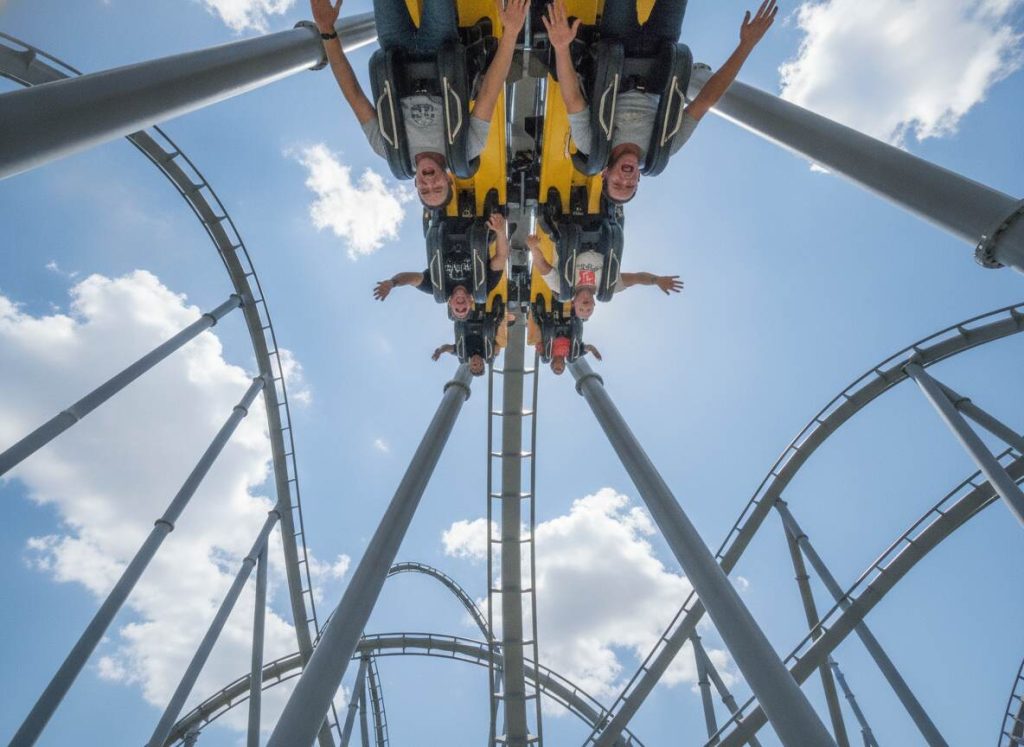
Inversion hangtime occurs during inversions like loops, corkscrews, and barrel rolls. As the coaster executes the inversion, riders experience negative G-forces that lift them out of their seats.
Inversion hangtime is particularly intense because riders are upside down while experiencing the weightlessness. The combination of being inverted and experiencing negative G-forces creates a unique sensation.
Airtime Hill Hangtime
Airtime hill hangtime occurs on hills designed specifically to maximize airtime. These hills have steep angles and are engineered to create extended periods of hangtime.
Wooden coasters are particularly good at creating airtime hill hangtime because their design allows for steeper hills and sharper transitions.
Sustained Hangtime
Sustained hangtime occurs when a coaster is engineered to maintain negative G-forces over an extended period. Instead of a brief moment of weightlessness, riders experience several seconds of hangtime.
Sustained hangtime is rare and requires precise engineering. Coasters like Skyrush at Hersheypark are famous for their sustained hangtime.
Famous Hangtime Coasters: Coasters Known for Extreme Airtime
Several coasters are famous for their exceptional hangtime and airtime.
Millennium Force at Cedar Point
Millennium Force is famous for its massive first hill and the incredible hangtime that occurs at the crest. The coaster reaches a height of 310 feet and a speed of 93 mph, creating intense negative G-forces at the top of the hill.
Riders on Millennium Force experience several seconds of hangtime at the crest of the first hill, with some riders reporting that they feel completely lifted out of their seats.
Kingda Ka at Six Flags Great Adventure
Kingda Ka is the tallest and fastest coaster in North America, reaching a height of 456 feet and a speed of 128 mph. The coaster’s massive first hill creates intense hangtime at the crest.
The hangtime on Kingda Ka is brief but intense. Riders experience a moment of extreme weightlessness before the coaster plunges down the 456-foot drop.
Top Thrill 2 at Cedar Point
Top Thrill 2 is a hydraulic launch coaster that reaches a speed of 120 mph and a height of 420 feet. The coaster features two massive hills that create intense hangtime.
The hangtime on Top Thrill 2 is particularly intense because the coaster launches to high speeds quickly, creating extreme negative G-forces at the crest of the hills.
Skyrush at Hersheypark
Skyrush is a winged coaster (a coaster where riders sit on the sides of the track with no support beneath them) that is famous for its sustained hangtime. The coaster features multiple airtime hills that create extended periods of weightlessness.
Because riders on Skyrush sit on the wings of the coaster with nothing beneath them, the hangtime sensation is particularly intense. Riders feel like they’re floating in space with nothing supporting them.
Intimidator 305 at Kings Dominion
Intimidator 305 is a hypercoaster that is famous for its airtime. The coaster features multiple airtime hills that create sustained hangtime throughout the ride.
Intimidator 305 is known for its aggressive airtime, with some riders reporting that they experience multiple seconds of hangtime on each airtime hill.
Fury 325 at Carowinds
Fury 325 is a hypercoaster that is famous for its relentless airtime. The coaster features numerous airtime hills that create sustained hangtime throughout the ride.
Fury 325 is considered one of the best airtime coasters in the world, with riders experiencing hangtime on nearly every hill.
El Toro at Six Flags Great Adventure
El Toro is a wooden coaster that is famous for its airtime. The coaster features multiple airtime hills that create sustained hangtime throughout the ride.
El Toro is often ranked as the best roller coaster in the world by enthusiasts, and much of that ranking is due to its exceptional airtime and hangtime.
The Engineering of Hangtime: How Designers Create Airtime
Creating hangtime requires precise engineering and careful design choices.
Hill Design
The shape and angle of hills are critical to creating hangtime. Hills designed for airtime are typically steeper and have sharper transitions than hills designed for other purposes.
Designers use CAD (computer-aided design) software to model hills and simulate the G-forces that riders will experience. By adjusting the shape and angle of the hill, designers can control the amount of hangtime.
Speed Management
The speed of the coaster at specific points is critical to creating hangtime. A coaster must be traveling at the right speed to create negative G-forces at the crest of a hill.
Designers use lift hills, launch systems, and brake zones to control the speed of the coaster at specific points. By managing the speed, designers can ensure that the coaster reaches the right speed for hangtime at the right locations.
Radius of Curvature
The radius of curvature of hills affects the G-forces experienced. A sharper curve (smaller radius) creates more intense G-forces than a gentler curve (larger radius).
Designers adjust the radius of curvature to create the desired G-force levels and hangtime effects.
Restraint Design
The type of restraints used on a coaster affects the hangtime experience. Lap bars allow riders to be lifted higher out of their seats than over-shoulder harnesses, creating a more intense hangtime sensation.
Winged coasters, where riders sit on the sides of the track with no support beneath them, create the most intense hangtime sensation because riders feel like they’re floating in space.
Transition Design
The transitions between hills are important for creating smooth, sustained hangtime. Designers use mathematical curves (like parabolas and clothoids) to create smooth transitions that maintain hangtime while keeping the ride comfortable.
The Psychology of Hangtime: Why We Love the Sensation of Weightlessness
Hangtime is thrilling because it creates a unique psychological experience.
The Loss of Control
Hangtime creates a sensation of loss of control. You’re lifted out of your seat, suspended in mid-air, with nothing supporting you. This loss of control is thrilling and creates an adrenaline rush.
The Sensation of Danger
Even though you know you’re safe, hangtime creates a psychological sensation of danger. The feeling of being suspended in mid-air with nothing supporting you triggers your fight-or-flight response, creating an adrenaline rush.
The Escape from Everyday Life
In everyday life, we’re always subject to gravity. We’re always pressed into our seats or standing on the ground. Hangtime is an escape from this everyday experience. The sensation of weightlessness is a departure from normal experience that’s thrilling and memorable.
The Sense of Freedom
Hangtime creates a sense of freedom. You’re lifted out of your seat, suspended in space, free from the constraints of gravity. This sense of freedom is exhilarating and creates a unique psychological state.
The Adrenaline Rush
Hangtime triggers an adrenaline rush. Your body releases adrenaline and endorphins in response to the perceived danger and the intense sensations. This adrenaline rush is addictive and is a major reason why people ride coasters multiple times.
Measuring Hangtime: How Much Airtime Is Too Much?
Hangtime can be measured in terms of G-forces and duration.
G-Force Measurement
Hangtime is often measured in terms of negative G-forces. Mild hangtime might be -0.5 G’s, while intense hangtime might be -1.5 G’s or more.
Most coasters are engineered to keep negative G-forces below -2 G’s to avoid causing discomfort or injury. However, some extreme coasters push the limits and create negative G-forces beyond -2 G’s.
Duration Measurement
Hangtime can also be measured in terms of duration. Brief hangtime might last a second or two, while sustained hangtime might last several seconds.
Coasters like Skyrush and Fury 325 create sustained hangtime that lasts several seconds on each airtime hill.
The Intensity Scale
Enthusiasts often rate hangtime on an intensity scale. Mild hangtime is noticeable but not intense. Moderate hangtime is clearly noticeable and thrilling. Intense hangtime is extreme and creates a sensation of being completely lifted out of your seat. Extreme hangtime is rare and creates a sensation of being suspended in space with no support.
Hangtime vs. Airtime: Understanding the Difference
Hangtime and airtime are related but distinct concepts.
Airtime Definition
Airtime is the general sensation of being lifted out of your seat. Any time a coaster creates negative G-forces that lift you out of your seat, you’re experiencing airtime.
Hangtime Definition
Hangtime is a specific type of airtime where you experience an extended period of weightlessness. Hangtime is airtime that lasts long enough to create a distinct sensation of suspension.
The Relationship
All hangtime is airtime, but not all airtime is hangtime. A brief moment of being lifted out of your seat is airtime but might not be hangtime. An extended period of weightlessness is both airtime and hangtime.
The Distinction in Practice
In practice, enthusiasts use the terms somewhat interchangeably, but hangtime specifically refers to the extended, sustained sensation of weightlessness that creates a distinct psychological experience.
The Physical Effects of Hangtime: What Happens to Your Body
Hangtime creates specific physical effects on your body.
Blood Redistribution
During hangtime, negative G-forces pull blood away from your head and toward your feet. This can create a sensation of lightheadedness or dizziness.
Extreme negative G-forces can cause blood to pool in your lower body, which can reduce blood flow to your brain and create a sensation of greyout (where your vision becomes grey) or even blackout (where you lose consciousness).
Muscle Tension
During hangtime, your muscles tense up as your body tries to maintain stability. Your core muscles, leg muscles, and arm muscles all tense up to keep you from floating away.
Adrenaline Release
Hangtime triggers the release of adrenaline and endorphins. These chemicals create a natural high that’s thrilling and addictive.
Heart Rate Increase
Hangtime increases your heart rate as your body responds to the perceived danger and intense sensations.
Breathing Changes
Many riders hold their breath during hangtime, which can increase the sensation of intensity. Other riders breathe rapidly in response to the adrenaline rush.
Hangtime and Safety: Is Extreme Airtime Dangerous?
Is extreme hangtime dangerous? That’s a common concern for riders.
The Safety Record
Modern roller coasters with extreme hangtime have an excellent safety record. Coasters like Kingda Ka, Millennium Force, and Skyrush have operated for years without serious injuries related to hangtime.
Engineering Safety Margins
Coaster designers build in safety margins. They engineer coasters to handle G-forces well beyond what riders experience. This ensures that even in extreme conditions, the coaster remains safe.
Restraint Systems
Modern restraint systems are designed to keep riders safely in their seats even during extreme hangtime. Lap bars, over-shoulder harnesses, and other restraints are engineered to handle the forces created by hangtime.
Medical Considerations
Extreme hangtime can cause discomfort or temporary physiological effects (like lightheadedness), but these effects are temporary and not dangerous for healthy riders.
Riders with certain medical conditions (like heart problems or blood pressure issues) should consult with a doctor before riding coasters with extreme hangtime.
Rider Responsibility
Riders should follow safety guidelines and use restraints properly. Riders should also be honest about their physical condition and avoid riding if they have medical concerns.
The Hangtime Experience: What Riders Say
What do riders say about the hangtime experience? Here are some common descriptions.
The Weightlessness Sensation
Riders consistently describe hangtime as a sensation of weightlessness. “It felt like I was floating,” “I felt like I was in space,” and “I felt like I was flying” are common descriptions.
The Loss of Contact
Riders describe the sensation of losing contact with the seat. “I felt completely lifted out of my seat,” “I felt like I was floating above the seat,” and “I felt like nothing was supporting me” are common descriptions.
The Thrill Factor
Riders describe hangtime as extremely thrilling. “That was the most intense sensation I’ve ever experienced,” “I’ve never felt anything like that,” and “That was absolutely incredible” are common reactions.
The Fear Factor
Some riders describe hangtime as frightening. “I felt like I was going to fall out of my seat,” “I felt completely out of control,” and “That was terrifying” are reactions from riders who find hangtime intense.
The Reridability Factor
Many riders want to ride coasters with extreme hangtime multiple times. The hangtime sensation is so thrilling that riders want to experience it again and again.
Hangtime Coaster Design: Different Approaches
Different designers approach hangtime in different ways.
The Hypercoaster Approach
Hypercoasters like Millennium Force and Intimidator 305 create hangtime through multiple airtime hills. These coasters feature numerous hills designed to create sustained airtime throughout the ride.
Hypercoasters typically create moderate to intense hangtime that lasts a second or two on each hill.
The Giga Coaster Approach
Giga coasters like Kingda Ka and Top Thrill 2 create hangtime through massive first hills. These coasters feature enormous first hills that create intense but brief hangtime at the crest.
Giga coasters typically create extreme hangtime that lasts only a second or two but is incredibly intense.
The Wooden Coaster Approach
Wooden coasters like El Toro and Voyage create hangtime through multiple airtime hills with steep angles and sharp transitions. Wooden coasters are particularly good at creating sustained hangtime because their design allows for steeper hills.
Wooden coasters typically create intense, sustained hangtime throughout the ride.
The Winged Coaster Approach
Winged coasters like Skyrush create hangtime through airtime hills combined with the unique sensation of sitting on the wings of the coaster. Because riders have no support beneath them, the hangtime sensation is particularly intense.
Winged coasters typically create sustained hangtime with an added sensation of floating in space.
The Inverted Coaster Approach
Inverted coasters create hangtime during inversions. As the coaster executes inversions like loops and corkscrews, riders experience negative G-forces that create hangtime while they’re upside down.
Inverted coasters create unique hangtime because riders experience weightlessness while inverted, creating a distinctive sensation.
The Evolution of Hangtime: How Coaster Design Has Changed
Hangtime has become increasingly important in coaster design over the decades.
The Early Days: Minimal Hangtime
Early wooden coasters were designed for speed and drops, not for hangtime. Riders experienced some airtime, but sustained hangtime was not a design goal.
The Steel Revolution: More Hangtime
As steel coaster technology advanced, designers began to focus more on airtime. Steel coasters allowed for more precise control of G-forces, making it possible to create more intense and sustained hangtime.
The Hypercoaster Era: Hangtime as a Design Goal
By the 1990s and 2000s, hangtime became a primary design goal. Hypercoasters like Millennium Force were designed specifically to create multiple airtime hills and sustained hangtime.
The Modern Era: Extreme Hangtime
Modern coasters push the limits of hangtime. Designers create coasters with multiple airtime hills, sustained hangtime, and extreme negative G-forces. Coasters like Fury 325 and Skyrush are designed to maximize hangtime throughout the entire ride.
The Future: Even More Hangtime
As technology advances, coasters will likely feature even more hangtime. Advanced computer control systems will allow for more precise G-force management, and new restraint designs will allow for more intense airtime sensations.
Hangtime and Coaster Ranking: Why Enthusiasts Love Airtime
Hangtime is a major factor in how enthusiasts rank coasters.
Airtime as a Ranking Factor
Coasters with exceptional hangtime and airtime are highly ranked by enthusiasts. Coasters like El Toro, Fury 325, and Skyrush are ranked highly largely because of their exceptional airtime.
The Airtime Preference
Many enthusiasts prefer airtime-focused coasters to coasters focused on other elements. The sensation of hangtime is so thrilling that enthusiasts seek out coasters known for their airtime.
The Airtime Pilgrimage
Enthusiasts often travel long distances to ride coasters known for their exceptional hangtime. Parks like Cedar Point, Hersheypark, and Kings Dominion attract enthusiasts specifically because of their airtime-focused coasters.
The Airtime Community
Within the coaster enthusiast community, there’s a subset of enthusiasts who are particularly passionate about airtime. These “airtime junkies” seek out coasters with the most extreme hangtime and compare their experiences.
Tips for Experiencing Maximum Hangtime
If you want to experience the maximum hangtime on a coaster, here are some tips.
Choose the Right Seat
Different seats on a coaster create different hangtime experiences. On hypercoasters, the back seats typically experience more intense airtime than the front seats. On some coasters, the middle seats experience the most sustained airtime.
Experiment with different seats to find the seat that gives you the most intense hangtime.
Arrive Early
Coasters with extreme hangtime are popular, so wait times can be long. Arriving early in the day or visiting during off-peak seasons can result in shorter waits and more ride opportunities.
Ride Multiple Times
Hangtime coasters reward multiple rides. Each ride reveals new sensations and new moments of hangtime. If you have time, ride multiple times to fully experience the hangtime.
Relax and Let Go
To fully experience hangtime, you need to relax and let yourself be lifted out of your seat. Tensing up or gripping the restraints can reduce the hangtime sensation. Take a deep breath, relax, and let the coaster lift you into the air.
Manage Your Expectations
Hangtime can be intense and disorienting. If you’re sensitive to G-forces or motion, start with coasters that have moderate hangtime and work your way up to coasters with extreme hangtime.
Stay Hydrated
Dehydration can increase the risk of lightheadedness or dizziness during hangtime. Make sure you’re hydrated before riding.
Avoid Eating Before Riding
Eating a large meal before riding a coaster with extreme hangtime can cause discomfort. Eat a light meal or snack before riding.
Watch POV Videos
Point-of-view videos of hangtime coasters can help you know what to expect. Watching videos before you ride can help you prepare mentally for the experience.
Hangtime and Virtual Reality: The Future of Airtime
Virtual reality (VR) technology is beginning to be integrated into coasters, and hangtime is a natural fit for VR.
Immersive Hangtime Experiences
VR coasters can create immersive hangtime experiences. Imagine experiencing hangtime while feeling like you’re floating in space, or while experiencing a virtual free fall.
Enhanced Psychological Impact
VR can enhance the psychological impact of hangtime. A VR experience that makes you feel like you’re falling through space or floating in the air can intensify the hangtime sensation.
Narrative Integration
VR can integrate hangtime into a narrative experience. Instead of just experiencing hangtime, you could experience hangtime as part of a story or adventure.
The Challenges
VR integration with coasters presents challenges. VR headsets can be uncomfortable during intense G-forces, and motion sickness is a concern. However, as technology advances, these challenges will likely be overcome.
Hangtime Around the World: International Hangtime Coasters
Hangtime coasters exist around the world, each with unique characteristics.
North America
North America has some of the most famous hangtime coasters, including Millennium Force, Kingda Ka, Fury 325, and Skyrush. North American coasters tend to focus on extreme hangtime and airtime.
Europe
European parks have built hangtime coasters with unique designs and themes. Some European coasters emphasize sustained hangtime over extreme hangtime.
Asia
Asian parks have embraced hangtime coasters as a way to create unique attractions. Some Asian coasters feature innovative designs that create unique hangtime experiences.
Australia
Australian parks have built hangtime coasters that emphasize the sensation of weightlessness. Some Australian coasters are known for their sustained airtime.
The Science Behind the Thrill: Why Hangtime Is So Addictive
Why is hangtime so thrilling and addictive? The answer lies in neuroscience and psychology.
The Adrenaline Response
Hangtime triggers the release of adrenaline and cortisol. These hormones create a natural high that’s thrilling and addictive. Riders want to experience that high again and again.
The Endorphin Release
Hangtime also triggers the release of endorphins, which are natural painkillers and mood elevators. Endorphins create a sense of euphoria that riders find addictive.
The Dopamine Response
Hangtime triggers the release of dopamine, a neurotransmitter associated with pleasure and reward. Dopamine creates a sense of satisfaction and accomplishment that riders find rewarding.
The Psychological Thrill
Beyond the neurochemistry, hangtime creates a psychological thrill. The sensation of weightlessness, the loss of control, and the sense of danger create a unique psychological state that’s thrilling and memorable.
The Addiction Cycle
The combination of neurochemical and psychological factors creates an addiction cycle. Riders experience the thrill of hangtime, their brains release reward chemicals, and they want to experience that thrill again. This cycle is why enthusiasts ride coasters multiple times and travel long distances to experience new hangtime coasters.
Hangtime and Coaster Preferences: Different Riders, Different Preferences
Not all riders prefer hangtime coasters. Different riders have different preferences.
The Hangtime Enthusiasts
Some riders love hangtime and seek out coasters with the most extreme airtime. These riders rate coasters highly based on their airtime and are willing to travel long distances to ride new hangtime coasters.
The Speed Enthusiasts
Some riders prefer speed over hangtime. These riders are more interested in coasters like Icon or Formula Rossa that emphasize pure speed rather than airtime.
The Inversion Enthusiasts
Some riders prefer inversions over hangtime. These riders are more interested in coasters with multiple loops and corkscrews than coasters with airtime hills.
The Theming Enthusiasts
Some riders prefer theming and storytelling over physical sensations. These riders are more interested in coasters like Space Mountain or Haunted Mine Train that emphasize theming.
The Comfort Seekers
Some riders prefer comfort and smoothness over intensity. These riders avoid coasters with extreme hangtime and prefer coasters with gentler pacing.
Conclusion: The Enduring Appeal of Hangtime
Hangtime is one of the most thrilling sensations on a roller coaster. The feeling of weightlessness, the loss of contact with your seat, and the psychological sensation of floating in space create an intense and memorable experience.
From the massive first hill of Kingda Ka to the sustained airtime of Fury 325 to the floating sensation of Skyrush, hangtime coasters offer a unique thrill that keeps riders coming back for more.
The physics of hangtime—negative G-forces, centripetal acceleration, and precise engineering—create a sensation that’s both thrilling and safe. Modern coasters are engineered to deliver extreme hangtime while maintaining excellent safety records.
Whether you’re an airtime junkie seeking the most extreme hangtime or a casual rider experiencing your first moment of weightlessness, hangtime is a sensation that will stay with you long after you’ve left the coaster.
The next time you’re on a coaster and you feel yourself lifted out of your seat, suspended in mid-air, experiencing a moment of weightlessness, you’ll understand why hangtime is one of the most beloved sensations in the coaster world. That moment of suspension, that loss of gravity, that sense of floating in space—that’s hangtime, and it’s absolutely incredible.
