What makes a roller coaster scary? Is it the height? The speed? The inversions? The feeling of helplessness? The answer is more complex than you might think. The scariest roller coaster in the world isn’t necessarily the tallest or fastest—it’s the one that creates the most intense psychological and physical experience.
There’s no single “scariest” coaster because fear is subjective. What terrifies one person might feel tame to another. But there are coasters around the world that consistently rank among the most intense, most feared, and most adrenaline-pumping attractions ever built. These are the coasters that push the boundaries of what riders are willing to endure.
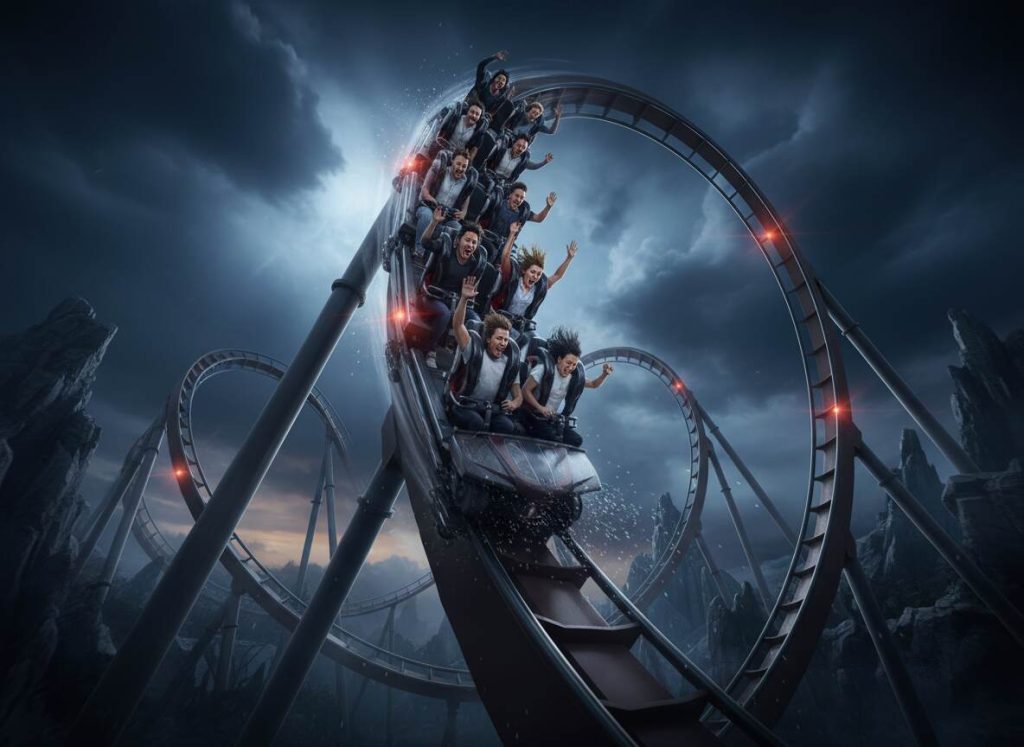
What Makes a Roller Coaster Scary?
Before we dive into specific coasters, let’s understand what actually makes a coaster scary. Fear on a roller coaster comes from several factors working together.
Height and the Fear of Falling
Height creates a primal fear response. The higher you are, the more your brain registers danger. A 400-foot drop triggers a deeper fear response than a 100-foot drop, even if the actual forces are similar. The visual perception of height—looking down from an extreme elevation—activates fear responses in most people.
Coasters like Kingda Ka (456 feet) and Top Thrill 2 (456 feet) use extreme height as their primary fear factor. The climb itself creates anticipation and dread, and the view from the top is genuinely terrifying for many riders.
Speed and G-Forces
Speed creates a sense of danger and loss of control. When you’re moving at 120+ mph, your body experiences intense G-forces that create a physical sensation of being crushed or weightless. These forces are real and intense, even though they’re safe.
The combination of speed and height creates a compounding fear effect. A coaster that’s both tall and fast feels significantly scarier than one that’s just tall or just fast.
Inversions and Disorientation
Inversions—loops, corkscrews, and other upside-down elements—create a sense of disorientation and loss of control. Your brain isn’t accustomed to being upside down at high speeds, and this triggers a fear response.
Coasters with multiple inversions (10+) create a sustained sense of disorientation that many riders find terrifying. You never have time to recover before the next inversion hits.
Airtime and Weightlessness
Airtime—the sensation of being lifted out of your seat—creates a primal fear of falling. Even though you’re safely restrained, the sensation of weightlessness triggers a deep fear response. Coasters designed to maximize airtime create sustained moments of this sensation.
Restraint Design and Psychological Fear
Interestingly, restraint design plays a huge role in how scary a coaster feels. Coasters with minimal restraints (like lap bars only) feel scarier than coasters with over-shoulder harnesses, even if the actual forces are identical. The psychological feeling of security matters as much as the actual safety.
Winged coasters—where riders sit on the sides of the track with nothing beneath them—create an intense psychological fear because riders feel exposed and vulnerable.
Pacing and Intensity
How a coaster is paced affects how scary it feels. A coaster that builds intensity gradually feels less scary than one that hits hard from the start. A coaster with no breaks or recovery time feels more intense than one with sections to catch your breath.
Theming and Psychological Factors
Sometimes the scariest coasters are scary because of what they represent. A coaster themed around a disaster, a haunted location, or something psychologically unsettling can feel scarier than the physical forces alone would suggest.
The Scariest Coasters in the World: Contenders
Several coasters consistently rank among the scariest in the world. Let’s explore what makes each one terrifying.
Kingda Ka (Six Flags Great Adventure, New Jersey)
Kingda Ka held the record as the world’s tallest coaster for a decade. At 456 feet tall with a 128 mph top speed, it’s an exercise in extreme height and speed.
What makes Kingda Ka scary: The coaster climbs at a steep angle, giving riders a clear view of how high they are. The top-hat design means you reach the peak and immediately face a 456-foot drop at a 90-degree angle. There’s no gradual descent—just a vertical plunge.
The first drop lasts about 3.5 seconds, which feels like an eternity when you’re falling from that height. The sustained weightlessness creates an intense fear response in most riders.
Kingda Ka’s minimal lap-bar restraints add to the psychological fear. Riders feel exposed and vulnerable, even though they’re completely safe.
Top Thrill 2 (Cedar Point, Ohio)
Top Thrill 2 is the reborn version of the original Top Thrill Dragster. At 456 feet tall and 120 mph, it matches Kingda Ka’s height and comes close to matching its speed.
What makes Top Thrill 2 scary: Like Kingda Ka, it features a vertical lift and a 456-foot drop. But Top Thrill 2 adds a twist—it has a top-hat element on both sides of the track, meaning riders experience two massive drops in quick succession.
The coaster accelerates from 0 to 120 mph in 3.8 seconds, creating intense acceleration forces. Combined with the extreme height and dual drops, Top Thrill 2 is genuinely terrifying.
Cedar Point’s reputation for extreme coasters means riders know what they’re getting into, which adds to the psychological intensity.
Takabisha (Fuji-Q Highland, Japan)
Takabisha holds the record for the steepest drop on any roller coaster: 121 degrees. That’s 31 degrees past vertical—riders are literally leaning backward as they plunge down the track.
What makes Takabisha scary: The 121-degree drop is genuinely disorienting. Your brain can’t process being tilted backward at that angle while moving at high speed. The sensation is unlike anything else in the coaster world.
Takabisha also features 14 inversions, sustained airtime, and a relentless pace that never lets up. The coaster is designed to be as intense as possible from start to finish.
The psychological factor of the beyond-vertical drop adds significantly to the fear factor. Riders know they’re experiencing something that defies normal physics.
Verrückt (Hersheypark, Pennsylvania)
Verrückt (German for “crazy”) is a dive coaster with a 200-foot tall lift hill and a 97-degree drop. While not the tallest or fastest coaster, it’s designed to maximize fear through its restraint design and pacing.
What makes Verrückt scary: Dive coasters use a unique restraint system—riders sit on the edge of the track with their legs dangling. There’s nothing beneath you, creating an intense psychological fear of falling.
The 97-degree drop feels like a vertical plunge, and the minimal restraints (just a lap bar) add to the sensation of vulnerability. The coaster’s relentless pacing and multiple inversions create sustained intensity.
Verrückt’s psychological design—the exposed seating, the feeling of sitting on the edge of a cliff—makes it feel scarier than coasters with similar physical specifications.
Millennium Force (Cedar Point, Ohio)
Millennium Force is a giga coaster (300+ feet tall) with a 310-foot height, 93 mph top speed, and a 80-degree first drop. While not the tallest or fastest, it’s consistently ranked as one of the most intense coasters in the world.
What makes Millennium Force scary: The coaster’s design emphasizes speed and sustained airtime. The 80-degree first drop creates intense weightlessness, and the coaster maintains high speed throughout the entire ride.
The coaster’s minimal restraints (lap bar only) and the sustained airtime create a psychological sense of danger. Riders feel like they’re about to fly out of their seats throughout the entire ride.
Millennium Force’s reputation as one of Cedar Point’s most intense coasters adds to the psychological fear factor.
Steel Dragon 2000 (Nagashima Spa Land, Japan)
Steel Dragon 2000 is the longest roller coaster in the world at 8,133 feet. At 318 feet tall and 95 mph, it’s not the tallest or fastest, but its extreme length creates a unique intensity.
What makes Steel Dragon 2000 scary: The coaster’s length means riders experience sustained intensity for nearly 4 minutes. The ride never fully lets up, creating a relentless sense of danger and adrenaline.
The coaster features multiple airtime hills, inversions, and high-speed turns. The sustained nature of the experience—the fact that it just keeps going—creates a unique psychological intensity.
For riders who fear the sustained nature of extreme experiences, Steel Dragon 2000 is genuinely terrifying.
Intimidator 305 (Kings Dominion, Virginia)
Intimidator 305 is a giga coaster with a 305-foot height, 90 mph top speed, and an 85-degree first drop. It’s designed to maximize speed and airtime.
What makes Intimidator 305 scary: The coaster’s name says it all—it’s designed to intimidate. The sustained airtime throughout the ride creates a constant sense of weightlessness and danger.
The coaster’s minimal restraints and high speed create a psychological sense of vulnerability. The relentless pacing and multiple airtime hills create sustained intensity.
Xcelerator (Knott’s Berry Farm, California)
Xcelerator is a hydraulic launch coaster that accelerates from 0 to 82 mph in 1.9 seconds. While not as tall as some other coasters, the extreme acceleration creates intense fear.
What makes Xcelerator scary: The acceleration is brutal. Your body experiences intense G-forces as you’re catapulted down the track. The 205-foot height combined with the extreme acceleration creates a unique intensity.
The coaster’s minimal restraints and the sensation of being launched into the unknown create psychological fear. The sustained airtime on the back half of the ride adds to the intensity.
Verrückt (Europa Park, Germany)
Europa Park’s Verrückt is a different coaster from Hersheypark’s Verrückt. This one features a 208-foot height, 81 mph top speed, and a 97-degree drop with the same exposed seating design.
What makes this Verrückt scary: The exposed seating design creates intense psychological fear. Riders sit on the edge of the track with nothing beneath them, creating a sensation of sitting on the edge of a cliff.
The 97-degree drop and the minimal restraints create sustained intensity. The coaster’s design prioritizes psychological fear over raw speed and height.
The Scariest Coasters by Category
Different types of coasters create different types of fear. Let’s break down the scariest coasters by what they do best.
Scariest for Height: Kingda Ka and Top Thrill 2
If you’re afraid of heights, Kingda Ka and Top Thrill 2 are genuinely terrifying. The 456-foot elevation creates a primal fear response that’s hard to overcome.
The sustained view of the ground from the top, combined with the vertical drop, creates an intense height-based fear that’s unmatched in the coaster world.
Scariest for Speed: Kingda Ka and Top Thrill 2
Kingda Ka’s 128 mph top speed and Top Thrill 2’s 120 mph speed create intense G-forces and a sensation of danger. The speed combined with the height creates a compounding fear effect.
Scariest for Inversions: Takabisha
Takabisha’s 14 inversions create sustained disorientation. The beyond-vertical drop adds a unique element that no other coaster offers.
If you’re afraid of being upside down, Takabisha is genuinely terrifying because it never gives you time to recover between inversions.
Scariest for Psychological Fear: Verrückt (Hersheypark)
Verrückt’s exposed seating design creates intense psychological fear. The sensation of sitting on the edge of a cliff, with nothing beneath you, triggers a deep fear response in most riders.
The psychological fear factor makes Verrückt feel scarier than coasters with similar physical specifications.
Scariest for Airtime: Millennium Force
Millennium Force’s sustained airtime creates a constant sensation of weightlessness. The feeling that you’re about to fly out of your seat, combined with the coaster’s speed and height, creates intense fear.
Scariest for Sustained Intensity: Steel Dragon 2000
Steel Dragon 2000’s extreme length means riders experience sustained intensity for nearly 4 minutes. The relentless pace and the fact that the ride just keeps going creates unique psychological intensity.
Why People Ride Scary Coasters
If these coasters are so scary, why do people ride them? The answer involves psychology, adrenaline, and the human desire to push boundaries.
The Thrill Paradox
Humans are drawn to experiences that create fear in a safe context. Riding a scary coaster triggers your fight-or-flight response, flooding your body with adrenaline and endorphins. This creates a natural high that many people find addictive.
The key is that the fear is contained and safe. You know you’re not actually in danger, even though your body is responding as if you are. This creates a unique psychological state that many people find exhilarating.
Overcoming Fear
For some people, riding scary coasters is about overcoming fear. Successfully riding a coaster that terrifies you creates a sense of accomplishment and builds confidence.
Many people who are afraid of heights or speed specifically seek out extreme coasters to challenge themselves and overcome their fears.
Social Bonding
Riding scary coasters with friends or family creates shared experiences and memories. The shared fear and adrenaline create strong social bonds.
Chasing the Ultimate Experience
Coaster enthusiasts are always seeking the next extreme experience. As you ride more coasters, you build a tolerance to fear, and you seek out more intense attractions. This creates a cycle of seeking increasingly extreme experiences.
Safety Considerations for Extreme Coasters
While extreme coasters are designed to be safe, they’re not for everyone. Before riding an extreme coaster, consider these factors.
Physical Health
Extreme coasters subject your body to intense G-forces. If you have heart conditions, back problems, or other health issues, consult with a doctor before riding extreme coasters.
The intense forces can be genuinely uncomfortable or even dangerous for people with certain health conditions.
Pregnancy
Pregnant people should not ride extreme coasters. The intense forces and the risk of impact injuries make extreme coasters unsafe during pregnancy.
Age and Size Restrictions
Most extreme coasters have height and age restrictions. These restrictions exist for safety reasons. Riders who don’t meet the restrictions may not be safely restrained.
Mental Health
If you have anxiety disorders or other mental health conditions that are triggered by fear, extreme coasters might not be a good choice. While fear in a safe context can be therapeutic, it can also be traumatic for some people.
Know yourself and your limits. There’s no shame in choosing not to ride a coaster that’s beyond your comfort zone.
Medication Interactions
Some medications can interact poorly with the intense forces of extreme coasters. If you take medications, consult with a doctor or pharmacist before riding extreme coasters.
How to Prepare for Your First Extreme Coaster
If you’re planning to ride one of the world’s scariest coasters, here are some tips to help you prepare.
Start with Less Intense Coasters
Don’t jump straight to Takabisha or Kingda Ka if you’re not an experienced coaster rider. Build your tolerance gradually by riding progressively more intense coasters.
Start with coasters that have moderate heights and speeds, then work your way up to more extreme attractions.
Research the Coaster
Watch POV (point-of-view) videos of the coaster before you ride it. Knowing what to expect reduces the fear factor significantly. Familiarity breeds confidence.
Read reviews and watch multiple videos to get a complete picture of what the ride experience is like.
Understand the Physics
Understanding the physics behind coasters can reduce fear. Knowing that the G-forces are safe, that the restraints are tested extensively, and that the coaster has multiple safety systems can help you feel more confident.
The more you understand about how coasters work, the less scary they feel.
Manage Your Breathing
Deep breathing before and during the ride can help manage fear and anxiety. Focus on slow, deep breaths rather than shallow, rapid breathing.
Many experienced riders use breathing techniques to manage fear and stay calm during intense rides.
Ride with Friends
Riding with friends or family can provide emotional support and make the experience more enjoyable. Shared fear creates shared memories.
Sit in Different Seats
Different seats on a coaster create different experiences. Front seats offer a view of what’s coming. Back seats amplify the forces and create more intense airtime. Middle seats offer a balanced experience.
If you’re nervous, try a middle seat first. Once you’ve ridden the coaster, you can experiment with different seats.
Don’t Force Yourself
If you’re genuinely terrified and don’t want to ride, don’t force yourself. There’s no shame in choosing not to ride a coaster that’s beyond your comfort zone.
Coaster parks have plenty of attractions for all thrill levels. You can have a great time without riding the most extreme coasters.
The Psychology of Fear on Coasters
Why do some people find extreme coasters exhilarating while others find them traumatic? The answer lies in psychology and how our brains process fear.
The Fear Response
When you’re on a scary coaster, your amygdala (the part of your brain that processes fear) is activated. Your body releases adrenaline and cortisol, triggering your fight-or-flight response.
Your heart rate increases, your breathing becomes rapid, and your muscles tense up. These are all normal physiological responses to perceived danger.
The Safety Context
The key difference between a coaster and actual danger is that you know you’re safe. Your rational brain understands that coasters are engineered to be safe and that thousands of people ride them every day without incident.
This creates a unique psychological state where your emotional brain is experiencing fear while your rational brain knows you’re safe. This disconnect is what creates the thrill.
Habituation and Tolerance
The more you ride coasters, the more your brain habituates to the fear stimulus. What felt terrifying on your first coaster feels mild after you’ve ridden dozens.
This is why coaster enthusiasts constantly seek out more extreme attractions. They’ve built a tolerance to fear and need more intense stimuli to achieve the same thrill.
Individual Differences
People have different baseline levels of fear sensitivity. Some people are naturally more anxious and fearful, while others are naturally more calm and confident.
Genetics, life experiences, and personality traits all influence how scary a coaster feels to you. There’s no “right” level of fear sensitivity—people just experience fear differently.
Extreme Coasters Around the World: A Global Perspective
The scariest coasters aren’t limited to the United States. Parks around the world have invested in extreme attractions.
Japan: Innovation and Intensity
Japanese parks like Fuji-Q Highland and Nagashima Spa Land have become centers of extreme coaster innovation. Takabisha and Steel Dragon 2000 represent the cutting edge of coaster design.
Japanese designers have pushed the boundaries of what’s possible, creating coasters that are genuinely unique and intensely scary.
Europe: Engineering Excellence
European parks have invested heavily in extreme coasters. Companies like Bolliger & Mabillard and Intamin have created some of the world’s most intense attractions.
European coasters tend to emphasize engineering excellence and smooth, precise design. This doesn’t make them less scary—it just means the fear comes from different factors.
United States: The Coaster Capital
The United States remains the center of coaster innovation and intensity. Cedar Point, Six Flags, and other major parks have invested in record-breaking attractions.
American coasters tend to emphasize height, speed, and airtime. The focus on breaking records creates a culture of extreme coasters.
The Future of Scary Coasters
What’s next for extreme coaster design? As designers push the boundaries, what new types of fear will they create?
Hybrid Coasters and New Track Systems
Hybrid coasters that combine wooden and steel elements are creating new types of intense experiences. New track systems like those developed by Rocky Mountain Construction are enabling coasters that were previously impossible.
As technology advances, designers will create coasters that are scarier and more intense than anything that currently exists.
Virtual Reality Integration
Some parks are experimenting with VR integration on coasters. Adding a digital layer to the physical experience could create new types of psychological fear.
Imagine riding an extreme coaster while wearing a VR headset that shows you falling into an abyss or being chased by something terrifying. The combination of physical and psychological fear could create unprecedented intensity.
Personalized Fear Experiences
As technology advances, parks might be able to create personalized fear experiences. Coasters could be adjusted based on individual rider preferences, creating custom levels of intensity.
This could allow riders to experience coasters at their own comfort level while still pushing their boundaries.
Conclusion: The Scariest Coaster Is Different for Everyone
There’s no single answer to the question “What is the scariest roller coaster in the world?” The scariest coaster is the one that scares you the most.
For some people, it’s Kingda Ka’s extreme height. For others, it’s Takabisha’s beyond-vertical drop. For still others, it’s Verrückt’s exposed seating and psychological fear.
The beauty of the coaster world is that there’s an extreme attraction for everyone. Whether you’re afraid of heights, speed, inversions, or sustained intensity, there’s a coaster out there that will challenge you and push your boundaries.
The scariest coasters in the world represent the pinnacle of coaster design and engineering. They’re the result of decades of innovation, pushing the boundaries of what’s possible and what riders are willing to endure.
If you’re brave enough to ride one of the world’s scariest coasters, you’ll experience something truly extraordinary. You’ll feel your heart pounding, your adrenaline surging, and your mind racing. You’ll experience fear in a safe context, and you’ll come away with a sense of accomplishment and a story to tell.
The next time you see someone getting off one of the world’s scariest coasters with a huge smile on their face, you’ll understand why. They’ve just experienced the ultimate thrill—fear, adrenaline, and the knowledge that they survived something genuinely intense.
That’s what makes the scariest coasters in the world so special. They’re not just attractions—they’re experiences that push the boundaries of human fear and courage.
