Roller coasters feel like they appear overnight. One day there’s a fenced-off patch of land with a few survey flags, and a few months later there’s a skyline of steel supports and track twisting into something that looks impossible.
But coaster construction is not magic, and it is not just “bolt the track together.” Building a roller coaster is a full-scale construction project with engineering constraints, heavy logistics, strict safety standards, and a long checklist of things that have to be right before a single guest ever rides.
This post focuses mostly on the construction side: what happens on site, what gets built first, how track actually goes up, and why testing takes as long as it does.
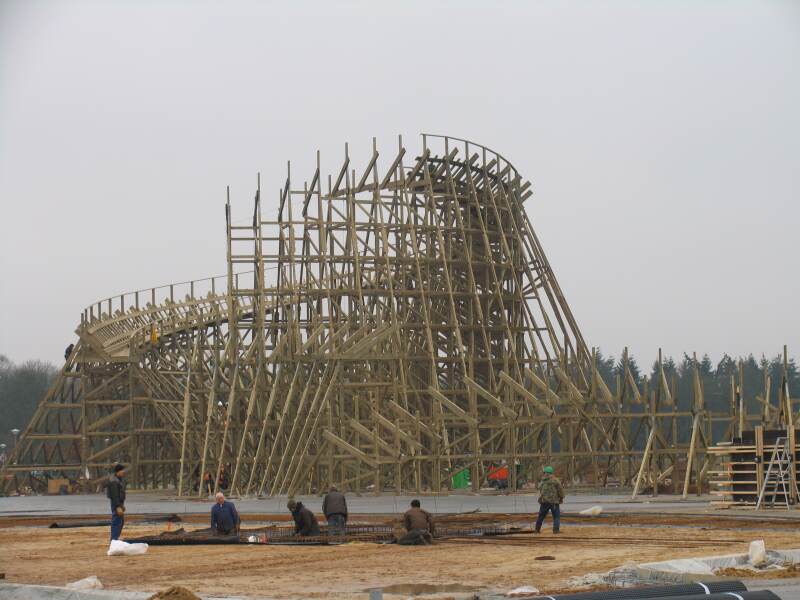
Quick Answer: Roller Coasters Are Built In Phases, Not All At Once
A roller coaster is usually built in overlapping phases: site prep and utilities, foundations, supports, track installation, mechanical and electrical systems, station and queue construction, and then extensive testing and commissioning. Different crews can be working on different parts at the same time, but the order still matters because many steps depend on earlier work being completed and verified.
If you want the “before construction” side, the companion piece is how roller coasters work
Step 1: Surveying, Permits, And Site Prep
Before anything dramatic happens, the park has to do the unglamorous work: surveying, permitting, and preparing the site. This is where the coaster starts to become real, even though it still looks like nothing is happening.
Surveying And Marking The Footprint
Survey teams map the site and mark where major elements will go: foundations, footers, station location, pathways, and utility runs. You will often see stakes, paint markings, and temporary fencing long before you see concrete.
Demolition And Clearing
If the coaster is replacing an older attraction, demolition happens first. If it’s a new plot, the park may remove trees, grade the land, and relocate or protect existing infrastructure.
Utilities: The Hidden Work That Makes The Ride Possible
Coasters need power, communications, drainage, and sometimes compressed air or other support systems. Parks often upgrade utilities during coaster construction because the ride’s electrical and control systems can be demanding.
This is one of the reasons coaster projects can be expensive even when the ride itself is not record-breaking. If you want the full cost context, your deep dive on how much a roller coaster costs
Step 2: Foundations And Concrete Work (Where The Real Timeline Starts)
Coasters are heavy. Supports transfer loads into the ground. The ground has to be able to handle those loads for decades through weather, temperature swings, and constant vibration.
Soil Testing And Engineering
Before foundations are poured, engineers evaluate soil conditions. If the soil is weak or unstable, the park may need deeper foundations, pilings, or additional reinforcement. This is one of those behind-the-scenes factors that can change a project’s cost and schedule dramatically.
Excavation And Rebar
Crews excavate for footers and foundations, then build rebar cages that reinforce the concrete. Rebar is not optional. It’s what gives concrete strength under tension and helps foundations resist cracking and shifting over time.
Anchor Bolts: The “Coaster Connectors” Embedded In Concrete
Steel supports are typically bolted to anchor bolts that are set into the concrete. These bolts have to be positioned precisely. If they are off, even by a small amount, it can cause major headaches when it is time to install supports.
This is one of those moments where coaster construction looks slow because it is. Precision matters more than speed.
Step 3: Fabrication And Shipping (Most Of The Coaster Is Built Before It Arrives)
Most coaster track and supports are fabricated off-site by the manufacturer. What arrives at the park is a giant kit of parts: track segments, support columns, cross-bracing, catwalks, stairs, hardware, and mechanical components.
Track And Supports Arrive In Sections
Track is shipped in manageable segments. Supports are shipped as columns and beams. Everything is labeled and staged on-site so crews can install in the correct order.
If you have ever seen a coaster construction site with piles of track pieces laid out like giant steel noodles, that is the staging process. It is organized chaos.
Why Track Looks “Finished” Before The Ride Is Actually Close To Opening
Track installation is visually dramatic, so it creates the illusion that the coaster is almost done. But after the track is up, the project still has a long list of critical work: electrical systems, control logic, sensors, station equipment, theming, landscaping, inspections, and testing.
Step 4: Erecting Supports (The Steel Skeleton Goes Up First)
Once foundations are cured and verified, supports begin to go up. This is where cranes become the stars of the show.
Cranes, Rigging, And Precision Placement
Support columns are lifted into place and bolted to foundations. Crews align them, torque bolts to specification, and install cross-bracing. The structure has to be rigid and correctly aligned before track can be installed safely and accurately.
This is also where weather can slow progress. High winds can make crane lifts unsafe, and rain can affect scheduling and site conditions.
Step 5: Track Installation (The Part Everyone Watches)
Track is installed section by section. Crews lift a track segment with a crane, position it on supports, and bolt or weld it into place depending on the coaster’s design and manufacturer standards.
Bolted Connections And Splices
Track segments meet at connection points. Those joints have to be aligned precisely so trains roll smoothly and forces behave as designed. Even small alignment issues can create roughness, noise, and long-term wear.
If you have ever wondered how trains can stay locked to the track through inversions and high forces, the answer is the wheel assembly design. My explainer on how roller coasters stay on the tracks
Catwalks, Stairs, And Maintenance Access
As track goes up, crews also install catwalks, stairs, and platforms. These are not just for looks. They are essential for daily inspections, maintenance, and emergency access.
Coasters are designed to be maintained. A ride that cannot be accessed safely is a ride that cannot operate reliably.
Step 6: Station Construction And Ride Hardware
The station is not just a loading platform. It is a mechanical and operational hub. This is where the coaster’s daily rhythm is controlled.
Station Equipment
Depending on the coaster type, station hardware can include:
- Drive tires or chain systems for moving trains in and out
- Transfer tracks for moving trains to maintenance bays
- Restraint checking systems and control panels
- Gates, air gates, and safety interlocks
Restraints And Trains
Trains are delivered, assembled, and tested. Restraints are checked repeatedly because they are one of the most critical rider containment systems on the entire ride.
If you want the deeper “why this restraint, not that one” explanation, why roller coasters have different restraintsare lap bars safe
Step 7: Electrical, Sensors, And Control Systems (The Coaster’s Nervous System)
This is the part most guests never think about, but it is one of the biggest reasons coasters take time to open. Modern coasters are loaded with sensors and control logic that monitor train position, speed, spacing, and system status.
Block Zones And Train Spacing
Coasters are designed with block sections that prevent trains from getting too close to each other. The control system uses sensors and brakes to ensure safe spacing. This is one of the core safety concepts in coaster operations.
Why Downtime Happens
When a sensor reads something out of spec, the ride can stop or refuse to dispatch. That is not necessarily a sign of danger. It is often a sign the safety systems are functioning as intended.
If you want the bigger context, roller coaster safety technology evolution
Step 8: Theming, Queue, And Guest Flow (The Part That Makes It Feel Finished)
While the coaster hardware is being installed, other crews are building the guest-facing experience: the queue, the landscaping, the signage, and any theming elements.
This is also where parks design how guests will move through the space. A coaster that dumps a thousand people into a narrow pathway can create a crowd problem. A well-designed area absorbs guests smoothly.
If you are curious how parks think about guest movement at scale, theme park planning for large groups
Step 9: Testing And Commissioning (The Ride Runs Empty Long Before It Runs With Guests)
Once track, trains, and systems are installed, the coaster enters a long testing phase. This is where the park and manufacturer confirm that the ride behaves exactly as intended.
Empty Runs And System Checks
Trains are cycled repeatedly to check:
- Braking performance
- Sensor timing and block logic
- Station dispatch systems
- Ride smoothness and vibration
- Restraint systems and fault responses
Weighted Testing
Parks often use weighted dummies or water dummies to simulate passenger loads. This helps verify performance under different conditions and ensures the coaster runs correctly with varying train weights.
Training Operators And Maintenance Teams
A coaster is not “openable” until staff are trained. Operators learn dispatch procedures, restraint checks, communication protocols, and what to do when the ride stops unexpectedly.
If you have ever wondered what happens when a coaster stops mid-cycle and guests are evacuated, what happens if a roller coaster gets stuck
Step 10: Inspections, Sign-Offs, And Opening Day
Before a coaster opens, it has to pass inspections and receive the necessary approvals. The exact process depends on location and regulations, but the core idea is consistent: the ride must demonstrate that it operates safely and predictably under real conditions.
Only after testing, training, and sign-offs does the coaster move into previews and then full public operation.
Why Coaster Construction Timelines Vary So Much
Two coasters can look similar and still have very different build timelines. Common factors include:
- Soil and foundation complexity
- Weather delays
- Shipping and logistics
- Theming scope
- Electrical and control system complexity
- Local permitting and inspection timelines
This is why “the track is up” is not the same as “the coaster is almost open.” Track is a milestone. It is not the finish line.
The Bottom Line
Roller coasters are built through a construction pipeline: site prep and utilities, foundations, support erection, track installation, station and hardware integration, electrical and control systems, theming and guest flow work, then long testing and commissioning before opening day.
It is a massive project, and the reason it works is the same reason coasters are so fascinating. They are not just rides. They are engineered systems designed to repeat a thrilling experience safely, thousands of times a year.

Leave a Reply