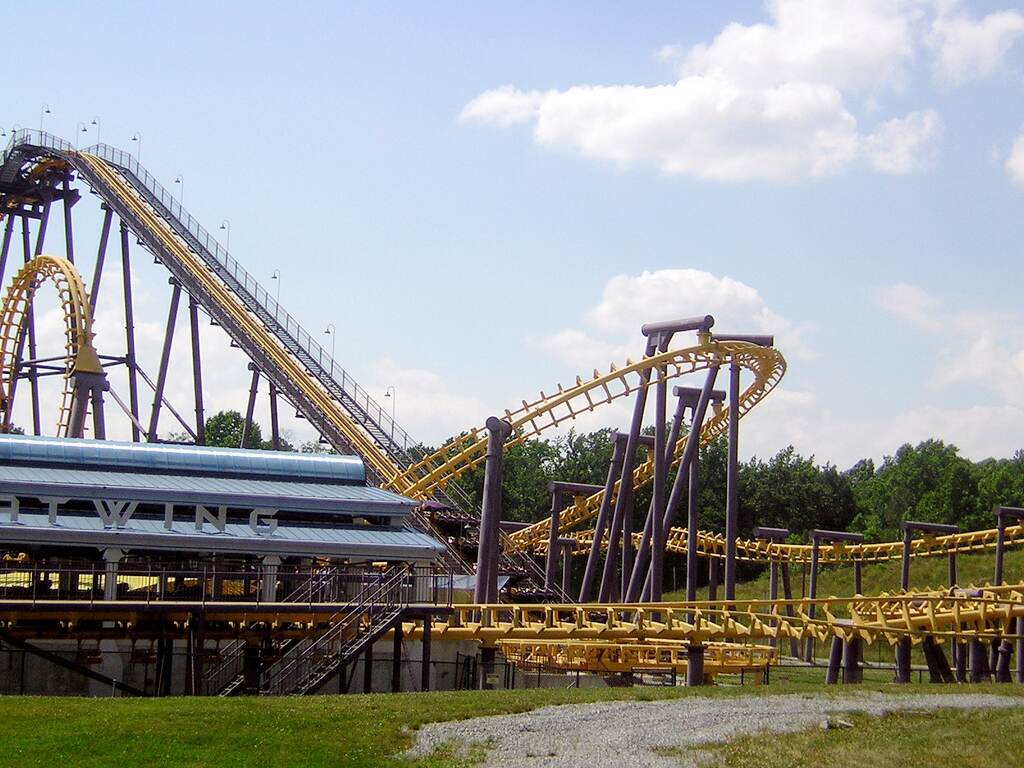
On July 8, 2025, Batwing took its final flight. The iconic flying roller coaster at Six Flags America in Prince George’s County, Maryland, closed indefinitely after a fiberglass piece from the front of the train fell off and shattered during operation. No riders were injured, but the incident marked the beginning of the end for a coaster that had thrilled guests for nearly 24 years. By September 2025, Six Flags officially announced that Batwing had been permanently closed, ahead of the park’s scheduled closure on November 2, 2025. A sign at the ride’s entrance read: “Soaring since 2001, this ride has taken its final flight. Thank you for the memories.”
With Batwing’s closure, an entire era of coaster design came to an end. Batwing was the last operating Vekoma Flying Dutchman coaster in the world—a distinction that made it a pilgrimage site for coaster enthusiasts and a living museum of early 2000s flying coaster technology. This is the story of how a Batman-themed flying coaster became a legend, and why its loss matters to the coaster community.
What Is a Flying Roller Coaster?
Before diving into Batwing’s history, it’s important to understand what makes a flying coaster unique. Unlike traditional roller coasters where riders sit upright or reclined in a seat, flying coasters position riders in a prone position—lying face-down, as if they’re flying through the air. The train itself is suspended beneath the track, and riders hang from the sides of the train with their legs dangling freely below them.
This positioning creates a unique sensation of weightlessness and freedom that traditional coasters can’t replicate. Riders experience the thrill of soaring through the air, with nothing but open space beneath them. The prone position also means that inversions feel different on a flying coaster—riders experience the full force of being upside-down without the security of a traditional seat.
Flying coasters are relatively rare in the amusement park industry. The technology is complex, the manufacturing is specialized, and the rider experience requires a specific type of train and restraint system. As a result, only a handful of manufacturers have ever produced flying coasters, and only a few parks have invested in them.
The Vekoma Flying Dutchman: A Revolutionary Design
Batwing was a Vekoma Flying Dutchman coaster—a specific model of flying coaster designed and manufactured by Vekoma, a Dutch company specializing in innovative coaster designs. The Flying Dutchman model was revolutionary when it debuted in the late 1990s, and it became one of the most sought-after coaster models in the industry.
Vekoma, founded in 1926, is known for pushing the boundaries of coaster design. The company pioneered the suspended coaster (where the train hangs from the track), the stand-up coaster (where riders stand throughout the ride), and numerous other innovations. The Flying Dutchman model represented the company’s ambition to create the ultimate flying coaster experience.
The first Vekoma Flying Dutchman coaster was Stealth, which opened at Drayton Manor in the United Kingdom in 2002. However, Batwing, which opened in 2001, was actually the first flying coaster on the East Coast of the United States, making it a pioneering attraction for the region. The Vekoma Flying Dutchman design became the standard for flying coasters in the early 2000s, with multiple parks ordering the model.
The Flying Dutchman Model Specifications
The Vekoma Flying Dutchman design features several distinctive characteristics. The trains are compact, with six cars that seat four riders each in a single row, for a total capacity of 24 riders per train. Each rider is secured by a vest over the chest and a lap bar, which keeps them firmly in the prone position throughout the ride.
The track is steel, allowing for precise control and smooth transitions. The trains are suspended beneath the track, with wheels that grip the track from above, below, and to the sides. This triple-wheel system ensures stability and safety, even during complex inversions and transitions.
One of the most distinctive features of the Flying Dutchman design is the “Lie to Fly” and “Fly to Lie” elements. These are unique transitions that flip the train between the prone (flying) position and the reclined (lying) position. A “Lie to Fly” element occurs when riders are on their backs, facing the sky, and are flipped to face the ground. A “Fly to Lie” element is the opposite—riders flip from the flying position back to the lying position.
These transitions are crucial to the Flying Dutchman experience. They create moments of disorientation and weightlessness that are impossible to achieve on other coaster types. The transitions also allow designers to create complex layouts that combine flying and non-flying elements, maximizing the variety of sensations throughout the ride.
The History of Batwing: From Announcement to Icon
The Announcement and Construction (2001)
In February 2001, Six Flags America announced that it would be receiving a new attraction: Batwing, a Vekoma Flying Dutchman coaster themed to Batman. The announcement was groundbreaking. Flying coasters were still relatively new technology, and the East Coast had never experienced one before. Six Flags America, located in Bowie, Maryland, was about to become a destination for coaster enthusiasts from across the region.
The coaster was designed to be built in the Gotham City section of the park, a Batman-themed area that included other DC Comics attractions. The Batman theme was perfect for a flying coaster—the sensation of flying through the air aligned perfectly with the idea of Batman soaring through Gotham City’s skyline.
Construction began in early 2001, and the ride was initially scheduled to open in May 2001. However, delays pushed back the opening date. On June 16, 2001, Batwing officially opened to guests. It was a massive success and immediately became the park’s flagship attraction.
The First Flying Coaster on the East Coast
Batwing’s significance cannot be overstated. It was the first flying roller coaster on the East Coast of the United States. For coaster enthusiasts in the Northeast, Mid-Atlantic, and Southeast regions, Batwing was the only opportunity to experience a flying coaster without traveling to the West Coast or internationally.
This made Batwing a pilgrimage site. Enthusiasts from across the country made trips to Six Flags America specifically to ride Batwing. The coaster generated significant buzz in the coaster community and helped establish Six Flags America as a destination park rather than just a regional amusement park.
The opening of Batwing also sparked interest in flying coasters among the general public. Families who had never heard of flying coasters before were intrigued by the unique concept. The Batman theme made the coaster accessible to a broader audience, and the ride became a must-do attraction for visitors to the park.
The Years of Operation (2001-2025)
For nearly 24 years, Batwing operated as one of the most beloved coasters at Six Flags America. The ride underwent routine maintenance and occasional updates, but the core experience remained consistent. Riders continued to experience the thrill of flying through the air, the disorientation of the “Lie to Fly” and “Fly to Lie” elements, and the adrenaline rush of the inversions and turns.
In 2007, Batwing was reduced from three trains to two trains. This change was made for operational efficiency and maintenance reasons. With two trains, the park could still maintain a reasonable throughput while reducing the wear and tear on the ride and the labor required for maintenance.
Throughout its operational history, Batwing maintained a strong reputation among coaster enthusiasts. It was consistently ranked among the best flying coasters in the world, praised for its smooth operation, thrilling inversions, and unique transitions. The coaster was also known for its reliability—mechanical issues were relatively rare, and the ride operated consistently throughout its lifespan.
The Ride Experience: What Made Batwing Special
The Technical Specifications
Batwing was an impressive piece of engineering. The steel track stretched approximately 3,340 feet (1,020 meters) in length, making it a substantial coaster by any standard. The lift hill reached a height of approximately 115 feet (35 meters) and climbed at a 33-degree angle.
The coaster featured five inversions in total: one vertical loop, two inline twists, two “Lie to Fly” elements, and two “Fly to Lie” elements. Each “Lie to Fly” and “Fly to Lie” element was counted as a half inversion, reflecting the unique nature of these transitions. The combination of inversions and transitions created a complex, varied ride experience.
The top speed reached on Batwing was 51 miles per hour (82 kilometers per hour), achieved on the first drop after the lift hill. The vertical loop, which stood 66 feet (20 meters) tall, subjected riders to 4.3 G’s of force—a significant acceleration that created the sensation of being pressed into the seat (or in this case, against the restraints).
The Ride Layout: A Detailed Breakdown
The Batwing experience began in the station, where riders were seated in the prone position and secured with a vest and lap bar. The train then tilted backwards into the “lay-down” position and dispatched backwards out of the station.
The train traveled backwards and turned left, beginning its ascent up the 115-foot lift hill at a 33-degree angle. The chain lift system pulled the train steadily upward, building anticipation as riders faced backward, unable to see what was coming next.
Once the train reached the top of the lift hill, it dipped down into the first inversion—a “Lie to Fly” element. This transition flipped the train from the laying position to the flying position, rotating riders from facing the sky to facing the ground. Suddenly, riders were prone, facing downward, with nothing but open air beneath them. The sensation was one of weightlessness and freedom, mixed with the disorientation of the sudden flip.
After the “Lie to Fly” transition, the train traveled down the first drop, accelerating to 51 miles per hour. The drop was steep and thrilling, and riders experienced the full sensation of diving toward the ground while in the prone position.
Following the drop, the train entered an overbanked Horseshoe Curve element. This turn was heavily banked, creating lateral forces that pressed riders against their restraints. The banking made the turn feel more intense and added to the sensation of flying.
After the Horseshoe Curve, the train entered a “Fly to Lie” element, which transitioned riders back to the laying position. This flip was disorienting in the opposite direction—riders went from facing the ground to facing the sky, creating another moment of weightlessness and confusion.
The train then entered the 66-foot vertical loop. In the prone position, a vertical loop feels completely different from a traditional coaster. Riders experienced 4.3 G’s of force as they were pressed against their restraints, upside-down, facing the ground. The sensation was intense and thrilling.
After exiting the loop, the train entered another “Lie to Fly” element, flipping back to the flying position. The train then went through a banked turn and hit two consecutive inline twists. These twists rolled the train side-to-side, creating a corkscrew-like sensation.
Following the inline twists, the train entered the final helix—a spiral turn that built momentum and created lateral forces. The helix was a perfect transition into the final “Fly to Lie” element, which flipped the train back to the laying position.
Finally, the train entered the brake run, where magnetic brakes gradually slowed the train to a stop. Riders returned to the station, exiting the train with their hearts pounding and their minds reeling from the unique experience they had just had.
The Unique Sensation of Flying
What made Batwing special was the sensation of flying. Unlike traditional coasters, where riders are seated upright or reclined with their backs against a seat, flying coaster riders are prone, with nothing beneath them. This creates a genuine sensation of weightlessness and freedom.
The prone position also changes how riders experience inversions. On a traditional coaster, an inversion can feel disorienting because riders are upside-down but still supported by their seat. On a flying coaster, an inversion feels more extreme because riders are truly hanging in the air, with nothing but the restraints keeping them secure.
The “Lie to Fly” and “Fly to Lie” transitions added another layer of sensation. These flips created moments of extreme disorientation—riders went from facing one direction to facing the opposite direction in a matter of seconds. The transitions were smooth and controlled, but they created a unique sensation that no other coaster type could replicate.
For many riders, Batwing was a transformative experience. First-time flyers often reported that the coaster exceeded their expectations and changed their perception of what a roller coaster could be. The combination of the prone position, the inversions, the transitions, and the speed created a unique thrill that kept riders coming back for more.
Batwing in the Context of Vekoma Flying Dutchman Coasters
The Flying Dutchman Fleet
Batwing was one of several Vekoma Flying Dutchman coasters built in the early 2000s. The model became popular with parks looking to offer a unique, thrilling attraction that would draw crowds and generate buzz.
Firehawk at Kings Island in Ohio was a sister coaster to Batwing—both were Vekoma Flying Dutchman models with similar layouts and specifications. Firehawk opened in 2000, a year before Batwing, making it one of the earliest Flying Dutchman coasters. However, Firehawk was closed in 2007, making Batwing the last operating Flying Dutchman coaster in the world for the final 18 years of its operation.
Nighthawk at Carowinds, located on the border between North Carolina and South Carolina, was another Vekoma Flying Dutchman coaster. Nighthawk had a slightly different ending and paint scheme compared to Batwing and Firehawk, but it was fundamentally the same model. Nighthawk was also closed before Batwing, further cementing Batwing’s status as the last of its kind.
The closure of Batwing in 2025 marked the end of the Vekoma Flying Dutchman era. No new Flying Dutchman coasters have been built in recent years, and the model is no longer in production. With Batwing’s closure, the only way to experience a Vekoma Flying Dutchman coaster is through historical records, videos, and the memories of those who rode it.
Why the Flying Dutchman Model Didn’t Survive
The Vekoma Flying Dutchman was a revolutionary design, but it ultimately didn’t become the dominant flying coaster model in the industry. Several factors contributed to this:
First, the technology was complex and specialized. Flying coasters require unique train designs, restraint systems, and track configurations. This complexity made them more expensive to build and maintain compared to traditional coasters. Parks had to be confident that the investment would pay off in increased attendance and revenue.
Second, the market for flying coasters was limited. While enthusiasts loved flying coasters, the general public was more familiar with traditional coaster types. Parks had to balance the appeal of a unique attraction against the risk of investing in an unfamiliar concept.
Third, other manufacturers developed competing flying coaster models that offered different experiences or advantages. Bolliger & Mabillard (B&M), a Swiss manufacturer, developed the Wingrider coaster, which positions riders on the sides of the track rather than beneath it. This design offered a different sensation and became popular with parks looking for a flying coaster alternative.
As a result, the Vekoma Flying Dutchman model was produced in limited numbers, and most of the coasters built in this model have since been closed. Batwing’s closure marked the end of an era, and with it, the loss of a unique piece of coaster history.
Six Flags America: The Park and Its History
The Park’s Background
Six Flags America, located in Bowie, Maryland, in Prince George’s County, is part of the Six Flags chain of amusement parks. The park originally opened as Wild World in 1972 and operated under that name until 1997, when it was acquired by Six Flags and renamed Six Flags America.
Six Flags America was never one of the flagship parks in the Six Flags chain. It was a regional park serving the Washington D.C. and Baltimore metropolitan areas. However, the park had a loyal following and was known for its collection of classic wooden coasters and family-friendly attractions.
The addition of Batwing in 2001 was a major investment for the park. It represented Six Flags’ commitment to upgrading the park and attracting visitors from beyond the immediate region. Batwing became the park’s most iconic attraction and helped establish Six Flags America as a destination for coaster enthusiasts.
The Park’s Decline and Closure
Despite Batwing’s success, Six Flags America struggled financially in recent years. The park faced competition from other regional parks and larger theme parks, and attendance declined over time. The COVID-19 pandemic further impacted the park’s finances.
In May 2025, Six Flags announced that Six Flags America would close at the end of the 2025 season on November 2, 2025. The announcement shocked the coaster community and local residents. Six Flags America had been operating for over 50 years, and its closure marked the end of an era for the region.
The announcement did not specify the status of individual rides, including Batwing. However, it was clear that the park’s closure would eventually lead to the closure of all attractions, including the iconic flying coaster.
The Final Flight: The 2025 Incident and Closure
The Accident
On July 8, 2025, Batwing experienced an incident that would ultimately lead to its permanent closure. During operation, a piece of fiberglass from the front decorative part of the train fell off and shattered. The fiberglass piece was part of the train’s aesthetic design, likely part of the Batman-themed decoration.
Fortunately, no riders were injured in the incident. The piece fell during the ride’s operation, but it did not strike any riders or cause any injuries. However, the incident raised safety concerns about the structural integrity of the train’s decorative elements.
Following the incident, Batwing was closed immediately. Six Flags initiated an investigation into the cause of the failure and assessed whether the ride could be safely operated again.
The Permanent Closure
After the July 8 incident, Batwing remained closed indefinitely. On August 31, 2025, Six Flags removed Batwing from the Six Flags app and the park’s map, signaling that the ride would not reopen. In September 2025, the park officially announced that Batwing had been permanently closed.
A sign was placed at the ride’s entrance that read: “Soaring since 2001, this ride has taken its final flight. Thank you for the memories.” The sign was a touching tribute to the coaster and its 24 years of operation.
The permanent closure of Batwing came just months before the park’s scheduled closure on November 2, 2025. The timing was poignant—Batwing’s final flight came before the park itself took its final bow.
Why Batwing’s Closure Matters
The Loss of a Unique Experience
Batwing’s closure represents the loss of a unique experience that can never be replicated. Flying coasters are rare, and the Vekoma Flying Dutchman model is no longer in production. With Batwing’s closure, there is no longer any Vekoma Flying Dutchman coaster operating anywhere in the world.
For coaster enthusiasts, this is a significant loss. Batwing was a pilgrimage site—a place where enthusiasts traveled to experience a piece of coaster history. The coaster represented a specific era in coaster design and technology, and its closure marks the end of that era.
For casual riders, Batwing’s closure means the loss of an attraction that introduced them to the concept of flying coasters. Many people experienced their first flying coaster on Batwing, and the ride left a lasting impression. The closure of the ride means that future generations will have to travel to other parks to experience a flying coaster, if they can find one at all.
The End of the Vekoma Flying Dutchman Era
Batwing’s closure marks the end of the Vekoma Flying Dutchman era in coaster design. The Flying Dutchman model was revolutionary when it debuted, but it ultimately didn’t become the dominant flying coaster design in the industry. With Batwing’s closure, the last operating example of this model is gone.
This raises questions about coaster preservation and the importance of maintaining historic attractions. Batwing wasn’t as old as some of the wooden coasters that are carefully preserved, but it was a significant piece of coaster history. The loss of Batwing means that future generations will only be able to learn about the Vekoma Flying Dutchman through videos, photos, and written accounts.
The Broader Implications for Six Flags America
Batwing’s closure is part of the larger story of Six Flags America’s decline and closure. The park’s inability to maintain and operate Batwing reflects the broader financial challenges that led to the park’s closure. The loss of Batwing is a reminder of how economic pressures can lead to the loss of iconic attractions and beloved pieces of cultural heritage.
Comparing Batwing to Other Historic Coasters
Batwing vs. Firehawk
Firehawk at Kings Island was Batwing’s sister coaster—both were Vekoma Flying Dutchman models with similar layouts and specifications. Firehawk opened in 2000, a year before Batwing, and operated until 2007. The two coasters had nearly identical layouts, with the same inversions, transitions, and overall structure.
The main differences between the two coasters were aesthetic. Firehawk had a different paint scheme and theming compared to Batwing’s Batman theme. However, the core experience was essentially the same.
Firehawk’s closure in 2007 left Batwing as the last operating Vekoma Flying Dutchman coaster in the world. This distinction made Batwing even more significant to the coaster community. Enthusiasts who missed the opportunity to ride Firehawk had one last chance to experience a Vekoma Flying Dutchman coaster on Batwing.
Batwing vs. Nighthawk
Nighthawk at Carowinds was another Vekoma Flying Dutchman coaster, but it had some differences compared to Batwing and Firehawk. Nighthawk had a slightly different ending and paint scheme, but it was fundamentally the same model.
Like Firehawk, Nighthawk was also closed before Batwing, further cementing Batwing’s status as the last of its kind. The closure of all three Vekoma Flying Dutchman coasters within a relatively short period highlights how quickly coaster models can become obsolete and disappear from the industry.
Batwing vs. Modern Flying Coasters
Modern flying coasters, such as those designed by Bolliger & Mabillard (B&M), offer a different experience compared to the Vekoma Flying Dutchman. B&M’s Wingrider coasters position riders on the sides of the track, creating a sensation of flying alongside the track rather than beneath it.
While modern flying coasters are impressive in their own right, they lack the specific sensations that made the Vekoma Flying Dutchman unique. The prone position, the “Lie to Fly” and “Fly to Lie” transitions, and the overall layout of the Flying Dutchman created an experience that is distinct from other flying coaster types.
This distinction makes Batwing’s closure even more significant. The specific experience that Batwing offered is now lost forever, and there is no modern equivalent that captures the same sensation.
The Legacy of Batwing
A Pilgrimage Site for Enthusiasts
For nearly 24 years, Batwing served as a pilgrimage site for coaster enthusiasts from across the country. Enthusiasts made trips to Six Flags America specifically to ride Batwing and experience the unique sensation of a Vekoma Flying Dutchman coaster.
Batwing’s status as the last operating Flying Dutchman coaster made these pilgrimages even more important. Enthusiasts understood that Batwing was a finite resource—once it was gone, there would be no other opportunity to experience this specific coaster type.
The closure of Batwing marks the end of these pilgrimages. The coaster is now part of history, accessible only through memories, videos, and photographs.
A Gateway to Flying Coasters
For many casual riders, Batwing was their introduction to flying coasters. The coaster’s location on the East Coast made it accessible to millions of people, and its Batman theme made it appealing to a broad audience.
Batwing introduced countless riders to the unique sensation of flying through the air in the prone position. For many of these riders, the experience was transformative and led to a deeper interest in coasters and amusement parks.
The closure of Batwing means that future generations will have to seek out other flying coasters to experience this sensation. The loss of Batwing represents a loss of accessibility to this unique experience for the millions of people in the Eastern United States.
A Symbol of Coaster History
Batwing is a symbol of a specific era in coaster design and technology. The Vekoma Flying Dutchman model represents the early 2000s, when manufacturers were experimenting with new coaster concepts and pushing the boundaries of what was possible.
The closure of Batwing marks the end of this era. The Flying Dutchman model is no longer in production, and there are no plans to build new coasters of this type. Batwing’s closure means that this specific piece of coaster history is now gone, preserved only in memory and media.
Conclusion: Remembering Batwing
Batwing was more than just a roller coaster. It was a pioneering attraction that brought flying coaster technology to the East Coast. It was a beloved ride that thrilled millions of guests over nearly 24 years of operation. It was a pilgrimage site for coaster enthusiasts from across the country. And it was the last operating example of a revolutionary coaster model that is no longer in production.
The closure of Batwing in 2025 marks the end of an era. The Vekoma Flying Dutchman model is now extinct in terms of operating coasters, and the unique experience that Batwing offered is lost forever. The closure also marks the end of Six Flags America, a regional park that served the Washington D.C. and Baltimore areas for over 50 years.
For those who rode Batwing, the memories will last forever. The sensation of flying through the air, the disorientation of the “Lie to Fly” and “Fly to Lie” transitions, the thrill of the inversions—these experiences are now part of coaster history. Batwing may no longer be soaring through the skies above Six Flags America, but its legacy will continue to inspire and fascinate coaster enthusiasts for generations to come.
A sign at the ride’s entrance said it best: “Soaring since 2001, this ride has taken its final flight. Thank you for the memories.”
