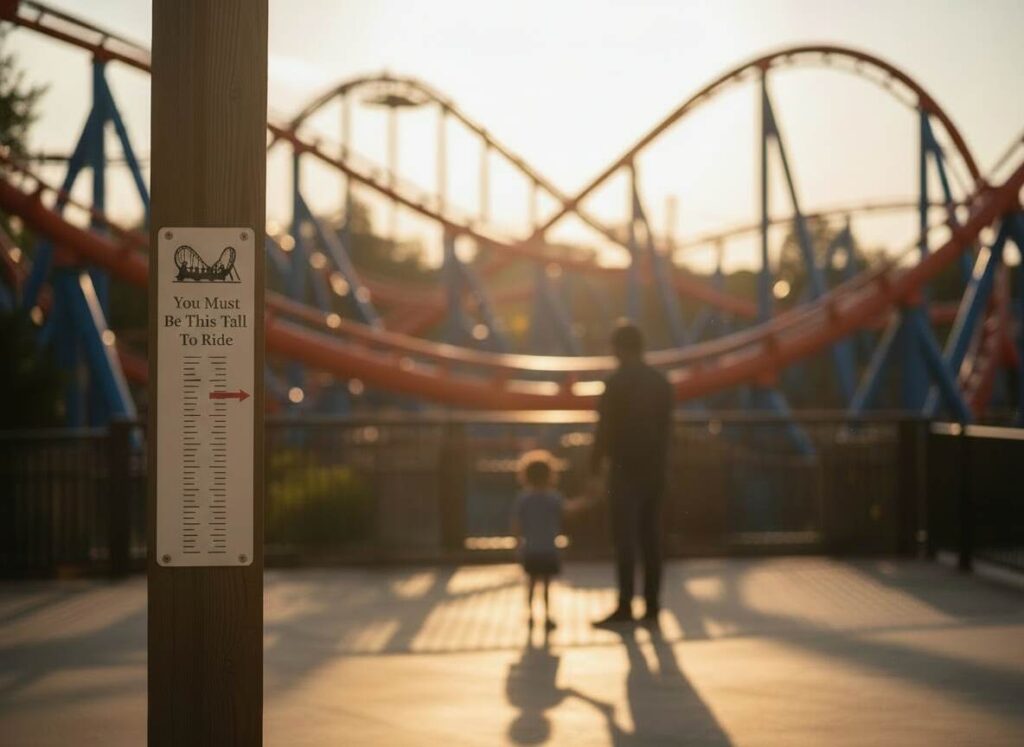
Height requirements can feel personal. One kid is tall enough on Friday, not tall enough on Saturday, and suddenly you are having a full emotional moment in the middle of a queue. Or you are an adult who is “definitely tall enough,” but you still get measured, and you wonder what the point even is.
Here is the honest truth: height requirements are not about being mean, and they are not just “insurance rules.” They are a practical shortcut for something parks cannot measure quickly in line: whether your body will be securely restrained in a specific seat, on a specific ride, during a specific set of forces.
This guide breaks down what height requirements actually do, why they exist, how parks measure you, why you can get different results at different times, and what you can do to make the whole process less stressful.
And if you want the bigger “how does any of this work” foundation first, I have a full explainer on how roller coasters work (engineering and physics) that pairs really nicely with this topic.
What Height Requirements Are Really Trying To Prevent
When a park sets a minimum height requirement, they are trying to prevent a small number of very specific failure modes. These are the things that keep engineers, manufacturers, and ride ops awake at night.
1) Restraints That Do Not Fit Correctly
Every restraint has a “safe operating envelope,” meaning there is a range of body sizes and shapes it is designed to hold securely. If you are too small, you might not make enough contact with the restraint for it to do its job the way it was tested and certified to do.
This is not just “can the lap bar touch you.” It is also:
- Where the lap bar contacts your body (upper thighs vs hips vs abdomen)
- Whether the restraint can ratchet down to a secure position
- Whether the seat belt, if present, sits correctly and can be latched without slack
- Whether your shoulders and chest are positioned correctly under over-the-shoulder restraints
Different restraint styles behave differently. If you want a deeper dive into why restraints feel so different, and why some people feel safer in one style than another, you may also like why roller coasters have different restraints.
2) Rider Movement During High Forces
Coasters create forces that push you into the seat, lift you out of the seat, and rotate you through space. Height requirements help ensure your body is positioned so the restraint can manage those forces.
Two sensations matter a lot here:
- Airtime: when you feel lifted or weightless
- Positive G-forces: when you feel pressed down into the seat
If you want a really clear explanation of what airtime and hangtime actually are, and why they feel different, read hangtime, airtime, and weightlessness.
3) Ejection Risk In Specific Seat And Restraint Combinations
This is the scary one, and I want to handle it carefully: the goal is to prevent a rider from slipping out of the restraint during the ride cycle. That risk is not evenly distributed across all coasters. It is more relevant on rides with:
- strong airtime moments
- abrupt transitions
- certain restraint geometries
- older restraint designs that rely heavily on rider positioning
It is also why parks are strict about “sit all the way back,” “keep your head back,” “do not slouch,” and “do not try to wiggle.” They are not being dramatic. They are trying to keep your body in the posture the restraint was tested with.
4) Evacuation And Emergency Procedures
Height requirements also connect to evacuation. If a ride stops, the park needs to be confident that riders can be safely assisted out of the vehicle and onto evacuation walkways, stairs, or platforms.
If the idea of getting stuck is one of your biggest fears, you will probably feel better after reading what happens if a roller coaster gets stuck. It is one of those topics that sounds terrifying until you understand the procedure.
Related post: Creepiest Roller Coasters
Why Height Is Used Instead Of Weight Or Age
People ask this all the time: why not just use age, or weight, or “how mature the kid is”?
Because height is the fastest, most consistent proxy parks have for a cluster of things that matter to restraint fit:
- leg length and thigh position
- torso height relative to the seat back
- shoulder height relative to over-the-shoulder restraints
- overall body scale relative to the restraint geometry
Age is not reliable because kids grow at wildly different rates. Weight is not reliable because two people can weigh the same and fit a restraint completely differently. Also, parks do not want to run a weigh-in station at the entrance of every ride for obvious privacy and dignity reasons.
Height is not perfect, but it is fast, visible, and measurable in a line without turning the whole day into a medical appointment.
How Parks Decide The Height Requirement In The First Place
Most parks are not inventing height requirements from vibes. Requirements are typically tied to manufacturer specifications, testing, and operational standards.
Here is the simplified version of how it usually works:
- The ride is designed with specific seats and restraints.
- The manufacturer tests restraint fit and safety across a range of body sizes.
- The ride is certified and approved under applicable standards and local regulations.
- The park posts and enforces the minimum height that matches the tested safe envelope.
Sometimes parks will be stricter than the minimum if they have operational reasons, local rules, or specific incident history that pushes them toward caution.
Why Two Rides With The Same Restraint Can Have Different Minimum Heights
This is where people get confused, because it feels inconsistent. If two rides both have a lap bar, why is one 42 inches and one 48 inches?
Because “lap bar” is not one thing. The geometry matters. The seat depth matters. The angle of the bar matters. The forces matter. The ride profile matters.
A coaster with mild airtime and gentle transitions can tolerate a wider range of rider sizes than a coaster that tries to throw you out of your seat every 12 seconds. That does not mean the second ride is “unsafe.” It means the second ride is more demanding, so the safe envelope is narrower.
How Parks Actually Measure You (And Why It Can Feel Random)
Parks measure height in a few common ways, and each one has quirks.
Entrance Height Sticks
The most common setup is a fixed height stick at the ride entrance. It is usually a vertical post with marks for minimum and sometimes maximum height.
Pros: fast, consistent, hard to argue with.
Cons: it depends on how the rider stands, what shoes they are wearing, and whether they are slouching.
Portable Measuring Sticks Used By Ride Ops
Some rides use a handheld measuring stick, especially if the line is moving and ops need to measure quickly.
Pros: flexible, can be used at the seat if needed.
Cons: more room for human variation. Two operators can measure slightly differently if one is stricter about posture.
Pre-Queue Checkpoints
Some parks measure you before you even enter the main queue. This is partly about guest experience. It is kinder to measure early than to let a kid wait 45 minutes and then get turned away at the station.
It is also about operations. It keeps the station moving.
How To Stand When You Are Being Measured (So You Do Not Lose An Inch)
This is not about cheating. It is about being measured accurately.
- Stand straight with your back against the post if possible.
- Look forward, not down.
- Keep feet flat, no tiptoes.
- Do not slouch, do not bend knees.
- Remove hats or bulky hair accessories if they interfere with the measurement point.
Also, shoes matter. Parks usually measure you with shoes on because that is how you ride. But if your kid is right on the line, switching from thick sneakers to thin sandals can change the result. That is not always a solution, but it is a real factor.

Related Post: Family Friendly Parks That Aren’t Disney or Universal
Why You Can Measure Different On Different Days
Yes, this happens. And it is not always because the park is inconsistent.
- Posture changes: kids slump when they are tired, excited, or nervous.
- Shoes change: different soles, different height.
- Hair and accessories: buns, bows, and hats can cause confusion.
- Operator strictness: some ops are more cautious, especially on high-intensity rides.
- Measurement location: pre-queue stick vs station stick can be mounted slightly differently.
And yes, kids also grow in bursts. Sometimes the “different day” is literally a growth spurt plus better posture.
Minimum Height Vs Maximum Height (Yes, That Is A Thing)
Most people only think about minimum height, but some rides also have maximum height limits. These are less common, but they exist for a few reasons:
- restraint closure range (the restraint may not latch safely beyond a certain body size)
- clearance envelopes (knees, shoulders, and limbs must stay within safe clearance zones)
- vehicle geometry (legroom and seat shape can become a safety issue)
Maximum height limits can feel surprising, but they are the same concept: the restraint system has a tested range.
Why Some “Kid Coasters” Still Have Height Requirements
Even mild coasters have forces. Even small drops create airtime moments for small bodies. Even gentle turns can shift a child in the seat if the restraint fit is loose.
Also, kid coasters often have simpler restraint systems. Simpler does not mean unsafe, but it can mean the fit range is narrower, so the minimum height is still important.
What About Adults Who Are Small?
Height requirements apply to adults too. If you are an adult under the minimum height, the issue is not maturity or bravery. It is geometry.
The restraint system does not know your age. It only knows whether it can secure your body the way it was designed to.
What About Health Conditions, Pregnancy, And “Should I Ride?” Questions
Height requirements are not a medical clearance. Being tall enough does not mean you should ride if you have a condition that makes certain forces risky.
If you want a straightforward discussion of one of the most common questions, here is my post on roller coasters and pregnancy safety.
And if you have ever wondered why some people grey out or faint, it is not just “they are weak.” It is often a mix of hydration, heat, anxiety, and how the body responds to sustained forces. Read why people faint on roller coasters if you want the full breakdown.
Why Parks Sometimes Use A Test Seat (And Why It Is Not An Insult)
Test seats are more common for size fit (often about larger body types), but they can also help in borderline cases for smaller riders depending on the ride.
A test seat is basically a “dry run” of the restraint closure. It lets you check fit without holding up the station and without the pressure of a crowd watching.
If a park offers a test seat, use it. It is one of the most guest-friendly tools in the whole industry.
Common Myths About Height Requirements
Myth: “It’s Just About Insurance”
Insurance is part of the ecosystem, sure, but the requirement is rooted in restraint fit and tested operating envelopes. If it were only about insurance, requirements would be simpler and more uniform across rides. They are not.
Myth: “If They Let One Kid Ride, They Have To Let All Kids Ride”
Nope. Parks measure each rider. If one kid meets the mark and another does not, the park is not being unfair. They are enforcing a safety threshold.
Myth: “Operators Can Make Exceptions If They Want”
Operators generally cannot. Even if they personally think a kid would be fine, they are trained to follow posted requirements. Exceptions create risk for the rider, the operator, and the park.
Related Post: Ultimate Guide to Planning a Budget Theme Park Visit
Practical Tips For Parents (And Anyone Managing A Group)
- Measure early: check height at the entrance stick before you commit to a long queue.
- Plan a “yes list”: identify rides everyone can do, then split for the bigger rides.
- Keep it emotionally neutral: treat it like a rule, not a judgment.
- Bring a distraction: if a kid gets turned away, pivot fast to a guaranteed win ride.
- Hydrate and cool down: tired kids slump, and slumping can cost you the measurement.
If your group is already anxious about coasters, start with confidence-building steps. I wrote a full guide on how to overcome roller coaster fear that is genuinely useful for both kids and adults.
Quick Answers
Why do roller coasters have height requirements?
Because height is a fast proxy for whether a rider will fit the restraint system correctly and stay securely positioned through the ride’s forces and movements.
How do parks measure you?
Usually with a fixed height stick at the entrance or a portable measuring stick used by ride ops. Some parks measure before the main queue to avoid long waits ending in disappointment.
Why did my kid measure differently today?
Posture, shoes, fatigue, and measurement method can all change the result, especially if the rider is right on the borderline.
Is being tall enough the same as being safe to ride?
No. Height requirements are about restraint fit. Health restrictions and personal comfort still matter.
Where To Go Next On Coaster Me This
If you want to keep going down the “how rides work and why they feel the way they feel” rabbit hole, here are a few good next reads:

Leave a Reply