Your first theme park trip is supposed to feel like pure fun. But a lot of first timers end up having the same kind of day: excited in the morning, confused by lunch, and quietly miserable by mid-afternoon. Not because they did anything “wrong,” but because theme parks are a weird environment. They are part vacation, part endurance event, part logistics puzzle.
The reassuring truth is that most “bad theme park days” are not caused by bad luck. They are caused by a handful of predictable mistakes that almost everyone makes once. If you know what they are, you can avoid the worst of them without turning your trip into a military operation.
This guide is long on purpose. It is meant to be the one page you send to a friend who says, “I’ve never been to a theme park, what do I need to know?” It is also broken into sections, so you can skim the parts that match your group: adults, families with kids, and coaster beginners.
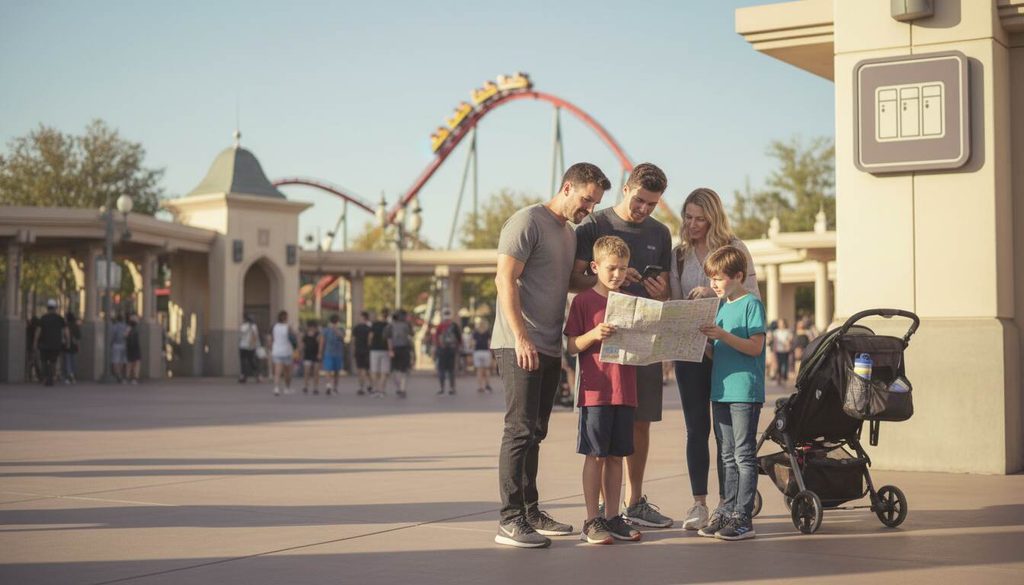
The Core First Timer Mistake: Treating A Theme Park Like A Normal Outing
A theme park is not a mall. It is not a casual afternoon walk. It is closer to a small city that happens to contain roller coasters. You will walk miles, stand in place for long stretches, make constant little decisions, and do it all in heat, noise, and crowds.
When first timers plan like it is a normal outing, they tend to under-pack, under-fuel, over-schedule, and then feel blindsided when the day gets hard.
Do this instead: Plan like you are doing a light hike with long pauses. Comfortable shoes, hydration, sun protection, and a realistic pace are not “extra.” They are the foundation.
Section 1: Planning Mistakes (The Ones That Create Long Lines And Regret)
Mistake 1: Showing Up With No Priorities (So Every Decision Feels Stressful)
A lot of first timers avoid planning because they do not want to overthink it. Totally fair. But the no-plan approach usually creates more stress, not less. You end up making every decision in the moment, in the heat, while hungry, while your phone battery drops.
What this looks like in real life:
- Walking back and forth across the park all day without realizing it
- Missing the rides you cared about most because you “never got to that side”
- Eating lunch at peak time, then spending 45 minutes in a food line
- Buying a skip-the-line product too late (or panic-buying the wrong one)
Do this instead: Pick 3 to 5 “must do” attractions and 2 “nice to have” attractions. That is it. If you do those, the day is a win. Everything else is a bonus.
If you want a gentle way to stack the odds in your favor, start with crowd timing. Even a basic crowd calendar can help you choose a day when the park is not at its worst. If you are planning a major destination trip, a guide like Best Time To Visit Universal Orlando (2026 Crowd Calendar) shows the bigger idea: your day gets easier when you are not fighting peak crowds.
Mistake 2: Not Understanding That “Early” Is A Strategy, Not A Personality
First timers often show up late because they assume the park will be “busy all day anyway.” The problem is that theme parks have a rhythm. The first hour or two after opening is usually the most efficient time you will get, especially for headliner rides.
Do this instead: You do not need to rope drop like a superfan. But if you can arrive close to opening, you will get more done with less stress. If you cannot, that is okay. Just accept that you are trading money or patience for sleep, and plan a calmer day.
Mistake 3: Overplanning Every Minute (And Then Feeling Like You Failed)
Some first timers go in the other direction and try to schedule the day down to the minute. Then one ride breaks down, one kid needs a bathroom, or one food line takes too long, and suddenly the plan collapses and everyone feels behind.
Do this instead: Plan in blocks, not minutes. Morning: 2 big rides. Midday: food and shade. Afternoon: flexible. Evening: one last priority and then vibes. A theme park day goes smoother when your plan can bend without breaking.
Mistake 4: Not Reading The Park’s Rules Before You Arrive (Bag Policy, Re-Entry, Closures)
This is the “why are we arguing at security” mistake. Parks have rules about bags, outside food, strollers, lockers, and re-entry. Those rules can change seasonally and can vary by park.
Do this instead: The night before, check the park’s official website for bag policy and any major closures. It is boring, but it prevents the most annoying kind of stress: the avoidable kind.
Section 2: Money Mistakes (The Ones That Quietly Drain Your Budget)
Mistake 5: Buying Tickets Without Thinking About The Day You Are Visiting
First timers often buy tickets based on the first available day that fits their schedule, not realizing that the day you visit can change the experience dramatically. Crowds affect wait times, food lines, show seating, and your overall energy.
Do this instead: If you have flexibility, choose your day strategically. If you want a broad, park-agnostic starting point, Cheapest Days To Visit Theme Parks is a good baseline because it frames the bigger pattern: cheaper days are often less crowded, and less crowded days feel better for first timers.
Mistake 6: Not Budgeting For The “Small Stuff” (Lockers, Parking, Water, Ponchos)
Theme parks are full of small costs that add up: parking, lockers, refillable cups, rain ponchos, sunscreen you forgot, and the emergency hoodie when the temperature drops at night.
Do this instead: Give yourself a “friction budget.” Even $30 to $60 set aside for small fixes can prevent the day from feeling like a constant series of financial surprises.
Mistake 7: Assuming Skip-The-Line Products Work The Same Everywhere
Different parks use different systems, and the names change constantly. First timers either refuse to consider any line skipping option and regret it on a busy day, or they panic-buy something expensive without understanding what it actually does.
Do this instead: Think in categories:
- Standby: you wait in the regular line
- Reservation return time systems: you book a time window and return later
- Express-style systems: you enter a shorter line, usually with fewer restrictions
If you are visiting a major park, read the official explanation of their system before you arrive. It is not about becoming an expert. It is about not spending a lot of money on something that does not match your day.
Section 3: Comfort And Energy Mistakes (The Ones That Cause Meltdowns, Even For Adults)
Mistake 8: Underestimating Heat And Dehydration
Heat is one of the biggest reasons first timers crash early. Theme parks are often hot, reflective, crowded, and physically demanding. Even if the temperature is not extreme, you are usually in direct sun for long stretches, walking miles, and sweating more than you realize.
Heat illness is preventable, but it sneaks up on people because the early symptoms feel like “I’m just tired” until you are suddenly dizzy, nauseated, headachey, and done.
Do this instead:
- Start hydrating before you feel thirsty
- Take shade breaks on purpose, not only when you are already miserable
- Eat actual food, not just sugar and caffeine
- Use a refillable bottle if the park allows it, or plan to buy water regularly
- Know the early signs of heat exhaustion so you can intervene early
If you want a high-authority overview of heat illness prevention, the CDC’s It’s Hot Outside: Stay Cool, Stay Hydrated, Stay Informed is a solid reference. It reinforces the core idea: heat-related illness is a real medical issue, not a personality flaw.
Mistake 9: Wearing The Wrong Shoes (And Pretending It Will Be Fine)
First timers wear cute shoes, new shoes, or “these are fine for walking” shoes. Then they discover that theme park walking is not normal walking. It is hours of pavement, standing in place, and sudden speed-walking because you are trying to make a return time.
Do this instead: Wear broken-in walking shoes or supportive sneakers. Bring blister protection if you are prone to hot spots. If you are choosing between style and comfort, pick comfort. Your feet are the vehicle for the entire day.
Mistake 10: Skipping Breakfast (Or Eating A Breakfast That Backfires)
A first timer classic is arriving hungry, grabbing the first sugary thing you see, and then feeling shaky or nauseated by mid-morning. Theme parks are not the place to experiment with a breakfast that does not work for your body.
Do this instead: Eat a portable, steady breakfast with protein and carbs. If you want a practical guide built for park mornings, Best Portable Breakfasts For Park Mornings (What To Eat Before Roller Coasters) is our post that fits this problem perfectly.
Mistake 11: Waiting Too Long To Eat Lunch (So Everyone Gets Mean)
Theme park hunger is different. You can go from “we are fine” to “why are we fighting about nothing” in about 12 minutes. First timers often wait too long to eat because they do not want to waste ride time, then they end up wasting more time because everyone is cranky and decision-making collapses.
Do this instead: Eat earlier than you think. Snack before you are desperate. If you are traveling with kids, plan food like it is part of the ride strategy, not an interruption.
If you are at EPCOT specifically, Hidden Gem Snacks At Epcot is a fun reminder that food can be a win, not a stressor.
Mistake 12: Not Planning For A Midday Reset
First timers often try to go hard from open to close. That sounds efficient, but it is usually what causes the 3:00 p.m. crash. Even adults hit a wall.
Do this instead: Build in one intentional reset: shade, water, bathroom, and sitting down. It is not wasted time. It is how you keep the second half of the day from falling apart.
Section 4: Ride Strategy Mistakes (The Ones That Waste Time Or Create Bad Memories)
Mistake 13: Not Understanding Loose Article Rules (And Losing A Phone, Hat, Or Patience)
First timers assume they can just hold their phone, keep their hat on, or shove things in a pocket. Many coasters do not allow that. Some rides require lockers. Some allow zip pockets only. Some allow nothing at all.
This is not parks being dramatic. Loose items can become projectiles. They can injure people. They can also cause ride delays when something falls into a restricted area.
Do this instead:
- Assume you will need a plan for phones, glasses, hats, and bags on major rides
- Use zip pockets if you have them, but do not assume they are always allowed
- Budget time for lockers on rides that require them
- If you wear glasses, consider a strap for rides where it is permitted
For a simple, safety-forward overview of common guest rules, a resource like the University of Kansas EHS Top 10 Amusement Park Safety Tips is useful because it reflects the same basic principles parks enforce: follow operator instructions, respect restrictions, and secure loose items.
Mistake 14: Ignoring Height Requirements Until You Are Already In Line
This is one of the most painful first timer mistakes for families. You wait 45 to 90 minutes, you get to the front, and your kid is half an inch short. Now everyone is upset, and you just burned a huge chunk of your day.
Do this instead: Check height requirements early, before you commit to long waits. Many parks have height check stations, and most ride entrances have the requirement posted. If your child is borderline, measure in the morning and plan around what is actually possible.
If you want a reality check on how limited “little kid coaster riding” can be at many parks, Can Infants Ride Roller Coasters? is a helpful baseline read.
Mistake 15: Not Using Rider Swap (Child Swap) When You Need It
Families with mixed riders often assume their only options are splitting up so one adult misses the ride, or waiting in the full line twice. That is where rider swap comes in. Many parks offer a rider swap, child swap, or rider switch system that lets adults take turns riding while someone stays with the non-rider, without doing the full wait twice.
Do this instead: Ask at the ride entrance if rider swap is available and what the process is for that attraction. Policies vary, but the concept is common.
Disney explains the basic concept on their Rider Switch page, and many other major parks offer a similar option even if they call it something different.
Mistake 16: Starting With The Most Intense Coaster (And Accidentally Scaring Yourself Off)
First timers who are nervous about coasters sometimes do the thing that feels brave: they start with the biggest ride in the park. Sometimes it works. A lot of the time, it backfires and turns the rest of the day into “I guess I’m not a coaster person.”
Do this instead: Build intensity gradually. Start with something smoother and less aggressive, then work up. If you are at Disney, internal guides like Least Intense Roller Coasters At Magic Kingdom and Least Intense Roller Coasters At Disneyland are designed for exactly this.
Mistake 17: Assuming All Coasters Feel The Same (They Do Not)
First timers often think “a roller coaster is a roller coaster.” But coaster experiences vary wildly based on track type, restraint style, smoothness, and forces. A wooden coaster can feel completely different from a modern steel coaster, and a launch coaster can feel different from a lift hill coaster.
Do this instead: Learn the basic categories so you can choose rides that match your comfort level. If you want a simple starting point, Wooden Vs Steel Roller Coasters and How Rough Is El Toro Really? are great examples of why “intensity” is not one thing.
Section 5: Safety And Health Mistakes (The Ones People Feel Weird Asking About)
Mistake 18: Not Taking Ride Health Warnings Seriously
First timers sometimes treat ride warning signs like background decoration. They are not there for vibes. They are there because certain ride forces can be risky for certain conditions.
Do this instead: If a warning applies to you, take it seriously. If you are unsure, ask a ride operator before you board. And if you are pregnant, it is worth reading a clear, practical guide like Roller Coasters And Pregnancy Safety so you are not making a stressful decision at the entrance.
Mistake 19: Pushing Through Dizziness Or Feeling Faint
Theme parks can trigger dizziness for a bunch of reasons: heat, dehydration, low blood sugar, anxiety, motion sensitivity, or just standing in the sun too long. First timers sometimes push through because they do not want to “ruin the day.”
Do this instead: Treat early symptoms like a real signal. Sit down. Get shade. Drink water. Eat something. Tell someone. A short reset can save the whole day.
If you want a practical, guest-focused checklist for what to do in the moment check out: What To Do If You Feel Faint At A Theme Park (Theme Park First Aid Basics For Guests).
Mistake 20: Assuming “Safety Systems” Mean You Can Ignore Instructions
Modern rides have multiple layers of safety technology, but guest behavior still matters. First timers sometimes assume that because rides are engineered, the rules are optional. That is when you see people trying to stand up, loosen restraints, hold a phone on a coaster, or ignore operator instructions.
Do this instead: Follow instructions the first time. If you have a question, ask before you board. If you want to understand why parks are strict about restraint checks and procedures, Roller Coaster Safety Technology Evolution is a helpful deeper read that explains how the industry got to today’s standards.
For a high-level, industry-facing overview of how parks think about safety culture, IAAPA’s guest safety messaging is a useful authority reference. Their discussion of accessibility in the attractions industry also reinforces a related point: parks are balancing safety, operations, and guest needs at scale.
Mistake 21: Not Understanding Restraints (So You Either Panic Or Fight Them)
Restraints feel different depending on the ride. Some are snug lap bars, some are over-the-shoulder restraints, some are vests, some are seatbelts, and some are combinations. First timers sometimes panic because something feels tighter than expected, or they do the opposite and try to “give themselves more room.”
Do this instead: Expect restraints to be firm. That is normal. Sit back, keep your posture neutral, and let the operator do their checks. If you want the calm, practical explanation of why restraint styles vary, Why Roller Coasters Have Different Restraints is the posts answers the question without fear-mongering.
Section 6: Family And Kid Mistakes (The Ones That Create Chaos Fast)
Mistake 22: Trying To Do A Full Adult Day With A Toddler Schedule
First timers with kids often plan the day like they are still traveling as adults, then feel shocked when the toddler hits a wall. Kids do not care that you paid for the ticket. They care that they are hot, tired, overstimulated, and hungry.
Do this instead: Plan your day around your child’s rhythm, not your wish list. That might mean doing one headliner ride, then doing something calm. It might mean leaving earlier than you expected. It might mean building in a nap window. That is not failure. That is how you keep the day enjoyable.
Mistake 23: Not Having A Simple “Lost Kid” Plan
This is one of those things nobody wants to think about, but it is worth 30 seconds of planning. First timers assume it will not happen, and then a crowd surge happens, or a kid stops to look at something, and suddenly your heart is in your throat.
Do this instead: Pick a simple meeting point (“the big fountain,” “the carousel,” “the front gate”) and make sure everyone knows it. If your child is old enough, practice what to do if you get separated: stop moving, find an employee, and say your name. If your child is too young for that, keep a recent photo of them on your phone and consider a simple ID bracelet or card.
Mistake 24: Not Using Rider Swap And “Split Strategy” For Big Groups
Families and friend groups often try to stay together all day, even when the group has mixed priorities. That is sweet, but it is also how you end up with everyone compromising until nobody is happy.
Do this instead: Normalize splitting up for an hour. You can regroup for meals and shows. If you are traveling with a big group, Theme Park Planning For Large Groups is the post that helps you set expectations without drama.
Section 7: Coaster Beginner Mistakes (The Ones That Make People Think They “Can’t Do Coasters”)
Mistake 25: Thinking Fear Means You Should Not Ride Anything
Fear is not a character flaw. It is your nervous system trying to keep you safe. First timers sometimes interpret fear as a sign that they should avoid rides entirely, even when they actually want to try.
Do this instead: Start small. Build up. Give yourself permission to opt out. If you want a step-by-step approach that does not talk down to you, Overcome Roller Coaster Phobia is the post designed for this exact situation.
Mistake 26: Not Knowing Why A Coaster Feels Rough (And Assuming That Is “Normal”)
Not all coasters are smooth, and “roughness” is not just discomfort. It can affect how you feel for the rest of the day. First timers sometimes get off a rough ride and assume all coasters will feel like that.
Do this instead: Learn the difference between a coaster that is intense in a fun way and a coaster that is physically punishing for you. If you want a concrete example, How Rough Is El Toro Really? is a good post because it treats roughness as a real guest experience factor, not a bragging point.
Mistake 27: Not Understanding How Coasters Actually Work (So Your Brain Fills In The Scary Parts)
Fear often comes from mystery. If you do not know how a coaster stays on the track, how braking works, or what the safety systems are doing, your brain will happily invent worst-case scenarios.
Do this instead: A little knowledge goes a long way. If you want the engineering explanation in plain language, How Do Roller Coasters Stay On The Tracks? and How Roller Coasters Work (Engineering + Physics) are great posts for calming the “what if” spiral.
Section 8: Expectation Mistakes (The Ones That Make A Good Day Feel Bad)
Mistake 28: Trying To Do Everything In One Day
This is the emotional mistake. First timers walk in with a mental checklist that is basically impossible. Then they spend the day stressed, because every choice feels like a loss: “If we do this, we miss that.”
Do this instead: Decide what kind of day you are having:
- Big Ride Day: fewer attractions, more waiting, more intensity
- Balanced Day: a mix of rides, shows, food, and breaks
- Chill Day: vibes first, minimal lines, lots of wandering
When you pick the type of day, your decisions get easier. You stop fighting the park and start using it.
Mistake 29: Forgetting The “Exit Tax” (The End Of Day Energy Crash)
First timers plan the whole day around the morning, then forget that leaving a theme park can take time and energy. Parking lots, transportation, tired kids, sore feet, and long lines for the last bathroom break can turn the end of the day into a mess.
Do this instead:
- Pick a realistic “we start heading out” time
- Do not save your most complicated logistics for the last 30 minutes
- If you are staying for nighttime shows, plan a calm break beforehand
Mistake 30: Thinking A “Bad Moment” Means The Whole Day Is Ruined
First timers often have one rough moment and mentally label the entire trip as a failure. A kid has a meltdown. Someone gets nauseated. A ride breaks down right when you finally get there. It happens.
Do this instead: Treat it like weather. It is a moment, not the whole climate. Reset with water, shade, food, and a calmer attraction. Theme park days are long, and they can recover.
A Gentle First Timer Game Plan (If You Want The Short Version)
If you want a simple plan that avoids most mistakes without overthinking:
- Before you go: pick 3 to 5 must-dos, check the park’s rules, and plan your shoes and hydration
- Morning: do 1 to 2 headliners early, before lines peak
- Midday: eat earlier than you think, then take a shade reset
- Afternoon: alternate intense rides with calmer ones, keep drinking water
- Evening: do one last priority, then let the rest be flexible
If you are visiting with a big group, build in permission to split up and regroup. If you are visiting with kids, build the day around their rhythm. If you are a coaster beginner, build intensity gradually. None of those approaches are “less fun.” They are how you actually enjoy the day you paid for.
And if you want a reminder that theme parks have always been a mix of wonder and chaos, Historic Theme Park Rides is a fun post that puts modern park problems in perspective. People have been figuring out how to have a good day in crowded amusement spaces for a very long time.

Leave a Reply