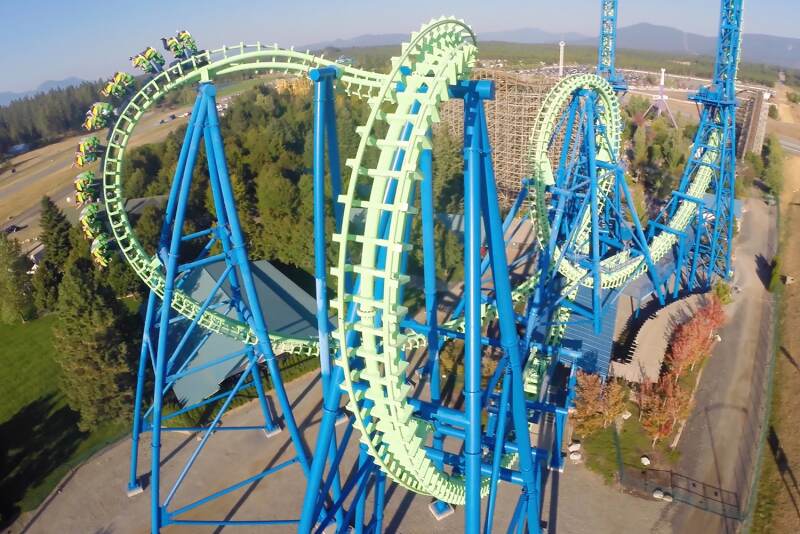
Aftershock is one of those roller coasters that feels like it should not exist in the best way. It is compact, intense, and weirdly elegant, and it delivers a kind of “big coaster” punch without needing a huge footprint. If you have ever watched a train hang beneath the track, climb straight up a spike, pause, and then rip backward through the same elements you just survived, you already understand the appeal.
At Silverwood Theme Park in Idaho, Aftershock is a rare bird: a Vekoma inverted shuttle coaster that was relocated from a major chain park and given a second life. It is part thrill ride, part engineering magic trick, and part coaster history lesson, all wrapped into a ride that can turn a normal park day into a “remember when we rode that thing twice in a row” day.
Quick Answer: Is Aftershock Worth Riding?
Yes, especially if you like intense coasters, unusual ride formats, or anything that feels a little “off menu” compared to the standard hypercoaster and wooden coaster lineup. Aftershock is short, but it is not small. The experience is punchy, forceful, and disorienting in a way that is genuinely different from most modern coasters.
If you are sensitive to headbanging or you dislike being pulled backward unexpectedly, you might want to watch a cycle first. Otherwise, for most coaster fans, Aftershock is a must ride at Silverwood.
What Kind Of Coaster Is Aftershock?
Aftershock is an inverted shuttle coaster in the “boomerang” family, specifically the Vekoma Invertigo model. “Inverted” means the train hangs beneath the track and your legs dangle. “Shuttle” means it does not complete a full circuit. Instead, it runs the course, reaches an end point, and then reverses direction to run the course again in the opposite direction.
That last part is the secret sauce. You do not just ride Aftershock once. You ride it forward, then backward, and the backward half often feels more intense because your body is reacting to forces you cannot anticipate as easily.
If you like understanding the mechanics behind rides, you will probably also enjoy my deeper explainer on how roller coasters stay on the tracks, because Aftershock is a great example of how much engineering confidence is baked into even a compact layout.
Aftershock Ride Stats (The Stuff People Actually Want To Know)
Aftershock is known for being tall for its footprint, fast enough to feel aggressive, and inversion heavy for such a compact layout. Exact published numbers can vary by source and by how a park chooses to describe them, but the practical takeaway is simple: this is an intense, inversion-focused coaster that delivers a full experience in a short runtime.
- Type: Inverted shuttle coaster (Vekoma Invertigo)
- Layout Style: Forward run through inversions, then reverse run through the same inversions
- Signature Feature: Vertical spikes at each end of the track
- Inversions: Multiple inversions experienced twice (forward and backward)
- Intensity Level: High for most guests, especially first timers
If you want a broader context for how parks communicate ride restrictions and warning signage, my guide to ride warning signs and what they mean is a helpful companion read, especially for families planning a first visit to Silverwood.
The Ride Experience: What Aftershock Feels Like
Aftershock has a very specific vibe. It is not graceful like a big modern hypercoaster, and it is not floaty like a newer family launch coaster. It feels mechanical in the most thrilling way, like a machine designed to do one job: flip you, yank you, and send you back the way you came before your brain has time to file a complaint.
The First Lift And The “Hanging” Feeling
Because it is inverted, you feel exposed immediately. Your feet are dangling, the track is above you, and your body is supported by a restraint system that feels very different from a lap bar coaster. Even before the ride gets intense, the sensation of hanging can spike your adrenaline, especially if you are a newer coaster rider.
If you are easing into bigger rides, you might like reading how to overcome roller coaster fear before your trip. Aftershock is not the gentlest “starter” coaster, but it is absolutely doable for a lot of people who think they cannot handle intense rides, as long as they understand what they are signing up for.
The Forward Run: Fast, Compact, And Surprisingly Forceful
On the forward pass, Aftershock wastes no time. The elements come at you quickly, and because the layout is compact, the forces can feel concentrated. You are not spending long stretches building anticipation. You are in it almost immediately.
This is also where people start forming opinions about comfort. Some riders find the experience thrilling and clean. Others feel the classic “older Vekoma” roughness, especially around the head and neck.
The First Spike: The Moment Everyone Remembers
After the forward elements, the train climbs the far spike. This is one of the most dramatic parts of the ride. You feel the speed bleed off as you rise, you get a brief moment of weightlessness and suspension, and then the ride does something that still feels rude even when you know it is coming: it stops, and you go backward.
That pause is not long, but it is long enough for your brain to register what is about to happen.
The Backward Run: The Same Track, A Completely Different Ride
Riding the same inversions backward changes everything. Your body cannot anticipate the transitions as easily, and the forces can feel sharper because you are reacting instead of predicting. For many people, the backward pass is the more intense half, even though the track is identical.
If you love coasters that feel unpredictable, this is where Aftershock earns its reputation.
Is Aftershock Scary?
It can be, especially if any of these are true:
- You are nervous about dangling coasters
- You dislike going backward on rides
- You get anxious when you cannot see where you are headed
- You are sensitive to head movement or roughness
But if you like intense coasters, Aftershock is “scary” in the fun way. It is the kind of ride that makes you laugh afterward because your body is still trying to catch up to what just happened.
Is Aftershock Rough?
This is the most common practical question, and the honest answer is: it depends on the day and on you. Vekoma’s older inverted hardware has a reputation for being less smooth than newer generation coasters. Some riders experience headbanging, especially if they let their head bounce between the restraint padding. Others ride it and feel fine.
If you want a useful comparison point for how “roughness” can become part of a coaster’s public reputation, my deep dive on how rough El Toro really is is a good read. Different coaster types, obviously, but the same basic truth applies: comfort is a mix of track, trains, maintenance, and rider body mechanics.
Restraints, Fit, And Comfort Tips
Aftershock uses an over-the-shoulder style restraint common to inverted coasters of its era. The restraint is part of why the ride feels secure, but it is also part of why some riders report head and neck discomfort.
If you want the best possible “why” behind restraint design, I have a full explainer on why roller coasters have different restraints, plus a more focused safety breakdown on how lap bars work and why they are safe. Aftershock is a great example of how restraint choices are often about the era a ride was designed in, not just the ride’s raw intensity.
- Tip: Sit back fully and keep your head steady instead of letting it bounce.
- Tip: Keep your chin neutral, not craned forward.
- Tip: If you are prone to motion sickness, do not ride this on an empty stomach or immediately after a heavy meal.
If nausea is a concern for you or someone in your group, my guide to what to eat before roller coasters can help you plan a park day where you can still ride intense coasters without feeling wrecked by lunchtime.
Best Seat On Aftershock
On a shuttle coaster like this, seat preference is less about “front row views” and more about how you want the forces to hit you. You are going to experience the same elements twice, but the timing and sensation can feel different depending on where you sit.
If you want a broader guide that applies to basically every coaster style, I also have a full breakdown of how to pick the best coaster seat for intensity versus comfort.
- If you want the most intense feeling: Try the back. You may feel stronger whip on transitions.
- If you want a slightly more controlled ride: Try closer to the front.
- If you are nervous: Ride near the middle first. It can feel a bit more balanced.
If you have time, the real move is to ride twice and compare. Aftershock is short enough that a second ride can completely change your opinion.
How To Ride Aftershock Like A Pro (Wait Time And Timing Tips)
Aftershock is a unique coaster and not a massive capacity monster, so it can draw a steady line when the park is busy. Your best strategy is simple: ride early, pace your day, and do not accidentally cook yourself in the sun before you get to the intense stuff.
If you like having a real plan instead of winging it, my energy management guide on rope drop strategy without burning out pairs perfectly with an Aftershock day, because this is exactly the kind of coaster that feels better when you are hydrated, fed, and not already exhausted.
- Ride earlier in the day if you can, before the mid-day crowd peaks.
- If you are testing your tolerance, ride once before lunch rather than after a heavy meal.
- If you are traveling with mixed thrill levels, let nervous riders watch a full cycle first. Seeing the forward and backward run helps a lot.
And if your group tends to push too hard and then crash, you will get a lot of value out of how to stay hydrated at theme parks without constant bathroom breaks. It is one of those unglamorous topics that quietly improves every ride you go on.
The History: Why Aftershock Is A Big Deal
Aftershock is not just a coaster at Silverwood. It is a coaster with a past, and that past is part of why enthusiasts care about it.
Silverwood’s Aftershock is widely known as a relocated inverted boomerang that previously operated as “Déjà Vu” at a Six Flags park. The Déjà Vu coasters were a small group of Vekoma Invertigo installations that stood out because they were inverted, they ran forward and backward, and they looked dramatic even from far away thanks to their tall spikes.
Over time, several of these rides were removed from their original parks. Relocations like this are not unusual in the coaster world, but they are still fascinating because they show how rides can be treated like giant, expensive, reusable machines rather than one-and-done installations.
If you enjoy the “where did it go and why” side of coaster history, you will probably also like my roundup of removed or banned roller coasters. Aftershock’s story is not about scandal, but it fits the same broader theme: rides have lifecycles, and sometimes the second life is the more interesting chapter.
Why The Vekoma Invertigo Model Has Such A Reputation
The Invertigo model sits in a sweet spot of coaster design history. It is intense, compact, and visually iconic. It also has a reputation that can be polarizing, because older inverted hardware and restraint designs can be less forgiving than modern equivalents. That combination is exactly why people talk about it.
Some coasters are beloved because they are smooth and universally pleasant. Invertigo coasters are beloved because they are a little unhinged. They feel like a thrill ride concept scaled up into a coaster format, and the backward run is the kind of gimmick that never really feels like a gimmick when you are actually on it.
If you like nerding out on how coaster design evolved into what we ride today, you might also enjoy how roller coaster safety technology evolved and the complete history of roller coaster loops. Aftershock is a great “bridge coaster” between eras: modern enough to feel bold, old enough to feel like a time capsule.
Who Will Love Aftershock (And Who Might Want To Skip It)
You will probably love Aftershock if you:
- Like intense coasters with inversions
- Enjoy rides that feel unusual and unpredictable
- Want something you cannot easily find at every park
You might want to skip Aftershock if you:
- Are very sensitive to head and neck discomfort
- Strongly dislike going backward on rides
- Are easing into coasters and want something smoother as a first step
If you are visiting with kids or newer riders and you are trying to map out a “confidence ladder,” it can help to read how to identify low intensity coasters
FAQ About Aftershock At Silverwood
Does Aftershock Go Backward?
Yes. You ride the course forward, climb a spike, then reverse and ride the same elements backward.
Does Aftershock Have Inversions?
Yes, and you experience them twice because of the forward and backward run.
Is Aftershock A Good First Inverted Coaster?
If you are brand new to inverted coasters, Aftershock can be a lot. It is intense and includes a backward run. If you are comfortable with big coasters already, it can be a fun step into inverted territory.
What Is The Best Seat On Aftershock?
If you want maximum intensity, try the back. If you want a slightly more controlled feel, try closer to the front. If you are unsure, start near the middle and then experiment.
The Bottom Line
Aftershock is the kind of coaster that makes a park feel bigger. It is intense without being huge, dramatic without needing a sprawling layout, and memorable because the backward run changes the entire personality of the ride.
If you are visiting Silverwood and you like thrill coasters, Aftershock should be on your short list. Ride it once to understand it, then ride it again to decide how you really feel. That second ride is where this coaster usually wins people over.

Leave a Reply