Picking a coaster seat is the closest thing theme parks have to a difficulty slider.
Same ride. Same track. Same restraints. Completely different experience depending on whether you sit in the front, middle, or back. One row feels like floating. Another feels like your organs filed a complaint with management.
This guide breaks down how coaster forces actually feel in different rows, and how that changes across major coaster types: hyper and giga coasters, B&M inverts, RMCs, woodies, launch coasters, spinning coasters, wild mice, floorless, flying, and stand-up.
Quick disclaimer: I am not a doctor, and this is not medical advice. If you have a medical condition, are pregnant, have back or neck issues, or you are unsure, follow the ride restrictions and ask your doctor. Also, listen to your body. “Toughing it out” is not a personality trait when you are strapped to a machine that can pull multiple Gs.
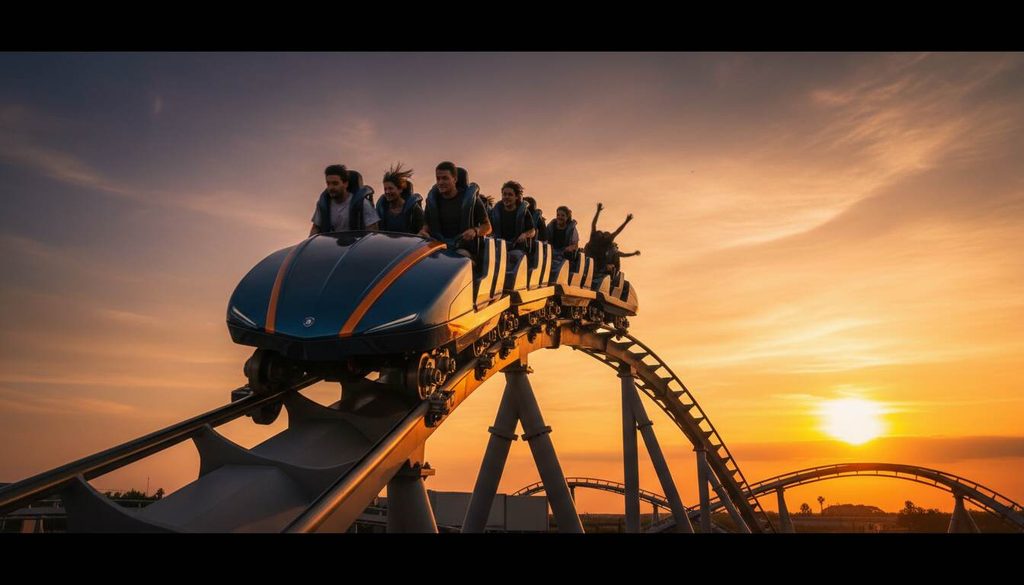
The Fast Answer: Front Vs Middle Vs Back
If you only remember one thing, make it this: the front and back exaggerate different parts of the ride, and the middle is usually the most “true to the designer’s intent” and the most forgiving.
| Row | What It Usually Feels Like | Best For | Worst For |
|---|---|---|---|
| Front | Smoother, more visual, more “float” on crests, less whip | Comfort, views, first-time riders, motion-sensitive riders | People chasing maximum whip and chaos |
| Middle | Balanced forces, often the smoothest overall | Comfort plus intensity, repeat rides, testing your tolerance | People who want the most extreme version of the ride |
| Back | More whip, stronger airtime “pop,” more aggressive transitions | Intensity, airtime hunters, experienced riders | Anyone who hates being yanked around, or is managing headaches or back sensitivity |
Why Different Rows Feel Different (Without Turning This Into A Physics Lecture)
Coasters are not one object moving along a track. They are a long train of cars connected together. That means different parts of the train are doing different things at the same time, and your body feels those differences as “front vs back.”
The Back Row “Whip” (The Rubber Band Feeling)
When the front of the train starts going down a drop, the back is still up on the hill. Then the back gets pulled over the edge like a rubber band snapping. That is why the back row often feels more aggressive on drops and transitions. You get more sudden changes in speed and direction.
The Front Row “Float” (Longer, Cleaner Airtime Sensation)
The front clears the top of hills and crests first. That can create a longer, cleaner feeling of floating over the top before the rest of the train catches up. On airtime hills, the front often feels like a smoother, more drawn-out lift out of your seat.
Train Dynamics And Track Wear (Why “Middle Is Smoothest” Is Often True)
On some coasters, especially older rides or rides that have developed a reputation for roughness, the middle cars can feel more stable. It is not that the laws of physics change. It is that vibration, wheel assemblies, and how the train settles into the track can make certain cars feel more “chattery” than others.
If you want the deeper “how does this even work” version, start with How Do Roller Coasters Stay On The Tracks? and How Roller Coasters Work (Engineering + Physics).
What “Intensity” Actually Means On A Coaster
When someone says “that coaster is intense,” they usually mean one or more of these sensations:
Positive Gs: the heavy feeling, like you are being pushed into your seat. You feel it most in valleys after drops, tight turns, and some inversions.
Negative Gs (Airtime): the floaty “butt out of seat” feeling. Strong airtime can feel like a quick pop or a sustained float depending on the element and your seat.
Lateral forces: side-to-side forces, often felt in older designs, wild mice, and rides with sharp direction changes.
Rotational forces: the twist and roll feeling, common on modern coasters with fast transitions, inversions, and off-axis elements.
Restraint pressure: sometimes what people call “intensity” is really restraint fit and pressure points. This matters a lot on inverts, flying coasters, and anything with over-the-shoulder restraints.
If you like the “why does my body feel weird after that” angle, you can pair this with Roller Coaster Accidents And Safety Statistics (for the safety context) and Why Roller Coasters Have Different Restraints (for the comfort side).
The Golden Rule: Pick Your Seat Based On Your Weak Spot
People talk about intensity like it is one thing, but your “nope” threshold might be totally different from mine.
If you hate whip and snap, avoid the back row on most coasters.
If you hate airtime (that stomach lift), avoid the back row on airtime machines and aim for the middle.
If you hate positive Gs (that heavy, pressed-down feeling), front and middle often feel more manageable, and you may want to avoid rides known for sustained high-G helixes.
If you hate roughness, the middle is usually your best friend, especially on older woodies.
Best Seats By Coaster Type (Intensity Vs Comfort)
Hyper And Giga Coasters (Big Drops, Big Speed, Big Airtime)
Hypers and gigas are the kings of speed and airtime. They are often smoother than you expect, but the forces can still be a lot because the ride is long, fast, and relentless.
Best Seats For Intensity
Back row is usually the move if you want the most aggressive first drop and the sharpest airtime pops. The back gets pulled over the crest harder, and that “snap” sets the tone for the whole ride.
Best Seats For Comfort
Front or middle is usually the sweet spot. Front gives you the cleanest view and often the smoothest-feeling airtime. Middle tends to reduce whip and can feel more stable at high speed.
How The Forces Feel By Row
Front: longer float over crests, less snap, more “I can see my future” exposure on the drop.
Middle: balanced, often the least rattly, usually the best “first ride” seat.
Back: strongest pull over drops, more punchy airtime, more whip in transitions.
B&M Inverted Coasters (Hanging Under The Track)
B&M inverts are famous for being smooth, forceful, and very locked in. You are hanging, your legs are free, and the ride wants to throw you through big sweeping elements with strong positive Gs.
Best Seats For Intensity
Back row if you want more whip through inversions and transitions. Inverts can feel noticeably different back vs front because the train is long and the elements are often large and fast.
Best Seats For Comfort
Front row is the comfort and vibes pick. You get the cleanest view, the least “being dragged through the element” feeling, and it often feels slightly less aggressive in transitions.
How The Forces Feel By Row
Front: more graceful, more visual, less whip.
Middle: strong but controlled, usually easiest on your head and neck.
Back: more snap, more “tail swing,” more intensity in direction changes.
B&M Dive Coasters (The Hang, The Drop, The Cleanest Lines)
Dive coasters are a very specific flavor. The intensity is front-loaded (literally). The pre-drop hang is the signature, and the rest is typically smooth, large-scale elements.
Best Seats For Intensity
Front row if you want the most dramatic hang and the biggest psychological drop. If you want the “my feet are in the sky and I regret everything” moment, front is the seat.
Back row if you want the strongest pull into the drop and a slightly more forceful feeling through transitions.
Best Seats For Comfort
Middle if you want the same ride without the most extreme version of the hang or the whip.
How The Forces Feel By Row
Front: maximum exposure, maximum hang, drop feels like falling off a building.
Middle: still dramatic, but less “edge of the world” time.
Back: less hang, more yank into the drop.
RMC Coasters (Hybrid And I-Box Chaos Machines)
RMCs are where “intensity” stops being a vague word and becomes a hobby. They are known for rapid transitions, strong airtime, and elements that feel like they were designed by someone who thinks “gentle” is an insult.
Best Seats For Intensity
Back row is typically the most violent in the best way. You get harder pulls, sharper whips, and more aggressive airtime snaps.
Best Seats For Comfort
Front or middle if you want to enjoy the ride and still function afterward. Front can feel smoother and more flowy. Middle can reduce the most extreme whip moments.
How The Forces Feel By Row
Front: smoother transitions, airtime feels more floaty than punchy.
Middle: still intense, but less likely to feel like you are being tossed around.
Back: maximum whip, maximum airtime pop, maximum “why am I laughing and also scared.”
Traditional Wooden Coasters (Classic Airtime, Sometimes Classic Violence)
Woodies are a wide category. Some are smooth and glorious. Some are educational in a way you did not ask for. Comfort can vary a lot based on track condition, train design, and where you sit.
Best Seats For Intensity
Back row for stronger airtime and more aggressive pacing. If the coaster is running fast, back row can be incredible.
Best Seats For Comfort
Middle is often the safest bet. If a woodie has a rough reputation, the middle can reduce some of the worst jolts.
How The Forces Feel By Row
Front: smoother feel over crests, less slam, more “glide.”
Middle: often the least punishing, best for rerides.
Back: strongest airtime pops, but also can amplify roughness.
If you want a real-world example of how “roughness” becomes part of the story, How Rough Is El Toro Really? is exactly that conversation.
Launch Coasters (Acceleration And “Oh, We Are Doing This Now” Energy)
Launch coasters are about acceleration, quick pacing, and sometimes multiple launches. Row choice matters, but not always in the way people assume.
Best Seats For Intensity
Front row can feel more intense on some launches because you hit the acceleration first and you get the cleanest sense of speed and exposure. Top hats and spikes can feel bigger from the front because you are the first one over the crest.
Back row can feel more intense on other launches because you get that slingshot snap as the train tightens and the force “catches up” through the cars. If a launch feels like it punches you in the spine, back row is often why.
So yes, this is one of those coaster types where both front and back can be the intensity seat, just in different flavors.
Best Seats For Comfort
Middle is usually the most consistent and least jerky, especially on rides with quick transitions right after the launch.
How The Forces Feel By Row
Front: speed and exposure, often feels cleaner and more aerodynamic.
Middle: balanced, less sudden, best if you are unsure.
Back: can feel more like a slingshot, especially when the train crests elements after the launch.
If you want a specific coaster-type deep dive, Impulse Roller Coaster is a good companion read, because impulse rides are basically a masterclass in how “front vs back” changes the sensation of the same track.
Spinning Coasters (Controlled Chaos, Sometimes Uncontrolled Chaos)
Spinning coasters are the wildcard because the spin can change every ride. Your row matters, but your weight distribution and who you ride with can matter more.
Best Seats For Intensity
If you want the most spin, ride with an unbalanced weight distribution (not perfectly symmetrical seating). On many spinning coasters, you cannot fully control this, which is either fun or horrifying depending on your personality.
Best Seats For Comfort
If you get motion sick, your best move is not “front row.” Your best move is damage control: ride earlier in the day, avoid heavy meals right before, hydrate, and pick the most stable-feeling seat available if the ride allows it.
How The Forces Feel By Row
Front vs back matters less than on a traditional train. The spin is the main event. If you are motion sensitive, spinning coasters are the type where “middle is best” is not a magic fix.
Wild Mouse Coasters (Sharp Turns, Lateral Forces, Sudden Braking)
Wild mice are small, compact, and surprisingly intense for what looks like a cute little box on wheels. The signature sensation is lateral forces, especially those tight hairpin turns.
Best Seats For Intensity
If you want maximum lateral snap, sit on the outside of the turns if the seating arrangement makes that possible. Some wild mice make you feel like you are being thrown outward. That is the point.
Best Seats For Comfort
Pick the seat that keeps you most centered and braced. If you hate being slammed against the side of a car, wild mice are not your friend, but you can reduce it by choosing a seat that feels more supported.
How The Forces Feel By Row
Row differences are less dramatic than on big trains. The car behavior and turn geometry dominate. Expect quick lateral hits and abrupt braking.
Floorless Coasters (Like Sit-Down, But With Extra Exposure)
Floorless coasters often ride similarly to sit-down coasters from the same manufacturer, but the lack of floor changes the sensation. It feels more open, and that can make the same forces feel more intense.
Best Seats For Intensity
Back row for more whip and stronger transitions.
Best Seats For Comfort
Front or middle for smoother pacing and less snap.
How The Forces Feel By Row
Similar to a sit-down coaster: front is smoother and more visual, back is more aggressive, middle is balanced. The difference is the exposure makes everything feel a notch bigger.
Flying Coasters (Face Down, Flying Position, Very Specific Kind Of Intense)
Flying coasters are their own thing. The sensation is not just G-forces. It is body position, restraint pressure, and the feeling of being rotated into a flying posture.
Best Seats For Intensity
Front can feel more intense because the flying sensation and visuals are more dramatic. You feel like you are leading the charge into the elements.
Back can feel more intense in transitions because of whip, especially if the ride has strong direction changes.
Best Seats For Comfort
Middle is usually the safest comfort pick. Flying restraints can create pressure points, and middle rows often reduce the most extreme whip moments.
How The Forces Feel By Row
Front: best visuals, strongest “I am actually flying” vibe.
Middle: most stable, often easiest on your body.
Back: more whip, more aggressive transitions.
Stand-Up Coasters (Comfort Is The Whole Conversation)
Stand-up coasters are controversial for a reason. The forces can be fun, but the comfort depends heavily on restraint fit, your height, and how you position yourself.
Best Seats For Intensity
Stand-up intensity is less about row and more about how the coaster runs and how the restraints fit you. Back row can still add whip, but the bigger factor is whether you are comfortable enough to enjoy the ride at all.
Best Seats For Comfort
Middle is often the best bet to reduce whip. But the real comfort advice is: adjust your stance, do not lock your knees, and do not try to “win” the restraint. If it feels wrong in the station, it will feel worse at speed.
How The Forces Feel By Row
Front: smoother, more visual.
Middle: most stable.
Back: more whip, which can be a problem if you are already uncomfortable.
Sit-Down Loopers And Multi-Inversion Coasters (The “Classic Modern Coaster” Category)
This is your big bucket of sit-down steel coasters with inversions: corkscrews, loops, zero-G rolls, Immelmanns, cobra rolls, and all the other shapes that make your non-coaster friends say “absolutely not.”
Best Seats For Intensity
Back row if you want the most whip through inversions and the most snap in direction changes.
Best Seats For Comfort
Front or middle if you want smoother pacing and less head toss. If a ride has older over-the-shoulder restraints, front and middle can be noticeably kinder.
How The Forces Feel By Row
Front: smoother entry into inversions, more visual anticipation.
Middle: most balanced, often least “rattle.”
Back: more whip, more aggressive transitions, more “tail swing.”
Coasters With Over-The-Shoulder Restraints (When Comfort Is About Your Head, Not Your Stomach)
Let’s be blunt: a lot of coaster discomfort is not about G-forces. It is about restraint design and how your head and neck get handled during quick transitions.
If you have ever gotten off a coaster and thought “my head feels like it got ping-ponged,” that is usually a restraint and pacing issue more than a pure intensity issue.
Best Seats For Comfort
Middle rows are often the best bet because they reduce the sharpest whip moments. Also, if you can choose between inside and outside seats (on some wider trains), the inside seat can sometimes feel slightly less exposed to lateral snap.
Also, this is where posture matters. Keep your head back against the headrest if there is one, and do not let your head flop side to side. You are not trying to look cool. You are trying to keep your neck from doing interpretive dance.
If you want the full restraint breakdown, Why Roller Coasters Have Different Restraints is the best internal companion piece for this section.
Single-Rail Coasters (Raptor-Style Rides And Similar Designs)
Single-rail coasters tend to feel precise, fast, and a little bit “knife edge” compared to wider trains. The transitions can be snappy, and the ride can feel more like it is threading you through the track rather than carrying you through it.
Best Seats For Intensity
Back row for the strongest whip and the most aggressive pacing.
Best Seats For Comfort
Front or middle if you want the cleanest, smoothest-feeling run. Front can feel particularly good on rides where the visuals are part of the thrill.
How The Forces Feel By Row
Front: clean, precise, more “glide.”
Middle: balanced, usually the least surprising.
Back: snappier transitions, stronger airtime pop.
Family Coasters And Mine Trains (Where Comfort Usually Wins)
On family coasters, the “best seat” is usually the one that makes the ride feel fun instead of punishing. Mine trains especially can have quick little lateral pops and tighter turns that feel sharper than you expect.
Best Seats For Comfort
Middle is usually the safest choice, especially if you are riding with kids or someone who is nervous.
Best Seats For Intensity
If you are trying to squeeze intensity out of a family coaster, back row will usually give you the most speed variation and the most noticeable airtime moments, if the ride has any.
How The Forces Feel By Row
Front: calmer, more scenic, less jostle.
Middle: most stable.
Back: a little more snap, a little more “we are moving,” but still family-friendly.
If you are bringing someone who is anxious about riding at all, pair this guide with Overcome Roller Coaster Phobia because seat choice is a sneaky way to make a first coaster experience go better.
How Coaster Forces Feel In Specific Rows (Front Row, Middle Row, Back Row)
Let’s zoom in and talk about the sensation differences in plain language, because “more whip” is true, but it is also vague.
Front Row: The “Cinematic” Seat
What you feel: smoother pacing, cleaner airtime crests, less whip, and the most visual intensity. You see everything first, which makes the ride feel bigger even when the forces are slightly less aggressive.
Why it feels that way: you crest elements first, you enter inversions first, and you are not getting yanked over the top by the rest of the train.
Best for: first-time riders, people who want the views, people who want intensity without chaos, and anyone who gets headaches from whip.
Not ideal for: people chasing maximum airtime pop or maximum snap.
Middle Rows: The “Truth Serum” Seat
What you feel: the most balanced version of the ride. If a coaster is great, the middle will feel great. If a coaster is rough, the middle will usually be the least rough.
Why it feels that way: you are buffered by cars in front and behind, and you are less likely to get the strongest pull over crests or the strongest snap through transitions.
Best for: comfort, rerides, testing your tolerance, and anyone who wants to enjoy the ride without feeling like they are doing a full-contact sport.
Not ideal for: people who want the most extreme version of the ride.
Back Row: The “Make It Meaner” Seat
What you feel: stronger pull over drops, more aggressive airtime pops, more whip in transitions, and a more chaotic feeling overall.
Why it feels that way: the front starts moving first, and the back gets pulled into motion. That creates sharper changes in acceleration and direction.
Best for: airtime hunters, experienced riders, and anyone who wants the ride to feel faster and punchier.
Not ideal for: people who hate being yanked, people managing back or neck sensitivity, and anyone who is trying to pace themselves for a long park day.
Intensity Vs Comfort: A Practical Seat-Picking Cheat Sheet
| If You Want… | Pick This Seat First | Why |
|---|---|---|
| Maximum airtime pop | Back row | Stronger pull over crests and sharper negative G moments |
| Sustained floaty airtime | Front row | Cleaner, longer crests and less whip |
| Least whip and snap | Middle rows | More buffered transitions, less tail swing |
| Best views and “cinematic” feeling | Front row | You see everything first, and exposure is half the thrill |
| Least roughness on older rides | Middle rows | Often the most stable part of the train |
| Most aggressive first drop | Back row | Rubber band pull over the edge |
| Most manageable “first ride” experience | Middle, then front | Balanced forces, less surprise, smoother pacing |
Comfort Tips That Matter More Than Seat Choice (Sometimes)
Seat choice is powerful, but there are a few comfort variables that can override it.
Restraint Fit Is Everything
If the restraint is uncomfortable in the station, it is not going to magically become comfortable at 60 mph. Adjust what you can, sit back, and do not contort yourself into a weird posture to “make it work.”
Hydration And Heat Change Your Tolerance
Heat and dehydration can make intensity feel worse. If you are feeling off, choose the middle row and pick a smoother ride. Also, take breaks. Nobody gets a medal for riding coasters while overheated.
Know Your Personal Triggers
If you get motion sick, spinning coasters and rides with lots of quick direction changes can be worse than tall coasters.
If you get headaches, whip and head movement are usually the culprit, not airtime.
If you have back sensitivity, roughness and abrupt transitions are often the problem, so middle rows and smoother coasters are your friend.
What To Do If You Are Trying To Balance Intensity And Comfort
This is the real “best seat” question for most people. You want the ride to feel like a coaster, not like a chiropractic experiment.
Here is the strategy I recommend:
- First ride: pick a middle row. Get a baseline.
- If you want more intensity: move to the back on your second ride.
- If you want more comfort and views: move to the front on your second ride.
- If the ride is rough: go back to the middle and call it a win.
If you are doing a full-day coaster marathon, you might also like Theme Park Planning For Large Groups for pacing ideas (even if you are not in a group, the pacing logic still applies).
Common Seat Myths (And What Is Actually True)
Myth: Front Row Is Always Less Intense
Not always. Front row can be more intense psychologically because of exposure and visuals. And on some launch coasters, front row can feel like you are getting punched into the ride first.
Myth: Back Row Is Always Better
Back row is better if your definition of “better” is “more aggressive.” If your definition is “I want to enjoy my day and not feel bruised,” back row is not always your friend.
Myth: Middle Row Is Boring
Middle row is often the best seat for appreciating the ride as designed. It is the “this coaster is actually good” seat. Also, if you are riding multiple coasters in a day, middle row can be the difference between “great day” and “why does my neck hate me.”
Related Reads On Coaster Me This
- How Roller Coasters Work (Engineering + Physics)
- How Do Roller Coasters Stay On The Tracks?
- Why Roller Coasters Have Different Restraints
- How Rough Is El Toro Really?
- Impulse Roller Coaster
- Overcome Roller Coaster Phobia
- Wooden Vs Steel Roller Coasters
- Roller Coaster Safety Technology Evolution
Bottom Line
If you want the simplest, most reliable advice:
Front row for views and smoother-feeling intensity.
Middle rows for comfort and the most balanced experience.
Back row for maximum airtime pop, whip, and chaos.
And if you are not sure, start in the middle. You can always make it meaner later.

Leave a Reply