Roller coaster design is one of the most exciting and rewarding careers in engineering. If you’ve ever ridden a great coaster and wondered how it was designed, or if you’ve dreamed of creating the next world-record-breaking attraction, becoming a roller coaster designer/engineer might be your ideal career path.
But here’s the reality: becoming a roller coaster designer is not a straightforward path. It requires a strong foundation in engineering, specialized knowledge in coaster design principles, practical experience, and often years of work in related fields before you land a role designing coasters. The field is competitive, the work is demanding, and the projects can take years from concept to completion. However, for those passionate about both engineering and coasters, the rewards—creating attractions that thrill millions of people—make it all worthwhile.
This comprehensive guide covers everything you need to know about becoming a roller coaster designer/engineer: the education required, the skills you need to develop, how to break into the industry, what your day-to-day work looks like, salary expectations, and the reality of working in this specialized field. Whether you’re a high school student exploring career options, a college student in an engineering program, or a career changer looking for a new direction, this guide will help you understand what it takes to design the world’s greatest coasters.
What Does a Roller Coaster Designer/Engineer Do?
Before diving into how to become a roller coaster designer, it’s important to understand what the job actually entails. Roller coaster design is not a single role—it’s a multidisciplinary field that involves several specialized engineering disciplines working together.
The Core Responsibilities
A roller coaster designer/engineer is responsible for creating the complete design of a roller coaster from concept to construction. This includes:
Conceptual Design: Working with parks and manufacturers to understand the vision for a new coaster. What type of coaster? What height, speed, and intensity? What theme or narrative? The designer translates these requirements into preliminary designs and concepts.
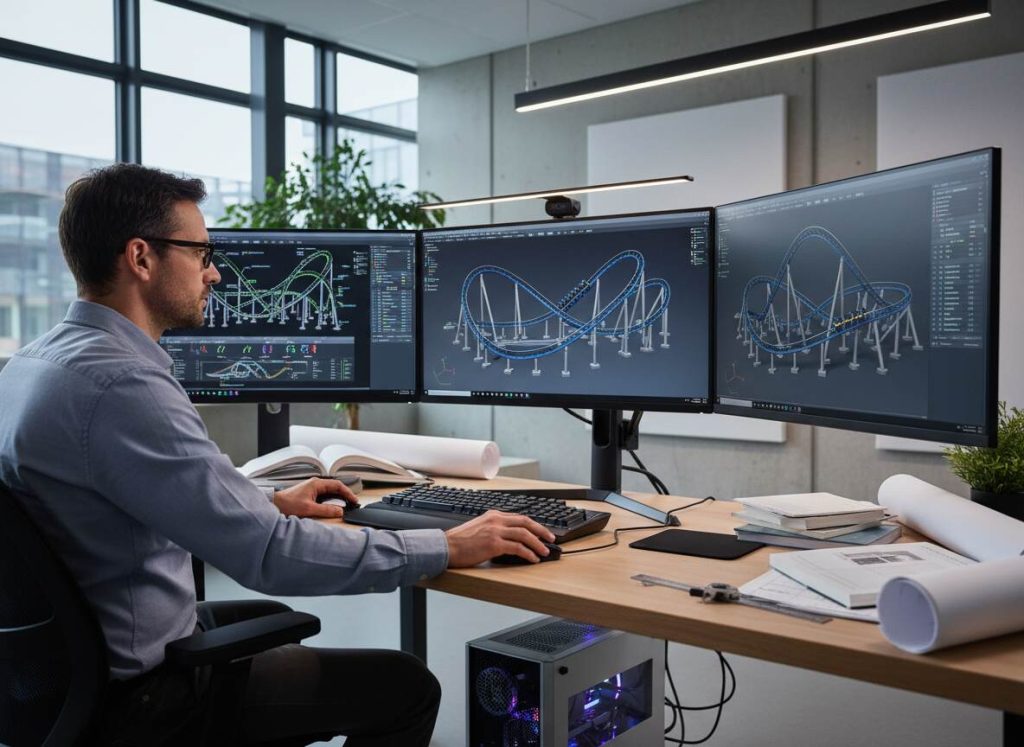
Engineering Analysis: Using computer-aided design (CAD) software and finite element analysis (FEA) to model the coaster and analyze forces, stresses, and structural integrity. This ensures the coaster is safe, efficient, and performs as intended.
Track Design: Designing the actual track layout, including hills, turns, inversions, and transitions. The designer must consider physics principles like centripetal acceleration, G-forces, and airtime to create a thrilling but safe ride experience.
Structural Engineering: Designing the support structure that holds the track in place. This involves calculating loads, stresses, and material requirements to ensure the structure can safely support the coaster train and riders.
Restraint System Design: Designing or selecting restraint systems (lap bars, over-shoulder harnesses, etc.) that safely secure riders while allowing for the intended ride experience.
Brake and Control Systems: Designing the braking systems, lift hill mechanisms, and control systems that operate the coaster safely and reliably.
Collaboration: Working with manufacturers, parks, safety consultants, and other engineers to refine designs, solve problems, and ensure the final product meets all requirements and safety standards.
Testing and Validation: Overseeing testing of the completed coaster, analyzing performance data, and making adjustments as needed to ensure the coaster performs as designed.
Types of Roller Coaster Designers
Roller coaster design is not monolithic. Different engineers specialize in different aspects:
Mechanical Engineers: Focus on the mechanical systems—track design, wheel assemblies, braking systems, and control systems. Mechanical engineers ensure that all moving parts work together safely and reliably.
Structural Engineers: Focus on the support structure and overall structural integrity. They calculate loads, stresses, and material requirements to ensure the structure can safely support the coaster.
Civil Engineers: May be involved in site planning, foundation design, and integration of the coaster into the park environment.
Software/Controls Engineers: Design the computer control systems that operate the coaster, manage safety systems, and monitor performance.
Aerodynamics Engineers: For some coasters, especially those with unique designs, aerodynamic analysis may be important.
Most roller coaster design companies employ teams of engineers with different specializations, all working together on a single project.
Education: Building Your Foundation
Becoming a roller coaster designer requires a strong educational foundation in engineering. There is no specific “roller coaster design” degree, but certain engineering disciplines provide the best foundation.
Undergraduate Degree Requirements
The first step is earning a bachelor’s degree in engineering. The most relevant disciplines are:
Mechanical Engineering: This is the most common path for roller coaster designers. Mechanical engineering covers the design and analysis of mechanical systems, which is directly applicable to coaster design. You’ll study mechanics, thermodynamics, materials science, and machine design.
Civil Engineering: Civil engineering focuses on structural design and analysis. Many structural engineers in the coaster industry have civil engineering backgrounds. You’ll study structural analysis, materials, and design principles.
Aerospace Engineering: Some coaster designers come from aerospace backgrounds. Aerospace engineers are trained in aerodynamics, structural analysis, and systems design, which are applicable to coaster design.
Other Engineering Disciplines: Electrical engineering, software engineering, and other disciplines can be relevant depending on your specific focus within coaster design.
When choosing a university, look for programs that offer:
Strong fundamentals in physics, mathematics, and materials science. These are essential for understanding coaster design principles.
CAD and FEA software training. Many universities now offer courses in AutoCAD, ANSYS, SolidWorks, and other industry-standard software.
Mechanics and dynamics courses. Understanding forces, stresses, and motion is critical for coaster design.
Design projects and capstone courses. Hands-on design experience is invaluable.
Internship opportunities. Some universities have partnerships with coaster manufacturers or parks that offer internships.
Essential Coursework
While pursuing your engineering degree, focus on courses that are most relevant to coaster design:
Statics and Dynamics: Understanding forces, motion, and acceleration is fundamental to coaster design. You’ll learn how to analyze forces and calculate accelerations, which directly applies to coaster design.
Mechanics of Materials: This course teaches you how materials respond to stress and strain. Understanding material properties is essential for designing safe, efficient coasters.
Machine Design: This course covers the design of mechanical components and systems. Many principles from machine design apply to coaster design.
Finite Element Analysis (FEA): FEA is a computational method used to analyze stress, strain, and other properties of structures. This is one of the most important tools in modern coaster design.
CAD Software Courses: Learning industry-standard CAD software like AutoCAD, SolidWorks, or Inventor is essential. Many universities offer these courses, and you can also learn them independently.
Thermodynamics and Fluid Mechanics: While not directly about coasters, these courses teach principles that apply to understanding coaster systems.
Control Systems: Understanding how to design and implement control systems is important for the automated systems that operate modern coasters.
Getting Good Grades and Building Your Resume
Your academic performance matters. Coaster design companies want engineers who understand the fundamentals deeply. A strong GPA (3.5 or higher) demonstrates that you’ve mastered the material.
Beyond grades, build your resume with:
Internships: Seek internships at engineering firms, coaster manufacturers, or theme parks. Even if the internship isn’t specifically in coaster design, experience in mechanical or structural engineering is valuable.
Design Projects: Participate in design competitions and capstone projects. If possible, choose projects related to mechanical systems or structural design.
Software Skills: Develop proficiency in CAD and FEA software. These are essential tools in coaster design, and employers want to see that you can use them.
Relevant Coursework: Take electives in areas like machine design, structural analysis, or control systems.
Passion Projects: If you’re truly passionate about coasters, consider personal projects like designing a coaster in CAD software or analyzing the physics of existing coasters. These demonstrate genuine interest and initiative.
Graduate Degree Considerations
A master’s degree is not strictly required for coaster design, but it can be advantageous. A master’s degree in mechanical engineering, structural engineering, or a related field provides deeper knowledge and can help you stand out in a competitive field.
Some engineers pursue a master’s degree after gaining a few years of work experience. This combination of practical experience and advanced education can accelerate career growth.
A PhD is rarely necessary for coaster design work, though some research-focused positions or academic roles might require one.
Developing Specialized Skills
Beyond formal education, successful roller coaster designers develop specialized skills that are specific to the field.
CAD and 3D Modeling
Computer-aided design (CAD) is the primary tool used in modern coaster design. Coaster designers spend much of their time creating 3D models of coasters in CAD software.
Industry-standard software includes:
AutoCAD: One of the most widely used CAD programs in the industry. AutoCAD is used for 2D and 3D design and is the standard at many coaster manufacturers.
SolidWorks: A 3D CAD program popular in mechanical engineering. Many coaster designers use SolidWorks for detailed component design.
Inventor: Another 3D CAD program used in coaster design, particularly for parametric modeling.
Catia: Used by some larger manufacturers for complex assemblies and simulations.
Proficiency in at least one of these programs is essential. Many universities offer courses in these programs, and you can also learn them independently through online tutorials and practice.
Finite Element Analysis (FEA)
FEA is a computational method used to analyze how structures respond to forces, stresses, and other loads. FEA is critical in coaster design because it allows engineers to predict how the coaster structure will perform under various conditions.
Common FEA software includes:
ANSYS: One of the most widely used FEA programs in the industry. ANSYS can analyze stress, strain, vibration, thermal properties, and other characteristics.
Abaqus: Another powerful FEA program used in coaster design.
NASTRAN: A structural analysis program used in aerospace and coaster design.
Learning FEA requires understanding both the software and the underlying theory. Many universities offer FEA courses, and you can also learn through online courses and practice.
Physics and Mathematics
A deep understanding of physics and mathematics is essential for coaster design. Key concepts include:
Centripetal Acceleration: The acceleration directed toward the center of a circular path. Understanding centripetal acceleration is critical for designing turns and loops.
G-Forces: The acceleration experienced by riders, measured in multiples of gravitational acceleration. Coaster designers must ensure that G-forces are within safe limits while creating thrilling sensations.
Airtime: The sensation of weightlessness that occurs when riders are lifted out of their seats. Calculating and optimizing airtime requires understanding the forces acting on riders.
Energy Conservation: Understanding how potential and kinetic energy change throughout the coaster helps designers predict speed and performance.
Structural Analysis: Understanding how forces are distributed through a structure and how materials respond to stress.
Many of these concepts are taught in university physics and engineering courses, but deep understanding comes from applying them to real coaster design problems.
Safety Standards and Regulations
Roller coaster designers must understand the safety standards and regulations that govern coaster design. Key standards include:
ASTM F24 Committee Standards: The American Society for Testing and Materials (ASTM) has developed comprehensive standards for amusement ride design and safety. ASTM F24 standards cover design, testing, inspection, and operation of amusement rides.
ISO Standards: International Organization for Standardization (ISO) has developed international standards for amusement rides.
Local and Regional Regulations: Different jurisdictions may have additional regulations or requirements.
Understanding these standards is essential because coasters must be designed to meet or exceed all applicable safety requirements. Designers must be familiar with load factors, safety factors, and testing requirements.
Coaster Physics and Design Principles
Beyond general engineering knowledge, successful coaster designers develop deep knowledge of coaster-specific design principles:
Track Design: Understanding how to design track layouts that create thrilling experiences while maintaining safety. This includes designing hills for airtime, turns for lateral forces, and transitions for smooth, comfortable rides.
Restraint Systems: Understanding different types of restraint systems and how they affect the ride experience. Different restraint systems allow for different design possibilities.
Wheel Assemblies: Understanding the three-wheel assembly system used on most coasters and how to design wheels and track for smooth, reliable operation.
Braking Systems: Understanding different braking technologies and how to design braking systems that reliably stop coasters.
Lift Hill Systems: Understanding chain lifts, cable lifts, and other lift technologies.
This knowledge comes from studying existing coasters, understanding the design philosophy of different manufacturers, and learning through experience.
Breaking Into the Industry: Getting Your First Job
Getting your first job in coaster design is challenging because the field is specialized and competitive. Most entry-level positions require some experience, so you need to be strategic about how you break in.
Coaster Manufacturers and Design Companies
The primary employers of roller coaster designers are coaster manufacturers and design companies. Major manufacturers include:
Bolliger & Mabillard (B&M): A Swiss manufacturer known for high-quality steel coasters. B&M is one of the most respected manufacturers in the industry.
Intamin: A German manufacturer known for innovative coaster designs, including hypercoasters, giga coasters, and hydraulic launch coasters.
Rocky Mountain Construction (RMC): An American manufacturer known for innovative wooden coasters and hybrid coasters. RMC has gained significant attention in recent years for their innovative designs.
Vekoma: A Dutch manufacturer known for steel coasters and family coasters.
Mack Rides: A German manufacturer known for family coasters and innovative designs.
GCI (Great Coasters International): An American wooden coaster manufacturer.
Dinn Corporation: A historic wooden coaster manufacturer (though currently less active than in previous decades).
Smaller Design Firms: Various smaller engineering and design firms specialize in coaster design and consulting.
These companies are located around the world, with significant concentrations in Europe (Germany, Switzerland, Netherlands) and the United States.
Entry-Level Positions
Entry-level positions in coaster design typically include:
Junior Engineer: A junior engineer works under the supervision of senior engineers, assisting with CAD modeling, analysis, and design tasks. This is a common entry-level position for recent graduates.
Design Drafter: A design drafter creates detailed drawings and CAD models based on engineer specifications. This role requires strong CAD skills but may not require a full engineering degree.
Engineering Intern: Many coaster manufacturers offer internship programs for students. Internships provide valuable experience and often lead to full-time positions.
Graduate Engineer: Some companies hire recent graduates as graduate engineers, providing training and mentorship as they develop their skills.
Related Positions That Lead to Coaster Design
If you can’t immediately land a coaster design position, consider related positions that provide relevant experience:
Mechanical Engineer at an Engineering Firm: Working as a mechanical engineer at a general engineering firm provides experience with CAD, FEA, and design principles that are directly applicable to coaster design.
Structural Engineer: Working as a structural engineer, particularly on projects involving complex structures or high loads, provides relevant experience.
Manufacturing Engineer: Working in manufacturing helps you understand how designs are actually built and what manufacturing constraints exist.
Theme Park Operations or Maintenance: Working at a theme park in operations or maintenance roles provides valuable understanding of how coasters actually operate and what challenges exist in the real world.
Amusement Ride Inspector: Working as an inspector for amusement rides provides deep knowledge of safety standards, regulations, and how coasters perform.
These positions provide relevant experience that makes you a stronger candidate for coaster design roles later.
Networking and Industry Connections
The coaster industry is relatively small, and networking is crucial for breaking in. Strategies for building industry connections include:
Attend Industry Conferences: The International Association of Amusement Parks and Attractions (IAAPA) hosts annual conferences where coaster manufacturers, parks, and engineers gather. Attending these conferences allows you to meet industry professionals and learn about job opportunities.
Join Professional Organizations: Organizations like ASME (American Society of Mechanical Engineers) and ASCE (American Society of Civil Engineers) have members in the coaster industry. Joining these organizations and attending local meetings can help you build connections.
Connect on LinkedIn: Many coaster designers and engineers are active on LinkedIn. Following companies and individuals in the industry, engaging with their content, and reaching out with genuine interest can help you build relationships.
Coaster Enthusiast Communities: The coaster enthusiast community is large and passionate. Engaging with enthusiast forums, social media groups, and events can help you connect with people in the industry and demonstrate your passion for coasters.
University Connections: If your university has relationships with coaster manufacturers or parks, leverage those connections. Professors may have industry contacts who can help you.
The Job Search Process
When searching for your first coaster design position, be strategic:
Target the Right Companies: Focus on coaster manufacturers and engineering firms that specialize in coaster design. Research companies thoroughly and understand their design philosophy and recent projects.
Customize Your Resume and Cover Letter: Tailor your resume and cover letter to each position, highlighting relevant skills and experience. Show that you understand the company and are genuinely interested in their work.
Highlight Relevant Projects: If you’ve completed design projects, CAD models, or analysis work relevant to coasters, include these in your portfolio. A strong portfolio can set you apart from other candidates.
Be Willing to Relocate: Coaster manufacturers are concentrated in specific locations (Germany, Switzerland, parts of the US). Be prepared to relocate for the right opportunity.
Start with Internships: If you’re still in school or recently graduated, internships are an excellent way to break in. Many interns are hired into full-time positions after their internship ends.
Be Patient: Breaking into coaster design may take time. You may need to work in related fields first before landing a coaster design position. Use those positions to build skills and experience that make you a stronger candidate.
What Your Day-to-Day Work Looks Like
Once you land a position in coaster design, what does your actual day-to-day work look like? The answer depends on your specific role and which stage of a project you’re working on, but here’s a realistic overview.
Early Project Stages: Conceptual Design
When a new coaster project begins, the team works on conceptual design. During this phase:
You attend meetings with the park or client to understand their vision and requirements. What type of coaster? What height, speed, and intensity? What theme? What budget and timeline? These meetings help define the project scope.
You work with senior engineers to develop preliminary designs and concepts. This might involve sketching ideas, creating rough CAD models, or analyzing different design approaches.
You research similar coasters and design approaches used by competitors. Understanding what’s been done before helps inform your design decisions.
You create preliminary calculations and analysis to estimate performance characteristics. Will the coaster achieve the desired speed and airtime? Are the G-forces within acceptable ranges?
You present concepts to the client and gather feedback. This iterative process continues until a concept is selected for further development.
Detailed Design Phase
Once a concept is selected, the team moves into detailed design. This is where most of the technical work happens:
You spend significant time in CAD software, creating detailed 3D models of the coaster. Every component—track, support structure, wheels, brakes, restraints—is modeled in detail.
You perform FEA analysis on the structure, calculating stresses, strains, and deformations under various loading conditions. You analyze the coaster under normal operating conditions, extreme conditions, and emergency scenarios.
You iterate on designs based on analysis results. If stresses are too high, you modify the design to reduce them. If performance doesn’t meet requirements, you adjust the track layout or other parameters.
You collaborate with other engineers on your team. Mechanical engineers work on track and wheel design. Structural engineers work on the support structure. Controls engineers work on the braking and control systems. Regular meetings ensure that all components work together properly.
You create detailed drawings and specifications that will be used for manufacturing. These drawings must be precise and complete, with all dimensions, tolerances, and material specifications clearly specified.
You perform calculations for safety factors, ensuring that the design meets all safety standards and regulations. Safety is paramount in coaster design.
Manufacturing and Construction Phase
Once the design is finalized and approved, the coaster moves into manufacturing and construction:
You work with manufacturing partners to ensure that the design is being built correctly. This might involve reviewing manufacturing drawings, approving material selections, or visiting manufacturing facilities.
You troubleshoot problems that arise during manufacturing. If a component doesn’t fit as expected or if manufacturing reveals issues with the design, you work to solve them.
You oversee the construction and installation of the coaster at the park. This might involve site visits, inspections, and coordination with installation teams.
You perform final checks and inspections to ensure that the coaster is built to specification.
Testing and Commissioning
Before a coaster opens to the public, it must be thoroughly tested:
You oversee testing of the coaster with instrumented trains that measure forces, accelerations, and other performance characteristics. This data is compared to your design predictions to verify that the coaster performs as expected.
You analyze test data and make any necessary adjustments. If performance doesn’t match predictions, you investigate why and determine if adjustments are needed.
You work with safety inspectors and regulatory authorities to ensure that the coaster meets all safety requirements.
You may conduct ride testing with test riders or park staff to evaluate the ride experience and make adjustments if needed.
Post-Opening Support
Even after a coaster opens, designers often provide ongoing support:
You monitor performance data and address any issues that arise during operation. If a coaster experiences unexpected problems, you investigate and recommend solutions.
You work with the park’s maintenance team to ensure the coaster is properly maintained and continues to perform safely and reliably.
You may be involved in modifications or upgrades to the coaster. If a park wants to retrack a wooden coaster or make other modifications, designers are involved in planning and executing these changes.
Typical Weekly Schedule
A typical week for a coaster designer might look like:
Monday: Team meeting to discuss project status, challenges, and next steps. You present progress on your assigned tasks.
Tuesday-Thursday: Focused work on CAD modeling, FEA analysis, or calculations. You might spend 6-8 hours per day in CAD software or running simulations. You attend occasional meetings with other team members to discuss specific design challenges.
Friday: Review of the week’s progress, preparation of reports or presentations, and planning for the following week. You might present your work to senior engineers or clients.
This schedule varies depending on project phase and deadlines. During critical phases, you might work longer hours. During slower periods, you might have more flexibility.
The Reality: Challenges and Frustrations
Coaster design is exciting, but it’s not all glamorous. Real challenges include:
Long Hours During Critical Phases: When a project has a tight deadline or faces challenges, you might work long hours. It’s not uncommon to work 50-60+ hour weeks during critical phases.
Dealing with Constraints: You rarely get to design exactly what you want. Budget constraints, timeline constraints, site constraints, and client requirements all limit your design freedom. Learning to work within constraints is a key skill.
Iterative Problem-Solving: Design rarely goes smoothly. You’ll spend hours on analysis, only to discover that your approach won’t work. Then you start over. This iterative process can be frustrating but is part of the job.
Communication Challenges: Coaster projects involve teams of engineers, manufacturers, parks, and regulatory authorities. Coordinating all these stakeholders and communicating effectively is challenging.
Responsibility and Pressure: You’re designing something that will be ridden by millions of people. The responsibility to ensure safety and quality is significant, and the pressure can be intense.
Slow Project Timelines: From initial concept to opening, a coaster project can take 2-5 years or longer. Seeing your work come to fruition takes patience.
Salary and Compensation
What can you expect to earn as a roller coaster designer? Salary varies based on experience, location, company, and specific role.
Entry-Level Salaries
Recent graduates starting as junior engineers or design drafters typically earn:
United States: $50,000-$70,000 per year
Europe: €45,000-€65,000 per year (varies by country)
Entry-level positions may offer lower salaries but provide valuable experience and training.
Mid-Level Salaries
Engineers with 5-10 years of experience typically earn:
United States: $80,000-$120,000 per year
Europe: €70,000-€110,000 per year
Mid-level engineers often have more responsibility and may lead smaller projects or teams.
Senior-Level Salaries
Senior engineers and project leads with 10+ years of experience typically earn:
United States: $120,000-$180,000+ per year
Europe: €100,000-€160,000+ per year
Senior engineers often lead major projects and have significant responsibility.
Factors Affecting Salary
Several factors affect your salary in coaster design:
Experience: More experience generally means higher salary. Designers with a track record of successful projects command higher salaries.
Company Size and Reputation: Larger, more prestigious manufacturers (like B&M or Intamin) typically pay more than smaller companies.
Location: Salaries vary significantly by location. The United States and Western Europe typically pay more than Eastern Europe or other regions.
Specialization: Engineers with specialized skills or expertise may earn more.
Project Success: If your designs are successful and well-received, you can command higher salaries and better positions.
Benefits and Perks
Beyond base salary, coaster design positions often include:
Health Insurance: Most companies provide comprehensive health insurance.
Retirement Plans: Many companies offer 401(k) or pension plans.
Vacation and Paid Time Off: Typical vacation time is 20-30 days per year, depending on location and company.
Professional Development: Many companies support continuing education, conference attendance, and professional certifications.
Free or Discounted Park Access: Some positions include perks like free or discounted access to theme parks, which is a nice benefit for coaster enthusiasts.
Travel: Depending on your role, you might travel to parks for installations, testing, or client meetings. While this can be a perk, it can also be demanding.
Career Growth and Advancement
What does career progression look like in coaster design?
Typical Career Path
A typical career path in coaster design might look like:
Entry-Level (0-3 years): Junior engineer or design drafter. You work on specific components or tasks under supervision of senior engineers. You develop CAD and FEA skills and learn coaster design principles.
Mid-Level (3-8 years): Engineer or senior engineer. You lead the design of specific systems (track, structure, controls) or smaller projects. You mentor junior engineers and contribute to major design decisions.
Senior-Level (8+ years): Senior engineer, project lead, or engineering manager. You lead major projects, manage teams, and have significant influence on design decisions and company direction.
Management (10+ years): Engineering manager, technical director, or other management roles. You oversee multiple projects and teams, manage budgets, and contribute to company strategy.
Specialization vs. Generalization
As your career progresses, you can choose to specialize or generalize:
Specialization: Becoming an expert in a specific area (track design, structural analysis, controls systems, etc.). Specialists are highly valued and can command premium salaries.
Generalization: Developing broad knowledge across all aspects of coaster design. Generalists are valuable for project leadership and management roles.
Many successful coaster designers combine both—deep expertise in one area combined with broad knowledge of other areas.
Lateral Moves and New Opportunities
As your career progresses, you might explore:
Moving to Different Companies: Switching between coaster manufacturers or to engineering firms can provide new challenges and growth opportunities.
Moving to Different Roles: You might move from design to project management, consulting, or other roles.
Starting Your Own Firm: Some experienced engineers start their own design or consulting firms.
Transitioning to Parks or Manufacturers: Some engineers move from design firms to work directly for parks or manufacturers in engineering or operations roles.
The Reality: Challenges and Considerations
Before committing to a career in coaster design, it’s important to understand the challenges and realities of the field.
Competitive Field
Coaster design is a small, specialized field. There are relatively few positions available, and competition for those positions is intense. You need to be excellent at what you do to succeed.
Demanding Work
Coaster design is intellectually demanding. You need strong technical skills, problem-solving abilities, and the ability to work with complex systems. The work can be mentally exhausting.
Project Timelines
Coaster projects take years from concept to opening. You might work on a project for 3-5 years before it opens to the public. This requires patience and long-term commitment.
Responsibility and Pressure
You’re designing something that millions of people will ride. The responsibility to ensure safety and quality is significant. If something goes wrong, the consequences can be serious. This pressure is real and can be stressful.
Geographic Constraints
Major coaster manufacturers are concentrated in specific locations (Germany, Switzerland, parts of the US). If you want to work for a major manufacturer, you may need to relocate to one of these areas. This can be challenging if you have family or other ties to a specific location.
Limited Job Mobility
Because the field is small and specialized, there are limited job opportunities. If you want to change jobs, you may need to relocate or accept a different type of role. This limited mobility can be frustrating if you’re unhappy in your current position.
Rapid Technology Changes
Technology in coaster design evolves constantly. New software, new materials, new design approaches, and new innovations emerge regularly. You need to continuously learn and adapt to stay current in the field.
Work-Life Balance
During critical project phases, work-life balance can suffer. Long hours, tight deadlines, and high pressure can make it difficult to maintain a healthy balance between work and personal life.
Skills Beyond Engineering: What Employers Really Want
While technical skills are essential, employers in coaster design also value other skills that are equally important.
Communication Skills
You need to communicate complex technical concepts to people with varying levels of technical knowledge. This includes clients, park operators, manufacturing partners, and regulatory authorities. Strong written and verbal communication skills are essential.
Problem-Solving and Creativity
Coaster design requires creative problem-solving. You need to think outside the box, consider unconventional approaches, and find innovative solutions to design challenges. Creativity combined with technical knowledge is highly valued.
The ability to troubleshoot problems, analyze root causes, and develop solutions is critical. When something doesn’t work as expected, you need to figure out why and fix it.
Project Management
As you advance in your career, project management skills become increasingly important. Understanding budgets, timelines, resource allocation, and stakeholder management is essential for leading projects.
Attention to Detail
Coaster design requires meticulous attention to detail. A small error in a calculation or drawing can have significant consequences. The ability to catch errors, verify work, and ensure quality is critical.
Collaboration and Teamwork
Coaster design is a team effort. You need to work effectively with other engineers, manufacturers, parks, and consultants. Strong collaboration and teamwork skills are essential.
Adaptability and Flexibility
Coaster projects rarely go exactly as planned. You need to be adaptable, flexible, and able to adjust to changing circumstances, new information, or unexpected challenges.
Passion for Coasters
While not strictly a “skill,” genuine passion for roller coasters is valuable. Employers want engineers who are genuinely excited about coasters, who understand the enthusiast community, and who are motivated by the desire to create great attractions.
Continuing Education and Staying Current
The field of coaster design evolves constantly. Staying current requires ongoing learning and professional development.
Professional Certifications
Several certifications are relevant to coaster design:
Professional Engineer (PE) License: In the United States, earning a PE license demonstrates professional competence and can enhance your career prospects. Earning a PE requires passing the Fundamentals of Engineering (FE) exam, gaining work experience, and passing the PE exam.
ASTM Standards Certifications: Various certifications related to ASTM standards and amusement ride safety are available.
Professional Organizations and Conferences
Staying connected to professional organizations and attending conferences helps you stay current:
ASME (American Society of Mechanical Engineers): ASME offers resources, publications, and conferences relevant to mechanical engineering and coaster design.
ASCE (American Society of Civil Engineers): ASCE offers resources relevant to structural engineering and coaster design.
IAAPA (International Association of Amusement Parks and Attractions): IAAPA hosts annual conferences where coaster designers, manufacturers, and parks gather. These conferences are excellent for learning about industry trends and networking.
Software Training and Development
As software evolves, continuing to develop your skills is important. Many software vendors offer training courses and certifications. Staying proficient in the latest versions of CAD and FEA software is essential.
Learning from Industry Trends
Following industry trends and innovations helps you stay current. This includes:
Reading industry publications and blogs about coaster design and amusement parks.
Following coaster manufacturers and their latest projects.
Studying new coasters as they open, analyzing their design and engineering.
Engaging with the coaster enthusiast community to understand what riders value and what trends are emerging.
Is Coaster Design Right for You?
Before committing to this career path, consider whether coaster design is right for you.
You Should Consider Coaster Design If:
You have a genuine passion for roller coasters and amusement parks. This passion will sustain you through the challenging aspects of the job.
You enjoy engineering and problem-solving. Coaster design is intellectually demanding and requires strong analytical skills.
You’re willing to invest in education and continuous learning. The field requires ongoing development of technical skills.
You’re comfortable with responsibility and pressure. You’re designing something that millions of people will ride, and safety is paramount.
You’re willing to potentially relocate. Major coaster manufacturers are concentrated in specific locations.
You value the opportunity to create something tangible that brings joy to millions of people. There’s something special about seeing a coaster you designed open to the public and watching people enjoy it.
You Might Want to Reconsider If:
You’re primarily motivated by salary. While coaster design pays reasonably well, it’s not the highest-paying engineering field. If maximum income is your primary goal, other engineering specialties might be better.
You need job security and stability. The coaster industry is cyclical, and job availability can fluctuate. Economic downturns can lead to layoffs in the industry.
You prefer work-life balance above all else. During critical project phases, work-life balance can suffer significantly.
You’re not willing to relocate. If you’re tied to a specific location, opportunities in coaster design may be limited.
You prefer immediate results. Coaster projects take years from concept to opening. If you need to see immediate results from your work, this might be frustrating.
Alternative Paths in the Coaster Industry
If coaster design doesn’t seem like the right fit, there are other careers in the coaster and amusement park industry that might interest you:
Amusement Ride Inspector: Inspectors ensure that coasters and other rides meet safety standards and regulations. This role requires knowledge of coaster design and safety standards but may not require the same level of design expertise.
Theme Park Operations Manager: Managing the daily operations of a coaster or rides division. This role requires understanding of coaster operations but focuses more on management than design.
Coaster Maintenance Technician: Maintaining and repairing coasters. This role requires hands-on mechanical skills and understanding of coaster systems.
Coaster Manufacturer Sales Engineer: Selling coasters and related products to parks. This role requires understanding of coaster design and engineering but focuses on sales and client relationships.
Coaster Retrack Specialist: Specializing in updating or replacing track on existing coasters. This role combines design and engineering with hands-on construction work.
Amusement Park Consultant: Consulting with parks on coaster selection, placement, and operations. This role requires broad knowledge of coasters and parks.
The Future of Coaster Design
The field of coaster design is evolving. Understanding future trends can help you prepare for your career.
Technological Advances
New technologies will shape the future of coaster design:
Advanced Materials: New materials with improved strength-to-weight ratios will enable new design possibilities.
AI and Machine Learning: AI tools may assist in design optimization, helping engineers explore more design possibilities more quickly.
Virtual Reality and Simulation: More sophisticated VR and simulation tools will allow designers to test and refine designs more thoroughly before construction.
Autonomous Systems: Some future coasters may incorporate autonomous or semi-autonomous control systems.
Sustainability and Environmental Concerns
Sustainability is becoming increasingly important in coaster design:
Energy Efficiency: Future coasters will likely focus on energy-efficient designs, using regenerative braking and other technologies to minimize energy consumption.
Sustainable Materials: Using sustainable, recyclable, or environmentally friendly materials will become more important.
Environmental Impact: Designers will need to consider the environmental impact of coaster construction and operation.
Innovation in Design
The industry will continue to innovate:
New Coaster Types: New types of coasters and hybrid designs will continue to emerge.
Record-Breaking Attractions: Parks will continue to push boundaries with taller, faster, and more innovative coasters.
Themed Integration: Coasters will be increasingly integrated with immersive theming and storytelling elements.
Conclusion: Pursuing Your Passion
Becoming a roller coaster designer is a challenging but rewarding career path. It requires strong technical skills, continuous learning, patience, and genuine passion for coasters. The field is competitive and demanding, but for those who love coasters and engineering, it offers the opportunity to create attractions that bring joy to millions of people.
The path to becoming a coaster designer typically involves earning a degree in mechanical, structural, or civil engineering; developing specialized skills in CAD and FEA; gaining experience in related engineering fields; and networking within the industry. It’s not a quick or easy path, but it’s achievable with dedication and persistence.
If you’re passionate about coasters, enjoy engineering and problem-solving, and are willing to invest in your education and career development, coaster design could be an incredibly fulfilling career. The opportunity to design something that millions of people will experience, that pushes the boundaries of what’s possible, and that brings genuine joy and excitement to people’s lives is something special.
The coaster industry needs talented engineers who are passionate about creating great attractions. If you have the skills, the dedication, and the passion, there’s a place for you in this exciting field. Start building your foundation now—take the right courses, develop your technical skills, seek out relevant experience, and network within the industry. Your dream of designing the world’s greatest coasters could become a reality.
